

Key Takeaways
Use names and dates as symbolic maps, not single-number verdicts
A system of correspondences. Numerology assigns numbers to letters and birth dates, then interprets the results as clues about character, purpose, or timing. Fenton presents it as a practical divination: a name and a date can be used to examine a person, a business, a pet, or an event. The book places the practice in a long spiritual history, connecting number symbolism with Pythagorean traditions, Hebrew texts, Hermetic writings, and later exchanges between India and Europe.
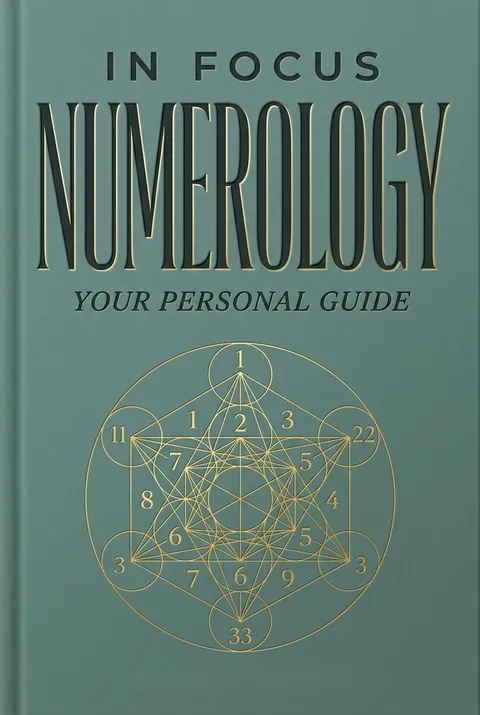
Many routes, one reading. The basic digits run from 1 to 9, while 11, 22, and 33 may be treated as power numbers. The book’s central method is to calculate several numbers from different parts of a name or date, then interpret them together rather than letting one result stand for the whole person.
The system’s strongest use may be as a vocabulary for reflection: a reader can ask whether a description of ambition, dependence, or restlessness fits, and why. That is different from demonstrating that numbers determine personality or events. The historical reach of number symbolism explains its cultural appeal, but a tradition’s age does not establish its predictive accuracy. Treating the reading as a prompt, rather than evidence about someone’s fixed nature, preserves its imaginative value without outsourcing judgment to arithmetic.
Calculate a name's Destiny Number with a repeating nine-letter code
Convert, add, reduce. The Alphabet Code assigns A, J, and S the value 1; B, K, and T the value 2; and continues in the same pattern through the alphabet. Add the values for a full name, then add the digits of the total until reaching 1 to 9. For instance, a total of 44 reduces to 8. The resulting Destiny Number, also called the Expression Number, is meant to describe a person’s purpose and general way of pursuing it.
Keep the exceptions visible. If the calculation yields 11, 22, or 33, the book allows readers to interpret that power number and also reduce it to a single digit for an additional reading. Fenton suggests starting with the birth-certificate name, but also considers an early-used name when the official one was never really used.
This is the book’s clearest entry point because the procedure is transparent and easy to repeat. The interpretation, however, depends on accepting the code’s symbolic premise, not on the arithmetic itself. A useful practice is to write down the calculation separately from the interpretation: that makes it easier to notice when a meaning feels persuasive because it fits prior knowledge, rather than because the number independently revealed it. The distinction is especially important when comparing different names.
Compare the face you show with the motives you keep private
Three angles on a name. Fenton derives different readings from different letter groups. The Personality Number comes from consonants in the name a person commonly uses and describes the outward impression they give. The Heart Number, also called the Soul Urge Number, comes from vowels and represents inner motives and talents. The Hidden Passion Number comes from the digit that appears most often in the name, and is used to describe a strong underlying drive.
A layered portrait. These numbers can suggest contrasts, such as appearing reserved while privately wanting recognition, or seeming confident while feeling vulnerable. The book acknowledges a limitation in the frequency method: letters are not evenly represented in names, just as some letters occur more often in ordinary language. If two digits tie for most frequent, both are interpreted.
The three-part structure resembles a familiar distinction in psychology between public behavior, private motives, and recurring desires. It can help a reader notice that people are not always consistent across settings. But a numerological profile is not an interview, and a mismatch between its categories does not prove a hidden self. The most productive question is not whether a number exposes a secret, but whether the contrast suggests something concrete to examine in a person’s choices and relationships.
Read birth dates through both life direction and birthday temperament
Two date-based readings. The Life Path Number is calculated by adding every digit in a birth date and reducing the result to 1 through 9. If the sum reaches 11, 22, or 33, Fenton recommends reading that power number as well as its reduced digit. The book describes the Life Path as a broad guide to a person’s direction, such as leadership, partnership, creativity, or practical work.
Keep the alternatives distinct. The Life Number uses the same birth-date digits but keeps a total from 1 to 21; a larger total is reduced. The Birth Day Number uses only the day of the month, grouping dates such as the 1st, 10th, 19th, and 28th together. Fenton treats this as a modifying influence on character, not a replacement for the other date readings.
Separate calculations can make the method feel nuanced, since a person is not reduced to one label. They also create more opportunities to find a description that seems to fit. This is a general challenge in systems that generate many interpretations: coherence can come from combining the readings, while contradictions can be explained as different layers. Keeping the calculation and its stated purpose clear helps readers use the framework as a set of questions instead of forcing every result into a seamless personality story.
Keep each number's strengths and distortions in the same frame
Every digit has a shadow. Fenton uses the same core meanings for 1 through 9 across the different numerological calculations. A 1 is associated with initiative and leadership, but also with selfishness or domination. A 6 suggests care and responsibility, with risks of perfectionism and exhaustion. An 8 points toward ambition and material achievement, while warning against overwork and insensitivity. Each reading pairs useful capacities with ways those capacities can become excessive.
Read the tension, not just the praise. This approach gives the profiles a practical edge: leadership can be tested for its effect on others, and helpfulness for whether it has become self-neglect. The descriptions also sometimes make claims about childhood, relationships, or future success, so they should not be mistaken for established facts about a person.
Balanced profiles are more useful than pure flattery because they invite self-correction as well as recognition. They also resemble the Barnum effect, the tendency for people to experience broad, generally applicable descriptions as uniquely personal. That does not make reflection worthless; it means the reader should ask for specific evidence. If a reading calls someone controlling, for example, the meaningful test is whether others’ accounts and repeated behavior support that judgment, not whether the label feels familiar.
Forecast in cycles, but leave room for life to interrupt the calendar
From years to hours. Personal Year Fortunes use the day and month of birth plus the target year, reduced to 1 through 9. Personal Month Fortunes add the birth day to the chosen month and year. For a daily reading, add the Life Path Number to the number for the date. The book associates each result with themes such as new beginnings, cooperation, work, reflection, or closure. It notes disagreement among numerologists about when a personal year starts and offers birth-month-based adjustments.
Hours add a planetary layer. A table assigns planets to hours of weekdays, linking them with moods or activities. Fenton gives an example of a planned wedding date becoming impossible, while the day the couple did marry also seemed favorable by numerology. The method can help readers choose a moment, but the book itself recognizes that circumstances intervene.
Forecasting can function as a planning ritual: it encourages someone to pause, name priorities, and consider whether a day suits a task. Yet flexible timing rules and favorable interpretations after an event make predictions difficult to test. The wedding story captures both sides. It shows how a framework can help people adapt when plans change, but a successful outcome does not establish that the date’s number caused it. Practical readiness and the choices of the people involved remain more reliable guides.
Turn the Karmic Number into a practical self-check, not a sentence
Combine two core numbers. To find the Karmic Number, add the Destiny Number from a person’s name to the Life Path Number from their birth date, then reduce the sum to a single digit. Fenton presents this result as an area where behavior can improve. A 4 reading, for example, advises loosening stubbornness and paying more attention to other people’s needs. A 5 reading focuses on finishing what has been started and becoming more dependable.
Make the advice observable. The useful part is the invitation to examine habits, not the claim that a number proves a person has karmic debts. Ask whether a pattern is present, what it costs, and what a better response would look like. The book’s recommendations often translate into ordinary choices: listen more, avoid bullying, follow through, or make time to rest.
This reading turns a spiritual idea into a behavior audit, which can be constructive when it leads to specific, revisable actions. Its ethical risk lies in treating hardship as deserved repayment or personality as fate. Those interpretations can obscure circumstances outside an individual’s control. A grounded approach keeps responsibility proportional: people can work on stubbornness or reliability without assuming that suffering is punishment, or that a birth calculation explains why it happened.
Keep the List of Fates separate from the familiar one-digit method
A different alphabet, a different rule. The List of Fates assigns letters values ranging from 1 to 1,400, using an unusual sequence attributed to early Hebrew and Greek alphabets. Add the values in a name, but do not reduce the final total to one digit. Instead, look for listed numbers within the total and consult their interpretations. If the sum exceeds 1,300, the book says to drop its first digit and use what remains. The system can also be applied to house or workplace numbers.
Other optional extensions. Higher Numbers offer interpretations from 10 to 30, rather than reducing every result to a single digit. These methods sit alongside the better-known 1-to-9 system, but do not use its same calculation rules. Fenton presents them as experiments readers may try, not as necessary steps in every reading.
The contrast between methods matters because it shows that numerology is not one uniform algorithm. Each system carries its own letter values, reduction rules, and interpretive tradition. That variety can be appealing to readers who enjoy symbolic exploration, but it also makes results depend heavily on which method is chosen. Keeping the rules distinct protects the reader from mixing calculations and makes it easier to see the system as a collection of traditions, rather than a single standardized instrument.
Choose birth, everyday, or business names according to the question
The name depends on the purpose. For a Destiny Number, Fenton generally recommends the full birth-certificate name, while allowing an early-used name when the official one was not actually used. For the Personality Number, she recommends the name a person usually goes by. She also suggests comparing a birth name with a later name, such as one adopted after marriage or for work, to explore how the person’s public identity may have changed.
Apply the same flexibility elsewhere. The book extends numerology beyond people: a shop can be read through its name and opening date, while a home, car, job, or pet can be considered through a relevant number or starting date. Fenton’s practical advice is not to calculate every possible number at once. Choose the aspect that fits the question, then compare readings if useful.
This flexibility makes the practice adaptable to real life, where people and enterprises can have several names and meaningful starting points. It also means the reader must decide which version counts before interpreting the result. That decision can shape the story the numbers appear to tell. Naming the choice in advance, such as birth name for origin or everyday name for present identity, makes the exercise clearer and reduces the temptation to select whichever calculation produces the most appealing answer.
Analysis
Fenton’s guide is best understood as a hands-on handbook for a symbolic practice, not a single argument about why numerology works. Its organizing idea is multiplicity: names yield readings for purpose, outward impression, inner motive, and dominant desire, while dates yield readings for life direction, temperament, and timing. The same number meanings recur across these categories, giving readers a way to build a composite portrait. The practical appeal is obvious. The arithmetic is simple, the calculations require little equipment, and the book turns abstract digits into questions about ambition, care, routine, relationships, and change.
That accessibility is also the method’s main epistemic weakness. The calculations are reproducible, but reproducible arithmetic does not validate the personality claims attached to it. The book offers no controlled evidence that a name or birth date predicts character, compatibility, or future events. Its profiles frequently combine a flattering capacity with a familiar weakness, and its several overlapping systems provide many chances to find a meaningful fit. In psychology, the Barnum effect describes how broadly applicable descriptions can feel uniquely accurate. Confirmation bias can then make hits more memorable than misses. These ideas are relevant cautions, not proof that every reader’s experience is meaningless.
The most defensible value is therefore reflective rather than predictive. A reader can use a profile to test a question: does helpfulness become overwork, or does independence become domination? That process is useful only if real behavior and feedback can correct the reading. The forecasts are best treated as prompts for planning, not grounds for major decisions. The book’s historical survey gives numerology cultural texture, but ancient associations should not be confused with scientific validation. Read in this way, the guide offers an organized set of symbolic lenses, while leaving authority with the person examining their life.
Review Summary
In Focus Numerology receives generally positive reviews, with an average rating of 4.01 out of 5. Readers appreciate its comprehensive yet beginner-friendly approach to numerology, covering various aspects like destiny numbers, personality numbers, and life path numbers. The book's aesthetics and easy-to-follow instructions are praised. Some readers find it a fun, quick read, while others note its usefulness as a reference guide. A few reviewers mention wanting more depth in certain areas, but overall, it's recommended for those interested in learning numerology basics.
Glossary
Alphabet Code
letter-to-number keyThe book’s method for converting letters into numbers in the main Pythagorean-style system. The alphabet repeats values from 1 through 9, so A, J, and S equal 1, B, K, and T equal 2, and the pattern continues. The values are added and usually reduced to a single digit.
Destiny Number
whole-name readingA number calculated from the letters in a person’s full name, usually the name on the birth certificate or an early-used name. Also called the Expression Number, it is interpreted as a person’s life purpose and the general pattern through which they pursue it. The book also applies it to named businesses and other entities.
Personality Number
outer impressionA name-based number calculated from consonants, usually in the name a person commonly uses. Also called the First Impression Number, it is interpreted as the outward personality or the impression a person gives others. Its reading is distinct from the Heart Number, which is calculated from vowels.
Heart Number
inner motivesA number calculated from the vowels in a name. Also called the Soul Urge Number, it is intended to describe inner motives, hidden talents, and the person’s less visible nature. It complements the consonant-based Personality Number by focusing on what may not be apparent in someone’s public manner.
Hidden Passion Number
most frequent name digitA number found by converting all the letters in a name and identifying which digit appears most often. The book interprets that most frequent digit as a strong underlying desire or psychological drive. If two digits are tied for the highest frequency, both are read as influences.
Power Numbers
11, 22, and 33The term used for 11, 22, and 33 when they appear in a name or date calculation. Rather than always reducing them immediately, the book permits a reading of the two-digit number itself, followed, if desired, by a reading of its reduced digit. Their use varies across the book’s different numerological methods.
Life Path Number
birth-date directionA number calculated by adding the digits in a person’s full birth date and reducing the result. The book interprets it as a broad indication of life direction and uses it in some forecasts. If the calculation produces 11, 22, or 33, those power numbers may be considered alongside the reduced number.
Life Number
birth-date referenceA separate number calculated from the digits of a birth date. Unlike the Life Path Number, it can retain a total from 1 to 21; totals above 21 are reduced by adding their digits. The book describes it as a quick-reference reading for the character of a person or situation.
List of Fates
alternate name-number systemA distinct numerological system that assigns letters values from 1 to 1,400, rather than repeatedly cycling through 1 to 9. The letters in a name are added, and the total is interpreted through selected entries in the list instead of being reduced to a single digit. The system can also be applied to house and other numbers.
Personal Year Fortunes
nine-year forecast cycleA forecasting method that adds the day and month of birth to the digits of a chosen year, then reduces the result to 1 through 9. Each result is associated with a theme for the year, such as beginnings, partnerships, practical work, or endings. The book notes that numerologists disagree about when the personal year begins.
Prediction Number
daily personal readingA number for an individual day, found by adding a person’s Life Path Number to the number calculated for the chosen calendar date. The resulting 1-to-9 number is interpreted as that day’s personal atmosphere, with themes that may guide reflection on work, relationships, or practical tasks.
Karmic Number
behavior-improvement readingA number found by adding a person’s Destiny Number to their Life Path Number and reducing the result. The book interprets it as an area for improving behavior and personal conduct. Its readings offer advice such as becoming more flexible, completing tasks, or avoiding domineering behavior.
Download PDF
Download EPUB
.epub digital book format is ideal for reading ebooks on phones, tablets, and e-readers.








