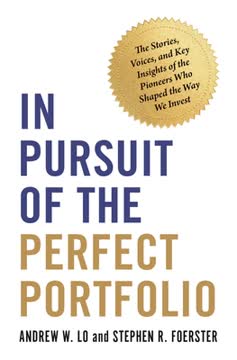
Key Takeaways
1. Diversification: The Cornerstone of Portfolio Construction
"My great insight was that you need to take into account correlation. This was the first of my ‘aha’ moments of my career."
The Markowitz Revolution. Before Harry Markowitz's seminal 1952 paper, "Portfolio Selection," the concept of diversification was largely intuitive, akin to the adage "don't put all your eggs in one basket." Markowitz formalized this idea mathematically, demonstrating that the risk of a portfolio is not simply the sum of individual asset risks but is profoundly influenced by how those assets move relative to each other—their correlations. This insight led to the creation of the "efficient frontier," a set of portfolios offering the highest expected return for a given level of risk, or the lowest risk for a given expected return.
Beyond Individual Assets. Markowitz showed that in a large portfolio, the covariance (or correlation) between assets matters far more than the individual variance of each asset. This means that combining assets whose returns don't move in perfect lockstep can significantly reduce overall portfolio risk without sacrificing expected returns. For instance, a portfolio of sixty railroad stocks offers poor diversification because they are highly correlated, whereas a mix of:
- Railroad stocks
- Public utility stocks
- Mining stocks
- Various manufacturing stocks
provides more effective risk reduction.
Democratizing Investment. Markowitz's work transformed investment management from an art based on individual stock picking into a repeatable, scientific process. It provided a framework for investors to systematically analyze and construct portfolios, making sophisticated risk management accessible to a broader audience. This "democratization" of investing laid the groundwork for future innovations, allowing even non-experts to build well-diversified portfolios and pursue their own "Perfect Portfolio" by understanding the trade-off between risk and return.
2. The Market Portfolio: A Powerful, Low-Cost Starting Point
"The two big implications are first, ‘Yes, Virginia,’ there is a reward for bearing risk but only nondiversifiable risk; the second implication is why do you want to bear that non-rewarded risk, which says for God’s sake diversify!"
Sharpe's Equilibrium Model. Building on Markowitz's foundation, William Sharpe developed the Capital Asset Pricing Model (CAPM), a remarkably simple yet powerful equilibrium model. CAPM posits that if all investors are rational and can borrow or lend at a risk-free rate, they will all hold the same optimal risky portfolio: the market portfolio. This theoretical portfolio includes all marketable assets, weighted by their market capitalization. The CAPM then establishes a linear relationship, the Security Market Line, where an asset's expected return is determined solely by its sensitivity to the market's movements, known as "beta."
Beta as the Sole Risk Measure. In a CAPM world, beta is the only measure of risk that matters for diversified investors. Any risk specific to an individual company (unsystematic risk) can be diversified away by holding the market portfolio and is therefore not rewarded with higher expected returns. Only systematic risk—the risk inherent to the overall market—commands a premium. This means that for a well-diversified investor, the volatility of an individual stock in isolation is irrelevant; what matters is how that stock contributes to the overall market risk.
The Rise of Indexing. Sharpe's work provided the intellectual bedrock for passive investing and the multi-trillion-dollar index fund industry. If the market portfolio is the optimal risky portfolio, then the most efficient way to invest is to simply hold a low-cost fund that replicates a broad market index, such as the S&P 500. This approach ensures maximum diversification and minimizes costs, making it accessible for all investors. As Sharpe himself advises, a "Perfect Portfolio" would ideally be a combination of a riskless asset like TIPS and a global index fund covering all tradable bonds and stocks in market proportions.
3. Costs and Behavior: The Silent Destroyers of Returns
"Whether markets are efficient or inefficient, investors as a group must fall short of the market return by the amount of the costs they incur."
Bogle's Cost Matters Hypothesis. John Bogle, founder of Vanguard, championed the "Cost Matters Hypothesis" (CMH), arguing that the aggregate costs of investing inevitably reduce investors' net returns. He observed that while market efficiency might be debatable, the impact of costs is a mathematical certainty: gross market returns minus investment costs equal the actual returns received by investors. Bogle identified three primary costs:
- Expense ratios: Annual fees as a percentage of assets.
- Sales commissions (loads): Upfront or deferred charges.
- Portfolio turnover costs: Hidden costs from frequent buying and selling within a fund.
His solution was simple: invest in low-cost, broadly diversified index funds, which minimize all three.
Ellis's Loser's Game. Charles Ellis reinforced Bogle's message with his influential article, "The Loser's Game." Drawing an analogy to amateur tennis, where players lose points through unforced errors rather than winning them through brilliant shots, Ellis argued that active investment management is a "loser's game." The increasing sophistication and competition among professional money managers mean that consistently outperforming the market after fees and costs is exceedingly difficult, if not impossible, for most. Trying too hard to win often leads to losing.
The Paradox of Professionalism. Ellis noted the paradox that as investment professionals become smarter, harder-working, and better-equipped, the collective effort makes the market more efficient, reducing opportunities for any single manager to consistently outperform. This intense competition effectively turns active management into a zero-sum game before costs, and a negative-sum game after costs. Both Bogle and Ellis advocate for a defensive strategy: avoid mistakes, minimize costs, and "join the market" through passive index investing, which guarantees investors their fair share of market returns.
4. Risk is More Than Volatility: Focus on Terminal Wealth and Drawdown
"If you can risk-manage your portfolio and cut your tail losses, you’ll be so much better off. But risk management, it’s not only to avoid the tail loss, but it’s participating in tail gains. It’s symmetric. You don’t want to just have low risk."
Scholes's Risk Management Focus. Myron Scholes, co-creator of the Black-Scholes option pricing model, emphasizes that the "Perfect Portfolio" is fundamentally about dynamic risk management, not just static asset allocation. He argues that investors should prioritize maximizing their terminal wealth (e.g., retirement nest egg) and compound returns, while minimizing drawdown—the peak-to-trough decline in portfolio value. Crucially, he highlights the disproportionate impact of "tail risks" (rare, extreme negative events) and "tail gains" (rare, extreme positive events) on long-term wealth accumulation.
Beyond Index Funds. While acknowledging the benefits of diversification, Scholes expresses caution about passive index funds. He notes that the risk of an index fund is not constant due to changing asset composition and correlations, especially during market turmoil when diversification benefits can diminish. He advocates for a more active, dynamic approach to portfolio management, where investors determine their maximum comfortable drawdown and adjust their asset allocation as market risks change. This involves:
- Interpreting information from derivatives markets (like the VIX) to gauge expected volatility.
- Using this information to construct portfolios that actively seek to minimize expected tail losses and maximize expected tail gains.
Merton's Goal-Based Approach. Robert Merton, Scholes's Nobel co-recipient, extends this risk-centric view to personal financial planning, particularly retirement. He argues that the "risk-free asset" is not a generic Treasury bill but rather an asset that guarantees the achievement of your specific financial goals. For retirement, this might mean an inflation-protected annuity. If current savings fall short of this "risk-free" goal, investors must strategically take on more risk. Merton advocates for professional guidance, using sophisticated models to:
- Translate life goals into financial targets.
- Dynamically adjust portfolios based on individual circumstances (age, income, expenses, future contributions).
- Provide "meaningful choices" about saving more, working longer, or taking more risk to bridge any funding gaps.
5. Equities for the Long Run: Outperforming Other Asset Classes
"Historical data show that we can be more certain of the purchasing power of a diversified portfolio of stocks 30 years hence than we can of the buying power of the principal on a 30-year U.S. Treasury bond."
Siegel's Enduring Case for Stocks. Jeremy Siegel, the "Wizard of Wharton," makes a compelling, evidence-based argument for stocks as the superior long-term investment in his classic book, Stocks for the Long Run. His research, spanning over two centuries of data, reveals that equities have consistently delivered a stable real (inflation-adjusted) return of approximately 6.7% per year. This remarkable consistency, even amidst short-term volatility and major economic upheavals, suggests that stocks exhibit "mean reversion" in the long run, returning to their historical trend line.
Stocks as a Long-Term Safe Haven. Counterintuitively, Siegel demonstrates that for long-term investors (e.g., 30-year horizons), a diversified portfolio of stocks is actually safer than bonds in terms of preserving purchasing power. While stocks are riskier in the short term, their long-term real returns are more predictable and less susceptible to inflation erosion compared to bonds. This challenges the traditional view that bonds are inherently safer for all time horizons, highlighting the importance of matching investment duration to financial goals.
Avoiding Growth Traps and Embracing Value. Siegel also warns against "growth traps," where investors overpay for rapidly growing companies, leading to disappointing long-term returns. He found that companies with lower initial valuations (higher dividend yields or lower P/E ratios) often outperform high-growth, "hot" stocks over decades, even if the latter show faster earnings growth. His "D-I-V Directive" for a "Perfect Portfolio" emphasizes:
- Dividends: Invest in companies with sustainable cash flows that pay dividends.
- International: Allocate substantially to international stocks (e.g., 40%) to capture global growth.
- Valuation: Favor stocks with reasonable valuations, avoiding speculative "new economy" fads and IPOs.
6. Market Efficiency: A Constant Debate Between Rationality and Exuberance
"I define a bubble as a social epidemic that involves extravagant expectations for the future."
Shiller's Challenge to Rationality. Robert Shiller, a behavioral economist, famously challenged the efficient market hypothesis (EMH) with his "excess volatility" research. He demonstrated that stock prices fluctuate far more than can be justified by subsequent changes in dividends, suggesting that market movements are often driven by psychological and social dynamics rather than purely rational assessments of fundamental value. This led to his concept of "irrational exuberance," a term later popularized by Alan Greenspan, describing periods where asset values become unduly escalated by speculative fervor.
Bubbles and the CAPE Ratio. Shiller views financial bubbles as "social epidemics" fueled by extravagant expectations, positive feedback loops (rising prices attracting more buyers), and compelling narratives. He argues that these bubbles are not merely rational responses to economic fundamentals but are often characterized by investors buying assets even when they suspect they are overvalued. To identify potential overvaluation, Shiller developed the Cyclically Adjusted Price-to-Earnings (CAPE) ratio, which averages stock prices over ten years of inflation-adjusted earnings. Historically, high CAPE ratios have predicted lower long-term stock returns, serving as a warning sign for investors.
Fama's Defense of Efficiency. Eugene Fama, the architect of the EMH, offers a contrasting view. While acknowledging market anomalies and the "joint hypothesis problem" (that testing efficiency also tests the asset pricing model), Fama maintains that markets are generally efficient. He argues that apparent "bubbles" and crashes are often rational responses to large swings in real economic activity and risk premiums, not irrational exuberance. Fama contends that there's no reliable evidence that market declines are predictable, and that behavioral explanations often amount to "storytelling after the fact." For Fama, the market portfolio remains the core of a "Perfect Portfolio," with any "tilts" (e.g., to value or small-cap stocks) representing compensation for additional, albeit identified, risk factors.
7. Personalization: Your Unique Path to the Perfect Portfolio
"The most important single thought I can give is, contrary to the often-made statements, it’s not about knowing the market and it’s not about selecting the right manager. It is about you, your values, your history, your financial situation, and what will work best for you to accomplish the objectives you have in your life."
Ellis's "Know Thyself" Imperative. Charles Ellis, the author of "Winning the Loser's Game," emphasizes that there is no single "Perfect Portfolio" because every investor is unique. Your ideal investment strategy must be deeply personalized, reflecting your individual circumstances, values, and financial situation. This involves a comprehensive self-assessment of factors such as:
- Age and dependents: Influencing time horizon and risk capacity.
- Income and spending habits: Determining savings potential.
- Investment knowledge and comfort with risk: Shaping your approach to active vs. passive management.
- Access to information and judgment: Affecting your ability to make informed decisions.
Ellis stresses that focusing solely on market returns or manager selection misses the crucial point that the "Perfect Portfolio" is ultimately about you.
Leibowitz's Funding Ratio. Martin Leibowitz, the "Bond Guru," reinforces the importance of personalization by advocating for a "generalized funding ratio" approach, similar to how pension funds manage assets against liabilities. This involves assessing your current assets and assured future income relative to your future financial needs. A high funding ratio provides greater capacity to take on risk, while a low ratio necessitates a more conservative approach or adjustments to spending and saving. Leibowitz cautions against rigid rules, suggesting that even with a high risk tolerance, one might choose to de-risk if market valuations are stretched or if additional returns offer little marginal value to one's lifestyle.
Beyond the Portfolio. Both Ellis and Leibowitz highlight that your "total portfolio" extends beyond financial assets. It includes your human capital (future earning potential), home equity, and social security benefits. Effective financial planning requires integrating these elements into a holistic view. They also stress the importance of:
- Clear goals: Defining what you want to achieve.
- Contingency planning: Preparing for unexpected life events and market downturns.
- Emotional discipline: Avoiding impulsive decisions driven by fear or greed.
Ultimately, the path to your "Perfect Portfolio" begins with a deep understanding of yourself and your unique financial landscape.
8. Dynamic Adaptation: The Key to Navigating Evolving Markets
"If Zen masters are correct that you can never step into the same river twice, it follows that you may never have the same Perfect Portfolio twice if you’re adapting as frequently as you should."
Markets are Adaptive. The Adaptive Markets Hypothesis (AMH) suggests that financial markets are not always perfectly rational or irrational, but rather adaptive systems influenced by human psychology, competition, and evolving economic environments. This implies that the relationship between risk and reward is not constant, and investment strategies that work well in one environment may fail in another. Therefore, a "Perfect Portfolio" cannot be static; it must dynamically adapt to changing market conditions and personal circumstances.
Responding to the Environment. Our experts, while differing on specifics, implicitly or explicitly advocate for dynamic adaptation. Jeremy Siegel, for instance, notes that while stocks are for the long run, understanding business cycles can inform tactical adjustments, though predicting turning points is challenging. Myron Scholes emphasizes using information from derivatives markets (like the VIX) to gauge real-time risk and adjust portfolio allocations to manage drawdown and capture tail gains. Martin Leibowitz advises that even a "buy-and-hold" strategy might need to be adjusted if market risk levels exceed one's true tolerance, or if the reward-to-risk ratio becomes unfavorable.
The RISE Criteria for Adaptation. To guide this adaptive process, we propose the "RISE" criteria:
- Risk: Your degree of risk aversion (Hawk or Dove).
- Income: Your current and future wealth/earnings power (Midas or Penia).
- Spending: Your current and future financial needs (Scrooge or Gatsby).
- Environment: The prevailing economic conditions (Expansion or Recession).
By regularly assessing these four characteristics, investors can identify their "investor archetype" and determine whether their current "Perfect Portfolio" needs adjustment. This framework highlights that the pursuit of the "Perfect Portfolio" is an ongoing journey of self-awareness and strategic response to an ever-changing financial landscape.
Last updated:
Review Summary
In Pursuit of the Perfect Portfolio offers a comprehensive history of modern investment theory, profiling influential figures like Markowitz, Sharpe, Fama, and Bogle. Readers appreciate the accessible yet rigorous academic approach, noting how recent investment science truly is—most concepts emerged within 75 years. The book combines mini-biographies with portfolio construction advice, though experts often present conflicting views. While some found it dry or historically focused rather than practically oriented, most praised its unique scope in chronicling finance's evolution from art to science, making it valuable for understanding portfolio management foundations.
Similar Books