

Key Takeaways
Treat the post-Cold War boom as a regime, not a permanent law
A powerful tailwind faded. McDonald argues that the Soviet collapse helped create a US-led era of expanding trade, cheaper production, and lower geopolitical risk. Global trade grew from less than $5 trillion in 1990 to $28 trillion in 2022. Offshoring and access to Asian labor and goods helped push inflation down, while falling Treasury yields made future company earnings more valuable to investors. The S&P 500's price-to-earnings ratio rose from about 7 in the early 1980s to 30 in the late 1990s and again in 2021.
The old conditions are changing. The book's central forecast is that renewed geopolitical conflict, reshoring, and resource constraints will make inflation harder to suppress. Investors, it argues, should not assume the last thirty years are a reliable template for the next decade.
What's useful here is the shift from predicting individual prices to asking which broad conditions make whole strategies work. Low inflation and falling rates favor assets whose value depends heavily on distant earnings; higher inflation can favor current cash flows and tangible resources. This is a regime-based lens, not a calendar forecast. The post-Cold War shift was important, but it was not the only force behind falling inflation: technology, demographics, and monetary policy also mattered. A sound application is therefore to test a portfolio against several plausible economic environments rather than treating one historical explanation as certainty.
Do not price every crash as if the Fed can always rescue it
Rescue can change behavior. The book traces the modern expectation of intervention to the 1998 rescue of Long-Term Capital Management, a highly leveraged hedge fund whose failure threatened counterparties across the financial system. The Federal Reserve organized private banks to stabilize the fund. Afterward, investors had reason to believe policymakers would step in when market stress threatened the system. McDonald calls this expectation the Fed put.
The rescue has a price. Repeated rate cuts, bailouts, and quantitative easing helped stabilize markets, but the author argues they also encouraged borrowing, risk-taking, and reliance on continued support. That support is not unlimited: in an inflationary crisis, another large injection of money could worsen price pressures. The book's warning is practical: a future crash may meet a very different policy response.
The important distinction is between stopping contagion and guaranteeing asset prices. Authorities can have strong reasons to keep payment systems and credit functioning, while still allowing investors, firms, or shareholders to absorb losses. Confusing those aims encourages hidden leverage and moral hazard, the expectation that someone else will bear the downside. Yet non-intervention can also deepen a panic when institutions are tightly connected. The useful question is not whether officials will act, but what they can act on, who benefits, and what costs are shifted elsewhere.
Expect supply-chain security to cost more than cheap global access
Cheap imports held prices down. China’s entry into the World Trade Organization in 2001 accelerated the movement of manufacturing to lower-cost locations. The book cites a New York Fed estimate that this entry reduced manufacturing price indexes by 7.6 percent from 2000 to 2006. From 1997 to 2015, the US consumer price index for personal computers and related equipment fell by 96 percent. Consumers gained from cheaper goods, while many American manufacturing communities lost jobs and production capacity.
Resilience costs money. Companies now face pressure to move production closer to home or to friendlier countries. Rebuilding supply chains in higher-wage locations requires factories, labor, and logistics, so the author expects this reversal to add inflationary pressure. André Esteves, a Brazilian banker interviewed in the book, stresses that trade depends not only on wages but also on secure, reliable routes for goods.
This argument links household prices to the less visible architecture of production. A low sticker price can depend on concentrated suppliers, long shipping routes, and geopolitical stability. Redundancy, the extra capacity that makes a system less brittle, is economically valuable but raises costs in normal times. The trade-off is not simply cheap versus expensive: it is efficiency versus resilience. Nor does reshoring automatically restore former jobs or communities, since automation and changing demand also shape employment. Investors and policymakers should distinguish strategic supply-chain investment from a blanket assumption that all domestic production is beneficial.
Low volatility can be the calm created by crowded, leveraged bets
Quiet markets can conceal strain. The book describes a feedback loop in which central-bank support and steady buying suppress price swings. Some investors then use leverage or sell options to earn returns from continued calm. When many traders make similar bets, a sudden shock can force them all to unwind together. The VIX, an index derived from options prices that reflects expected stock-market volatility, jumped 270 percent in one day during the 2018 episode dubbed Volmageddon. In March 2020, the book reports, order-book depth in S&P futures fell by 90 percent as markets plunged.
Liquidity can vanish under stress. McDonald argues that automated strategies, passive fund flows, and short-volatility trades can amplify forced selling when prices turn. The lesson is to ask who must sell if a popular trade reverses, not merely whether markets look calm today.
This is a useful systems insight: stability can alter incentives until participants take risks that make the system less stable. The pattern resembles a crowded exit, where each investor's attempt to reduce exposure worsens prices for everyone else. Still, passive funds and exchange-traded funds are not inherently destabilizing; they can provide low-cost diversification and, in ordinary conditions, support trading. Fragility depends on the interaction among leverage, liquidity, and correlated positioning. For an individual investor, the practical implication is to understand the risks of leveraged or volatility-linked products, rather than assuming a quiet market means a safe one.
When a compelling story outruns cash flows, check who funds the euphoria
Bubbles need both belief and money. The book connects past manias, from Japanese property to dot-com stocks and cryptocurrencies, to narratives that made extraordinary prices seem justified. In the crypto boom, Bitcoin was presented as an escape from government-controlled money. Pandemic-era stimulus and cheap credit helped push Bitcoin from $4,826 in March 2020 to almost $68,790 in November 2021. The collapse of FTX, led by Sam Bankman-Fried, showed how a persuasive story and celebrity attention could coexist with serious questions about the business behind it.
Check the valuation engine. A discounted cash flow model estimates what a company's future cash flows are worth today. When interest rates rise, those future dollars are discounted more heavily, which can hit speculative growth companies especially hard. The book argues that investors should examine funding, cash generation, and the assumptions embedded in a high valuation.
The strongest part of this account is its separation of a technology's potential from the price paid for it. Blockchain may have uses even if a particular token, exchange, or investment thesis fails. That distinction is easy to lose during a boom, when social proof replaces investigation and rising prices appear to confirm the story. Cash-flow analysis helps restore discipline, but it is not a crystal ball: young companies may create value before conventional earnings appear, and forecasts can be wrong in both directions. A useful test is whether an investment still makes sense if enthusiasm, cheap financing, or a famous backer disappears.
Invest in energy transition constraints, not just the transition's promised winners
A transition requires materials and power. McDonald argues that ambitious plans for electrification and renewable energy depend on mines, transmission lines, storage, and reliable electricity. He cites a $2.4 trillion reduction in fossil-fuel and metals capital spending from 2014 to 2020, alongside population growth of 800 million. Copper, lithium, cobalt, and uranium face long development timelines and supply risks; the book notes that opening a copper mine can take five to ten years. Its discussion of cobalt also describes dangerous artisanal mining in the Democratic Republic of the Congo, including child labor.
Look beyond the final product. Instead of betting only on which electric-vehicle or technology company wins, the author points investors toward the materials, energy producers, and infrastructure those industries need. He also sees nuclear power as a possible bridge between fossil fuels and lower-carbon electricity.
The bottleneck perspective is powerful because infrastructure and mineral supply can constrain adoption even when demand and policy are strong. It also exposes a moral blind spot: a product marketed as clean can rely on extraction with severe human and environmental costs. However, shortages are not guaranteed. High prices can prompt new supply, substitution, recycling, and more efficient designs, while technology can change the quantity of material required. The investment case should therefore include project timing, permitting, political risk, and the possibility that demand projections prove too optimistic. A strong social claim is not, by itself, a reliable price forecast.
Treat dollar dominance as a political asset that can be spent
Trust supports reserve status. The US dollar's role in trade and reserves gives the country an unusually deep pool of potential buyers for its debt. The book argues that sanctions and the freezing of Russian reserves have made some governments more cautious about holding dollars. It points to efforts by China and other countries to settle more trade in alternative currencies, along with central-bank purchases of gold. These developments do not prove that the dollar is about to lose its central role, but they may gradually reduce demand for US assets.
Debt raises the stakes. McDonald highlights a US federal debt burden of about $33 trillion and large refinancing needs. If borrowing costs remain high while overseas demand weakens, the government faces harder choices. The author expects inflation and financial repression, policies that keep government borrowing costs below inflation, to become more attractive than politically painful spending cuts.
Reserve currencies rely on more than military strength or a large economy. They also depend on institutions, liquid markets, and confidence that assets will remain accessible. Using financial sanctions may achieve immediate strategic goals while encouraging some governments to diversify over time. That is a gradual risk, not proof of imminent dollar collapse: alternatives must offer comparable liquidity, convertibility, and trust, which is difficult to build. The book's debt figures should be read as a warning about fiscal choices, not as a precise countdown to crisis. Investors should separate the possibility of dollar weakness from certainty about its timing or replacement.
Use market breadth and credit to measure pain, then resist panic
Look beneath the headline index. The book describes a 21-indicator risk dashboard built to track stress across markets. Its signals include changes in credit, bonds, commodities, and investor positioning. The author also watches market breadth: how many stocks are making new lows or trading above their 200-day moving average. At severe selloffs, such as March 2020, very few stocks remained above that average. Credit can offer another clue: McDonald argues that distressed high-yield bonds sometimes turned upward before stocks recovered.
Wait for evidence, not comfort. Investor David Tepper describes cutting risk when several concerns accumulate, then buying when selling becomes extreme and policy support is credible. Charlie Munger's lesson in the book is simpler: avoid constant trading and wait for a small number of compelling opportunities. These signals are tools for judgment, not guaranteed market-timing formulas.
The approach has a valuable advantage over headline watching: it asks whether weakness is broad, whether credit agrees with stocks, and whether selling is accelerating. Combining signals across asset classes can reduce dependence on a single noisy indicator. But a dashboard can create false confidence if its thresholds are fitted to past crises or if the next shock behaves differently. Extreme readings may identify stress without identifying the exact bottom. The disciplined use is probabilistic: define what evidence would change the view, size positions so error is survivable, and avoid mistaking a memorable historical pattern for a law.
Build for inflation with diversified real assets, not yesterday's 60/40
Portfolio assumptions must change. The familiar 60 percent stocks and 40 percent bonds mix benefited from an era of falling inflation and rates, according to McDonald. If inflation persists, he argues, commodities and value-oriented businesses may offer better protection than a portfolio dominated by growth stocks and long-term bonds. His proposed allocation for the 2020s is 10 percent cash, 40 percent stocks, 30 percent bonds, and 20 percent commodities. He also emphasizes that precious metals and commodity producers respond differently to interest rates, so the timing and type of exposure matter.
Keep the forecast in perspective. The book's case rests on a predicted rotation toward energy, metals, and other hard assets, including copper, gold, silver, and uranium. It presents a long-term thesis, not a personalized allocation or a guarantee of returns.
The deeper principle is diversification across economic sensitivities, not simply owning a fixed ratio of stocks and bonds. Assets that respond differently to inflation, growth, and interest rates can make a portfolio less dependent on one forecast. Yet commodities can be volatile, concentrated, and costly to hold, while inflation can fall faster than expected. The author's proposed mix is best treated as a scenario to stress-test, not a universal prescription. Investors should also account for time horizon, liquidity needs, taxes, and tolerance for large drawdowns before changing allocations. A thesis can be compelling and still be early, wrong, or already reflected in prices.
Analysis
The book's most coherent contribution is its causal chain: geopolitical integration and offshoring helped suppress costs; lower inflation and rates raised the value of financial assets; policy rescues reinforced confidence in those assets; passive flows and leverage then made crowded markets more vulnerable. That is more useful than a bare prediction that inflation or commodities will rise, because it identifies mechanisms readers can monitor.
Its greatest strength is also its main risk. McDonald assembles historical episodes, market indicators, and expert interviews into a persuasive narrative, but narrative coherence can make contingent links feel inevitable. A rescue may encourage risk-taking, yet it can also prevent a liquidity crisis from destroying otherwise viable firms. Reshoring may add costs, yet automation, new suppliers, and productivity gains can offset them. A weaker dollar is plausible, but reserve-currency transitions are slow and depend on the quality of alternatives, not just dissatisfaction with US policy.
The book is most valuable when treated as a stress test for portfolios and assumptions, rather than as a forecast to follow literally. Its advice to examine credit alongside equities, notice crowded positioning, and respect real-world supply constraints is broadly useful. Its specific predictions about persistent inflation, shortages, and capital migration deserve scenario analysis and periodic reassessment. The proposed commodities allocation, in particular, is a thesis with substantial volatility and timing risk, not a one-size-fits-all solution.
The narrative's sharpest tension is between the promise of a green transition and the resources required to build it. That tension invites a more precise question than whether fossil fuels or renewables will win: how quickly can energy systems expand reliable capacity while reducing emissions and limiting human costs? The answer will shape investment opportunities, but it will also depend on engineering, policy, and public consent. Markets can signal scarcity, but they cannot settle those trade-offs by themselves.
Review Summary
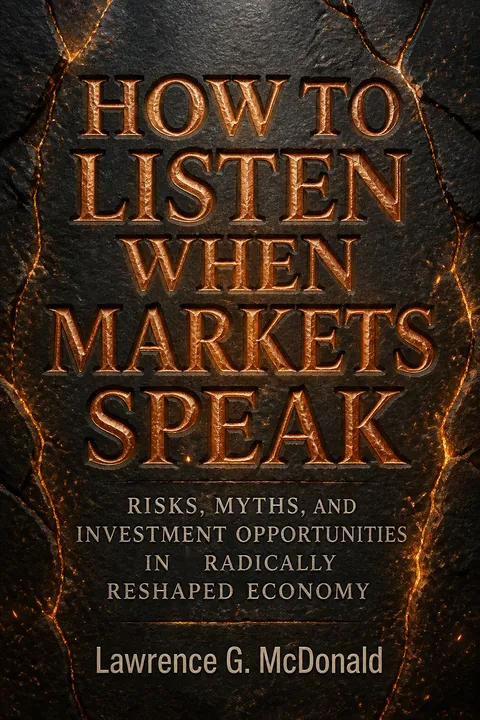
How to Listen When Markets Speak receives mostly positive reviews, with readers praising its insights into market dynamics and investment strategies. Many appreciate McDonald's analysis of shifting economic trends and his predictions for future market behavior. Some readers find the book's technical content challenging, while others value its blend of economics, politics, and history. Critics note excessive name-dropping and self-promotion. Overall, reviewers recommend it for investors seeking to understand current market risks and opportunities in a changing economic landscape.
People Also Read






Glossary
Fed put
Expected central-bank rescueAn investor expectation that the Federal Reserve will respond to severe market declines with measures that support financial conditions. The term evokes a put option, which limits an investor's downside. In the book, repeated crisis responses help create this expectation, potentially encouraging more leverage and risk-taking. It does not mean the Fed guarantees a particular asset price.
quantitative easing
Central-bank asset purchasesA monetary policy in which a central bank buys bonds and other eligible assets, paying for them by creating reserves in the banking system. The book argues that these purchases add liquidity, lower yields, and push investors toward riskier assets. It also warns that repeated use may inflate financial markets and complicate efforts to control consumer-price inflation.
mosaic research
Evidence assembled across sourcesA research approach described in the book: gather separate pieces of information, place them beside other evidence and informed perspectives, and assess what the combined pattern suggests. The method depends on broad networks and careful questioning rather than a single data point. Its purpose is to distinguish a meaningful market signal from the surrounding noise.
Twenty-one Lehman systemic risk indicators
Cross-market risk dashboardA set of indicators developed by McDonald after the Lehman Brothers collapse to assess systemic market risk. The book describes signals drawn from areas such as credit conditions, investor sentiment, short interest, and market behavior. The indicators are intended to reveal shifts in risk appetite before they become obvious in headline stock indexes, though they do not guarantee accurate timing.
financial repression
Debt costs held below inflationPolicies that steer financial institutions or savers toward holding government debt while keeping borrowing costs artificially low. In the book's account, a government facing heavy debt may benefit when inflation exceeds the interest rate it pays, because the real value of its obligations falls. Such policies can reduce savers' purchasing power and distort how capital is allocated.
Fourth Turning
Crisis phase of a historical cycleA phase in the historical-cycle framework developed by William Strauss and Neil Howe. Their model describes recurring sequences of four periods, ending in a crisis that disrupts established institutions and may create new ones. McDonald uses the concept to frame current political and economic upheaval, but it is an interpretive historical framework, not a precise forecasting tool.
seven-factor capitulation model
Measures extreme sellingA framework described in the book for estimating when investors in volatile, high-beta sectors are exiting positions rapidly. It combines measures of selling intensity and technical market conditions to identify a possible selling climax. The goal is not to pinpoint an exact bottom, but to build positions gradually when panic may have created more attractive prices.
FAQ
What's How to Listen When Markets Speak about?
- Market Signals Focus: The book emphasizes understanding market signals and indicators to navigate the evolving economic landscape, highlighting a shift from a deflationary to an inflationary regime.
- Investment Strategies: It offers insights into new investment strategies, particularly focusing on hard assets like commodities and precious metals, as traditional approaches may no longer be effective.
- Historical Context: The book traces historical events, such as the collapse of Lehman Brothers, to explain the current economic order and market dynamics.
Why should I read How to Listen When Markets Speak?
- Expert Insights: Written by Lawrence McDonald, a seasoned Wall Street trader, the book provides expert insights into market behavior and investment strategies.
- Preparation for Change: It prepares readers for upcoming economic shifts, emphasizing the need to adapt to a new era of persistent inflation and geopolitical tensions.
- Practical Advice: The book includes practical advice on identifying investment opportunities in hard assets and avoiding pitfalls associated with passive investing.
What are the key takeaways of How to Listen When Markets Speak?
- Shift to Inflation: The book argues that the era of disinflation is over, and investors should prepare for sustained inflation, which won't return to past low levels.
- Value of Hard Assets: It highlights the importance of investing in hard assets like gold, silver, and commodities, expected to outperform traditional growth stocks.
- Listening to Market Signals: McDonald stresses the importance of understanding market signals through systemic risk indicators for informed investment decisions.
What are the best quotes from How to Listen When Markets Speak and what do they mean?
- "Sooner or later everyone sits down to a banquet of consequences.": This quote underscores the idea that every action in financial markets has consequences, urging investors to consider long-term effects.
- "The markets are speaking loudly and clearly; we just need to have ears to listen.": It emphasizes the need for investors to pay attention to market signals for better investment outcomes.
- "The end of the Cold War... ushered in a generational financial boom.": This reflects on how historical events shape economic conditions, highlighting the importance of understanding the past.
How does How to Listen When Markets Speak define passive investing?
- Strategy Overview: Passive investing replicates market indices rather than actively selecting stocks, gaining popularity for its perceived lower costs and simplicity.
- Market Share Growth: Passive investors now control at least 50% of all fund assets in America, raising concerns about market volatility and risk.
- Risks of Complacency: McDonald argues that passive investing can lead to a lack of awareness regarding market risks, creating vulnerabilities in the financial system.
What is the New Washington Consensus discussed in How to Listen When Markets Speak?
- Shift in Economic Policy: It refers to a shift from deflationary policies focused on globalization to inflationary policies emphasizing domestic production and labor rights.
- Impact on Inflation: This new consensus is expected to lead to higher inflation rates as governments increase spending and support for labor unions.
- Geopolitical Tensions: The consensus reflects growing geopolitical tensions and the need for countries to secure their energy and resource supplies.
How does How to Listen When Markets Speak address the concept of liquidity?
- Liquidity Importance: Liquidity is essential for financial markets, allowing asset transactions without significant price impact, typically correlating with lower volatility.
- Liquidity Crisis Examples: The book discusses events like the COVID-19 sell-off, where liquidity evaporated, leading to severe market disruptions.
- Investor Awareness: McDonald encourages investors to be mindful of liquidity conditions when making decisions, as understanding liquidity dynamics can help navigate risks.
What strategies does How to Listen When Markets Speak suggest for investing in hard assets?
- Focus on Value: McDonald advocates for value investing and hard assets, such as commodities and precious metals, as a hedge against inflation.
- Diversification: The book emphasizes diversifying investments across various hard assets to mitigate risk, including sectors like energy, mining, and agriculture.
- Long-Term Perspective: Investors are advised to adopt a long-term perspective, as hard asset markets can be volatile, requiring patience and strategic positioning.
How does How to Listen When Markets Speak relate to the current economic climate?
- Inflationary Pressures: The book discusses rising inflation rates and their impact on investment strategies, driving a shift towards hard assets and value stocks.
- Geopolitical Risks: McDonald highlights increasing geopolitical tensions and their potential effects on global markets, urging investors to consider these risks.
- Market Cycles: The author emphasizes entering a new market cycle with higher interest rates and inflation, crucial for adapting investment strategies.
What are the implications of the "endless bid" phenomenon in How to Listen When Markets Speak?
- Market Support Mechanism: The "endless bid" refers to continuous buying pressure from institutional investors, supported by central bank liquidity, inflating asset prices.
- Volatility Suppression: It tends to suppress market volatility, creating a false sense of security among investors, leading to increased risk-taking.
- Potential for Sudden Reversals: McDonald warns that when buying pressure subsides, it can lead to rapid market declines, requiring investor preparedness.
How does How to Listen When Markets Speak address the decline of the U.S. dollar?
- Weakening Dollar Outlook: McDonald predicts a decline in the U.S. dollar due to rising inflation and increasing government debt, impacting global markets.
- Impact on Investments: A weakening dollar will drive capital out of financial assets into hard assets like commodities and precious metals, requiring portfolio adjustments.
- Geopolitical Factors: Geopolitical tensions and potential shifts away from the dollar as a reserve currency could exacerbate its decline, affecting global trade dynamics.
What is the significance of demographic trends in How to Listen When Markets Speak?
- Aging Population Impact: The aging baby boomer population is shifting investment preferences from stocks to bonds and hard assets, affecting capital flows.
- Wealth Transfer: As baby boomers retire, wealth transfer to younger generations with different investment priorities could reshape market dynamics.
- Investment Strategy Adaptation: Investors need to adjust strategies based on demographic trends, understanding different age groups' preferences for informed decisions.
Download PDF
Download EPUB
.epub digital book format is ideal for reading ebooks on phones, tablets, and e-readers.








