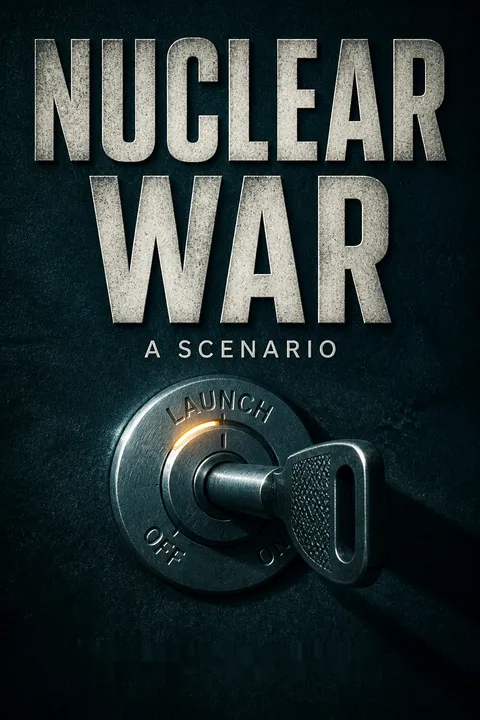


Key Takeaways
Deterrence keeps peace by threatening catastrophe, not by preventing it.
The threat is the mechanism. Nuclear deterrence is the promise that an attack will bring devastating retaliation. The United States and the Soviet Union built arsenals meant to make that threat credible, keeping weapons ready to launch. The logic may discourage an attack, but it does not make weapons harmless or remove the chance of error. The American stockpile grew from 13 bombs in 1947 to 18,638 in 1960, then peaked at 31,255 in 1967. In 1952, the Ivy Mike thermonuclear test erased an island and left a crater described as large enough to hold fourteen Pentagon buildings.
Safety through danger. The system rests on assumptions about leaders, warning technology, and command procedures working correctly under extreme pressure. Its security promise is therefore also a source of risk: readiness intended to deter can accelerate a mistaken response.
What's striking is that deterrence is not a shield but a bargain built on anticipated fear. In risk engineering, a system is safer when it has independent layers that can catch one another's failures. Deterrence instead depends on the opponent correctly interpreting signals and believing retaliation is certain. That may help explain why policymakers defend it, but it also concentrates risk in rare, irreversible moments. The book's critique is strongest when it distinguishes the theory's intended effect from its actual guarantee: deterring attack is not the same as ensuring safety. The fact that nuclear war has not occurred does not, by itself, establish that the arrangement is reliable.
A 1960 war plan turned hundreds of millions of civilian deaths into arithmetic.
A plan on a wall. In December 1960, defense official John Rubel watched a briefing of the United States' first integrated plan for general nuclear war, the SIOP. Layers of transparent maps showed successive attacks on the Soviet Union and China. The plan projected about 600 million deaths: roughly 275 million in the first hour, followed by hundreds of millions more from fallout. China alone was expected to lose about half its population, although it might not have been part of the war.
One dissenting voice. Marine commandant David Shoup objected that a plan killing millions of Chinese civilians was unacceptable. No one joined him. Rubel, who stayed silent at the meeting, wrote about it decades later. The current plan is known as an Operational Plan, or OPLAN, and remains classified.
The briefing illustrates how bureaucracy can turn moral choices into apparently technical ones. A target map and casualty estimate make mass death legible to planners, but legibility is not justification. Organizational research often finds that people defer to group norms, especially when responsibility is divided across offices and procedures. Shoup's dissent matters because it shows that the plan was not beyond criticism, even inside its own institutions. The comparison with genocidal bureaucracy is morally charged and should not erase the distinct histories involved. Its narrower warning is powerful: orderly administration can make indiscriminate destruction feel like routine work.
A missile warning can leave a president six minutes to choose Armageddon.
Minutes to decide. An intercontinental ballistic missile can cross continents in about half an hour. In the book's North Korea scenario, the estimated flight to the East Coast is 33 minutes. Once warning reaches the president, the decision window described is around six minutes. Launch on Warning means preparing to fire nuclear weapons after sensors indicate an incoming attack, before the country has absorbed a nuclear strike.
Warnings can mislead. The book recounts a 1979 computer error that made a simulated attack look real. Former defense secretary William Perry believed for several minutes that nuclear war had begun. Earlier systems mistook swans and the rising moon for hostile activity. These episodes make the central danger concrete: the decision-maker must judge an unprecedented event using incomplete information on a deadline.
This is a problem of decision design as much as military strategy. Cognitive science shows that severe time pressure narrows attention and encourages reliance on defaults, precisely when a decision requires skepticism and context. The system's short deadline is not just a personal burden on a president; it is an institutional choice about how much uncertainty society is willing to tolerate. Faster warning can create more time to respond, but an automatic expectation to act quickly can consume that advantage. The historical false alarms demonstrate that sensors can be sophisticated and still produce ambiguous evidence.
Missile defenses are a thin, uncertain layer, not a dependable shield.
Interception is difficult. The United States' Ground-Based Midcourse Defense system has 44 interceptor missiles, located in Alaska and California. Each attempts a direct collision with a warhead moving at extreme speed. The task becomes harder when the attacking missile releases decoys, which can resemble warheads to sensors. The book reports that nine of twenty interceptor tests failed over a five-year period, and describes four interceptors missing in its scenario.
Timing matters. Space-based sensors can track a missile's hot exhaust during powered flight, but lose that view when the rocket motor stops. Experts Richard Garwin and Theodore Postol proposed keeping armed drones near North Korea to try to intercept missiles during that brief powered phase. The book says that proposal was not adopted. Its point is not that interception can never work, but that defense cannot be treated as assured.
The distinction between a defensive capability and a reliable defense is essential. Engineering tests can demonstrate that a system works under particular conditions, but operational performance also depends on surprise, countermeasures, maintenance, and the quality of incoming data. At the same time, test records alone do not establish the exact probability of success in a real attack. The book's worst-case sequence makes the vulnerability vivid, though its chosen failures should not be mistaken for a universal forecast. The broader lesson is to avoid building national survival assumptions around a system with a narrow margin for error.
One launch can turn ambiguous signals into a superpower exchange.
Retaliation creates new signals. In the scenario, the United States responds to North Korea's attack with 82 nuclear warheads. Some American Minuteman missiles travel over Russian territory on their way to North Korea. Russian early-warning systems, portrayed as less capable, interpret the launches and later missile objects as a much larger attack. Russian leaders see evidence of a strike against their country, although the United States intended to hit North Korea.
The war game ended alike. The 1983 Proud Prophet exercise tested many nuclear conflict scenarios. Participant Paul Bracken recalled that each ended in catastrophe, with no workable path to victory or de-escalation. The book's fictional chain shows how one country's retaliatory action can look like a first strike to another, especially when leaders cannot quickly establish what is happening.
This is a classic security dilemma: one side's attempt to protect itself can appear threatening to another, prompting countermeasures that confirm the original fear. Nuclear weapons make that feedback unusually unforgiving because missiles travel faster than diplomacy can clarify intent. The scenario also demonstrates why communication links and shared interpretations matter as much as weapon counts. Still, a constructed chain of events does not prove that Russian leaders would respond exactly this way. Its value is diagnostic: it identifies how misread trajectories, poor warning data, and mistrust can interact, rather than assigning certainty to a particular national response.
A nuclear blast overwhelms the institutions survivors expect to rescue them.
Destruction extends beyond the fireball. The opening strike in the scenario is a one-megaton weapon detonated over Washington, D.C. The book describes an expanding fireball, a destructive blast wave, mass fires, and the loss of electricity and water systems. It estimates that one to two million people are dead or dying, while hospitals and emergency services are themselves destroyed or unreachable. The account is grounded in nuclear-effects research and the 1945 bombings of Hiroshima and Nagasaki. Survivor Setsuko Thurlow, 13 at the time, escaped a burning building after a stranger freed her from rubble.
A second target compounds the damage. A 300-kiloton surface burst strikes California's Diablo Canyon nuclear power plant. In the scenario, the destruction of reactors and stored fuel produces a vast radioactive release, turning an attack into a long-lasting contamination crisis.
The focus on hospitals, communications, and water changes the usual picture of disaster response. Emergency systems are not external to catastrophe; they are part of the infrastructure a strike can destroy. That makes capacity, not simply the initial casualty count, central to understanding the harm. The human account from Hiroshima gives the calculations a historical anchor, while the modern scenario extrapolates from known effects to a much larger weapon and a different city. Exact outcomes depend on burst height, weather, terrain, and construction. The essential point is less a precise body count than the collapse of ordinary rescue capacity.
Plan for cascading failures, not just the blast.
A pulse can disrupt systems. The book's later scenario imagines a high-altitude electromagnetic pulse, or EMP, damaging power grids and electronic controls across the United States. It focuses on SCADA systems, computer networks that monitor and control infrastructure such as electricity, water, transport, and industrial plants. If those controls fail together, a nuclear attack can trigger further accidents and prevent people from communicating, moving, or obtaining basic services.
Government survival is not public rescue. FEMA's Continuity of Operations planning aims to preserve essential government functions. Former FEMA director Craig Fugate explains that this is different from having the capacity to save the general population after a surprise nuclear strike. In the book's account, people outside the destroyed region may have to rely on limited information and their own ability to survive.
Network science helps explain why infrastructure damage can spread: tightly connected systems transmit failures across sectors, so electricity loss can impair water, health care, and communications at once. Redundancy and local capacity can reduce cascading risk, though they cannot make a society invulnerable. The EMP scenario needs particular care. The book acknowledges debate over the scale of a high-altitude pulse's real-world effects, and its most severe predictions are not settled fact. That uncertainty does not erase the broader preparedness lesson: emergency planning should examine interdependence, not assume that each service fails in isolation.
Nuclear winter makes famine, not blast, the largest global killer.
Smoke changes the climate. After a large nuclear exchange, fires in cities and forests could send soot high into the atmosphere, blocking sunlight. The book cites an estimate of about 150 teragrams of soot and a modeled average global temperature decline of roughly 27 degrees Fahrenheit. Reduced sunlight and rainfall would damage crops, livestock, fisheries, and the food supply. The temperature effects could persist for years, with severe cold across much of the Northern Hemisphere.
The death toll spreads. A 2022 study cited in the book estimated that a U.S.-Russia nuclear war could cause more than five billion deaths, largely through famine. That number is a model-based projection, not a count or certainty. Its significance is the scale of indirect harm: people far from a blast zone could still face starvation as climate and food systems fail.
Nuclear winter shifts attention from immediate destruction to the coupled systems that sustain life. Climate models are sensitive to assumptions about fire, soot, and atmospheric behavior, so particular temperature and mortality estimates should be read as projections. Yet uncertainty about exact magnitudes is not evidence of safety. The basic causal concern is clear: large fires can alter sunlight and climate, while modern food production depends on stable growing conditions and transport. This is a useful risk-analysis distinction: uncertainty can widen the range of outcomes, including severe ones, rather than simply weakening the case for preparation.
Get off the nuclear treadmill; more weapons cannot make war winnable.
The race has no finish line. Defense official Paul Warnke described the arms race as a treadmill: each side imitates the other's buildup without reaching safety. The book's account of Proud Prophet reinforces the point. In the simulated conflicts, escalation did not produce a stable victory. At the end, the story turns to Göbekli Tepe, a monumental gathering place built by hunter-gatherers roughly 12,000 years ago. Archaeologists can study its stones and tools, but cannot know exactly what its builders thought or why the site was abandoned.
Civilization is not guaranteed. The imagined nuclear exchange could leave future people with ruins and unanswered questions about the society that made them. The book's final argument is that rival populations are not the underlying enemy. The weapons and the systems that can launch them threaten everyone on either side.
The treadmill image makes an abstract arms race visible as repeated motion without a destination. It also helps redirect attention from national character to incentives and institutions that reward matching capabilities. That shift is valuable, but it should not imply that political conflicts disappear when weapons are condemned. Durable risk reduction requires both addressing adversarial relationships and changing the machinery that makes rapid escalation possible. Göbekli Tepe adds a humbling perspective: societies can leave impressive artifacts and still lose the meanings that once held them together. Preventing catastrophe is more consequential than designing a plan for its aftermath.
Analysis
Nuclear War: A Scenario is an investigative narrative rather than a conventional policy treatise. It moves from the creation of thermonuclear arsenals and a 1960 war plan into a minute-by-minute hypothetical crisis, then follows the consequences from immediate blast effects to global famine and possible civilizational collapse. Its engine is contrast: elaborate command systems promise control, while their operators face incomplete evidence, tiny decision windows, and technologies that cannot guarantee protection.
The book's strongest contribution is to make institutional abstractions tangible. Launch on Warning becomes a president's compressed choice. Deterrence becomes a chain of messages interpreted by anxious governments. A missile defense system becomes a limited set of interceptors confronted by decoys. This translation from doctrine to lived consequences gives readers a way to understand why nuclear risk is not simply a question of leaders choosing war. It also reveals how policies built to prevent attack can accelerate retaliation once warning systems signal danger.
The scenario must not be read as a forecast. Its sequence depends on many contingent events: a North Korean attack, failed interception, American retaliation, Russian misinterpretation, and further escalation. The book does not assign a probability to that full chain. Its technical numbers also vary in certainty, from well-established blast physics to debated high-altitude EMP effects and climate projections. The most responsible reading separates the scenario's exact plot from its broader warning about interacting vulnerabilities.
That distinction strengthens rather than weakens the book's case. A low-probability event with catastrophic consequences deserves scrutiny, but vividness alone cannot establish likelihood. The work is most persuasive when it shows the mismatch between the irreversibility of nuclear use and the fallibility of human organizations. Its implicit policy challenge is not merely to imagine survival after war, but to question launch postures and command arrangements that make a mistaken interpretation potentially irreversible. In that sense, the scenario functions as a stress test for deterrence, political judgment, and the systems on which civilian life depends.
Review Summary
Nuclear War: A Scenario is a terrifying and meticulously researched book that presents a hypothetical nuclear conflict. While some readers found it informative and chilling, others criticized its speculative nature and repetitive prose. The book details a scenario where North Korea attacks the US, leading to global nuclear war. Many praised Jacobsen's thorough research and ability to convey the horrifying consequences of nuclear warfare. However, some felt the writing was sensationalized and the premise far-fetched. Overall, the book serves as a stark warning about the dangers of nuclear weapons.
People Also Read






Glossary
Single Integrated Operational Plan (SIOP)
Integrated nuclear war planThe SIOP was the United States' integrated plan for conducting general nuclear war, combining separate military services' target lists and nuclear plans into one operational scheme. The 1960 plan described in the book projected mass casualties across the Soviet Union, China, and other countries. Its successor planning structure is referred to as an Operational Plan, or OPLAN.
Launch on Warning
Launch before impactLaunch on Warning is a nuclear posture in which a country may launch retaliatory weapons after its warning systems indicate an incoming attack, rather than waiting to absorb a nuclear strike. The policy is meant to preserve forces from destruction and demonstrate retaliation. It also compresses decision time and makes the quality and interpretation of warning information critically important.
Hair-Trigger Alert
Weapons ready for launchHair-Trigger Alert describes nuclear forces kept in a state of readiness that allows them to launch quickly after receiving an authorized order. In the book, this readiness works alongside Launch on Warning: forces are maintained so that retaliation can occur before an incoming attack destroys them. Critics argue that such alert status increases the risk of accidental launch or miscalculation.
nuclear triad
Land, air, and sea forcesThe nuclear triad is the combination of three delivery systems: land-based intercontinental ballistic missiles, nuclear-capable aircraft, and submarine-launched ballistic missiles. Each leg has different strengths and vulnerabilities. Submarines are difficult to locate, land-based missiles are fast to launch but fixed in known locations, and bombers can be recalled after takeoff.
Proud Prophet war game
Nuclear conflict simulationProud Prophet was a classified 1983 exercise in which U.S. military and civilian officials simulated possible nuclear conflicts. Scenarios varied in their starting events and participants, but civilian participant Paul Bracken recalled that the outcomes consistently ended in catastrophe. The exercise is cited as evidence that nuclear war plans do not provide a reliable route to victory or de-escalation.
MIRV
Multiple independently aimed warheadsMIRV means multiple independently targetable reentry vehicle. A MIRVed missile carries several nuclear warheads that can be directed toward separate targets after the missile leaves its launch phase. This allows one missile to threaten multiple locations. The book emphasizes that submarine-launched missiles retain this capability, making their potential destructive reach especially difficult to contain.
Super-EMP
High-altitude electromagnetic attackSuper-EMP refers in the book to a proposed high-altitude nuclear detonation intended to produce an especially powerful electromagnetic pulse. The pulse could disrupt or damage electronic equipment and infrastructure over a broad area. The book presents severe national-grid consequences as a scenario while noting that the scale and likelihood of such effects are disputed.
SCADA
Industrial monitoring and controlSCADA stands for Supervisory Control and Data Acquisition. These computer-based systems collect information from industrial equipment and allow operators to monitor or control infrastructure, including power, water, transport, and manufacturing. The book highlights SCADA as a vulnerability because failures in shared control systems could interrupt many essential services at once.
nuclear winter
Cooling from nuclear-war sootNuclear winter is a modeled climate disruption in which soot from fires after a large nuclear exchange blocks sunlight and lowers temperatures. Reduced light and rainfall could damage crops, livestock, and marine food systems, creating famine far beyond the blast zones. Estimates of the exact severity vary, but the cited research warns of potentially prolonged global agricultural failure.
Apes on a Treadmill
Arms race without progressApes on a Treadmill is Paul Warnke's metaphor for an arms race in which rival countries repeatedly match one another's military buildup without achieving lasting security. The book uses the image to question whether continued nuclear competition can produce a winner. It links the metaphor to a chimpanzee treadmill study in which some animals chose to stop running.
FAQ
1. What is Nuclear War: A Scenario by Annie Jacobsen about?
- Minute-by-minute nuclear scenario: The book presents a meticulously researched, realistic scenario of a nuclear war, beginning with a surprise missile launch and escalating to global catastrophe.
- Focus on command and control: It explores the inner workings of U.S. and Russian nuclear command systems, decision-making processes, and the roles of leaders during a crisis.
- Consequences and aftermath: The narrative details the immediate and long-term effects of nuclear war, including environmental devastation, societal collapse, and the existential threat to humanity.
- Grounded in expert interviews: Jacobsen bases her scenario on exclusive interviews with military officials, scientists, and emergency experts, as well as declassified documents.
2. Why should I read Nuclear War: A Scenario by Annie Jacobsen?
- Unprecedented realism and detail: The book offers a rare, near-real-time depiction of nuclear war, moving beyond theory to show the human, environmental, and geopolitical realities.
- Critical understanding of nuclear risks: Readers gain insight into the dangers of current nuclear policies, such as "Launch on Warning" and "Hair-Trigger Alert."
- Urgent call for awareness: Jacobsen emphasizes the fragility of deterrence and the catastrophic consequences of nuclear conflict, urging readers and policymakers to reconsider nuclear strategies.
- Authoritative and accessible: The book draws on expert interviews and declassified sources, making complex topics understandable for general readers.
3. What are the key takeaways from Nuclear War: A Scenario by Annie Jacobsen?
- Nuclear war is fast and devastating: The scenario shows that nuclear war could unfold within an hour, with millions killed almost instantly and little time for decision-making.
- Paranoia and mistrust drive escalation: Historical and psychological factors, such as fear of decapitation strikes, fuel rapid and catastrophic decisions.
- Nuclear winter and societal collapse: The aftermath includes environmental devastation, famine, and the potential collapse of civilization, with humanity possibly reduced to a hunter-gatherer existence.
- Nuclear weapons are the true enemy: The book stresses that the existence of these weapons poses an existential threat to all humanity.
4. What are the best quotes from Nuclear War: A Scenario by Annie Jacobsen and what do they mean?
- “The world could end in the next couple of hours.” – General Robert Kehler. This quote highlights the immediacy and unpredictability of nuclear war risk.
- “Humanity is just one misunderstanding, one miscalculation away from nuclear annihilation.” – UN Secretary-General António Guterres. It underscores the fragility of peace and the dangers of human error.
- “Paranoia is a psychological phenomenon, same as deterrence.” – Annie Jacobsen. This reflects how psychological factors can be as influential as military hardware in nuclear decision-making.
- “If North Korea detonates a high-altitude EMP over America, it’s Electric Armageddon.” – Dr. Peter Pry. This quote illustrates the catastrophic potential of EMP attacks, beyond direct nuclear strikes.
5. How does Annie Jacobsen describe the timeline and phases of a nuclear missile attack in Nuclear War: A Scenario?
- Detection within seconds: U.S. satellites detect a missile launch almost instantly, triggering alerts across multiple command centers.
- Flight phases: The missile’s journey includes a Boost Phase (5 minutes), Midcourse Phase (20 minutes), and Terminal Phase (1.6 minutes), totaling about 26 minutes and 40 seconds.
- Critical decision window: The U.S. president has approximately six minutes after detection to decide on a counterattack, a timeframe described as dangerously short.
- Escalation to global conflict: The scenario shows how quickly a single launch can escalate into a full-scale nuclear exchange.
6. What is the "Launch on Warning" policy in Nuclear War: A Scenario and why is it risky?
- Definition: "Launch on Warning" means launching nuclear weapons upon detection of incoming missiles, before they strike, to preserve retaliatory capability.
- Extreme time pressure: Leaders have only minutes—sometimes as few as six—to make irreversible decisions, increasing the risk of mistakes.
- Expert criticism: The policy is described as “inexcusably dangerous” by experts and former officials, due to the potential for accidental or mistaken launches.
- Ongoing practice: Despite widespread criticism, both the U.S. and Russia maintain this policy, keeping many weapons on hair-trigger alert.
7. How does Nuclear War: A Scenario by Annie Jacobsen portray nuclear command and control systems?
- Complex, multi-layered systems: Command and control involve multiple facilities, satellites, communication networks, and personnel working around the clock.
- Sole authority of leaders: The U.S. and Russian presidents have sole authority to order nuclear launches, without requiring approval from others.
- Vulnerabilities and redundancies: While there are backup systems and airborne command posts, many facilities are vulnerable to direct strikes and EMPs.
- Human and technical factors: The book highlights how stress, miscommunication, and technical failures can interact with catastrophic results.
8. What is the "Dead Hand" system and its significance in Nuclear War: A Scenario by Annie Jacobsen?
- Automatic retaliation mechanism: The "Dead Hand" (Perimeter) is a Soviet/Russian system designed to automatically launch nuclear weapons if command is lost and a nuclear strike is detected.
- Cold War origins: It was developed to ensure mutual destruction in case of a decapitation strike, reflecting deep-seated paranoia.
- Modern uncertainty: The system reportedly still exists, though its current capabilities are unclear; it symbolizes the dangers of automated escalation.
- Escalation risk: The existence of such systems increases the likelihood of uncontrollable nuclear war.
9. How does Annie Jacobsen describe the effects of a nuclear bomb detonation on a major city in Nuclear War: A Scenario?
- Immediate destruction: A 1-megaton bomb obliterates the Pentagon and surrounding areas, with a fireball over a mile wide.
- Mass casualties: Over 1 to 2 million people are killed or fatally injured within seconds, with severe burns and trauma miles from ground zero.
- Firestorm and fallout: The blast ignites massive fires and spreads radioactive fallout, making rescue and survival nearly impossible.
- Long-term uninhabitability: The affected area remains lethal for days, complicating any recovery efforts.
10. What is the U.S. nuclear triad and why is it significant in Nuclear War: A Scenario by Annie Jacobsen?
- Three delivery systems: The triad consists of land-based ICBMs, nuclear-capable bombers, and nuclear-armed submarines.
- Survivability and deterrence: Submarines are the most survivable, bombers can be recalled, and ICBMs are kept on hair-trigger alert for rapid response.
- Strategic complexity: The triad ensures a retaliatory capability but complicates decision-making under extreme time pressure.
- Central to nuclear policy: The triad is a cornerstone of U.S. deterrence strategy, but also increases the risk of rapid escalation.
11. How does Nuclear War: A Scenario by Annie Jacobsen explain the risks and limitations of U.S. missile defense systems?
- Limited interceptor capacity: The U.S. has only 44 ground-based interceptors, with a success rate of about 55%, insufficient for a large-scale attack.
- Technological challenges: Systems like the Sea-Based X-Band Radar have been criticized as costly and unreliable, and distinguishing real warheads from decoys is difficult.
- No defense against SLBMs: Submarine-launched missiles can strike with little warning and are nearly impossible to intercept.
- False sense of security: The book warns that missile defense cannot reliably protect against a determined nuclear attack.
12. What are the psychological and societal impacts of nuclear war described in Nuclear War: A Scenario by Annie Jacobsen?
- Mass panic and chaos: Cities descend into panic, with infrastructure collapse, communication failures, and overwhelmed emergency services.
- Survivor suffering: Radiation sickness, firestorms, and lack of medical care lead to horrific suffering and high mortality among survivors.
- Government continuity at risk: Decapitation strikes threaten the survival of government, risking military rule and loss of democracy.
- Long-term societal collapse: The book warns of a breakdown in social order, with survivors facing starvation, disease, and a return to primitive living conditions.
About the Author
Other books by Annie Jacobsen
Download PDF
Download EPUB
.epub digital book format is ideal for reading ebooks on phones, tablets, and e-readers.








