

Key Takeaways
America recruited more than 1,600 Nazi specialists through a secret military program
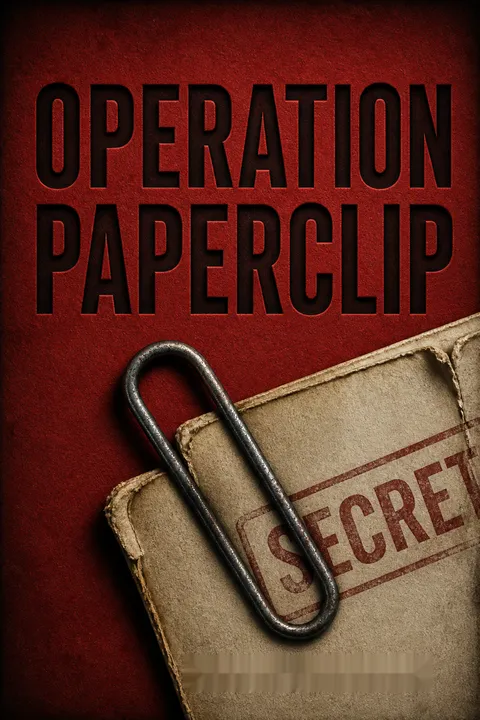
A secret recruitment machine. In May 1945, the United States began bringing German scientists and technical experts to work under military contracts. The program, eventually known as Operation Paperclip, placed them on projects involving rockets, chemical and biological weapons, aviation medicine, and other military technologies. Its managers argued that if America did not recruit these specialists, the Soviet Union would.
Useful knowledge, compromised origins. The book follows 21 men, showing that many were not passive academics swept up by events. Fifteen had joined the Nazi Party, ten belonged to its paramilitary organizations, and several had worked closely with Hitler’s senior officials. Others had records that were less incriminating. Their technical value became the program’s rationale, but achievement did not settle the question of responsibility for their wartime conduct.
What's striking is how the program treated expertise and culpability as separate ledgers. That distinction can be administratively convenient: one office evaluates technical usefulness, another handles criminal allegations, and the institution claims each decision is outside its remit. Yet the separation itself is a choice. A scientist’s knowledge can be valuable while the conditions under which it was acquired, and the crimes that enabled it, remain relevant. The book’s strongest moral question is not whether the technology worked, but whether national advantage can excuse a state from confronting its own standards.
The V-2's American legacy began with slave labor and mass death
Rockets built underground. After Allied bombing threatened the V-2 program, the Nazis moved production to Mittelwerk, an underground factory near Nordhausen. Concentration camp prisoners assembled the rockets in filthy tunnels, with little food, ventilation, or sanitation. About 60,000 people were brought into the Nordhausen system, and roughly half died through forced labor, disease, starvation, and violence.
The workers disappear from the triumph. Engineers including Wernher von Braun and Arthur Rudolph continued the rocket work, while the missiles were fired at Allied cities. One V-2 struck Antwerp’s Rex Cinema, killing 567 people. After the war, the United States recruited leading rocket personnel and shipped rockets, machinery, and documents out of the region. The technical inheritance was real. So was the human cost built into it.
The rocket’s history demonstrates why innovation cannot be evaluated only by its later uses. A technology may produce genuine advances while its original production system depends on coerced labor and lethal violence. This is not a claim that every later application inherits identical moral responsibility. It is a warning that a celebrated outcome can obscure the chain of people and institutions that made it possible. The book also makes a practical point about historical memory: when the workers vanish from the story, the engineers’ achievements look cleaner than the underlying record allows.
The Soviet race made captured Nazi expertise seem indispensable
A scramble for knowledge. As Allied forces advanced into Germany, scientific intelligence teams searched factories, laboratories, and military sites for useful research. Operation Alsos investigated atomic, biological, and chemical threats. The joint British-American Combined Intelligence Objectives Subcommittee, or CIOS, pursued a wider range of German science. Other military teams ran separate missions, often competing for the same people and equipment.
The lists become valuable. A set of documents salvaged from a Bonn University toilet led investigators to the Osenberg List, a catalogue of thousands of German scientists, engineers, and research facilities. It helped the Allies identify who had worked on what. Once the Soviet Union became the central strategic concern, captured scientists were increasingly treated as assets to deny to Moscow. Intelligence estimates warned of a possible future conflict and helped turn recruitment into an urgent national-security project.
The hunt shows how intelligence work can change the meaning of evidence. A record created by a dictatorship to mobilize researchers for war became a map for a victorious power seeking to acquire their expertise. That is a striking institutional reversal, but not a neutral one: the list could identify technical capacity without resolving individual responsibility. The Soviet threat gave officials a compelling reason to act quickly. It also narrowed the question from whether recruitment was justified to whether the other side might get there first.
When Nazi records blocked recruitment, officials changed the rules
Restrictions give way. Early policy said that scientists known or alleged to be war criminals should not be brought to the United States, and that recruits would be employed temporarily before returning to Germany. In practice, military agencies already wanted exceptions. As the Soviet rivalry intensified, the government expanded the program, first called Operation Overcast and later Operation Paperclip, and allowed scientists’ families to join them.
A new test for eligibility. The decisive question shifted from whether a recruit had been an ardent Nazi to whether the Soviet Union might benefit from his skills. JIOA officials also developed a workaround: files considered especially troublesome could be delayed from State Department review while the scientists remained under military control. The program’s language and procedures changed alongside its ambitions, making the pursuit of expertise easier than public scrutiny.
This is a case study in how organizations adapt rules without openly admitting that their priorities have changed. Replacing a moral or legal standard with a security test does not eliminate the original question; it relocates it to a less visible process. Bureaucratic compartmentalization can make each decision appear narrow and technical even when the cumulative policy has changed dramatically. The book does not imply that every official shared the same motives. It shows how institutional incentives, secrecy, and urgency enabled decisions that would have been difficult to defend in public.
Do not call coerced experiments medical progress
Medicine without consent. At Dachau, Nazi physicians conducted freezing, high-altitude, and seawater experiments on concentration camp prisoners. Some victims were tortured or killed. Dr. Leopold Alexander, an American physician and war-crimes investigator, traced evidence from the experiments to Luftwaffe doctors, including colleagues of Hubertus Strughold. Several doctors who had worked on or overseen this research were also recruited by the U.S. military for aviation medicine.
A principle forged in court. The Nuremberg doctors’ trial exposed the use of prisoners as experimental subjects and helped establish the Nuremberg Code, whose central requirement is voluntary, informed consent. The book also recounts the survivor Karl Höllenrainer’s testimony about a saltwater experiment and the judge’s initial punishment of him for trying to attack the doctor he identified. The episode shows how formal procedure can protect due process while still failing to meet a victim’s immediate need for justice.
Informed consent is more than a form to sign. It marks a boundary between research conducted with a person and research imposed on a person. The Nuremberg Code matters because technical expertise can make coercion appear scientific, especially when institutions define some lives as expendable. The trial also reveals a tension in legal systems: impartial procedure is necessary, but procedure can feel profoundly inadequate to those who have suffered abuse. Ethical safeguards need both clear rules and institutions willing to enforce them against powerful sponsors.
Nazi nerve agents crossed from hidden factories into American arsenals
A pesticide becomes a weapon. IG Farben chemist Gerhard Schrader discovered tabun while trying to develop an insecticide. The compound proved lethal to warm-blooded animals, and the Reich classified it for chemical warfare. Farben and the German state then built production facilities for nerve agents, including the Dyhernfurth plant, where prisoners performed dangerous work.
Expertise crosses the Atlantic. After the war, the United States acquired hundreds of tons of tabun and sought German chemists who could explain how to manufacture nerve agents. Otto Ambros, a key Farben manager at Auschwitz and Dyhernfurth, was sought for his knowledge. U.S. Army officer Philip Tarr helped shield him from arrest while pursuing technical information. Later, General Charles Loucks worked with former Nazi chemists, including Walter Schieber’s contacts, to develop a process for producing sarin. The resulting military program drew on both captured weapons and the expertise behind them.
The transfer was not simply a matter of collecting a dangerous substance. It required technical knowledge, industrial processes, and people who understood how to reproduce it. That makes the moral problem harder, not easier: the United States was not merely studying an enemy weapon but building its own capacity. The security argument was powerful in a world of feared chemical warfare. Yet the book’s account of clandestine deals and obstructed arrests shows how technical collaboration could overtake ordinary accountability rather than wait for it.
Conviction did not stop war criminals from regaining wealth and status
Punishment shrinks. In 1951, U.S. High Commissioner John J. McCloy commuted ten of fifteen death sentences imposed on Nazi war criminals and reduced many other sentences. Otto Ambros, convicted at Nuremberg of mass murder and slavery, left prison after about two and a half years of an eight-year sentence. His confiscated wealth was restored, and he returned to influential positions in business and consulting.
A verdict is not a lasting boundary. Ambros later worked for private companies and the U.S. Department of Energy. He described himself as a victim of the Nazi regime, despite his role in managing slave labor and chemical weapons production. Kurt Blome, a biological weapons official acquitted at the doctors’ trial, also worked for the U.S. Army in Germany. Their paths differed, but both cases show how strategic usefulness, political pressure, and time could weaken the consequences of wartime crimes.
Justice depends not only on judgments but on what institutions do after judgment. Early release, restored property, and renewed employment can communicate that a conviction is negotiable when a person remains useful. This does not make every clemency decision equivalent, nor does it erase the different evidence in individual cases. It does raise a systemic question: whether accountability can be credible when governments selectively treat punishment as fixed for some people and flexible for others.
Moonshots turned former Nazi engineers into celebrated American heroes
A public story takes shape. Wernher von Braun became a prominent advocate for space travel, writing for Collier’s, appearing in a Disney television program seen by an estimated 42 million viewers, and helping lead the American rocket effort. Walter Dornberger promoted missile and space weapons, while Kurt Debus became the first director of the Kennedy Space Center. Their public achievements were substantial.
The past stays offstage. Their wartime roles were harder to see. Von Braun’s V-2 work was tied to Nordhausen’s slave labor system, and Debus had been an active Nazi who reported a colleague to the Gestapo. Public presentations emphasized American space progress, while the recruitment program and damaging records remained classified. When questions surfaced, officials and the scientists often relied on incomplete or misleading accounts. The same institutions that celebrated their achievements had helped keep the wartime history out of view.
Public memory often favors stories with a visible payoff. A rocket launch is dramatic, measurable, and easy to associate with national achievement. The laborers who assembled the earlier rockets, and the people harmed by the regime they served, are less likely to appear in the celebratory image. This is not a reason to deny the engineering accomplishment. It is a reason to resist treating accomplishment as a substitute for a complete account, especially when the institutions telling the story also control access to the records.
Covert interrogation turned national-security fear into experiments on unwitting people
The search for control. At Camp King, U.S. intelligence agencies interrogated Soviet-bloc prisoners and explored methods involving drugs, hypnosis, and shock. The CIA’s Operation Bluebird developed into Operation Artichoke, which sought to alter behavior and improve interrogation. Army and CIA personnel worked with specialists at Camp Detrick, including scientists involved in chemical and biological research.
The experiment reaches its own staff. In 1953, CIA officers secretly gave LSD to bacteriologist Frank Olson and other colleagues at a retreat. Olson suffered a severe psychological crisis and died after falling from a New York hotel window. The death was ruled a suicide, though the circumstances have continued to invite questions. The episode connects the book’s themes of secrecy and consent: the agency seeking ways to manipulate other people subjected its own employee to a covert drug test without his knowledge.
Fear of an adversary can create a self-reinforcing logic: officials imagine the opponent is using extreme methods, so they authorize experiments to prepare, then justify secrecy because the work is defensive. The categories of defense and offense become difficult to distinguish once coercive techniques are being developed and tested. Olson’s case is especially unsettling because professional loyalty did not protect him from experimentation. Security institutions need independent oversight precisely when they claim that secrecy is essential.
Keep survivor testimony beside the awards given to Nazi scientists
Reputation meets evidence. Decades after the war, the U.S. government investigated Paperclip recruits such as Arthur Rudolph. In 1984, Rudolph left the United States rather than face a possible war-crimes trial over his role at Nordhausen. Public scrutiny also led the Air Force to remove Hubertus Strughold’s name from an honored library display after reviewing evidence about his wartime activities.
A survivor names what endures. In 2012, Auschwitz survivor Gerhard Maschkowski was asked what lasts. He showed the interviewer the number tattooed on his arm, a record of his imprisonment and survival. The book’s archive work brought thousands of government records into view, but documents alone cannot stand in for witness testimony. Nor does disclosure automatically undo the honors, careers, or benefits granted while the history was hidden.
Archives can correct public myths, but they do not speak with the moral clarity of a person who endured the system being documented. Survivor testimony also prevents the historical record from becoming a contest among governments over who possessed the better technology. The book’s ending puts physical evidence and institutional paperwork side by side: one carried on a body, the other held in files that could be withheld, lost, or released. Preserving both is essential, and neither guarantees that accountability will follow.
Analysis
Operation Paperclip is a history of institutional choice under pressure, told through the lives of scientists, officers, investigators, prisoners, and survivors. Its narrative begins with the discovery of evidence of Nazi medical crimes and follows the postwar competition for expertise through rocket development, chemical and biological weapons, aviation medicine, intelligence operations, and the American space program. The book’s central tension is not simply whether the recruits were brilliant. It is how governments decide that technical value outweighs criminal history, then construct procedures and public stories that make the decision appear ordinary.
The archive-driven approach gives the story force. Files, interrogation reports, trial testimony, and personal papers show how responsibility was dispersed: one office sought scientists, another processed visas, another handled war-crimes evidence, and commanders made exceptions in the name of security. The result was not a single secret decision but a system whose separate actions reinforced one another. The book also shows that secrecy was not absolute. Some officials objected, journalists and survivors challenged official accounts, and investigators eventually reopened cases.
A careful reading must distinguish degrees of culpability. The recruits were not a uniform group: some had direct roles in slave labor, weapons programs, or criminal experimentation, while others had less incriminating records. Evidence varies by individual, and technical usefulness does not itself prove participation in atrocity. Nor does the narrative establish that every later American weapons or space program was simply a continuation of Nazi research. Its more persuasive claim is institutional: once security competition becomes the dominant test, moral and legal constraints can be reinterpreted, deferred, or hidden.
The book’s enduring value lies in that distinction. It neither treats scientific achievement as absolution nor assumes that every technical product is morally identical to its origin. Instead, it asks readers to evaluate the whole chain: who made the knowledge, under what conditions, who benefited, and who was permitted to tell the story afterward.
Review Summary
Operation Paperclip receives mixed reviews, with praise for its thorough research and exposure of a controversial U.S. program that recruited Nazi scientists post-WWII. Readers appreciate the detailed accounts of individual scientists and their work. However, some criticize the book's organization and repetitive nature. Many find the moral dilemmas presented thought-provoking, questioning whether the scientific gains justified pardoning war criminals. Despite its flaws, most reviewers consider it an important, eye-opening read that sheds light on a dark chapter of American history.
People Also Read




Glossary
Operation Paperclip
Secret U.S. recruitment programA postwar U.S. military and intelligence program that brought German scientists, engineers, and other specialists to work on American projects. Initially framed as temporary employment, it expanded under Cold War pressure and recruited people whose Nazi records could make them ineligible for normal immigration or government work.
Operation Overcast
Paperclip's original program nameThe early name for the U.S. program that transferred German specialists into American military custody and employment after World War II. The program was presented as temporary exploitation of a limited number of experts. It was renamed Operation Paperclip as recruitment expanded and its procedures changed.
Joint Intelligence Objectives Agency (JIOA)
Agency directing specialist recruitmentA Joint Chiefs of Staff agency created to coordinate the recruitment and employment of German specialists. The JIOA managed Operation Paperclip, worked with military intelligence and other departments, and increasingly prioritized denying useful experts to the Soviet Union over enforcing earlier restrictions on Nazi Party membership and alleged war crimes.
Osenberg List
German wartime science directoryA catalogue assembled under engineer Werner Osenberg for the Reich Research Council. It indexed German scientists, engineers, doctors, and research facilities, helping the Nazi government assign technical personnel to wartime work. Captured by Allied investigators after the war, the list became a major intelligence resource for locating specialists and understanding German research programs.
Central Registry of War Criminals and Security Suspects (CROWCASS)
Allied wanted-persons registryAn Allied registry that collected information about people suspected of war crimes and security offenses. Investigators and military agencies used it to identify individuals for arrest or further inquiry. Its records also exposed conflicts within postwar policy when people listed as suspects were nevertheless considered for American military employment.
Nuremberg Code
Research ethics principlesA set of principles associated with the Nuremberg doctors’ trial that places voluntary, informed consent at the center of human experimentation. The code arose from the prosecution of medical crimes committed on concentration camp prisoners. In this book, it serves as a direct challenge to research conducted under coercion or without participants’ knowledge.
Accelerated Paperclip / Project 63
Expanded specialist recruitment effortA later phase of Paperclip that sought to move selected German scientists and technicians from Germany to the United States more quickly. Called Project 63 in the field, it expanded recruitment to people previously excluded by Nazi affiliations or security classifications. The program justified the transfer as a way to deny expertise to the Soviet Union.
Operation Bluebird
CIA interrogation research programA CIA program developed to study interrogation methods and assess techniques believed to be used by Soviet intelligence. It involved exploration of drugs, hypnosis, shock, and other methods. The program’s stated defensive purpose did not prevent it from developing techniques for covertly altering or impairing a subject’s behavior.
Operation Artichoke
Covert behavior-modification programThe successor name for the CIA’s Bluebird interrogation work, focused on influencing behavior through covert methods. The program involved CIA, military, and medical personnel, and included experiments with drugs and hypnosis. Its operations raised serious consent and oversight concerns, including the secret drugging of agency employee Frank Olson.
psychochemical warfare
Chemical incapacitation strategyA term used by Army chemist L. Wilson Greene for a proposed form of warfare using drugs or chemicals to cause temporary mental or physical incapacity rather than death. Greene argued that agents producing confusion, panic, or psychosis could weaken an opponent’s ability to resist. The idea later intersected with military and CIA research into behavior-altering substances.
Camp King
U.S. intelligence interrogation centerA U.S. military intelligence facility at Oberursel, Germany, that became a joint interrogation center during the early Cold War. It housed Soviet-bloc prisoners and supported work involving Army, Air Force, Naval Intelligence, and the CIA. The site was associated with the development of covert interrogation and behavior-modification programs.
About the Author
Other books by Annie Jacobsen
Download PDF
Download EPUB
.epub digital book format is ideal for reading ebooks on phones, tablets, and e-readers.








