

Key Takeaways
Read secret power as a network, not a lone spymaster
Power had a social address. Talbot presents Allen Dulles not as a solitary spy chief but as a broker among Sullivan & Cromwell, Wall Street clients, the Council on Foreign Relations, government offices, and intelligence officers. Sociologist C. Wright Mills called this interlocking corporate, military, and political leadership the power elite. Dulles’s authority came partly from his access to that network and the trust it placed in him, not simply from his CIA title.
Relationships were infrastructure. The Dulles brothers defended corporate interests before they held top government offices, while Allen cultivated journalists, bankers, officials, and agency veterans. Talbot argues that these continuities help explain how covert action could persist across administrations. The model does not require every participant to share one secret plan. Common interests, social ties, and weak oversight can align behavior without a command meeting.
What's striking is how this account shifts attention from a mastermind to the channels that make power durable: law firms, clubs, agencies, and trusted personal ties. Political sociology often finds that influence travels through overlapping networks rather than formal chains of command. That makes the book's model useful beyond intelligence history. It also demands precision: shared interests and repeated contact can explain coordination, but they do not prove a single coordinated conspiracy. The distinction between structural influence and deliberate collusion is essential.
Notice when charm turns people into instruments of power
Warmth could conceal distance. Family testimony, Clover Dulles’s diaries, and Mary Bancroft’s journals portray Allen as convivial in public but emotionally remote at home. His daughter Joan recalled that he rarely discussed politics or his work with his children. Bancroft, his wartime confidante and lover, described a relationship in which he valued her for the information and access she could provide. The contrast matters: a person can be socially engaging without being emotionally reciprocal.
People became pieces. Bancroft remembered Dulles describing his pleasure in watching unsuspecting people realize they had been caught in a trap. Talbot places that chilling anecdote beside Dulles’s treatment of family, lovers, agents, and political allies. His portrait suggests that instrumental thinking was not confined to operations abroad. It shaped private relationships too, making human beings seem like resources to deploy or liabilities to manage.
The biographical material gives the political argument an important human scale. Bureaucracies can reward emotional distance because decisions become easier when their subjects appear as categories, assets, or risks. Yet the portrait rests heavily on retrospective family memories and intimate journals, which reveal experience more securely than motive. The strongest reading is not that private coldness mechanically caused public cruelty, but that a habit of treating people as means can travel comfortably between the household, the office, and the covert operation.
Watch wartime enemies become partners in the next conflict
The enemy became useful. Operation Sunrise was Dulles’s covert negotiation with SS General Karl Wolff for the surrender of German forces in Italy near the end of World War II. Dulles pursued the separate deal despite President Roosevelt’s policy of unconditional surrender. Talbot argues that Dulles’s priority was not simply ending the war sooner. He wanted to preserve useful German networks and prevent Soviet influence from spreading into postwar Europe.
Old networks survived. Dulles helped protect Wolff from the full force of prosecution, and American intelligence later built a working relationship with Reinhard Gehlen, Hitler’s eastern-front intelligence chief. Gehlen’s organization became the foundation of West Germany’s intelligence service. These cases show how urgent anti-Soviet priorities could soften demands for accountability, allowing former Nazi personnel to reenter institutions under new names and new patrons.
This is a sharp account of how institutions convert yesterday's enemy into tomorrow's asset. In security policy, short-term utility can crowd out questions of justice, reliability, and long-term legitimacy. The bargain may appear pragmatic when a new threat dominates attention, but it also preserves personnel and habits that survive the original emergency. The book's claim is strongest when it documents specific protections and working relationships; the moral label attached to every participant requires more careful evidence than association alone.
Question coups sold as defenses of freedom or security
Nationalism was relabeled danger. In Iran, Prime Minister Mohammad Mossadegh nationalized the Anglo-Iranian Oil Company. In Guatemala, President Jacobo Arbenz’s land reform threatened United Fruit’s holdings. The book describes how the Eisenhower administration and CIA framed both governments as Communist threats, although each leader was primarily pursuing national reforms. CIA-backed coups removed Mossadegh in 1953 and Arbenz in 1954, restoring governments more acceptable to U.S. interests.
The language mattered. Anti-Communism made intervention sound like collective self-defense rather than a choice to override another country’s political decisions. Talbot connects the Dulles brothers’ corporate ties to their support for intervention. That connection raises serious questions about whose interests shaped policy, while the cases also show that nationalist reform and Communist control are not interchangeable categories.
The central analytical move is to compare public justification with material stakes. That is a valuable check on official language, especially when national security claims are difficult for outsiders to verify. Still, corporate benefit does not by itself establish that a company ordered a coup, and the presence of left-wing parties does not settle what a government might become. A careful reader can hold both points at once: the interventions served identifiable interests, and their motives and causal chains should be demonstrated rather than presumed.
Judge covert victories by their political aftershocks
A quick win can poison the future. The overthrow of Arbenz was described by some CIA participants as clean or nearly bloodless. Talbot traces a very different aftermath: repression, torture, executions, and death squads followed. He estimates that roughly 250,000 people were killed in Guatemala over the ensuing decades. In Iran, the shah’s restoration brought years of secret-police repression before a revolution eventually ended his rule.
The damage outlasted the operation. These histories complicate the language of success. A coup may achieve an immediate objective while weakening political institutions, silencing peaceful opposition, and deepening public anger. The book does not show that every later crisis followed inevitably from a single intervention. It does show why success measured only by the day a government falls can hide the costs that accumulate afterward.
The long view is the section's most practical contribution to judging intervention. Organizations tend to measure what they can count quickly: governments removed, facilities protected, or immediate threats contained. The hardest costs emerge more slowly, in damaged legitimacy and fewer peaceful avenues for political change. This is not proof that any one coup explains every later tragedy. It is a reason to include time horizons, local voices, and downstream institutional effects in the definition of success.
Fear of enemy methods can license abuse at home
A warning became a program. In 1953, Dulles publicly condemned Soviet brainwashing while authorizing MKULTRA, a CIA research program exploring drugs and other means of influencing human behavior. The program funded work at universities and hospitals, often without the subjects’ informed consent. Researchers tested LSD and other methods on people who had little ability to refuse, including patients and prisoners.
The harm became personal. CIA scientist Frank Olson grew troubled by interrogation practices he witnessed and died after falling from a New York hotel window following an LSD exposure arranged by agency colleagues. Dulles also turned to CIA-connected physicians for his brain-injured son, Allen Jr. The episode exposes the ethical danger of treating citizens as experimental material while claiming to defend them from an enemy’s abuses.
The moral inversion is striking: a state can condemn coercive methods abroad while adopting related practices under the label of research or security. Modern research ethics rests on informed consent precisely because expertise and institutional authority can overwhelm a subject's ability to refuse. The comparison should not flatten distinct methods or outcomes into equivalence. It does, however, expose a recurring problem: when secrecy blocks independent review, a program's claims of necessity can become impossible for the people harmed by it to challenge.
Propaganda turns policy disputes into tests of patriotism
A false story could do real damage. Operation Splinter Factor was a CIA plan that portrayed humanitarian worker Noel Field as an American agent operating inside the Soviet bloc. Talbot argues that this helped intensify Stalinist purges of officials who had known Field. The operation turned an invented spy network into a weapon against people already vulnerable to political suspicion.
Culture was another front. The CIA also funded the Congress for Cultural Freedom, a network that sponsored magazines, books, conferences, and arts events to counter Soviet influence. At home, politicians such as Richard Nixon used anti-Communism to discredit New Deal officials and progressive opponents. These were different methods, from covert fabrication to public accusation, but both made disagreement easier to portray as disloyalty.
The section connects information warfare to ordinary political life: once an opponent is labeled an agent or fellow traveler, argument can be replaced by suspicion. Research on propaganda and group identity suggests that emotionally charged labels spread especially well when they confirm an audience's existing fears. The distinction between covert fabrication and open political persuasion still matters. The former deceives its audience about the source or facts; the latter can be challenged publicly, provided institutions protect dissent.
A president can inherit an intelligence service that resists him
Kennedy inherited a fait accompli. Allen Dulles and his aides pressed the new president to approve the Bay of Pigs invasion, while the agency's own planning acknowledged that success required substantial U.S. military support. Dulles did not make that dependence clear to Kennedy. When the Cuban exile force was stranded, the president refused to escalate with American troops or air strikes, and the invasion collapsed.
Control was the deeper issue. Kennedy accepted public responsibility but removed Dulles and other senior officials. Talbot interprets the operation as a trap designed to force a broader invasion. The record described in the book firmly supports poor planning, withheld information, and a dangerous expectation that Kennedy would yield. It is less conclusive about whether failure was deliberately engineered from the start.
This episode resembles a principal-agent problem: elected leaders delegate work to specialists who possess more information, then struggle to supervise them. Secrecy magnifies that imbalance because the president may not know which assumptions are hidden. Kennedy's refusal to escalate shows that authority can still be exercised, but it came after a costly failure. The distinction between deliberate entrapment and institutional overconfidence matters. Both deserve scrutiny, but they are not the same accusation.
Demand independence when an inquiry investigates its own institutions
The investigator had conflicts. The Warren Commission was the official inquiry into Kennedy’s assassination. Lyndon Johnson appointed Dulles, although Kennedy had removed him from the CIA after the Bay of Pigs. The commission relied heavily on evidence from the FBI and CIA, agencies whose actions and possible failures were part of the story. Dulles helped steer attention toward Oswald as a lone gunman and away from deeper examination of the intelligence services.
The process shaped the result. Talbot argues that the commission’s structure and information flow narrowed its inquiry. He invokes the term deep politics, used by scholar Peter Dale Scott for covert power operating beneath visible institutions. That framework helps explain the concern, but the conflict of interest does not by itself prove that Dulles organized Kennedy’s murder. It does make independent review essential.
An investigation can produce a technically detailed report and still lack institutional independence. When agencies supply evidence about their own conduct, the risk is not only deliberate concealment. It also includes selective access, narrow questions, and assumptions that go untested. The appropriate response is not automatic disbelief, but safeguards: independent investigators, transparent records, adversarial review, and clear accounts of what remains unknown. The Warren Commission's authority made these safeguards especially important.
Separate suspicious patterns from proof of assassination
The book leaves a charged question. Talbot notes that Dulles met in 1963 with anti-Castro figure Paulino Sierra Martinez, and that Oswald’s story intersected with intelligence-connected figures including de Mohrenschildt and CIA officers. He also emphasizes irregularities in the official investigation and the presence of possible motives among powerful opponents of Kennedy. These details form a circumstantial case for deeper inquiry.
They do not settle who killed Kennedy. The book's most provocative suggestion is that Dulles may have been connected to a conspiracy. It does not establish that claim with definitive proof. The House committee later concluded that Kennedy was probably killed by a conspiracy, but could not identify its members or funding. The distinction between an unanswered question and a proven answer is crucial to reading this history responsibly.
The assassination argument is where the book's evidentiary strengths and limits meet. Unexplained contacts, institutional conflicts, and contradictory testimony justify investigation, particularly when the official inquiry depended on agencies under scrutiny. Yet proximity is not proof, and a plausible motive cannot identify an assailant. The strongest position is neither reflexive trust nor automatic conspiracy: preserve the unresolved evidence, test competing explanations, and state clearly where the record stops.
Analysis
The book's central achievement is to make intelligence history legible as a struggle over who gets to define national interest. Its narrative follows Allen Dulles from Wall Street and wartime Switzerland through the CIA, the coups in Iran and Guatemala, and the conflict with John F. Kennedy. That sequence shows how personal networks, corporate exposure, anti-Communist ideology, and institutional secrecy can reinforce one another. The stories of Noel Field, Frank Olson, Patrice Lumumba, and the Kennedy family also prevent the account from becoming a study of agencies alone. They show what strategic abstractions cost when applied to particular lives.
The most important distinction for readers is between documented institutional behavior and the book's most disputed inference. The text offers substantial detail about Dulles's wartime relationships, CIA interventions, experiments, and influence over the Warren Commission. It also assembles circumstantial indications that intelligence-connected actors may have been involved in Kennedy's murder. Those strands deserve serious attention, but they do not carry equal evidentiary weight. A meeting, a conflict of interest, and a misleading investigation can establish cause for suspicion without proving a murder plot. That distinction strengthens, rather than weakens, the case for transparency.
The book is openly prosecutorial, and that stance gives it narrative force while creating a risk of confirmation bias. Readers should test its claims against the primary documents it cites, distinguish direct records from recollection, and notice when a sequence of suspicious events is treated as a causal chain. The broader lesson remains powerful even where individual allegations remain unresolved: democratic oversight fails when secret agencies control both operations and the evidence used to judge them. The most defensible response is not to accept either official certainty or sweeping conspiracy as a substitute for inquiry, but to demand records, independent scrutiny, and honest limits on what history can prove.
Review Summary
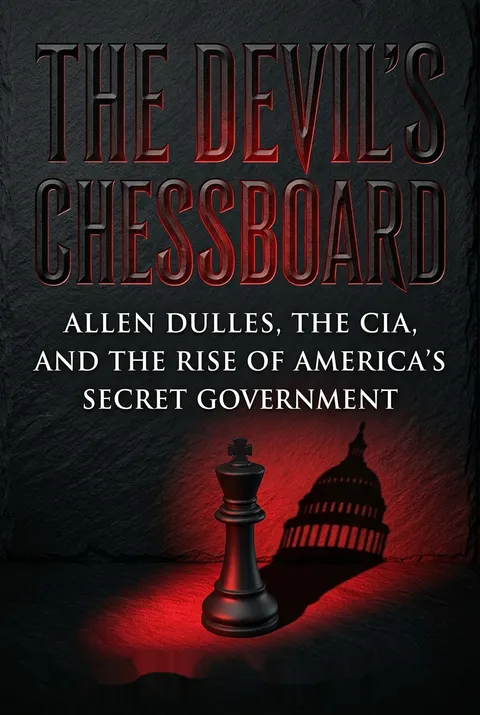
The Devil's Chessboard is a meticulously researched and compelling account of Allen Dulles's role in shaping America's secret government. The book explores Dulles's career from WWII through his tenure as CIA director, detailing his involvement in covert operations, regime changes, and the JFK assassination. Readers praise Talbot's thorough investigation and engaging narrative, though some criticize his bias and speculative conclusions. The book offers a disturbing look at the CIA's influence on U.S. foreign policy and raises questions about democracy and accountability in government.
People Also Read
Glossary
Power elite
Interlocking centers of powerSociologist C. Wright Mills used this term for the close-knit leadership linking major corporations, government, and the military. Its members move among senior positions, share institutions and social circles, and shape national decisions. In Talbot's account, Dulles's influence depended on this network as much as on his formal authority as CIA director.
Operation Sunrise
Secret surrender negotiationsAllen Dulles's covert negotiations with SS General Karl Wolff near the end of World War II. The talks sought the surrender of German forces in Italy outside the formal Allied policy of unconditional surrender. The operation helped preserve Wolff and other German intelligence contacts who later became useful in the emerging struggle against the Soviet Union.
Operation Splinter Factor
False spy network operationA CIA plan built around the false claim that former humanitarian worker Noel Field was an American agent operating in Eastern Europe. Talbot argues that this deception helped prompt Stalinist purges of officials connected to Field. The episode shows how fabricated intelligence could trigger real arrests, torture, and political destruction.
MKULTRA
CIA behavior-control researchA CIA program launched in 1953 to investigate drugs and other methods of influencing human behavior. The work involved universities, hospitals, and researchers, sometimes using people who had not consented to the experiments. The book highlights the use of LSD and the death of scientist Frank Olson after an agency-arranged exposure.
Deep politics
Power beneath formal institutionsA term associated with scholar Peter Dale Scott for covert or unaccountable networks that influence public decisions outside ordinary democratic processes. Talbot uses it to describe the connections among intelligence agencies, political figures, corporations, and private networks. The term directs attention to hidden influence, but does not by itself prove a particular conspiracy.
Warren Commission
Official JFK assassination inquiryThe presidential commission established by Lyndon Johnson in 1963 to investigate John F. Kennedy's assassination. Chaired by Supreme Court Chief Justice Earl Warren, it concluded that Lee Harvey Oswald acted alone. Dulles, whom Kennedy had removed as CIA director, served on the commission and played a major role in its investigation.
Download PDF
Download EPUB
.epub digital book format is ideal for reading ebooks on phones, tablets, and e-readers.








