

Key Takeaways
Read Epstein’s rise as a chain of patrons, not a lone-genius story.
A networked ascent. Epstein moved from teaching at New York’s Dalton School to Bear Stearns, despite lacking a college degree. Bear Stearns partner Alan Greenberg sponsored his entry; Epstein became a limited partner by 1980. He left during an SEC insider-trading investigation connected to a Seagram takeover, but was interviewed and never charged. In 1987, he joined Steven Hoffenberg at Towers Financial. A grand-jury account identified Epstein as central to the fraudulent transactions, yet he escaped prosecution while others were charged.
Connections before certainty. The book follows Epstein through arms dealer Douglas Leese, financier Leslie Wexner, and Ghislaine Maxwell. Some links are documented in records; others depend on interviews, contested claims, or inference. Its central point is that wealth, introductions, opaque businesses, and protection help explain his reach better than a tale of a self-made financial prodigy.
The network view usefully shifts attention from individual charisma to sponsorship and institutional access. In organizational analysis, a person’s influence often comes less from formal credentials than from brokers who connect otherwise separate circles. That helps explain how Epstein could move among finance, fashion, politics, and philanthropy. The caution is that a dense contact map can make every association look causally meaningful. A relationship may establish opportunity, not knowledge or complicity. The strongest account distinguishes who enabled access, who knew about abuse, and who merely crossed paths with Epstein.
Treat intelligence ties as a hypothesis, not a settled biography.
A disputed affiliation. The book assembles several clues suggesting Epstein may have worked with intelligence services. It cites a reported account from Alex Acosta, the prosecutor who approved Epstein’s 2008 plea deal, that Epstein “belonged to intelligence.” Former Israeli intelligence officer Ari Ben-Menashe said Robert Maxwell introduced Epstein to an intelligence-linked circle in the 1980s. Epstein also possessed an expired Austrian passport under another name, and had reported access to Israeli military sites during a 2008 visit.
Clues are not confirmation. The public record described here does not establish which agency, what work Epstein performed, or whether he was an operative at all. The book’s hypothesis is that intelligence ties could help explain his protection and later blackmail activities. That is a serious question, but it remains a question rather than a demonstrated fact.
Intelligence relationships are deliberately difficult to verify, so indirect evidence can matter. Yet secrecy also creates a trap: gaps in the record can be treated as proof of a hidden hand. A disciplined reading weighs each clue by its source, independence, and alternative explanations. Acosta’s reported remark, a passport, and an interview with a former officer do not carry identical evidentiary weight. The broader institutional issue remains important even if the agency theory is unproven: prosecutors and regulators need transparent procedures for handling defendants whose influence or claimed connections place them beyond ordinary scrutiny.
A trafficking operation scales through trusted recruiters and rehearsed grooming.
Abuse had a system. Victim testimony and court proceedings describe Epstein and Maxwell using promises of money, education, modeling work, or artistic help to draw in girls and young women. Epstein called the encounters massages, a label that obscured their sexual purpose. Maxwell cultivated trust, lowered victims’ boundaries, and helped coordinate recruits. Some victims were then paid to bring in others. In one 2021 trial account, a girl described being 14 when the abuse began and being paid hundreds of dollars for massage visits and recruitment.
A wider circle. The book details alleged roles for assistants, schedulers, and modeling agents, including Jean-Luc Brunel. Maxwell was convicted of sex trafficking-related offenses and sentenced to 20 years. Other associates’ roles vary in evidentiary status, and allegations should not be mistaken for convictions.
The account’s most powerful contribution is showing grooming as a process, not a single act. Social trust, economic need, attention, and gradual boundary violations can make exploitation appear ordinary to a young victim. The recruitment structure also explains how one perpetrator can extend abuse through people who may themselves have been manipulated or coerced. That complexity matters for investigations: culpability should be assessed individually, not erased by a simple victim-or-villain label. At the same time, the organizational pattern should not distract from the central fact that adults used their authority and resources to exploit minors.
Delegated wealth can become infrastructure for private access and impunity.
Trust became control. Leslie Wexner hired Epstein as a financial adviser and, in 1991, gave him broad power of attorney over financial and property matters. Epstein gained influence over Wexner’s businesses, including Victoria’s Secret, and over real estate connected to Wexner. Wexner purchased and lavishly renovated a Manhattan townhouse that Epstein occupied, although Wexner later said Epstein had deceived him and that their relationship ended.
Access had practical value. The book links properties and business entities to Epstein’s social world, including apartments allegedly used to house young women. It also describes how Epstein invoked Victoria’s Secret to attract aspiring models. These arrangements help explain how money, housing, business status, and prestige could support access to potential victims, without by themselves proving that every person in Wexner’s orbit knew of Epstein’s crimes.
Delegation is a genuine governance risk: when one adviser controls accounts, property, introductions, and personal logistics, oversight can become nominal. Strong fiduciary controls normally separate those powers and require independent review. The story therefore has relevance beyond the particular people involved. Still, the distinction between enabling conditions and knowing participation matters. A benefactor’s resources may create opportunity for abuse without proving that the benefactor intended or understood the abuse. The public record described here supports scrutiny of the relationship and its safeguards, not a shortcut from proximity to guilt.
Seventeen White House visits show access, not what happened inside.
A revealing paper trail. Visitor records show Epstein went to the Clinton White House 17 times between 1993 and 1995. His first recorded visit was associated with Treasury official Robert Rubin. Many later visits were signed in by Mark Middleton, a White House aide involved in fundraising. Epstein also attended a 1993 reception for donors to White House renovation work after contributing $10,000 to the White House Historical Association.
Limits of the logs. Some visits included Ghislaine Maxwell or other women, and reports have suggested Epstein may have met President Clinton. The visitor records do not establish that he did, or reveal the substance of meetings. The important point is that a financier with a murky background received repeated access to senior political spaces, while the records leave unanswered questions about who arranged it and why.
Access logs are valuable because they replace vague recollection with a checkable record. They can reveal frequency, intermediaries, and timing, which are often enough to expose weak screening practices. But an entry is not a transcript: it cannot establish the meeting’s purpose, the president’s presence, or any agreement. This distinction is crucial in political reporting, where a genuine fact can be inflated into a larger allegation. The logs warrant explanation from institutions and officials, while conclusions about conduct require corroborating evidence beyond the calendar.
Foreign money made campaign access a documented political vulnerability.
Fundraising created entry points. Congressional investigations into the 1996 election found illegal or improper donations routed through figures including John Huang, Charlie Trie, and Johnny Chung. Some used intermediaries or companies to disguise foreign sources. Several also obtained access to the Clinton White House, often through Mark Middleton. The book connects these fundraising networks to business interests seeking influence over trade, technology exports, and China policy.
Causation remains harder. The investigations documented serious campaign-finance abuses, but they do not prove that every meeting bought a policy change or that every participant belonged to one coordinated operation. The book also follows controversies over Chinese arms imports and technology transfers, including Loral’s satellite dealings. Its broader question is how money, official access, and trade decisions overlapped, not whether one donor can be shown to have dictated every outcome.
Campaign-finance rules are designed to prevent private money from becoming privileged political access. The cases described here show how easily that boundary can be obscured through reimbursed donors, shell entities, and social intermediaries. The analytical challenge is separating influence-seeking from influence achieved. A meeting followed by a policy decision may be suggestive, but the causal chain needs evidence of requests, deliberation, and response. The book is strongest when it uses official investigations to establish misconduct and more tentative when it infers a unified foreign operation from overlapping networks.
Trace logistics and export controls, not just names on guest lists.
Cargo routes mattered. The book follows The Limited’s efforts to draw air-cargo services to Columbus’s Rickenbacker airport. Aeroflot, Arrow Air, and Southern Air Transport became part of the evolving picture. Southern Air had a documented history in covert Iran-Contra operations, and Ohio offered it tax credits, a low-interest loan, and a training grant to relocate. Much of its proposed Hong Kong cargo was intended for The Limited.
A route is not proof. The author argues that the airlines’ histories, Epstein’s role in logistics, and contemporaneous Chinese arms and technology controversies deserve joint scrutiny. But the text does not establish that illicit cargo traveled on the Columbus routes. Following supply chains can expose hidden dependencies and weak oversight; it cannot substitute for shipment records, manifests, or corroborated testimony.
Logistics are a useful lens because covert activity, like ordinary commerce, depends on transport, finance, and paperwork. Cargo operations can create opportunities for concealment while appearing commercially routine. The same is true of export licensing, where oversight gaps can matter more than a dramatic meeting. Yet suspicious context is not evidence of a specific shipment. A rigorous investigation would compare manifests, contracts, customs records, and corporate incentives. This is a case where the book identifies a potentially important research trail, while leaving the key factual question unresolved.
Treat philanthropy as a network-building technology, not a neutral label.
Programs shape leadership. Leslie Wexner’s foundation created fellowships and leadership programs for Jewish communal professionals and Israeli public officials. Its initiatives included support for Israeli officials studying at Harvard Kennedy School and substantial funding for Harvard’s Center for Public Leadership. The book argues that such programs build durable networks by educating people who later hold influential posts.
Influence is not automatically covert. The Clinton Global Initiative and Gates Foundation also brought together governments, companies, and wealthy donors around global health and development. Epstein was connected to both, and his lawyers claimed he helped conceive the Clinton initiative. These examples show how philanthropy can blend public benefit, private strategy, and elite networking. They do not prove that every program was a front for intelligence or blackmail.
Leadership programs are a form of soft power: they cultivate shared language, relationships, and ideas without requiring direct control. This can be socially valuable, particularly when institutions invest in training people who would otherwise lack access. It can also concentrate agenda-setting among donors whose priorities are not democratically accountable. The useful questions are concrete: who selects participants, what curriculum is taught, where alumni go, and who can audit funding? Those questions reveal influence more reliably than treating philanthropy as either pure generosity or automatic deception.
Blackmail scales when surveillance stores secrets without a visible victim.
From rooms to databases. The book traces a possible shift from sexual blackmail, which relies on recruited victims and hidden cameras, toward digital systems that collect and connect personal information. It discusses PROMIS, a software program the author says was stolen and modified for intelligence use; Main Core, an alleged database of Americans; and Total Information Awareness, a proposed Pentagon program that sought to combine data for counterterrorism analysis. It also examines Palantir and Carbyne, systems built to analyze or transmit sensitive information.
Capability is not proof of use. The author argues that mass surveillance can make coercion cheaper and more scalable. But a data platform’s ability to collect or analyze information does not establish that it was used to blackmail anyone. The enduring issue is who controls the data, who can search it, and whether access is independently audited.
The movement from a hidden camera to a searchable database changes the scale of the risk. Surveillance systems can turn scattered traces into intimate profiles, while secrecy about access makes it difficult for individuals to detect misuse. This resembles a panopticon: the possibility of being watched can alter behavior even without a direct threat. The analogy is powerful, but it should not flatten distinct tools into one conspiracy. Privacy safeguards, audit logs, access controls, and independent oversight are practical ways to test whether a system’s claimed protections work.
Map the connections, then label exactly what each source proves.
Evidence comes in layers. This investigation combines corporate filings, visitor logs, court testimony, official inquiries, media reports, and interviews. Those materials do not all support the same kind of conclusion. A criminal conviction establishes a different level of certainty from an untested allegation. A company record can establish a shared director or address, but not necessarily a covert purpose. A witness account can identify a lead while still requiring corroboration.
The book’s method has a trade-off. Its sprawling network map makes overlooked overlaps visible, including financial ties and repeated access to institutions. But its reach sometimes moves quickly from documented association to speculation about intelligence coordination. Readers should preserve the map while keeping the labels: established fact, reported claim, and authorial inference.
This is the method’s central discipline. Network analysis is good at finding brokers and repeated pathways, but it can also generate false patterns when many powerful people share the same institutions. A source hierarchy prevents a striking connection from becoming an unsupported accusation. The book is most persuasive when it shows records and asks who had authority to act; it is least secure when it treats proximity as evidence of a common plan. That distinction protects both accountability and fairness, and makes the remaining unanswered questions more precise.
Analysis
Volume two is an expansive investigative argument built around a compelling structural claim: Epstein’s crimes were enabled by networks of money, access, institutional deference, and alleged intelligence relationships, rather than by individual cunning alone. Its narrative moves from Epstein’s early career through Wexner’s patronage, Maxwell’s recruitment role, political fundraising, cargo and technology networks, philanthropy, and finally digital surveillance. The accumulation of records and overlooked connections gives the reader a useful map of how influence can travel across sectors that are usually studied separately.
The book’s greatest analytical strength is its attention to infrastructure. A financial adviser’s authority, an office address, a donor reception, an airline contract, or a leadership fellowship may appear mundane in isolation. Together, they can reveal how people acquire access and how oversight fails. Its discussion of grooming also insists that abuse is organized: trust, money, status, and recruiters make exploitation repeatable.
The central weakness is evidentiary compression. The source material ranges from court records and official investigations to anonymous accounts, disputed interviews, and chains of circumstantial inference. The prose sometimes places them beside one another so that association begins to feel like proof of coordination. A shared address establishes a link, not its purpose; a suspicious pattern justifies investigation, not conviction. This matters especially where the book speculates about intelligence agencies, political leaders, or specific cargo operations.
The most durable takeaway is therefore both critical and restrained. Powerful networks can protect predators without every participant sharing a plan. Investigators should follow money and access, but also distinguish documented fact from allegation and inference. That approach preserves the book’s essential challenge to institutional complacency while resisting the conspiratorial certainty that can make its strongest questions easier to dismiss.
Review Summary
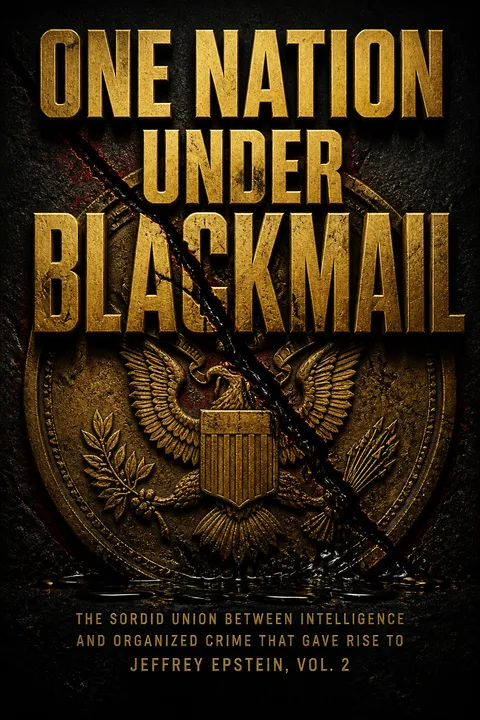
One Nation Under Blackmail receives high praise for its extensive research and revelatory content. Readers commend Webb's meticulous documentation of corruption networks linking organized crime, intelligence agencies, and politics. Many find the book's insights into Jeffrey Epstein's connections and broader implications of blackmail operations both fascinating and disturbing. While some note the dense information can be overwhelming, most appreciate the author's courage in exposing these intricate webs of power. Reviewers consistently describe the work as eye-opening, thought-provoking, and essential reading for understanding modern political realities.
People Also Read





Glossary
PROMIS
Case-management softwarePROMIS, short for Prosecutor’s Management Information System, was software developed by Inslaw for managing legal cases. The book describes allegations that the software was taken and modified with a hidden access feature, then distributed to government and intelligence users. The theft and extent of intelligence use have been disputed, so the term refers both to the program and to the controversy surrounding it.
Main Core
Alleged domestic surveillance databaseMain Core is described in the book as an alleged database used in continuity-of-government planning to identify and locate Americans considered potential threats or dissidents. The account links its development to the Iran-Contra era and to PROMIS software. Public details about the database’s exact structure, use, and current status remain limited, making claims about its operation difficult to verify.
Total Information Awareness
Proposed mass-data analysis programTotal Information Awareness, or TIA, was a Pentagon research program proposed after the September 11 attacks. It sought to analyze large amounts of data to identify patterns relevant to terrorism and other threats. Public opposition focused on the danger of pervasive surveillance. The program was officially discontinued, while the book argues that related capabilities continued through separate government and private-sector projects.
Chinagate
Campaign-finance and influence scandalChinagate is the label used in the book for controversies surrounding 1990s campaign fundraising, foreign-source donations, and access to the Clinton administration. Figures including John Huang, Charlie Trie, and Johnny Chung were investigated for improper fundraising practices. The term covers documented violations and broader allegations about foreign influence, which should not be treated as a single proven conspiracy.
Edge
Science and technology forumEdge is an online intellectual community and event network created by literary agent John Brockman. It brought together scientists, technologists, writers, and wealthy technology leaders for discussions and private gatherings. The book emphasizes Jeffrey Epstein’s financial support and access to this community. Membership or attendance alone does not establish a participant’s knowledge of Epstein’s crimes.
Third Culture
Science-led public intellectual cultureThird Culture is John Brockman’s term for scientists and technology thinkers who explain major ideas about human life and society to a broad public, taking on a role once associated with traditional literary intellectuals. In the book, the concept helps explain the appeal of Edge and its mix of research, technology, and elite networking.
FAQ
What's One Nation Under Blackmail about?
- Explores Epstein's Connections: The book investigates Jeffrey Epstein's ties to organized crime and intelligence agencies, arguing that he was part of a larger network involving powerful elites.
- Intelligence and Organized Crime: It examines historical collaborations between intelligence agencies and organized crime, particularly in blackmail and political manipulation.
- Broader Implications: The narrative suggests that understanding Epstein's actions requires examining systemic corruption within American institutions, especially those related to national security and law enforcement.
Why should I read One Nation Under Blackmail?
- In-depth Research: Whitney Alyse Webb provides a thorough investigation into the intertwining of organized crime and intelligence, backed by extensive documentation and historical context.
- Reveals Hidden Histories: The book uncovers lesser-known aspects of American history, particularly regarding power manipulation and blackmail.
- Critical Perspective: Webb challenges mainstream narratives surrounding Epstein, encouraging readers to question traditional media information.
What are the key takeaways of One Nation Under Blackmail?
- Interconnected Networks: Epstein's activities were part of a broader network involving organized crime and intelligence agencies, complicating the narrative of him as a lone criminal.
- Historical Context: Webb provides historical examples to illustrate long-standing collaborations between intelligence and organized crime.
- Call to Action: The author urges readers to become informed and engaged in addressing systemic corruption, presenting knowledge as a tool for empowerment and change.
What are the best quotes from One Nation Under Blackmail and what do they mean?
- “A corrupt elite debasing our future.”: Highlights the manipulation of systems by powerful individuals for personal gain, emphasizing the need for accountability.
- “Secrets can cut many ways.”: Reflects the dual nature of blackmail and secrecy, suggesting that power built on manipulation is precarious.
- “We cannot properly address the crimes of Jeffrey Epstein... unless we grapple with the covert power structures.”: Emphasizes the importance of understanding broader systems of power and corruption to prevent future abuses.
How does One Nation Under Blackmail connect Epstein to intelligence agencies?
- Acosta's Admission: References Alex Acosta's statement that Epstein "belonged to intelligence," suggesting a protective relationship with government entities.
- Historical Ties: Webb traces Epstein's connections to various intelligence figures, illustrating how these relationships facilitated his operations.
- Media Silence: Critiques mainstream media for failing to investigate these connections, allowing networks to operate with impunity.
What role does Ghislaine Maxwell play in One Nation Under Blackmail?
- Espionage Connections: Depicted as a key figure in Epstein's operations, with her background and family ties to intelligence agencies explored in detail.
- Legacy of Robert Maxwell: Discusses how her father's influence and connections to espionage shaped her involvement in organized crime.
- Trial and Consequences: Examines the implications of her trial and the information redacted, raising concerns about transparency and accountability.
How does One Nation Under Blackmail address the concept of blackmail in Epstein's operations?
- Systematic Approach: Details how Epstein allegedly used blackmail as a tool to maintain control over powerful individuals, suggesting a calculated strategy.
- Network of Compromise: Illustrates how Epstein's network was designed to create leverage over influential figures, ensuring his protection.
- Historical Precedents: Connects Epstein's methods to historical instances of blackmail used by intelligence agencies and organized crime.
What is the significance of the PROMIS software scandal in One Nation Under Blackmail?
- Background of PROMIS: Revolves around a software program developed by Inslaw, allegedly misappropriated by the U.S. government for intelligence purposes.
- Israeli Intelligence Involvement: Details how Israeli intelligence exploited PROMIS for global espionage, illustrating the intersection of technology, intelligence, and crime.
- Legal and Political Ramifications: Highlights the complexities of government contracts and the influence of powerful interests, reflecting broader issues of corruption.
How does One Nation Under Blackmail connect to current events?
- Relevance to Modern Politics: Themes of corruption, blackmail, and power manipulation are highly relevant in today's political climate.
- Ongoing Investigations: Exploration of Epstein's connections continues to resonate as investigations into his network unfold.
- Awareness of Systemic Issues: Highlights the need for vigilance and accountability in political and social systems, urging readers to remain informed.
What are the implications of Epstein's connections to intelligence agencies as discussed in One Nation Under Blackmail?
- National Security Concerns: Raises alarms about the potential for intelligence agencies to be compromised by individuals like Epstein.
- Manipulation of Political Outcomes: Argues that Epstein's ties to intelligence could have influenced political decisions and outcomes.
- Legacy of Abuse: Highlights the need for accountability and reform within both intelligence and political systems.
How did Epstein and Maxwell recruit their victims according to One Nation Under Blackmail?
- Targeting Vulnerable Populations: Often targeted young women from economically disadvantaged backgrounds, luring them with promises of modeling careers or financial assistance.
- Use of Industry Connections: Leveraged connections in fashion and art industries to present themselves as influential figures.
- Normalization of Abuse: Maxwell played a significant role in grooming victims, normalizing abusive behavior, and creating an environment where exploitation was seen as acceptable.
What can readers learn from One Nation Under Blackmail?
- Understanding Power Dynamics: Gain insights into how power operates behind the scenes, particularly in relation to exploitation and abuse.
- Awareness of Vulnerability: Highlights the importance of recognizing and addressing the vulnerabilities of individuals in various industries.
- Call to Action: Encourages readers to challenge the status quo and advocate for systemic change, emphasizing collective responsibility in addressing power and exploitation issues.
Download PDF
Download EPUB
.epub digital book format is ideal for reading ebooks on phones, tablets, and e-readers.








