

Key Takeaways
Carry your mother's rules when every other source of safety vanishes
A farewell became a compass. Before leaving Afghanistan, Enaiat's mother tells him not to use drugs, weapons, or deception, and urges him to keep a wish alive. He is about ten, though neither he nor the authorities can establish his exact birth date. In Quetta, after she leaves him to return to his siblings, those rules are all he has from home.
Values travel with him. The advice does not make the journey safe, but it helps him decide who he wants to be. Later, when selling goods in Pakistan, he rejects tricks that would manipulate parents into buying. His mother's lessons become a form of continuity when familiar people, places, and protections disappear.
What's striking is that the mother's rules are practical moral guidance, not a promise that goodness earns protection. Enaiat faces violence and exploitation despite trying to act decently. That distinction matters: personal ethics can preserve a sense of self under pressure, but they cannot substitute for safe housing, fair work, or legal protection. The story also shows how values become portable. A child separated from family cannot carry a home with him, but he can carry standards for how to treat others.
Hazara identity made home, school, and travel unsafe
Persecution shapes the route. Enaiat belongs to the Hazara community in Ghazni province. After his father is killed while driving a lorry under threat, men demand compensation from the family and threaten to take Enaiat and his brother as slaves. His mother eventually decides that sending him away is safer than keeping him near her.
School becomes a target. The Taliban order Enaiat's school closed, then return with armed men and kill his teacher in front of the pupils. Enaiat stresses that Taliban fighters are not simply another name for Afghans, and says the attackers included people from several countries. His account connects ethnic persecution with the loss of education and ordinary movement.
The insistence on distinguishing Afghans from the Taliban is more than a correction of labels. It resists turning a diverse population into a single political identity, a common failure in accounts of conflict. The story also links identity to everyday geography: a road, classroom, or family home can become dangerous because of who is recognized as belonging there. The account concerns specific perpetrators and threats, not a license to generalize blame across ethnic or national groups.
A job can keep a child alive while exploiting him
Shelter came with labor. In Quetta, Enaiat asks the owner of a guesthouse for work because he is afraid to sleep outside. The owner lets him stay and eat, but gives him no wages. A shoe seller then offers him a better arrangement: he supplies small goods, Enaiat sells them, and they share the profit. The boy gains money and a place to sleep in the shop.
Community adds protection. Hazara boys help him when older sellers try to steal his goods. He learns to navigate the bazaar, but misses school so deeply that he walks past a playground just to hear children at break. His mother's rule against cheating stops him from using dishonest sales tricks, even when he needs money.
The guesthouse and shopkeeper illustrate a tension often hidden by stories of resourcefulness: informal help can be lifesaving and still rest on unequal terms. Enaiat's work creates agency, but the fact that a child must work for shelter is not evidence that the arrangement is fair. His peer network matters too. It supplies practical protection that no institution offers, but such solidarity should not be mistaken for a substitute for adult care or labor protections.
His first passage to Iran cost four months of wages
The fare was labor. Enaiat and his friend Sufi cannot pay the full price to a trafficker, so they agree to work in Iran while their wages cover the journey. They are taken to a building site, where the other workers are also undocumented and live inside the unfinished apartments. Enaiat says they sometimes work ten or eleven hours a day. After four months, the foreman begins paying them directly.
Work does not end the danger. Enaiat saves his wages, but police raids lead to repeated deportations, and the migrants must pay for their return journeys. In a stonecutting factory, work can last fourteen hours, machinery is hazardous, and Enaiat suffers a serious leg wound. A job offers income, yet does not protect him from injury or removal.
This passage complicates the simple distinction between a helpful smuggler and a villain. The arrangement provides passage and work, but the boys have little bargaining power and their wages are controlled for months. Their vulnerability is produced by a wider system: employers need labor, migrants lack papers, and authorities can deport them while making them pay for the trip. Individual kindness can soften that system, but it cannot make the underlying exchange equal.
On a 26-day crossing, 12 of 77 travelers disappeared
A trek became a death toll. Enaiat joins seventy-six other people crossing the mountains from Iran toward Turkey. The smugglers had suggested the trip would last only a few days. Instead, the group walks for twenty-six days, moving through freezing conditions, sleeping by day, and rationing food. At the end, twelve people are missing, most of them Bengalis and Pakistanis.
Survival is uneven. When a Bengali traveler collapses, the smugglers threaten the group for stopping, and the others cannot carry him. Enaiat later finds shoes on a frozen body and takes them because his own are ruined. The count is stark, but each loss is an individual life, not just a number in a journey's accounting.
The exact count gives the story force, but it should not be mistaken for a general statistic about migration routes. Its value is testimonial: it records what this traveler says happened in this group. The detail also exposes how survival decisions are made under coercion and exhaustion. People may abandon someone not because they feel nothing, but because smugglers, weather, and physical limits leave them with almost no real choices.
Prepare for dangers no traveler can name or verify
The route keeps changing. After the mountain crossing, Enaiat is packed with other migrants into a hidden compartment beneath a gravel truck. They remain crouched in darkness for three days, with little room to move and dwindling water. In Turkey, he later joins four boys in a small dinghy bound for Greece. Their life jackets fail, the sea grows rough, and their friend Liaqat is swept overboard and disappears.
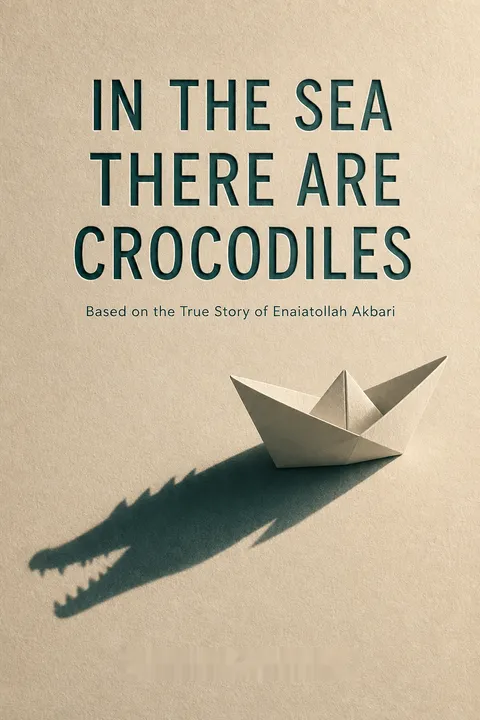
The title carries a warning. Hussein Ali fears that crocodiles may be in the sea. The book's closing note says Enaiat has since learned that crocodiles really do inhabit it, giving the title a literal edge. The journey's greater danger, though, is the constant uncertainty about what waits beyond the next border.
The title's dark wit sits beside severe physical danger. A child's imagined crocodile and the real hazards of smugglers, exposure, and drowning share the same landscape of uncertainty, but they are not equivalent threats. That distinction keeps the story from turning peril into adventure. The crossings are not tests designed to build character. They are choices made with incomplete information, under conditions where the cost of a mistake can be fatal.
Reaching Greece ended the crossing, not the need for safety
Arrival was only a pause. After Liaqat disappears, the remaining boys reach a Greek island. Enaiat is arrested with Hussein Ali, and they are released before being fingerprinted. Later, an older woman finds Enaiat alone, gives him food, a shower, clothes, and money for a ferry ticket. Her help gets him to Athens, but it does not give him a home.
Work becomes a foothold. Enaiat sleeps in a park with other Afghan boys and finds meals through churches. During the 2004 Olympics, unfinished venues create work for undocumented migrants. He earns cash helping with landscaping. When the work ends, he faces the same question again: where can he go, and how can he stay safe?
The island crossing and the woman's generosity make arrival feel like a breakthrough, but the next scenes prevent that moment from becoming a tidy rescue. Food, a ticket, and temporary work matter enormously, yet none guarantees secure residence or shelter. The story distinguishes reaching a country from being protected by it. Private kindness can change one person's immediate prospects, while durable safety depends on systems that do not leave survival to chance encounters.
A family and a classroom made settlement imaginable
Care offered a place to land. Enaiat reaches Italy in a freight container and makes his way to Rome, then Turin, looking for Payam, a boy from his village. Payam and social worker Danila help connect him with Danila's family. Marco and Danila foster him, give him a room, and welcome him into family routines. He is wary at first, but their ordinary, unforced care helps him feel he can stay.
School restores a future. After a restrictive stay in a migrant hostel, Enaiat returns to the family and studies Italian, then attends school. He works hard, completes middle school exams, and enrolls in upper school despite having missed years of education. The book's ending notes that he graduates from high school and hopes to attend university.
The contrast between the foster home and the hostel shows that shelter is not merely a roof. A locked, orderly institution can feel like confinement, while a family home offers trust, routine, and room to learn. Education also does more than improve prospects: for Enaiat, it answers the loss of the Afghan school that was violently closed. His progress is remarkable, but it depends on people and services making learning accessible.
Make danger legible to officials deciding whether you may stay
He argues in his own voice. At his asylum interview in Rome, Enaiat declines an interpreter because he wants the officials to hear his emotions directly, even if his Italian is imperfect. The commissioner questions whether Afghanistan is dangerous for him. Enaiat then shows a newspaper report about a very young boy taking part in an execution, and explains that he could have been drawn into that life.
Evidence changes the decision. A few days later, he learns that he has been granted asylum. His case is not just a list of places crossed; it is an account connecting his personal history to continuing danger. The interview gives him a chance to make that connection visible to people with power over his future.
Asylum procedures ask private experience to become an administratively recognizable claim. Enaiat's newspaper supplies a public piece of evidence, while his own story gives it personal meaning. That combination makes the scene persuasive, but it also reveals a risk: a person may be disbelieved if danger does not arrive in a form officials recognize. One successful interview should not imply that others can secure protection simply by telling their stories well.
Safety gave him room to call home after eight years
Survival had crowded out memory. Enaiat says he does not seriously try to reconnect with his mother, brother, and sister until after gaining asylum and beginning to feel settled in Italy. He asks a friend to help locate them. The search is difficult because his family has moved from Nava, but the friend's father eventually finds them in Pakistan and persuades his mother to leave Afghanistan.
A few breaths carry the reunion. Enaiat and his mother speak by phone for the first time in eight years. Neither can find words; they hear each other crying and breathing before the call ends. The conversation confirms that she is alive, and that he is, too. The book closes with a family still separated by distance, but no longer lost to one another.
The delay in contacting home could be misread as indifference. The story offers another explanation: when a person is occupied with immediate survival, emotional attention can narrow to the next meal, job, or escape. Once Enaiat has some stability, memory and attachment return to the foreground. The phone call is moving precisely because it does not resolve everything. It restores contact, not the years apart or the certainty of reunion.
Analysis
This book's structure follows a route across six countries, but its deeper organizing principle is the repeated question of what counts as safety. Home becomes unsafe because Enaiat is Hazara. Pakistan offers work and peers, but little security. Iran brings wages, friendship, and repeated deportation. Greece permits arrival without guaranteeing shelter. Italy offers foster care and education, then asks him to prove that returning is dangerous. Each new place changes the shape of the threat rather than ending it.
Fabio Geda's conversational frame matters. Enaiat tells his story to a listener who asks questions, sometimes prompting memories and sometimes challenging his tendency to dismiss people or places as unimportant. This gives the account a tension between event and interpretation: Enaiat often values what happened over who helped him, while the interviewer draws attention to the human relationships around the event. The reader sees both the survivor's practical focus and the emotional world that focus can obscure.
The work also marks its own limits. Geda says the memories were reconstructed together, using maps and other tools, and that the result should be treated as fiction based on a true life. That framing is not a defect to conceal. It makes the process of shaping a fragmented past visible, while reminding readers not to treat every remembered detail as a verified record. The chronology itself is sometimes uncertain, especially around Enaiat's age.
The most important caution is against turning endurance into a moral demand. Enaiat is resourceful, funny, and repeatedly helped by others, but his survival should not be presented as proof that every displaced child can overcome the same barriers. The story's force lies in showing both agency and dependence: he makes choices, yet the risks, work, and legal outcomes are largely structured by forces beyond a child's control. Its hopeful ending is therefore not a simple triumph. It is a fragile opening toward safety, schooling, and renewed family contact.
Review Summary
Reviews of In the Sea There are Crocodiles are largely positive, praising the remarkable true story of Enaiatollah Akbari's journey from Afghanistan through Pakistan, Iran, Turkey, Greece, and Italy. Many readers found it deeply moving and recommended it as essential reading, particularly for its themes of resilience, hope, and the refugee experience. Some critics noted the writing style as overly simplistic or flat, and a few felt the narrative lacked depth. The interview-style format was divisive, though most agreed the story's authenticity and emotional power outweighed any stylistic shortcomings.
People Also Read



Glossary
samavat
Transit guesthouseA samavat is a lodging house used by travelers passing through places such as Quetta. Enaiat describes it less like a conventional hotel than a crowded stop where migrants sleep, eat, and seek contacts for onward travel. In his case, it first shelters him with his mother, then gives him a place to work and sleep.
buzul-bazi
A sheep-bone gameBuzul-bazi is a game played with a bone from a sheep's foot, boiled and shaped somewhat like a lumpy die. Enaiat compares it to dice or marbles. He remembers playing it in his village, and the game recurs as a marker of the childhood and friends he left behind.
Telisia and Sang Safid
Feared Iranian detention centersTelisia and Sang Safid are named as temporary detention centers in Iran, dreaded by Afghan migrants. Enaiat hears accounts of beatings and severe abuse there and fears being sent to them when police stop him. The story distinguishes these reports from what he directly experiences, including police detention and forced labor at a border station.
felfeli
Chili pepper nicknameFelfeli is a Persian nickname meaning chili pepper, given to Enaiat in Baharestan because he is small. A shopkeeper uses a saying about the chili's size and spiciness to suggest that a person's stature does not determine their strength or character. The nickname reflects a brief period when Enaiat begins to feel welcomed.
Hazara
Enaiat's ethnic communityHazara is the ethnic identity Enaiat shares with his family and the people of his village in Ghazni province. His account describes Hazaras facing discrimination and violence, including restrictions on education and movement. It also emphasizes that Taliban fighters are not synonymous with Afghans as a whole.
Download PDF
Download EPUB
.epub digital book format is ideal for reading ebooks on phones, tablets, and e-readers.








