

Key Takeaways
Treat absence as part of how life, meaning, and purpose work
What is missing matters. Physical science describes objects and forces, but meaning, function, purpose, and value depend on something beyond what is materially present. A shovel’s use is not simply its shape or substance. It is the possibility of digging. Deacon calls this an absential feature: a phenomenon whose identity depends on an absent object, outcome, or possibility. This does not require a ghostly substance. It asks how an actual physical system can be organized around something that is not there yet, or may not exist at all.
Zero offers a clue. Zero represents no quantity, yet its incorporation into arithmetic helped make new forms of calculation possible. Deacon proposes an analogous shift for science: learn to account for absences as causal features, rather than excluding them or treating them as magic. The meanings you read, for example, are not the ink or pixels, yet they can influence what you do.
The zero analogy makes the problem memorable, but analogy alone cannot establish that absence causes anything. Its strongest interpretation is more disciplined: absent possibilities matter when physical arrangements constrain what can happen. That connects the argument to information theory, where a signal becomes informative against alternatives that were possible but not sent. The challenge is to specify the physical process that carries this constraint. Deacon’s project is compelling precisely because it treats that demand as scientific work, not as permission to invoke an immaterial force.
Explain purpose without inventing a hidden manager inside the system
Beware the little manager. A homunculus is an unexplained inner agent invoked to explain perception, action, or thought. Saying that the brain understands a map because another brain region reads it only moves the question: what interprets that region’s map? The same problem appears when a theory says that a mental module recognizes, decides, or regulates without explaining how that function works.
Mechanism can hide the gap. The Jewish golem story imagines a clay figure that follows commands without understanding them. Deacon uses it as a warning about accounts that explain behavior as information processing while leaving meaning and interpretation outside the mechanism. Computation can describe reliable operations, but the computer’s designers and users supply its purposes. Eliminating mental vocabulary does not explain how living systems acquire their own functional organization.
The homunculus critique is a useful test for explanations across neuroscience and artificial intelligence: does a proposed mechanism explain a capacity, or merely rename it? Yet decomposition is not automatically a mistake. Breaking perception into lower-level processes has produced valuable empirical work. The sharper warning is against treating a component’s label, such as detector or interpreter, as an explanation of its competence. A good account must show how the capacity is generated, while avoiding the opposite shortcut of declaring meaning unreal.
Track what a system cannot do, not only what it does
A constraint is a real limit. In Deacon’s framework, a constraint is a reduction in the states or changes a system could otherwise realize. It is not necessarily a wall or an instruction imposed from outside. A solid object, for example, is characterized partly by motions its molecules do not make. At larger scales, many tiny differences cancel out, leaving a smaller set of robust patterns that can affect other systems.
Order need not be a picture. Calling a room orderly can depend on someone’s preferences. Describing its constraints can be more objective: which movements are blocked, which arrangements recur, and which possibilities are excluded. A group of objects that survive a series of tests may share no obvious positive feature, yet their common failures can make them useful for a later task. What does not happen can shape what becomes possible.
This negative approach avoids treating every pattern as a perfect form imposed by an observer. It also resonates with engineering, where boundary conditions often matter as much as the parts being designed. The important caution is that a constraint is not automatically meaningful or functional. A rock blocks motion, but that fact alone does not make it an organism. The framework gains explanatory force only when it identifies how constraints arise, persist, and enter into organized relations with other constraints.
See life as a new causal level, not just complicated chemistry
Three kinds of dynamics. Deacon builds a hierarchy. Homeodynamics describes spontaneous change toward less constrained states, as in heat spreading through a room. Morphodynamics describes patterns that form and stabilize under ongoing disturbance. Teleodynamics describes interdependent processes that preserve and regenerate the organization that sustains them, as in life. Each depends on the level below it, but cannot be fully described by that level alone.
Convection shows the middle step. Heat a shallow layer of liquid from below and, under suitable conditions, organized hexagonal convection cells appear. The pattern helps move heat, even though no designer arranges the liquid. It is an example of morphodynamics, not life: the cells do not preserve themselves for their own sake. Deacon argues that the move from spontaneous pattern formation to self-maintaining organization is a further transition.
The hierarchy gives readers a map through a difficult argument: physical dissipation, spontaneous organization, then self-maintaining function. Convection is a strong example because it shows how order can arise without foresight. The conceptual leap comes at teleodynamics, where order is no longer merely produced, but organized around maintaining the process that produces it. That distinction is useful in biology, though its boundaries may be gradual in real systems. The categories should guide investigation, not be mistaken for sharply separated boxes in nature.
Life may begin when self-organizing processes preserve one another
A proposed bridge to life. An autogen is Deacon’s hypothetical minimal system in which two spontaneous processes support one another. In his model, an autocatalytic set of molecules helps produce material for a self-assembling container. The container, in turn, keeps the catalytic components close enough to interact. Alone, each process tends to undermine itself: catalysis uses up resources, while a closed container eventually blocks further activity. Together, they can preserve the conditions for renewed activity.
A rudimentary self appears. If disruption allows an autogen to re-form or split into copies, the organization can persist even as particular molecules change. Deacon argues that such a system would have primitive function and a basic distinction between conditions that support it and those that damage it. He presents this as a model for how teleodynamic organization might arise, not as a demonstrated account of how life began on Earth.
The model’s value is that it puts the origin-of-life problem in organizational terms instead of assuming that DNA, membranes, and metabolism arrived together as a ready-made package. Its reciprocal logic also suggests why containment and chemical production could become mutually advantageous. But plausibility is not evidence of historical occurrence. The proposed chemistry must be experimentally realized, and competing routes to early life remain possible. The model is best treated as a testable conceptual scaffold, not a settled explanation of abiogenesis.
Trace causal power through work, not energy alone
Work redirects change. Deacon uses orthograde for change that follows a system’s spontaneous tendency, and contragrade for change that must be forced against that tendency. Work is the production of contragrade change. In an engine, expanding hot gas is constrained so that it pushes a piston rather than spreading freely. Energy is necessary, but the constraints determine what that energy can accomplish.
Higher levels add new possibilities. Deacon extends this account from physical labor to the organization of patterns and goals. A brain’s metabolic activity supports neural processes, but mental effort is not simply the amount of energy consumed. Solving a difficult problem involves organizing processes against competing tendencies, much as a physical machine channels energy against resistance. The book proposes that new forms of work emerge as constraints become organized at higher levels.
This account usefully separates energy, which is conserved, from the capacity to direct it toward a particular effect. It also links familiar physical work with less tangible effort, such as changing a belief or solving a problem. That broader use is illuminating, but it risks becoming too elastic unless different forms of work can be measured independently. The framework’s promise depends on showing how its proposed levels connect empirically, rather than relying on the shared everyday word work.
Treat information as a relationship, not a message stored in matter
A signal needs context. Shannon information measures how much uncertainty a signal reduces among the possible signals that could have been sent. It does not say what the signal is about. A sequence of marks can be decoded in many ways, and its meaning depends on an interpreting process. Deacon argues that reference requires more than a pattern: the signal must be physically open to modification by something beyond itself, and the resulting change must matter to an organized system.
Noise can become evidence. In 1965, Arno Penzias and Robert Wilson detected persistent microwave noise while testing an antenna. Only after ruling out local sources did they interpret it as evidence from the early universe. The hiss became informative through comparison with expectations and alternative explanations. Deacon’s broader claim is that biological information likewise depends on constraints, work, and the needs of the organism interpreting it.
The distinction between signal capacity and meaning remains vital in debates about data, computation, and artificial intelligence. A database may contain enormous variation without understanding any of it. Deacon’s emphasis on interpretation helps explain why information is not simply a synonym for physical difference. Still, his account sets a high bar: showing that a system responds to a signal is not enough to prove that it represents what the signal concerns. The relationship between useful response, reference, and genuine understanding remains contested.
Natural selection filters living systems, but cannot create life’s first requirements
Selection is not the whole origin story. Natural selection explains how inherited variants become more or less common through differential reproduction. It does not, by itself, explain how the first systems capable of maintaining themselves and reproducing came to exist. Deacon argues that life’s initial self-maintaining organization had to emerge before selection could act. His hypothetical autogen is intended to illustrate how rudimentary reproduction and selection might arise from mutually supportive self-organizing processes.
Genetic information is a later achievement. In Deacon’s account, DNA does not create life on its own. Its sequences become informative through their role in a functioning organism. He points to duplicated hemoglobin genes as an example of redundancy that can let variants acquire distinct roles, including different oxygen-binding properties. Evolution can then preserve useful combinations. The claim is not that selection is unimportant, but that it depends on prior organization and on the production of viable variation.
This argument corrects a common explanatory shortcut: invoking selection does not explain the existence of the reproducing units on which selection operates. It also places development and organism-level organization back into evolutionary theory, rather than treating genes as little agents acting alone. The distinction between a prerequisite and an evolutionary product is conceptually strong. However, the origin of life remains unresolved, and the autogen proposal does not establish which early mechanisms actually preceded genetic inheritance.
Locate the self in a continuing pattern, not a body part
Selfhood is organized persistence. Deacon treats a living self as a teleodynamic process, not a special object hidden inside the body. Cells produce and maintain one another’s conditions of existence, while bodily boundaries help protect this organization without defining it completely. A teleogen is a partly autonomous teleodynamic unit embedded in a larger one, such as a body cell within an organism. Its functions can serve the larger self even when the cell is not independently viable.
Selves can be nested. Mitochondria retain traces of an ancient bacterial origin, yet now depend on the cells they inhabit. Likewise, brain-based selfhood depends on the organism whose needs shaped the brain. Deacon proposes that brains build models of possible situations and actions, adding a more complex, self-referential layer to the basic organization of living systems.
This process-based view helps make sense of biological cases where individuality is not identical to a membrane or a single genome. It also connects selfhood to debates in biology about symbiosis and levels of individuality. The account is more flexible than a simple body boundary, but it needs criteria for deciding when a collection of dependent parts forms one self rather than merely a cooperative system. That question matters for organisms, colonies, and any future attempt to identify non-biological selves.
Understand feeling as work that protects a vulnerable perspective
Sentience is not mere intelligence. A computer might produce appropriate answers by matching inputs to stored patterns without experiencing what those answers mean. Drawing on the Chinese room thought experiment, Deacon distinguishes successful information processing from a system whose own persistence is at stake. He proposes that sentience arises in teleodynamic systems, and that brain-based experience is a more complex form built on cellular and organism-level processes.
Feeling registers consequential change. In Deacon’s speculative model, emotion reflects the effort required to reorganize brain activity when bodily needs or external events threaten the organism’s ongoing organization. Pain is a vivid case: neural activity represents bodily damage and mobilizes action to stop it. If the harmful condition cannot be changed, the continuing demand to act can become suffering. The proposal links experience to bodily vulnerability, but the neural account remains a theoretical sketch.
The distinction between intelligent output and subjective experience is essential: behavioral competence alone cannot settle whether a machine feels. Deacon’s emphasis on embodiment also fits research traditions that treat cognition as shaped by bodily regulation and action. The more ambitious claim, that teleodynamic organization explains feeling itself, is not established by the analogy. Neural and metabolic correlations can illuminate consciousness without yet explaining why those processes have a felt quality. The chapter is strongest as a research program that keeps the question open.
Analysis
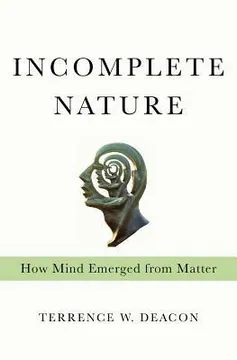
Incomplete Nature is a scientific-philosophical argument built around one reversal: instead of treating only what is materially present as causally real, examine how physical systems are organized by constraints, unrealized possibilities, and outcomes that may never occur. The book moves from the puzzle of meaning to a hierarchy of dynamics, then uses a hypothetical minimal life-like system to connect physical process with function, information, selfhood, and consciousness. Its unifying ambition is unusual: make purpose and value continuous with nature without reducing them to mere shorthand or adding a supernatural force.
The strongest contribution is conceptual discipline. Deacon distinguishes spontaneous physical change, self-organizing patterns, and systems that maintain the conditions of their own persistence. That sequence clarifies why natural selection can explain adaptation while presupposing living systems, and why Shannon’s measure of signal uncertainty does not by itself explain reference. It also gives researchers a vocabulary for asking what organization contributes beyond a list of components.
The argument’s most important limitation is the gap between a productive model and an established mechanism. The autogen is proposed, not demonstrated as life’s historical precursor. The claim that constraint-based organization grounds aboutness is plausible for rudimentary biological function, but it does not automatically yield semantic representation or subjective experience. Likewise, treating neural population dynamics and metabolic effort as the basis of feeling is a research conjecture, not a settled neuroscientific result. The book sometimes moves quickly from functional normativity to sentience, where further distinctions are needed.
Read as a completed theory, the account overreaches. Read as a research agenda, it is more powerful: it asks science to connect thermodynamics, self-organization, evolution, and meaning without pretending that one level makes the others disappear. Its enduring question is precise and difficult: what physical organization makes an absent possibility matter to a system itself?
Review Summary
Reviews of Incomplete Nature are sharply divided. Many praise it as groundbreaking, calling it one of the most important scientific-philosophical works in recent memory for its ambitious attempt to explain how life and mind emerge from matter through emergent dynamics and "absential" constraints. Critics, however, find the book excessively long, poorly edited, and written in an abusive, jargon-heavy style filled with unnecessary neologisms. Some question Deacon's grasp of thermodynamics and note his arguments rely more on analogy than rigorous science.
Glossary
Absential
Defined by something absentA term for a feature of a phenomenon whose identity depends on something not materially present, such as a possible outcome, a represented object, or a function’s result. Deacon uses it to describe how meaning, purpose, and value can be physically consequential without being objects or forces in the ordinary sense.
Ententional
Oriented toward what is absentDeacon’s broad term for phenomena organized in relation to something beyond themselves. It includes biological functions, adaptations, information, thoughts, purposes, experiences, and values. These phenomena differ from one another, but each depends on a relationship to an absent condition, object, or outcome.
Constraint
A limit on possible changeA restriction on the states or changes a system could otherwise realize. A constraint can arise from physical boundaries, interactions, or the organization of a larger process. Deacon emphasizes its negative character: it is defined partly by possibilities that are not expressed, yet it can shape later interactions and the work a system can perform.
Homeodynamics
Spontaneous constraint dissipationDeacon’s term for the basic tendency of physical processes to move toward less constrained distributions, as in heat spreading through a system. It generalizes the familiar thermodynamic tendency toward equilibrium. Homeodynamic processes provide the physical base on which more organized and self-maintaining dynamics can arise.
Morphodynamics
Pattern formation under disturbanceA class of processes that develop organized, relatively stable patterns while being continually perturbed and supplied with energy or material. Examples include convection cells in heated liquid and other self-organizing structures. In Deacon’s framework, morphodynamics amplifies constraints, but does not by itself create a system that preserves its own organization for its own sake.
Teleodynamics
Self-maintaining consequence organizationA form of organization produced by mutually supporting morphodynamic processes, where the system’s activity helps preserve the conditions that allow that activity to continue. Deacon uses the term for the basic end-directed organization of life and as a foundation for understanding function, biological normativity, and more complex mental processes.
Autogen
Hypothetical self-generating systemDeacon’s proposed minimal teleodynamic system, made from complementary self-organizing processes. In the model, autocatalytic chemistry supplies material for a self-assembling enclosure, while enclosure keeps catalytic components close. Their interdependence could allow the system’s organization to re-form or reproduce, though the model is not presented as an experimentally established origin of life.
Orthograde
Following spontaneous changeA term for change that proceeds in the direction a system tends to change without external interference. The spread of heat through a room is an example. Deacon uses orthograde to distinguish spontaneous tendencies from changes that require work to overcome those tendencies.
Contragrade
Forced against spontaneous changeA term for change that runs counter to a system’s spontaneous tendency and therefore requires an external influence or work. Constraining hot gas so that it pushes a piston rather than expanding freely is an example. Contragrade change helps explain how systems can redirect energy toward specific outcomes.
Shannon information
Uncertainty reduced by a signalA measure of how much uncertainty a received signal removes from the set of possible signals that could have been sent. It quantifies a medium’s information-carrying capacity, but says nothing by itself about what the signal means or refers to. Deacon treats reference as a further problem requiring an interpreting system.
Boltzmann entropy
Thermodynamic state probabilityDeacon’s label for thermodynamic entropy, used to distinguish it from Shannon’s information-theoretic measure. It concerns the statistical likelihood of physical arrangements in a system. A highly dispersed equilibrium state is more probable than many constrained arrangements, so deviations from it can indicate that work has been done.
Teleogen
Embedded teleodynamic unitA partly autonomous teleodynamic system that functions as a component within a larger organized system. A body cell is an example: it has its own ongoing processes, yet may depend on the organism and serve the organism’s persistence. The term helps describe nested levels of biological and potentially mental organization.
Download PDF
Download EPUB
.epub digital book format is ideal for reading ebooks on phones, tablets, and e-readers.








