

Key Takeaways
Trace the crisis to a century-long contest over grace, nature, and authority.
A long historical arc. Marshall argues that the Church’s modern crisis did not begin with Vatican II. He traces it to nineteenth-century movements that, in his account, sought to replace a faith centered on divine revelation and grace with a religion centered on human reason, political ideals, and nature alone. The story runs from anti-clerical campaigns and the loss of the Papal States in 1870 through disputes over theology and worship, and into the conclaves and scandals of the twentieth and twenty-first centuries.
A spiritual diagnosis. The book interprets these events as more than institutional failure: it presents them as a spiritual struggle in which human actors can serve forces hostile to Christianity. That conviction shapes its history and its proposed remedy, which is spiritual discipline as well as reform.
The book’s organizing idea is its strongest source of coherence: it connects political history, doctrine, worship, and institutional conduct through a single conflict over whether human life needs supernatural grace. That lens helps explain why apparently technical disputes about liturgy matter to the author. It also risks turning a complex history into a single, preselected story. A careful reader can retain the theological question while separately assessing each historical claim. In that way, the book’s central frame becomes a prompt for inquiry rather than a verdict that every event must fit.
Watch institutions, because the alleged strategy prizes gradual influence over open attack.
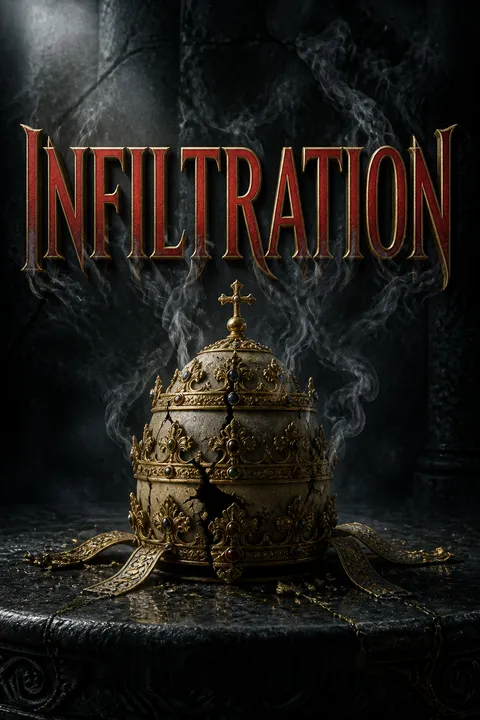
The proposed strategy. Marshall gives a central role to the Permanent Instruction of the Alta Vendita, a document he presents as an internal plan of the Italian Carbonari, a secret society. Its alleged strategy was patient: influence young people, form the clergy, gain positions within Church institutions, and shape the environment from which future cardinals and popes would emerge. The document’s long time horizon gives the book its title and its account of infiltration.
A key distinction. Marshall links this strategy to Freemasonry, liberalism, and later Communist activity in seminaries. He cites former Communist agents Bella Dodd and Manning Johnson, who said Communists had placed members in religious institutions. Their testimony and the Alta Vendita text are important to his case, but they do not by themselves establish that a coordinated plan caused later Church decisions.
Institutional change often travels through ordinary channels: hiring, education, promotion, and professional norms. That makes the book’s focus on formation more analytically interesting than a simple tale of a hidden mastermind. Yet a strategic document, even if authentic, proves an intention, not its successful execution across generations. The argument becomes stronger when each link is independently supported: who acted, what they changed, and how that change affected policy. Without that chain, resemblance between a plan and a later outcome can create a compelling pattern without establishing causation.
Test every modernization against the boundary between adapting language and changing belief.
Marshall’s definition of Modernism. In the book, Modernism is a theological tendency to reinterpret Catholic belief through philosophies that reject supernatural revelation. Marshall describes three connected shifts: treating Scripture’s miracles as natural or symbolic, recasting salvation as social or political progress, and loosening the connection between doctrine, moral truth, and worship. He argues that the result is not simply a new way to explain old beliefs, but a change in what those beliefs mean.
The Pius X response. Pope Pius X condemned propositions he identified as Modernist, issued the encyclical Pascendi, and required an anti-Modernist oath from clergy and teachers. Marshall contrasts this with later theologians associated with nouvelle théologie, or “new theology,” whom he sees as weakening the distinction between nature and grace. He presents this dispute as a defining intellectual struggle before Vatican II.
The distinction between translation and alteration is useful well beyond theology. Institutions must communicate inherited ideas in new settings, but change can become substantive when the assumptions behind a concept shift. Marshall gives readers a practical question: does a new explanation preserve the claim, or quietly replace it? His account is also sharply partisan in its classification of theologians, whose work and aims are not fully represented by the label of Modernism. Readers can apply the question without accepting every verdict: examine both the original teaching and the proposed interpretation.
Treat worship as theology in action, not a neutral matter of presentation.
The liturgy as a battleground. Marshall argues that changes to Catholic worship can alter how believers understand the faith. He focuses on Annibale Bugnini’s work on Holy Week reforms in the 1950s and the later creation of the Novus Ordo Missae, the order of Mass introduced under Pope Paul VI. He objects to changes including greater use of vernacular language, simplified rites, and new arrangements of the altar and priest’s role.
Competing accounts of reform. The Second Vatican Council’s liturgy constitution called for clearer rites and fuller participation by the faithful. Critics, including the authors of the 1969 Ottaviani Intervention, argued that the new Mass obscured the sacrificial character of the Eucharist. Paul VI proceeded with the reform. Marshall’s account makes worship central to the conflict: the question is whether adaptation helps people enter the sacred or makes the sacred conform to ordinary expectations.
Ritual is a form of embodied teaching. Its gestures, words, and spatial arrangements communicate what a community considers central, often more powerfully than formal explanations do. That insight helps explain why liturgical change can provoke deep disagreement even when its advocates intend continuity. At the same time, a rite’s appearance alone cannot settle its theological meaning; interpretation depends on texts, official teaching, and how communities practice it. The most productive assessment considers both the reformers’ stated goals and the experience of worshippers, rather than assuming either that change is harmless or that every alteration represents rupture.
Read Fatima as the book's prophetic lens, not settled proof of its plot.
Apparitions shape the narrative. Marshall uses the 1917 Fatima apparitions to interpret the century that follows. The children’s reported messages call for prayer and penance and warn that Russia could spread its errors unless consecrated to Mary’s Immaculate Heart. The book connects that warning to later war, persecution, and papal consecrations. It also recounts the disputed Third Secret, which the Vatican published in 2000 as a vision of a suffering pope and other religious figures.
A contested interpretation. Marshall argues that the published text leaves out a second part about a crisis of faith. He also favors the longer 1879 version of the La Salette secret, which predicts religious decline and apostasy. Both questions are disputed within the book’s own account: the La Salette text was censured, and claims about an unpublished Fatima section depend on contested testimony and inference.
Prophecy can function as a powerful interpretive lens: it gives a community a language for fear, endurance, and moral responsibility. It can also encourage retrospective pattern-finding, where later events appear to confirm an earlier prediction because the interpretation is flexible. Marshall’s presentation is most informative when it distinguishes the reported visions, the documents’ publication histories, and his own conclusions about them. That distinction does not require dismissing religious belief. It simply keeps devotional meaning separate from historical proof, allowing readers to understand why the prophecies matter without treating every proposed reading as established fact.
Measure reform against outcomes, but do not confuse decline with proof of cause.
A statistical indictment. Marshall cites figures for the United States showing steep declines between 1958 or 1965 and 2000 or 2002. In his source, Sunday Mass attendance falls from 74 percent to 25 percent; priestly ordinations fall from 1,575 to 450; and seminarians fall from 49,000 to 4,700. He also lists fewer baptisms, marriages, religious sisters, and Catholic schools. These numbers support his claim that Catholic life weakened sharply during the decades after Vatican II.
The causal claim. Marshall argues that the reforms of Vatican II and the new liturgy helped produce the decline, and he compares the Church’s response to a company refusing to abandon a failing product. The figures do show a serious trend in the period he examines. They do not, by themselves, identify which reforms caused it or account for wider social changes and other possible explanations.
The figures give the book a concrete measure of institutional change, and they challenge readers to take declining participation seriously rather than dismissing it with optimistic slogans. The analytical limit is equally important: a before-and-after comparison cannot isolate cause. A stronger test would compare different communities, track multiple explanations, and ask whether particular reforms predict different outcomes. That caution does not weaken the practical question of whether reforms are working. It makes the question more useful by shifting discussion from loyalty to a period or policy toward evidence about what sustains belief, participation, and vocations.
Separate documented scandals from the conspiracy that Marshall builds around them.
A chain of suspicions. The book connects financial scandals, disputed conclave stories, and alleged clerical networks into a theory of coordinated infiltration. It recounts the Vatican Bank’s losses involving financier Michele Sindona, whose criminal connections and later conviction are part of the historical record it presents. It also discusses the 1978 death of Pope John Paul I, whose circumstances have generated murder theories, and the Sankt Gallen meetings, which some participants described as political organizing around a future papal election.
Evidence comes in different grades. Marshall treats these episodes as signs of a continuing plot, but some steps rely on anonymous accounts, disputed testimony, or inference. The book itself acknowledges that the circumstances of John Paul I’s death remain hypothetical. Readers should distinguish a recorded event, a witness’s claim, and the author’s conclusion that they form one coordinated operation.
A sequence of real scandals can reasonably raise questions about oversight, incentives, and accountability. But narrative coherence is not the same as evidentiary strength: once events are arranged as parts of a plot, every coincidence can look like confirmation. A useful discipline is to keep an evidence ledger, marking what is documented, what is alleged, and what remains speculative. This approach neither excuses institutional secrecy nor endorses conspiratorial certainty. It gives scrutiny a firmer foundation, especially where serious accusations could damage reputations or distort understanding of how organizations actually fail.
Resist errors while remaining within the Church, then rebuild through prayer and practice.
The author’s middle position. Marshall rejects several ways of resolving the crisis: embracing post-conciliar change as wholly correct, leaving Catholicism for atheism or another Christian tradition, declaring the papal office vacant, or claiming Benedict XVI remained pope after his resignation. He favors “recognize and resist”: accept the current pope’s authority while respectfully opposing teachings or actions judged inconsistent with earlier Catholic doctrine. He points to Saint Paul’s resistance to Peter as a model for correction without denying office.
Repair requires habits. Marshall’s final chapter draws on Nehemiah’s rebuilding of Jerusalem to pair defense with construction. He recommends the Rosary, prayer to Saint Michael, fasting, catechesis, sacramental life, study, and chastity. The point is not only to identify alleged enemies, but to build religious practice and knowledge strong enough to withstand confusion.
The proposed position tries to hold two commitments together: institutional belonging and principled dissent. That tension is real in many organizations, where authority can be legitimate yet fallible in particular judgments. The distinction is constructive when disagreement is specific, reasoned, and accountable, rather than turning every conflict into proof of corruption. The book’s spiritual practices also give its response a daily scale: prayer and teaching are actions available to ordinary members, not just leaders. The challenge is to combine vigilance with humility, so resistance does not become a mirror image of the certainty it opposes.
Analysis
Infiltration is a polemical work of Catholic history and apologetics, structured as a long chronology that moves from nineteenth-century secret societies through Vatican II and the Francis pontificate. Its central claim is that the Church’s crisis is not merely a sequence of mistaken policies or cultural adjustments, but the result of a sustained effort to redirect Catholicism from supernatural religion toward naturalism. The book’s memorable strength is its insistence that doctrine, ritual, appointments, and finance belong to one institutional story. Its weaker feature is the method by which it connects them.
Marshall uses sources of very different kinds: papal documents, official records, published accounts, retrospective testimony, journalistic reporting, and allegations from controversial witnesses. Those materials do not carry equal evidentiary weight. At points, the narrative moves from evidence that an event occurred to the much larger conclusion that it was part of a coherent, century-spanning campaign. The distinction matters most in accounts of the 1958 conclave, the unpublished portion of Fatima’s Third Secret, John Paul I’s death, and alleged networks of clerical infiltration. The book sometimes acknowledges uncertainty, yet its dramatic framing can make conjecture feel settled.
Its use of statistics has a similar limitation. The cited declines in American religious participation are striking and warrant explanation, but a timeline alone cannot show that liturgical or theological reforms caused them. Demographic, cultural, institutional, and economic shifts may also matter. A stronger historical argument would compare competing explanations and test each link in the proposed chain.
The best way to read the book is neither as a neutral institutional history nor as a set of conclusions that must be accepted whole. It is a forceful intervention from a traditionalist Catholic perspective, valuable for identifying disputes over grace, authority, worship, and continuity. Its most durable contribution is to insist that reforms have theological stakes. Its most necessary qualification is to distinguish that insight from claims of secret coordination that require stronger proof.
Review Summary
Reviews of Infiltration are deeply divided. Enthusiastic readers praise its thorough historical research, readable style, and courageous examination of Church corruption, finding it essential reading for Catholics seeking to understand recent crises. Critics, however, raise serious concerns about poor sourcing, factual errors, reliance on unverified conspiracy theories, excessive dependence on private revelation, and a tendency toward calumny against popes and Church figures. Several reviewers note the book oversimplifies complex events and fosters an unhealthy conspiratorial mindset, though even critics acknowledge some sections are well-argued and valuable.
People Also Read
Glossary
Alta Vendita
A secret-society instructionA document attributed to the Alta Vendita, the highest lodge of the Italian Carbonari. Marshall presents it as a plan for long-term influence inside the Catholic Church, beginning with youth and clergy and extending to Church leadership. Its authenticity, scope, and relationship to later events should be distinguished from Marshall’s interpretation of its contents.
Modernism
A disputed theological movementIn Marshall’s usage, Modernism is an approach that rereads Catholic doctrine through modern philosophies that reject or minimize supernatural revelation. He associates it with treating biblical miracles as natural or symbolic, prioritizing secular goals, and loosening fixed doctrinal and moral claims. Pope Pius X condemned propositions he identified with the movement in the early twentieth century.
Nouvelle théologie
A twentieth-century theological currentFrench for “new theology,” this term refers to a set of twentieth-century Catholic theological approaches that sought renewed engagement with Scripture and the Church Fathers, often criticizing the dominance of later Scholastic categories. Marshall treats the movement as a route toward Modernism, especially where it revises the relation between nature and grace. The term covers diverse thinkers and does not itself imply a single shared doctrine.
Novus Ordo Missae
The reformed order of MassThe Latin name commonly used in the book for the revised order of the Roman Catholic Mass promulgated under Pope Paul VI in 1969 and published in 1970. Marshall argues that its changes to language, ritual, and the priest’s role weakened the expression of the Mass as sacrifice. The term identifies the reform; its theological significance remains contested among Catholics.
Coetus Internationalis Patrum
A council minority groupLatin for “International Group of Fathers,” this was an informal alliance of bishops during the Second Vatican Council, associated with Archbishop Marcel Lefebvre and other conservative council participants. Marshall describes it as an organized minority that sought to oppose or modify proposals it considered doctrinally or pastorally dangerous.
recognize and resist
Accept authority, oppose errorsA Catholic position that recognizes a pope as the legitimate officeholder while permitting respectful resistance to particular teachings or decisions judged mistaken. Marshall presents it as an alternative to treating recent popes as invalid and to accepting every post-conciliar development without question. Its application depends on how authority, doctrine, and the limits of dissent are understood.
Sankt Gallen Mafia
A reported reform-minded cardinal groupA nickname associated with informal meetings of European church leaders in Sankt Gallen, Switzerland. Some participants and biographers described the group as discussing Church reform and the future papacy; Marshall argues that it organized to prevent Joseph Ratzinger’s election and promote Jorge Bergoglio. The meetings and their aims should be distinguished from broader claims of a coordinated conspiracy.
Leonine Prayers
Prayers after Low MassA set of prayers traditionally recited after Low Mass, expanded by Pope Leo XIII to include an invocation to Saint Michael and prayers for the Church. Marshall interprets their later removal from the liturgy as symbolically significant, because he sees the prayers as protection against spiritual and institutional threats.
Download PDF
Download EPUB
.epub digital book format is ideal for reading ebooks on phones, tablets, and e-readers.








