

Key Takeaways
Turn inventions into systems customers can actually use and buy
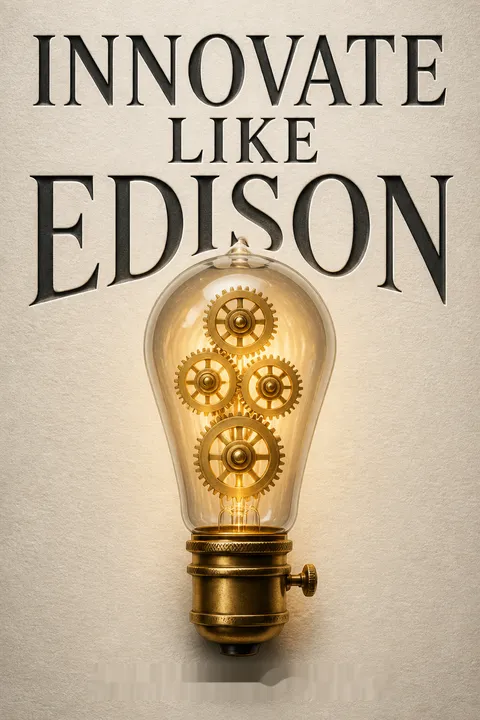
A bulb was only the beginning. In October 1879, Edison and his team kept a carbon-thread lamp glowing for 14.5 hours. The result depended on more than a bright idea: they needed a reliable vacuum, a durable filament, electrical connections, and a workable way to hold everything inside the bulb. Edison’s breakthrough was making these parts function together, then building the businesses and infrastructure to bring electric light to customers. By 1882, a central power station was lighting part of New York City.
Build for delivery. The book defines innovation as creating and delivering new customer value, not merely inventing something novel. Menlo Park and the larger West Orange operation joined research, prototyping, manufacturing, and commercialization. Edison’s phonograph and movie ventures followed the same logic. His wider lesson is that an invention remains a possibility until people can use it and an organization can sustain its delivery.
The systems view anticipates what contemporary product development calls the whole product: a core device plus the services, infrastructure, and complements that make it useful. A lamp without reliable power distribution is a demonstration, not a household utility. The same logic applies to software, where onboarding, support, security, and integration often determine adoption more than a feature list. The framing also resists the lone-genius myth by making production and implementation visible. One qualification matters: a working system is not automatically socially beneficial. Access, affordability, and environmental costs belong in any modern account of value.
Let purpose fuel persistence, while evidence keeps optimism honest
Give effort a destination. Edison linked his work to a broad purpose: applying scientific discovery to improve people’s lives. That conviction helped him pursue difficult problems without treating every setback as a verdict. His 1914 factory fire destroyed buildings and equipment worth millions by the book’s estimate, yet he immediately planned a rebuild that could incorporate better factory methods. His optimism helped rally people around the work.
Keep testing the story. Edison’s early vote-counting machine worked, but politicians had no desire for faster, more transparent votes. He learned to investigate whether a solution mattered to its intended users. His method paired ambitious goals with reading, repeated trials, records, and attention to results. Optimism supplied stamina; it did not make evidence optional. The point is not to assume success, but to keep searching while the facts remain useful.
This pairing resembles a distinction in behavioral science between motivation and calibration. Hope can sustain effort, while feedback helps a person update a plan rather than repeat it blindly. Edison’s response to the fire illustrates resilience as recovery and adaptation, not mere cheerfulness. Still, optimism has a failure mode: confidence can become escalation of commitment, especially when status or money has already been invested. The failed vote machine is a valuable counterweight. Purpose is most productive when it directs attention toward a problem, while evidence remains free to change the proposed solution.
Generate many rough ideas before judging which deserve precision
Keep ideas in motion. The authors call Edison’s practical, multi-angle creativity kaleidoscopic thinking. He used notebooks to capture fragments, sketches, questions, and observations before polishing them. Edison and his staff filled more than 2,500 notebooks. At one point, he reportedly worked on about forty projects at once, allowing discoveries in one field to suggest possibilities in another.
Connect unlikely material. Edison linked his earlier experiments with carbon to a later effort to improve the telephone transmitter. An odd result from telegraph testing became useful because he had recorded it rather than dismissing it. He also used analogy, visual sketches, and speculative thought to explore possibilities. The working sequence is simple: collect widely, make connections, produce alternatives, then test them. Premature criticism narrows the field before a worthwhile idea has had room to appear.
The notebooks function as external memory: they reduce the mental burden of retaining every possibility and make old observations available for recombination. Research on creativity often distinguishes divergent thinking, producing varied options, from convergent thinking, evaluating them against constraints. The book’s advice to generate first captures that useful shift in mode. It should not mean that every idea deserves equal investment. A team still needs criteria for selecting experiments, and a notebook without review can become an archive of distractions. The durable habit is not endless ideation, but preserving enough raw material to notice a connection others miss.
Alternate demanding focus with genuine recovery to sustain inventive work
Manage energy, not just hours. Edison could work intensely for long stretches, but his laboratories also made room for meals, jokes, music, naps, and time away from the bench. At Menlo Park, workers sometimes gathered for a late meal while someone played the organ. Edison himself switched tasks when stuck, took short naps, and relaxed through gardening or fishing. The authors call this range of focused work and restorative activity full-spectrum engagement.
Make room for incubation. A difficult problem can benefit from a pause, a change of activity, or quiet time alone. Edison arranged his workspaces so he could move between private thought and contact with colleagues. The lesson is not to imitate his unusually long days or limited sleep. It is to create a rhythm that protects concentration while giving attention and the body a chance to recover.
The strongest modern connection is recovery science: sustained performance depends on cycles of exertion and restoration, not uninterrupted maximum effort. Breaks can support attention and allow ideas to incubate, while solitude reduces the pressure to respond instantly to other people. The historical schedule is a poor template for contemporary workers, however. Edison’s reported sleep habits should not be treated as a productivity prescription; chronic sleep restriction impairs judgment and learning. The transferable principle is deliberate alternation. Organizations can support it by designing realistic workloads, protected focus time, and breaks that are not quietly penalized.
Design collaboration so diverse talent compounds instead of colliding
Assemble complementary skills. Edison’s laboratories brought together people skilled in mathematics, chemistry, mechanics, glassblowing, drafting, and prototyping. Hiring could include a practical task, such as assembling machine parts, rather than relying only on credentials. Edison’s trusted inner group was supported by a wider circle of employees and advisers, giving him access to expertise across a growing enterprise.
Make cooperation part of the work. Edison encouraged discussion across ranks, trained people to experiment independently, and shared learning through talks and access to technical resources. He rewarded some collaborators through royalties, shares, or greater responsibility. He also cultivated relationships with journalists, financiers, scientists, and potential partners. In this account, collaboration is not simply putting people in a room. It requires complementary abilities, open exchange, room for initiative, and recognition of contributions.
Diverse teams can improve problem solving when members bring genuinely different knowledge and can combine it. Psychological safety, the shared belief that questions and disagreement are welcome, helps make that knowledge usable rather than merely present. Edison’s practical hiring tests and open discussion point in this direction. Yet the book’s team story remains centered on a powerful leader who directed the work and received much of the public credit. That arrangement can accelerate decisions, but it can also obscure contributions. A modern team needs transparent authorship, fair rewards, and enough independence to challenge the person with the strongest authority.
Observe customers in context before polishing a clever solution
Look at actual use. Edison’s failed vote-counting machine taught him that technical performance cannot create demand where there is no customer need. His electric pen found buyers, but users complained that it was noisy, heavy, and awkward to maintain. Instead of guessing from the laboratory, Edison sent people to observe customers at work. Their findings led to fifteen mechanical refinements and a more practical product.
Study the setting. Before launching electric lighting, Edison’s teams surveyed homes and businesses in a six-block area of Manhattan, observing how people used gas lighting and estimating demand. He also read customer letters and treated complaints as evidence. The book’s approach is close to ethnographic research: learning how people behave in the places where a product or service is used. Listening to stated preferences matters, but watching real work often exposes needs customers do not know how to describe.
This is a strong argument for combining interviews with observation. People can explain what frustrates them, but their routine workarounds often reveal needs they have normalized or forgotten to mention. Modern service design and field research use the same principle: study the user’s context before finalizing a solution. There is a caveat. Observing behavior does not by itself explain why it occurs, and a small group of observed customers may not represent a wider market. Good discovery therefore combines contextual observation with broader evidence and repeated testing. Edison’s key correction is methodological: do not let the inventor’s enthusiasm substitute for contact with users.
Test the business model and the scale-up, not just the prototype
Plan the route to market. Edison looked for shifts in customer needs, gaps in existing offerings, and ways his capabilities could address them. He then considered how to produce, distribute, support, and finance the result. For electric lighting, the product was not just a bulb. It required generators, wiring, meters, switches, trained installers, and a local power system. Edison used different business arrangements across his ventures, including licensing inventions and helping municipalities establish power services.
Increase scale in stages. Before the Pearl Street power station went live in 1882, Edison tested lighting at his home and laboratory and installed a system aboard the ship Columbia. The Manhattan launch then exposed practical challenges, including a shortage of trained engineers. Prototypes and limited trials can reveal defects cheaply, but infrastructure sometimes requires a costly live test. Scale-up needs its own budget, skills, and contingency plans.
The distinction between building a prototype and building a repeatable operation remains central to entrepreneurship. A design may work once yet fail when suppliers vary, users behave unpredictably, or service costs rise. Staged testing helps surface these problems before they spread, while a coherent business model explains who pays and who performs each essential task. The Pearl Street story also shows that infrastructure innovations depend on workforce development, not merely engineering. The book’s historical framing can sound like scale is a final hurdle; in practice, scaling often changes the product itself, so customer learning and operational adjustment must continue together.
Make value memorable through demonstrations, useful design, and audience-first communication
Show the benefit. Edison built a recognizable name through press relationships, public demonstrations, customer instruction, quality control, and products designed for practical use. To promote his storage battery, he demonstrated vehicles climbing steep hills with the batteries powering them. The scene conveyed a benefit more vividly than a technical description alone. He also offered phonographs in many models and price ranges, helping bring a new technology to different households.
Design for recall. The book notes that audiences are more likely to remember what comes first or last, what is repeated, what stands out, and what connects to personal experience. Edison’s presentations and advertising translated technical features into user benefits. A strong brand, in this view, is not a clever slogan laid over a weak product. It is a dependable experience that communication makes easy to understand and remember.
Demonstration is a form of evidence, not just theater: it lets a buyer see a product perform under conditions that matter to them. Memorable communication also reduces the gap between technical capability and perceived usefulness. This connects to cognitive research on attention and memory, where salience and repetition influence what people retain. But spectacle can overstate reliability, as modern product launches often prove. The demonstration must be representative, and the promise must match everyday performance. Edison’s strongest branding lesson is therefore operational: communicate vividly, then make the product experience worthy of the attention it attracts.
Assess your innovation habits, then practice the weakest skill deliberately
Turn reflection into a plan. The authors propose innovation literacy as a learnable working knowledge of attitudes, thinking skills, and practices that help ideas reach reality. Their assessment tool asks individuals or teams to rate habits across a set of innovation abilities, map strengths and gaps, and choose an area for improvement. The intent is diagnosis, not a permanent label.
Use strengths as leverage. A sample participant reviews a low score in goal-setting alongside stronger scores in optimism and learning. The participant uses those existing strengths to make a focused ninety-day plan, sets observable targets, schedules reviews, and involves a trusted colleague for accountability. Edison’s own career also cautions against turning his methods into a personality cult: he resisted alternating current despite its advantages and held too long to the phonograph cylinder. Systems help, but they require honest updating.
The assessment approach is useful because broad aspirations become easier to act on when translated into a specific practice and review date. Using a strength to support a weaker behavior also resembles implementation planning: a person links a new action to resources already available. Still, self-ratings measure perceived habits, not necessarily performance, and can reward confidence over competence. Team assessments benefit from behavioral examples and multiple viewpoints. The most credible use of a scorecard is as a conversation starter, followed by a real experiment and observable feedback. Edison’s mistakes reinforce the need to revise beliefs when evidence changes.
Analysis
The book’s central contribution is to recast innovation as an organized social and commercial process rather than a flash of individual genius. Its opening lamp experiment makes the argument tangible: a successful device depends on materials, testing, skilled collaborators, manufacturing, distribution, customer adoption, and a viable enterprise. The five-part architecture then translates that historical claim into habits that range from personal attention and idea generation to team design and market execution.
The framework’s breadth is its strength and its challenge. By placing motivation, creativity, recovery, collaboration, and commercialization in one account, it discourages the familiar mistake of equating innovation with brainstorming. Yet the many practices can feel like a catalogue unless a reader sees how they form a cycle: understand a need, generate alternatives, test them, learn from use, and adapt the organization that delivers them. The customer and scale-up stories provide that connective tissue.
Edison is a compelling case, but not a neutral or fully reproducible template. He worked in a particular era, benefited from specialized collaborators, and held unusual authority over his laboratories. His persistence sometimes became stubbornness, most clearly in resisting alternating current and in misjudging popular entertainment. Those failures strengthen the book’s practical message: disciplined innovation needs mechanisms for correction, not just confidence and effort. Some claims about learning styles and the benefits of optimism are presented more categorically than current evidence warrants. Readers should retain the actionable practices while treating those broad psychological claims cautiously.
The lasting insight is institutional as much as personal. Innovation improves when people can record unfinished ideas, disagree constructively, learn from customers, and connect technical work to production and value. The real object of imitation is not Edison’s workload or persona. It is the deliberate creation of conditions in which useful ideas can be discovered, tested, improved, and delivered.
Review Summary
Innovate Like Edison receives mixed reviews, with ratings ranging from 2 to 5 stars. Positive reviews praise its insights into Edison's methods, innovative principles, and practical tips for creativity. Critics find it redundant, overly worshipful of Edison, and lacking depth. Some readers appreciate the book's focus on Edison's business acumen and marketing skills, while others find it too similar to other self-help books. Overall, readers value the historical information but have varying opinions on its practical applications.
Glossary
Innovation literacy
Practical fluency in innovationA working knowledge of the attitudes, thinking strategies, and communication skills that help people turn ideas into useful outcomes. The book treats it as a learnable capability for individuals and organizations, not as a synonym for creativity. It includes understanding customer needs, testing ideas, collaborating, and carrying promising work into the marketplace.
Solution-centered mindset
Purposeful focus on solutionsAn orientation that directs attention toward finding workable responses to important challenges. In the book, purpose shapes what a person notices, while optimism and persistence help sustain effort. The mindset is paired with learning and objective testing, so commitment to a goal does not require ignoring evidence about whether a proposed answer works.
Kaleidoscopic Thinking
Creative connections from many anglesThe authors’ term for Edison’s practical approach to generating and combining ideas. It involves recording observations, producing many alternatives, using analogies and visual representations, noticing patterns, and considering unconventional possibilities. The aim is to expand the range of possible solutions before evaluating which options merit experiments.
Ideaphoria
A fluent flow of ideasA term the authors use for the enjoyable, productive flow of insights and possibilities. They describe it as drawing on association, analogy, and imaginative speculation to create numerous ideas. Ideaphoria emphasizes quantity and free connection during generation, with evaluation and organization following rather than interrupting the early flow.
Full-spectrum engagement
Flexible management of attentionThe authors’ label for Edison’s ability to move among different modes of work and attention. It includes balancing concentrated effort with rest, seriousness with play, solitude with collaboration, and complex problems with clear priorities. The principle is to work with less wasted friction, not to imitate Edison’s exceptionally long workdays or limited sleep.
Master-mind collaboration
Coordinated, purposeful group intelligenceA form of collaboration in which people combine knowledge and effort in a constructive, coordinated way toward a shared purpose. The book applies the idea to Edison’s teams, which joined distinct disciplines, encouraged discussion, and connected laboratory work to outside networks. The concept emphasizes deliberate team conditions rather than assuming that group work automatically improves ideas.
Super-value creation
Distinctive value for customersThe authors’ term for creating and delivering customer value that stands out in the market. It requires more than a novel invention: an organization must understand users, select a workable business model, build and scale the offering, and communicate its benefits. The concept places customer usefulness and commercial delivery at the center of innovation.
Edison Innovation Literacy Blueprint
Assessment and development mapA tool presented in the book for rating individual or organizational innovation practices, identifying strengths and gaps, and planning development. Users score habits, display the results, and choose areas for focused improvement. The blueprint is intended to support ongoing learning and action, rather than to certify a fixed level of talent or predict success.
FAQ
What is Innovate Like Edison: The Success System of America's Greatest Inventor by Michael J. Gelb about?
- Comprehensive innovation system: The book explores Thomas Edison’s systematic approach to innovation, blending biography, historical anecdotes, and practical strategies for developing innovation literacy.
- Five competencies framework: It introduces Edison’s Five Competencies of Innovation—Solution-centered Mindset, Kaleidoscopic Thinking, Full-spectrum Engagement, Master-mind Collaboration, and Super-value Creation—as a blueprint for personal and organizational innovation.
- Practical application: Readers are provided with actionable exercises, assessments, and blueprints to apply Edison’s principles to their own work and lives.
- Bridging past and present: The book connects Edison’s 19th-century methods with modern innovation challenges, making his system relevant for today’s fast-paced, knowledge-driven economy.
Why should I read Innovate Like Edison by Michael J. Gelb?
- Timeless lessons from a master: Edison’s approach shaped modern R&D and business practices, offering proven lessons on creativity, persistence, and collaboration.
- Actionable innovation framework: The book provides a 25-step blueprint and tools to assess and improve your innovation skills, making it accessible for entrepreneurs, managers, and creative professionals.
- Competitive advantage: Mastering Edison’s methods can help individuals and organizations stay ahead in a world where innovation drives success.
- Mindset and inspiration: The book inspires a shift toward charismatic optimism, solution-centered thinking, and aligning passions with goals for sustained innovation.
What are the key takeaways from Innovate Like Edison by Michael J. Gelb?
- Innovation is systematic: Edison’s success was not just due to genius but to a disciplined, repeatable system that anyone can learn.
- Five core competencies: The book distills Edison’s methods into five competencies, each with five supporting elements, covering mindset, ideation, engagement, collaboration, and value creation.
- Practical tools and assessments: Readers gain access to self-assessment tools, planning frameworks, and exercises to build innovation literacy.
- Continuous improvement: The book emphasizes ongoing learning, experimentation, and adaptation as keys to innovation success.
What are Edison’s Five Competencies of Innovation as described in Innovate Like Edison?
- Solution-centered Mindset: Focuses on aligning goals with passions, relentless learning, persistent experimentation, charismatic optimism, and rigorous objectivity.
- Kaleidoscopic Thinking: Involves generating abundant ideas (ideaphoria), challenging convention, using notebooks, recognizing patterns, and visual expression.
- Full-spectrum Engagement: Balances intensity and relaxation, seriousness and playfulness, sharing and protecting ideas, complexity and simplicity, and solitude and teamwork.
- Master-mind Collaboration: Encompasses recruiting for chemistry and results, building multidisciplinary teams, fostering open exchange, rewarding collaboration, and networking.
- Super-value Creation: Links market trends with core strengths, tunes into target audiences, applies the right business model, understands scale-up, and creates memorable brands.
How does Innovate Like Edison by Michael J. Gelb define and teach the Solution-centered Mindset?
- Passion-driven goals: Edison’s achievements were fueled by aligning his deepest passions with his goals, making work enjoyable and energizing.
- Charismatic optimism: He maintained a positive outlook, viewing setbacks as learning opportunities and inspiring confidence in others.
- Relentless learning and experimentation: Edison voraciously sought knowledge and persisted through thousands of trials, never labeling failures as defeat.
- Rigorous objectivity: He analyzed data without bias, accelerating discovery and ensuring practical results.
What is Kaleidoscopic Thinking and how did Edison use it, according to Innovate Like Edison?
- Idea generation techniques: Edison used word association, analogical thinking, and storytelling to generate a flood of ideas, suspending judgment to unlock creativity.
- Notebooks as creative tools: He kept over 2,500 notebooks filled with sketches and observations, making connections across diverse projects and disciplines.
- Pattern recognition and visual thinking: Edison discerned patterns in data and nature, using mind maps and visual metaphors to explore and communicate ideas.
- Creative agility: This thinking style allowed him to juggle multiple projects and explore unconventional paths, fueling breakthrough innovation.
How does Innovate Like Edison explain Full-spectrum Engagement for innovation?
- Balancing work and rest: Edison worked intensely but incorporated breaks, play, and naps to maintain creativity and stamina.
- Seriousness and playfulness: He combined rigorous focus with humor and storytelling, fostering a joyful and innovative work environment.
- Sharing and protecting ideas: Edison balanced openness with strategic protection of intellectual property, using patents and selective sharing.
- Managing complexity: He balanced complexity with simplicity and solitude with teamwork to sustain high performance.
What does Innovate Like Edison reveal about Edison’s approach to experimentation and persistence?
- Experimentation as learning: Edison viewed every experiment as valuable data, never as failure, and designed diverse hypotheses for rigorous testing.
- Systematic innovation labs: He created the first R&D laboratory at Menlo Park and later the Industrial R&D complex at West Orange, combining science with manufacturing.
- Persistence fueled by optimism: Edison’s optimism and passion drove him to persist through setbacks, embodying his belief in trying “just one more time.”
- Data-driven progress: Rigorous objectivity and documentation helped him accelerate discovery and refine his inventions.
How did Thomas Edison balance solitude and teamwork, according to Innovate Like Edison by Michael J. Gelb?
- Workspace design: Edison’s labs featured private offices for deep thinking and public spaces for collaboration, supporting creative flow.
- Special rooms for focus: He used simple, unadorned rooms for solitary contemplation before inviting teams for impromptu meetings.
- Solitude as creative fuel: Periods of solitude allowed Edison to enter flow states and generate ideas, which he then shared with his teams.
- Lab culture: Employees were encouraged to work both independently and collaboratively, mirroring Edison’s own balance.
What recruitment and team-building strategies does Innovate Like Edison recommend based on Edison’s methods?
- Recruit for chemistry and results: Edison sought individuals with practical problem-solving skills, broad knowledge, and a solution-centered mindset, often testing candidates with hands-on challenges.
- Design multidisciplinary teams: His teams included experts from diverse fields, with cross-training to tackle complex problems and compensate for blind spots.
- Foster open exchange: Edison encouraged free idea flow without hierarchy, rewarding initiative and learning opportunities.
- Reward collaboration: He offered royalties and stock options, building loyalty and high performance.
How does Innovate Like Edison by Michael J. Gelb define Super-value Creation?
- Exceptional customer value: Edison focused on delivering value beyond competitors by linking market trends with his core strengths and addressing real customer needs.
- Right business model: He experimented with various business models, aligning R&D, manufacturing, marketing, and distribution for maximum impact.
- Scale-up and branding: Edison emphasized prototyping and debugging before launch, building a powerful brand through public relations and consistent quality.
- Market-moving innovations: His customer-centric approach and branding created trust and momentum for his inventions.
What practical tools and assessments does Innovate Like Edison offer to develop innovation literacy?
- Edison Innovation Literacy Blueprint: A visual chart mapping the five competencies and twenty-five elements, helping individuals and organizations assess strengths and gaps.
- Competency assessments: Detailed questionnaires allow readers to score their habits and behaviors, track progress, and set measurable goals.
- SMART EDISON planning: A goal-setting framework using Specific, Measurable, Accountability, Relevant, Timeline, Emotion, Decision, Integration, Optimistic, and Now criteria for actionable 90-day plans.
- Continuous improvement: These tools encourage ongoing learning and application of Edison’s principles for sustained innovation growth.
What are the best quotes from Innovate Like Edison by Michael J. Gelb and what do they mean?
- “If we all did the things we are capable of doing we would literally astound ourselves.” — Encourages realizing human potential through action and innovation.
- “Genius is one per cent inspiration and ninety-nine per cent perspiration.” — Highlights the importance of hard work and persistence over mere ideas.
- “Anything that won’t sell, I don’t want to invent. Its sale is proof of utility, and utility is success.” — Stresses that inventions must meet real customer needs to be successful.
- “The value of an idea lies in the using of it.” — Underlines that practical application and execution create value, not just ideas alone.
- “Be able to be alone. Lose not the advantage of solitude, and the society of thyself.” — Emphasizes the importance of solitude for creativity and self-connection, a key theme in Edison’s work style.
About the Author
Other books by Michael J. Gelb


Download PDF
Download EPUB
.epub digital book format is ideal for reading ebooks on phones, tablets, and e-readers.








