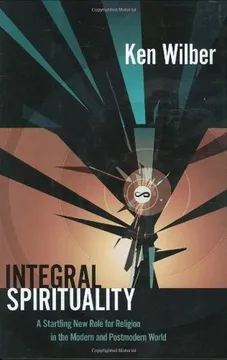


Key Takeaways
Build spirituality around the whole person, not one favored kind of evidence
A wider map. Wilber argues that spirituality should draw on the full range of human knowledge, rather than treating meditation, science, theology, or social context as the whole story. His AQAL framework is a map made from five dimensions: perspectives on individual and collective life, developmental levels, distinct capacities, temporary states, and enduring types. A person might be highly skilled in reasoning yet undeveloped in emotional or ethical judgment; a moving mystical experience does not automatically change that imbalance.
Use the map carefully. The framework is meant to reveal what a narrow approach leaves out, not dictate what anyone must believe. Wilber’s practical aim is to bring contemplative traditions into conversation with modern research and postmodern attention to culture, while remembering that a map guides inquiry but does not replace experience.
The strength of this approach is its insistence that different kinds of evidence answer different questions. A brain scan can track physiology, while first-person practice describes experience and conversation reveals shared meaning. Treating these as complementary can prevent both spiritual claims that ignore biology and scientific explanations that flatten experience. The risk is that a very inclusive framework can become difficult to test: a map that can accommodate every result may explain little unless its categories and predictions are independently clarified.
Check the inner, outer, personal, and social sides of every spiritual problem
Four useful angles. The framework divides experience into the inner and outer aspects of individuals, and the inner and outer aspects of groups. In ordinary language, that means feelings and intentions, bodily behavior and biology, shared meanings and relationships, and institutions or material systems. Wilber calls these the quadrants. A health problem, for instance, may involve a physical condition, a patient’s fear, family support, and access to treatment. Ignoring any one of these can leave a plausible explanation incomplete.
Apply it beyond health. In spirituality, private experience is only one part of the picture. A teaching also has biological, cultural, and institutional dimensions. The aim is not to treat every factor as equally important in every case, but to ask which relevant perspective a favored explanation might have missed.
This is a practical antidote to single-cause thinking. Public health, for example, increasingly studies how individual behavior interacts with social conditions and institutional access. The same habit of checking multiple levels can improve spiritual care, where a person’s practice may be shaped by community, family, and material stress. The framework does not itself tell practitioners how much weight to give each angle, however. Good use requires evidence and judgment, not simply filling four boxes.
Do not mistake a temporary mystical state for lasting psychological growth
States pass; structures persist. Wilber distinguishes temporary states of consciousness, such as waking, dreaming, deep sleep, or a powerful meditation experience, from developmental stages, which describe more stable capacities. Someone may feel profound unity during meditation yet remain unchanged in how they reason, relate, or make ethical decisions. The experience can be meaningful without proving that every aspect of the person has matured.
Keep both in view. The Wilber-Combs Lattice places states alongside developmental stages. It proposes that people at different stages can encounter similar meditative states, but interpret them through their existing beliefs and capacities. A Christian, Buddhist, or secular meditator might report a comparable experience and give it a different meaning. For Wilber, practice may support growth, but a peak experience alone cannot certify it.
The distinction offers a useful way to discuss spiritual experience without dismissing it or treating it as proof of maturity. Psychology also separates transient emotion from enduring traits, although its measures differ from Wilber’s spiritual categories. The important caution is that the lattice is a conceptual model, not a diagnostic instrument with universally accepted measures. Reports of a state can be sincere and transformative, but claims about someone’s developmental level need more than a single experience or an observer’s impression.
A rebellious answer can come from immaturity or genuine moral expansion
Similar words, different motives. Wilber’s pre/trans fallacy describes confusing pre-rational responses with trans-rational ones because both may reject conventional rules. In Carol Gilligan’s example of moral reasoning about abortion, respondents could answer yes from self-interest, no from obedience to a rule, or yes after weighing effects on everyone involved. The first and third answers sound alike, but the reasoning differs.
Watch for borrowed ideals. Wilber applies this distinction to boomeritis, his term for pluralistic, postconventional values mixed with self-centered impulses. A person may use the language of freedom or tolerance to defend simple narcissism. Conversely, a genuine critique of convention may express a broader moral concern. The argument is not that unconventional views are suspect, but that the reasons behind them matter.
This distinction is valuable wherever identical positions arise from different motives. Political dissent, for example, can reflect either self-protection or principled concern for people outside one’s group. Yet developmental labels can also become a convenient way to rank opponents and dismiss their arguments as immature. The strongest use of Wilber’s idea is to examine reasoning and consequences directly, rather than assigning people a stage from their slogans, age group, or disagreement with an established norm.
Own disowned emotions before trying to transcend them
A rejected feeling returns. Wilber describes the shadow as feelings or impulses a person disowns because they conflict with their self-image. Someone who insists on being harmless may deny anger, then experience other people as hostile or develop distress they cannot explain. Merely observing the anger in meditation may not resolve the problem if the person still treats it as someone else’s feeling.
Restore ownership first. The 3-2-1 Process is Wilber’s method for working with a troubling reaction: look at the issue, engage it as if in dialogue, then try to recognize the quality as one’s own. For example, a person upset by a colleague’s need for control might ask where that same impulse appears in themselves. The goal is not to excuse harmful behavior, but to acknowledge an emotion before attempting to release it.
The central insight resonates with psychotherapy’s attention to avoidance, projection, and emotional awareness. It also offers a useful caution to contemplative practice: attention can clarify a feeling without changing the person’s relationship to it. Still, the claim that a disturbing reaction usually reflects a person’s own disowned quality can be overapplied. Others may genuinely behave badly, and anger can be an appropriate response. Self-inquiry is most useful when it adds perspective without erasing external facts or boundaries.
Make spiritual claims answer to practice, perspective, and shared scrutiny
Methods disclose different things. Integral Methodological Pluralism, or IMP, is Wilber’s proposal to use multiple methods because no single method captures every dimension of experience. Introspection may investigate personal awareness; developmental research may study changes in reasoning; dialogue can examine shared understanding; biology and systems research address other features. Wilber argues that these methods can complement one another without collapsing into a single standard.
Claims need a route. His Integral Post-Metaphysics asks what practice or inquiry would let someone investigate a claim, what experience it produces, and whether others using the same method can assess it. A meditation claim, for example, calls for contemplative practice, not only a laboratory measurement. This approach makes spiritual assertions more accountable, though it does not mean that an experience by itself proves a supernatural explanation.
The emphasis on method is a strong bridge between spiritual practice and disciplined inquiry. In science, a claim becomes more useful when its method, evidence, and limits are visible; contemplative traditions also have practices that can be learned and compared. Wilber’s extension is that different domains need different methods. The challenge is deciding what counts as adequate confirmation, especially when experiences are culturally shaped and their interpretations conflict. Reproducibility of an experience does not automatically establish a shared metaphysical explanation for it.
Let spiritual life include relationship, not just solitary awareness
A group is not one mind. Wilber calls shared understanding a we: the meanings and communication that form between people. A group can influence its members without being a giant individual with one controlling consciousness. A circle of friends, for example, exists through membership and interaction, not through a separate super-person who thinks for everyone.
Include the relational face. Wilber also describes Spirit through first-person awareness, second-person relationship, and third-person reality. This lets spirituality include inward contemplation, devotion or encounter with another, and wonder at the world’s systems. These are Wilber’s interpretive categories, not conclusions that every reader must accept. His point is that a spirituality centered only on private awareness can overlook how meaning and practice are shaped through relationships and culture.
This view gives relationships more than a supporting role: mutual understanding becomes a real part of human experience. It connects with social psychology and dialogical philosophy, both of which show how identity and meaning develop through interaction. The distinction between a group and a super-organism also helps resist simplistic claims that society has one unified will. Still, shared meaning can conceal power differences. A genuine account of a we should ask not only what its members share, but whose voice sets the terms.
Help faith grow beyond literalism instead of forcing belief or disbelief
A developmental bottleneck. Wilber argues that religion can preserve stories and practices that remain meaningful at different levels of understanding. But when a tradition presents mythic accounts as literal fact, people who adopt modern reasoning may feel forced to choose between keeping faith and accepting evidence. He cites a survey reporting that 79 percent of American college juniors considered spirituality important, while arguing that many found little room for mature religious discussion in either universities or conservative communities.
A possible bridge. He calls religion a conveyor belt when it helps people reinterpret inherited faith as their capacities change, rather than demanding either rigid belief or total rejection. Wilber estimates that 50 to 70 percent of people remain at ethnocentric or earlier developmental levels, and uses the deliberately provocative comparison to Nazis. That rhetoric is not a sound way to classify whole populations, but his concern about exclusionary belief and cultural conflict is clear.
The useful proposition is institutional: religious communities can offer ways to question inherited interpretations without requiring members to abandon the tradition. That may ease a genuine tension between belonging, evidence, and moral inclusion. The book’s numerical estimates and its Nazi comparison deserve caution. Developmental scales are contested, and equating conventional or group-centered thinking with Nazism dehumanizes people while obscuring differences in belief and behavior. The argument is strongest when it addresses specific exclusionary practices, not when it assigns a sweeping label to most of humanity.
Cross-train attention, shadow work, body, and worldview in daily life
Practice on several fronts. Integral Life Practice, or ILP, turns Wilber’s map into a modular routine. Its four core areas are an integral framework for taking perspectives, contemplative practice for training awareness, shadow work for reclaiming disowned parts of the self, and exercise that attends to gross, subtle, and causal experience. Optional areas include ethics, relationships, work, sexuality, and emotional practice.
Choose, then combine. The method is not to master every possible discipline before beginning. It is to choose suitable practices from different areas and work on them concurrently. The rationale is that meditation can develop attention while leaving emotional habits or ethical blind spots untouched. A broad practice makes those gaps more visible and gives the person more than one route for growth.
The modular design has a practical advantage: it treats development as more than a meditation schedule and can be adapted to different lives. Cross-training is familiar in physical education, where varied capacities are developed rather than endlessly repeating one movement. The analogy does not establish that every module accelerates spiritual growth, however. Too many simultaneous practices can also become a demanding checklist. The useful test is whether the combination addresses a real limitation and can be sustained, rather than whether it looks maximally comprehensive.
Define awakening as freedom that embraces an evolving world
Freedom is not the whole story. Wilber distinguishes realization of Emptiness, which he associates with freedom from identification, from Fullness, which means including the changing world of experience. He argues that spiritual awakening should involve both. A nondual experience may feel complete, yet a person’s understanding of the world can still exclude forms of knowledge and care they have not developed.
A moving standard. His proposed definition of full Enlightenment is unity with the major states and developmental structures available in a particular historical period. On this view, an earlier sage could be fully realized relative to the capacities of that era, while later generations inherit new forms of knowledge and responsibility. This turns enlightenment into a historically sensitive idea rather than a timeless badge that automatically settles every question.
This formulation takes evolution seriously without treating spiritual insight as obsolete. It also distinguishes an intense experience of unity from the harder work of engaging the world’s complexity. The difficulty is that the model risks making enlightenment depend on a hierarchy whose highest levels are difficult to measure and may reflect the author’s preferred map. A more modest reading is compelling: spiritual realization should not excuse ignorance of the present. Whether that principle requires a single developmental scale remains open.
Analysis
Integral Spirituality is both a spiritual argument and a theory of knowledge. Its central move is not to reconcile every religion or discipline into one doctrine, but to claim that apparent conflicts often arise because different methods examine different dimensions of human life. Meditation describes first-person experience; developmental research studies durable patterns; cultural analysis examines shared meaning; biological and systems approaches investigate observable conditions. This makes the book unusually ambitious: its map aims to organize not only personal practice but also the boundaries of what can count as evidence.
That ambition is productive when it encourages humility about partial explanations. A spiritual experience is not a brain scan, and neither is a substitute for social or ethical analysis. The distinction between temporary states and developmental capacities is especially useful because it resists the assumption that intensity equals maturity. Likewise, the shadow discussion challenges a common spiritual shortcut: calm observation can coexist with avoidance of emotional ownership.
The framework is less persuasive when its developmental vocabulary is treated as settled measurement. Wilber’s colored levels, claims about historical stages, and estimate of how much of humanity remains at early levels are not neutral descriptions. They depend on contested models, selection of evidence, and judgments about what counts as more developed. His comparison of most people to Nazis is a particularly poor rhetorical shortcut. The book also presents masculine and feminine types in broad generalizations that risk turning cultural stereotypes into psychological laws.
The best way to use the system is therefore as a set of questions, not a final ranking of people or traditions. What kind of evidence is being offered? What experience or method could test it? Which dimensions of the problem are missing? Does a spiritual insight produce greater capacity for responsibility and inclusion, or only a claim to superiority? Those questions preserve the book’s integrative value while leaving its most sweeping empirical and metaphysical claims open to examination.
Review Summary
Integral Spirituality receives mixed reviews, averaging 3.81/5. Admirers praise Wilber's ambitious synthesis of psychology, religion, and science into his AQAL framework, calling it mind-expanding and transformative. Critics find the dense jargon, complex diagrams, and repetitive structure inaccessible, with some detecting cult-like undertones and intellectual arrogance. Several readers note the book requires prior familiarity with Wilber's work. Common criticisms include cherry-picked references, overconfidence, and excessive self-promotion, while fans highlight insights on shadow work, the pre/trans fallacy, and stages versus states of consciousness.
Glossary
AQAL
five-part integrative mapAcronym for Wilber’s framework combining perspectives on individual and collective life, developmental levels, lines of capacity, states of consciousness, and types. It is intended as an organizing map that helps users compare different disciplines and notice what a narrow explanation leaves out. Wilber stresses that the map is not the experience or reality it describes.
Integral Methodological Pluralism
multiple methods for knowingWilber’s proposal that reliable knowledge depends on using multiple methods suited to different dimensions of experience. These include first-person inquiry, developmental research, interpretation between people, cultural analysis, and studies of biological or social systems. The methods are meant to complement one another, rather than treating introspection, science, or cultural interpretation as sufficient by itself.
Wilber-Combs Lattice
states crossed with stagesA model placing temporary states of consciousness alongside enduring developmental structures. It proposes that people at different developmental stages can have similar mystical or meditative experiences, while interpreting them through their current capacities and cultural frameworks. The lattice was introduced to explain why contemplative attainment and psychological development do not necessarily advance together.
Pre/trans fallacy (PTF)
confusing pre-rational with trans-rationalA developmental error in which pre-rational states and trans-rational states are treated as the same because both are not conventionally rational. One version dismisses spiritual experience as childish thinking; another praises immature impulses as spiritual wisdom. Wilber argues that distinguishing what is before rational development from what may go beyond it prevents both reductionism and romanticization.
Boomeritis
pluralism mixed with narcissismWilber’s term for a proposed dysfunction in which postconventional pluralism is mixed with egocentric self-interest. In his account, a person may use the language of tolerance, freedom, or anti-hierarchy to defend personal impulses without considering others. The term extends the pre/trans distinction to a cultural diagnosis, though its application to a generation is controversial.
3-2-1 Process
reclaim a disowned qualityA shadow-work technique that moves from observing a troubling person or quality, to engaging it in dialogue, to recognizing the quality as a possible part of oneself. The sequence is intended to turn projection into ownership before attempting to let go of the feeling. Wilber presents it as a way to complement meditation, which may observe a feeling without resolving its disowned status.
Level/Line Fallacy (LLF)
mistaking one stage for a whole capacityThe error of confusing a particular developmental level within a line of ability with the entire line. Wilber applies it to spirituality when critics treat mythic religion as the only possible kind of religion, or defenders freeze spiritual development at that same level. The result, in his argument, is that higher or different forms of spiritual understanding are ignored.
Integral Life Practice
combined personal-development practiceA modular approach to personal development based on Wilber’s integral framework. Its core areas include perspective-taking, contemplative awareness, shadow work, and physical practice; other modules address ethics, relationships, work, and emotional life. Practitioners select and combine activities rather than relying on one practice to address every dimension of growth.
Integral Post-Metaphysics
claims grounded in methodsWilber’s attempt to preserve spiritual inquiry while avoiding unsupported claims about a single, pre-existing structure of reality. It asks speakers to identify the perspective and developmental context involved in a claim, and the practices or methods through which others could investigate it. The proposal treats spiritual questions as method-dependent rather than exempt from scrutiny.
Conveyor belt
religion supporting developmental transitionsWilber’s metaphor for a role religion could play by giving people meaningful interpretations of inherited stories as their understanding changes. Religious institutions, in this account, can preserve mythic traditions while also legitimizing rational, pluralistic, and more inclusive readings. The metaphor depends on religions making room for development rather than insisting on only literal belief or total rejection.
About the Author
Other books by Ken Wilber









Download PDF
Download EPUB
.epub digital book format is ideal for reading ebooks on phones, tablets, and e-readers.








