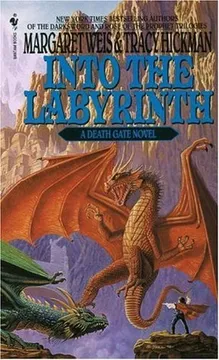


Plot Summary
Xar Finds the Seventh Gate
On Abarrach, the Patryn ruler Xar2 perfects the runes needed to raise the dead, hoping to turn corpses into soldiers without sacrificing his few living followers. The lazar Kleitus,9 a tormented Sartan corpse, tells him that living Sartan may still survive and reveals an old primer describing the Seventh Gate, where the worlds were divided.
Kleitus9 claims the dead know its location, but refuses to guide Xar2 unless Xar2 grants him release through death. Before Xar2 can press him further, Patryn guards bring in two prisoners: Samah,6 the Sartan leader responsible for the Sundering, and the eccentric old man Zifnab.8 Xar2 sees Samah6 as both an enemy to punish and a source of answers.
Xar’s first impulse is to convert knowledge into command: necromancy will supply troops, and the Seventh Gate may supply a greater instrument of rule. The dead challenge this arithmetic. Kleitus’s existence shows that a tool meant to serve the living can become a prison for both body and soul. Xar hears the warning but treats it as leverage rather than moral evidence. Samah’s arrival sharpens the conflict between historical responsibility and personal vengeance: the architect of the Patryn catastrophe is now vulnerable, but Xar’s need for information prevents simple retribution.
Samah Dies Twice
Xar2 interrogates Samah6 about the Seventh Gate while Sang-drax,7 Xar’s unsettling adviser,7 inflicts terror through magical visions. Samah6 admits that the Sartan feared the Patryns and intended the Labyrinth to weaken them, though he says they never meant it to become lethal. Near death, he manages to say that the Seventh Gate was sent away.
Xar2 kills him and immediately inscribes the necromantic runes, bringing him back as a lazar. The resurrected Samah6 refuses to answer, his will still resisting because Xar2 raised him before his soul had departed. Meanwhile Zifnab8 escapes his cell, leaving behind a dragon scale. The lazar Jonathon21 later frees Samah’s soul,6 and Xar2 realizes his experiment has not given him reliable control over the dead.
The experiment turns Xar’s ambition into an ethical and practical trap. He can animate a corpse, but the result is not a compliant soldier: Samah remains conscious enough to resist, and his soul suffers inside the body. The difference between technical success and humane success matters here. Xar celebrates the magic before understanding its cost, then dismisses the freed soul as a lost opportunity. Zifnab’s escape and the scale introduce a second kind of uncertainty. The threat is no longer merely the dead or the old Sartan; someone beyond Xar’s understanding is moving through his territory.
Marit Becomes Xar’s Eyes
Xar2 orders Marit,3 a disciplined Patryn survivor of the Labyrinth, to travel to Arianus and discover why Haplo1 has helped the mensch rather than advanced Xar’s campaign.2 Sang-drax7 claims that Haplo1 aided the dwarves in restarting the Kicksey-winsey and may be seeking power for himself. Xar2 sends Marit3 as a secret observer, then rune-joins with her so they can communicate across worlds.
Their bond is also a personal claim: Xar2 reveals that he once loved Haplo1 and expects Marit3 to kill him if his betrayal is confirmed. Marit3 accepts the duty, though she has her own history with Haplo1 and once left their child with Squatters. She departs for Arianus, carrying loyalty and private conflict together.
Xar’s rune-joining turns intimacy into infrastructure. A Patryn bond can share thought and strengthen trust, but Xar uses it to secure intelligence and obedience, treating closeness as both privilege and surveillance. Marit accepts because Xar rescued her from the Labyrinth and gave her life a structure built around loyalty. That history makes her consent meaningful but not uncomplicated. She is not simply an agent sent to judge Haplo; she is a person whose old attachment and present allegiance pull in different directions. The scene establishes how political control in this world often travels through the body itself, written into skin as magic.
Hugh Takes the Accursed Blade
On Arianus, Hugh the Hand4 returns to the Brotherhood after being shunned for failing to complete a previous killing. He tells Ciang, the guild’s ancient leader, that the Kenkari have bound him to a contract made for the dead Bane:20 he must kill Haplo,1 the Patryn who serves Xar.2 Hugh4 is shaken by having died and returned, and fears he has been left between life and whatever peace he briefly knew.
Ciang searches the Brotherhood’s forbidden armory and gives him an old rune-marked dagger called the Accursed Blade. Its power is uncertain, but a past user transformed it into a vast weapon and grew extra arms before dying of shock. Hugh4 takes it because Iridal,17 the woman he loves, may also be at risk.
Hugh’s return to the Brotherhood is not a bid to recover status so much as an attempt to recover a moral direction. His old profession supplied clear rules: accept a contract, perform the killing, accept the consequence. Now the contract comes from a dead child, and Hugh’s own experience of death has made that code feel inadequate. Ciang recognizes that his altered conscience is dangerous to the guild’s self-protective order. The blade offers an answer in the language Hugh understands, force, but its unstable magic mirrors the very loss of control that brought him to Ciang.
The Kicksey-Winsey Wakes
Marit3 reaches Drevlin and finds Haplo1 among human, elven, and dwarven leaders preparing to restart the Kicksey-winsey, the vast machine built by the Sartan. She hears that the races are attempting an alliance, but interprets their trust in Haplo1 as evidence that he has betrayed Xar.2
Hugh4 arrives separately in disguise and tests the Accursed Blade near Haplo;1 the weapon suppresses the Patryn’s warning runes. When Limbeck10 follows the Sartan instructions and turns the machine’s wheel, lightning activates the machinery.
Water rises from Drevlin and rains over the upper realms, easing the scarcity that has fueled generations of war. Haplo,1 still weakened by a wound to his heart-rune, returns to his ship, where Hugh4 ambushes him and reveals Xar’s supposed order to kill him.2
The machine’s return makes political peace materially possible: water, previously a scarce currency and cause of war, can now reach the upper worlds. Yet the new cooperation is fragile because it depends on trust in Haplo, precisely what Marit and Hugh have been taught to doubt. The blade’s test turns suspicion into a physical advantage by disabling the warning system Haplo relies on. The contrast is pointed: the Kicksey-winsey reconnects a divided world, while the assassin’s weapon narrows a person’s choices until only violence seems available. Progress and danger arrive together, not in separate chapters of history.
The Blade Chooses Its Victims
Hugh4 binds Haplo1 and prepares to kill him, but the dog16 tackles the assassin,4 causing Hugh4 to fall onto Haplo’s hidden dagger.1 Hugh4 dies, then returns to life with a Sartan rune on his chest, unable to remain dead or take another life. Haplo1 promises to find Alfred,5 the Sartan who can explain the mark. Before they can leave Arianus, Marit3 appears and claims Xar2 wants Haplo1 brought back.
Hugh4 recognizes a hidden dagger and warns Haplo;1 Marit3 attacks. The Accursed Blade becomes a giant bat, then a tytan, forcing the Patryns to combine their magic. They escape through Death’s Gate to Chelestra, where water nullifies their runes. The blade burns into Haplo’s hand1 until he submerges it, while dragon-snakes close around the breaking ship.
This encounter collapses several kinds of agency. Hugh cannot control the blade, Marit cannot trust her own divided loyalties, and Haplo cannot rely on the magic that usually protects him. His accidental killing of Hugh makes the assassin’s return to life a consequence, not a chosen rescue. The blade keeps changing form to fit the danger it perceives, turning fear into a weapon with its own appetite. Chelestra reverses the usual hierarchy: the Patryns’ greatest strength becomes useless in water. Haplo’s decision to use the sea against the blade is a practical act of survival that also exposes how much his power depends on conditions he cannot command.
Pryan Calls the Tytans
While Haplo’s ship1 is lost in Chelestra, the survivors inside Pryan’s citadel watch its Star Chamber awaken. The elf Paithan12 has studied the Sartan books, and the human Rega15 accidentally triggers the chamber’s machinery.
Its humming sound draws the blind, giant tytans toward the city. The five trapped survivors, including Paithan’s sister12 Aleatha,13 Rega’s brother15 Roland,19 and the dwarf Drugar,14 face starvation and quarrels over dwindling food. When Xar2 arrives seeking the Seventh Gate, tytans surround him and block his way into the citadel.
Zifnab’s dragon8 drives the monsters back, while the dragon confronts Sang-drax.7 Their true forms emerge in the struggle, and both vanish. Xar2 is left inside the citadel without his ship, which Sang-drax7 has taken.
The Star Chamber links Pryan’s local survival crisis to the larger machinery of the worlds. Its signal gives the tytans a destination, but the people who activate it do not understand its full function. Paithan’s imperfect scholarship and Rega’s accidental action show knowledge arriving through curiosity rather than mastery. Inside the citadel, scarcity repeats the old social fracture in miniature: five people cannot agree on food, trust, or responsibility, even while hoping for rescue. Xar’s arrival does not resolve their danger; instead, the dragon and Sang-drax’s revealed forms expose a conflict that dwarves, elves, and humans cannot yet interpret.
Zifnab Remembers Earth
Stranded in the citadel, Xar2 tries to learn where the Seventh Gate lies and why Sang-drax7 has taken his ship. Zifnab,8 repeatedly interrupting his own thoughts with jokes and borrowed identities, tells Xar2 that the dragon-snake is steering him away from the Gate and will not return Haplo’s body.1 He then recalls that he opposed Samah’s plan6 to divide the world.
Left behind on Earth, he witnessed cities, forests, and oceans destroyed in the Sundering; Samah6 later sent him to the Labyrinth, from which he escaped. Xar2 also learns that Zifnab’s work8 helped shape the Nexus. The revelation unsettles Xar,2 but Zifnab’s memories8 are broken by madness, leaving the lord with history but no dependable guide.
Zifnab’s scattered speech is not mere comic relief; it is the damaged form in which unbearable memory can survive. His account restores the civilians erased by Samah’s language of necessity. The Sundering was not an abstract reordering of worlds but a catastrophe witnessed by someone who had wanted to stop it. Xar receives this history at a moment when he is tempted to repeat Samah’s logic on a larger scale. Yet the revelation does not transform him instantly. He remains hungry for the Gate, illustrating how knowledge can expose a pattern without automatically breaking it.
Alfred Names the Prison
Alfred5 rescues Haplo,1 Hugh,4 Marit,3 and the dog16 from the wreck on Chelestra and brings them to a white, rune-covered sanctuary in the Vortex. Haplo1 wakes to find his burned hand healed and Marit3 alive, but distrust remains between them. Alfred5 explains that the sanctuary is the Vortex, the center of the worlds, and that the Chamber of the Damned on Abarrach is the Seventh Gate: the place where the Sartan created the four worlds before sending the chamber into oblivion.
Hugh4 learns that the rune Alfred5 placed on him prevents him from killing or dying, and that the Kenkari likely sent him to locate Alfred.5 Alfred5 believes the Seventh Gate may free Hugh,4 but admits he cannot leave the Vortex by the ordinary gate.
The Vortex changes the scale of the characters’ predicament. They are not simply stranded in another world; they are at the center of a system whose origin and destructive power have been hidden from them. Alfred’s explanation makes creation and destruction inseparable: the same chamber that formed the worlds could undo them. Hugh’s condition further complicates the moral order, because an imposed rescue has become an imposed punishment. The Kenkari’s role suggests that institutions claiming to protect the dead may also manipulate the living. Alfred can explain much, but his knowledge does not provide an easy exit.
They Enter the Labyrinth
Hugh4 discovers a path from the Vortex to a vast cavern marked by the First Gate, the beginning of the Labyrinth. Haplo1 recognizes the place as the prison where Patryns have been born, struggled, and died for generations. He reveals that his child lives somewhere inside and says he had already intended to return for her.
Marit3 recoils at the prospect of enduring the Labyrinth again, but eventually agrees to go with him. Hugh4 follows because the journey may lead to freedom from his Sartan mark. Alfred5 refuses to join them, believing he belongs in the Vortex. As the three travelers set out among the deadly forks, Haplo1 sends the dog16 back toward Alfred,5 hoping to bring the hesitant Sartan after them.
The return to the Labyrinth turns an abstract history of imprisonment into a chosen, immediate risk. Haplo’s motive is not conquest or revenge but a child he has not raised, making the journey a test of whether care can survive the world that taught Patryns to distrust attachment. Marit’s reluctance is equally concrete: she has already escaped once and knows what the prison takes from those inside it. Hugh joins for a different reason, seeking release from an involuntary condition. The group is bound by need rather than reconciliation, and the supplied text ends before their first challenge or the Vortex’s final outcome is shown.
Analysis
In the supplied text, power repeatedly arrives with an overlooked cost. Xar2’s necromancy can move a corpse, but it cannot make the trapped soul willing or whole. Samah6’s account of the Labyrinth reveals how fear can be built into institutions and then mistaken for necessity. Zifnab8’s memory of the Sundering sharpens the indictment: the worlds were created through a decision that treated civilian lives as expendable, and Xar2 risks repeating that logic while claiming to protect his people.
The novel also gives political change a material test. On Arianus, water has served as currency and a reason to fight; restarting the Kicksey-winsey makes cooperation more than a moral aspiration. Yet the same technological awakening attracts the tytans, so progress does not erase danger. It changes the conditions under which danger must be met. Haplo1’s willingness to help the mensch therefore matters not because he has become innocent or infallible, but because he acts beyond the narrow loyalty Xar2 expects.
The intimate plots echo these public conflicts. Xar2 turns a rune-bond into surveillance; Marit3 guards herself against attachment; Hugh4 discovers that professional rules cannot settle what he owes the living or the dead. Their struggles suggest that freedom is not simply escape from a prison or mastery of magic. It requires accepting relationship and responsibility without trying to control every consequence.
The supplied book text ends as Haplo,1 Marit,3 and Hugh4 enter the Labyrinth in search of Haplo’s child.1 Their journey and the novel’s final resolution are not included in the document, so this summary stops at that threshold rather than inventing an ending.
Review Summary
Into the Labyrinth receives mixed reviews, with many praising its second half and the exciting Labyrinth sequences, while criticizing the slow first half. Readers appreciate the character development of Haplo and Alfred, and enjoy the series' unique world-building. Some find the introduction of Marit late in the series unnecessary, and certain plot inconsistencies frustrate dedicated fans. The cliffhanger ending earns widespread acclaim, leaving readers eager for the final installment. Overall, it's considered a solid penultimate entry despite pacing issues.
Characters
Haplo
Labyrinth-born Patryn leaderHaplo is Xar’s skilled Patryn servant2, a survivor of the Labyrinth whose journeys across the worlds have made him question the certainty of his orders. He is capable, guarded, and accustomed to treating magic as both weapon and protection, yet his choices increasingly involve people outside his own kind. His bond with his dog16 reveals a tenderness he rarely explains, while his concern for a child gives his private life a weight that his public duties cannot absorb. Haplo tends to act before he can fully articulate what he believes, then accepts the danger of those choices. His central tension is between loyalty to the leader who saved him2 and responsibility for what that leader2 may unleash.
Xar
The conquering Patryn lordXar, Lord of the Nexus, rescued many Patryns from the Labyrinth and commands their intense gratitude. He is formidable, strategic, and deeply shaped by the suffering he endured and witnessed there. His desire to protect his people is genuine, but he increasingly equates protection with control, gathering armies and seeking the Seventh Gate’s power. Xar rarely exposes vulnerability except when someone he loves appears disloyal; even then, he tries to turn emotional pain into a plan. His authority depends on being seen as the person who knows what must be done. That certainty is both his strength and the weakness that makes warnings from Haplo1, Samah6, and Zifnab8 difficult for him to accept.
Marit
The guarded Patryn scoutMarit is a former Runner, trained by the Labyrinth to trust her own instincts and keep moving when despair makes surrender seem sensible. She is disciplined, capable, and fiercely loyal to Xar2, whose rescue gave her a reason to serve beyond mere survival. She is also emotionally guarded; closeness feels dangerous because it can create needs that the Labyrinth may exploit. Marit favors action over explanation and often treats vulnerability as a risk to be contained. Her assignment to watch Haplo1 tests the boundary between her devotion to Xar2 and her own judgment. She is most revealing when she tries to make duty simple, even as the people and memories involved refuse to stay simple.
Hugh the Hand
The conscience-struck assassinHugh is a celebrated member of Arianus’s Brotherhood, a professional killer whose reputation rests on patience, nerve, and exact execution. His encounter with death and forgiveness has unsettled the rules that once made his work feel manageable. He still understands contracts and honor, but he is no longer certain that obedience can excuse what he does. His feelings for Iridal17 and his concern for Bane20 draw him into obligations that conflict with his identity as an assassin. Hugh uses bluntness and dry humor to cover exhaustion, yet he is unusually willing to admit fear when the old certainties fail. He approaches danger with professional skill, even when he no longer knows what survival would mean.
Alfred
The anxious Sartan healerAlfred is a Sartan whose immense magical abilities sit uneasily beside his nervous, self-effacing manner. He often appears confused or physically awkward, and his memory is not always dependable, but he carries knowledge that reaches back to the making of the worlds. Alfred is troubled by the consequences of Sartan choices and by the possibility that his own magic has harmed people while trying to help them. He responds to suffering with compassion, though shame can make him retreat rather than act. His relationships with Haplo1 and Hugh4 are strained by secrets and unintended consequences, but he continues to offer care. Alfred embodies the difficulty of taking responsibility when one’s power exceeds one’s understanding.
Samah
The burdened Sartan patriarchSamah led the Sartan Council of Seven and helped decide the fate of the Patryns and the divided worlds. He is accustomed to making decisions in the name of collective safety, but his confidence has been shaken by the human cost of those decisions. His explanations reveal a man who can acknowledge error without escaping responsibility for it. The authority he once held cannot protect him from the consequences he set in motion.
Sang-drax
Xar’s unnerving adviserSang-drax serves as Xar’s personal assistant and adviser2, presenting himself as useful, deferential, and keenly informed. He knows how to direct attention toward opportunities that appeal to Xar2, especially military advantage. His polished courtesy is paired with a disturbing intensity that leaves even loyal Patryns uneasy. Sang-drax is a reminder that political counsel can be a form of influence, particularly when a ruler mistakes agreement for loyalty.
Zifnab
The evasive old wizardZifnab is an elderly Sartan whose odd jokes, apparent forgetfulness, and sudden flashes of insight make him difficult to judge. He often seems to evade questions by losing the thread, yet he carries memories that reach farther back than the other characters’ histories. His eccentricity is not simply a mask; pain and confusion genuinely interrupt what he can say. Zifnab’s humor gives him a way to approach truths too terrible to hold steadily, while his concern for others shows through his baffling manner.
Kleitus
The tormented dead rulerKleitus was the Dynast of Necropolis before becoming a lazar, a being caught between bodily existence and the restless soul. He still carries the habits of authority, but death has reduced his ambitions to hatred of the living and longing for release. His knowledge of Sartan history makes him valuable to Xar2, though his motives remain governed by resentment. Kleitus shows the personal cost of Abarrach’s necromancy more clearly than any book can.
Limbeck
The questioning dwarf reformerLimbeck is a dwarf leader whose curiosity has led him to challenge the explanations his people inherited. He is nearsighted, earnest, and sometimes comically literal, but his questions have helped make cooperation among the races imaginable. Limbeck trusts careful study and shared work more than inherited rank. His optimism does not mean he fails to see danger; it means he believes ignorance and fear can be confronted rather than obeyed.
Jarre
The practical dwarf partnerJarre is Limbeck’s partner10 and a capable, clear-eyed participant in the dwarves’ political and technical changes. She helps interpret the Sartan instructions and keeps Limbeck10 grounded when excitement threatens to carry him away. Jarre is more practical than he is, but she shares his commitment to a future in which dwarves are not defined by subordinate labor. Her affection is direct, and her judgment often supplies the caution that his enthusiasm lacks.
Paithan
The stranded elven observerPaithan is an elf trapped in a Pryan citadel with dwindling supplies and a handful of uneasy companions. He reads Sartan books more readily than the others and is fascinated by the citadel’s machinery, though he does not fully understand it. His curiosity can look like self-absorption, particularly when the people around him need practical reassurance. Paithan is also capable of recognizing that survival depends on cooperation, even when the personalities closest to him make it difficult.
Aleatha
The wounded elven flirtAleatha is Paithan’s beautiful, sharp-tongued sister12, accustomed to using charm and provocation to manage attention. Her flirtation with Roland19 lets her control the terms of intimacy while keeping deeper attachment at a distance. Underneath that performance is a fear of abandonment and a history of losses she rarely acknowledges plainly. In the citadel, boredom and confinement intensify her need to feel seen, but her relationships with the other survivors reveal flashes of compassion and uncertainty.
Drugar
The solitary dwarven survivorDrugar is a reserved dwarf whose people have been devastated by the tytans. He carries grief as suspicion and is slow to trust the humans and elves who once left his kind exposed. His silence is often mistaken for hostility, though he watches carefully and acts when others hesitate. Drugar’s admiration for Aleatha13 is restrained by an awareness of their differences and by his own sense of dignity. He offers steadiness in a group prone to quarrels.
Rega
The stubborn human survivorRega is Roland’s sister19 and Paithan’s human partner12, practical enough to distrust unfamiliar machinery and brave enough to intervene when others are in danger. She is emotionally direct, often more willing than Paithan12 to state what she fears or needs. Her relationships with both men are shaped by affection and friction, while life in the citadel forces her to confront how little control any of them have. Rega’s courage is not the absence of fear; it is the decision to act while afraid.
The Dog
Haplo’s loyal companionHaplo’s dog1 is his constant companion, alert to danger and unusually attentive to his master’s1 changing moods. Its appetite and simple affection provide comic relief, but it also acts decisively when Haplo1 is threatened. The dog’s loyalty is physical and immediate: it follows, warns, comforts, and sometimes intervenes before the people around it understand what is happening.
Iridal
The grieving mysteriarchIridal is a powerful mysteriarch whose life has been marked by painful choices and personal loss. She is composed in public, but grief remains visible in the guarded way she moves through the world. Her connection to Hugh4 gives his struggle a human center beyond his contract, while her presence among the Kenkari suggests a desire to put magical knowledge to constructive use. Iridal’s restraint is not indifference; it is a way of continuing after events she cannot undo.
King Stephen
The pragmatic human kingStephen rules the human lands of Arianus and supports peace with the elves, even as his people remain suspicious. He understands that a treaty cannot erase generations of prejudice at once. His manner is blunt and practical, and he balances public authority with affection for Queen Anne and their child.
Roland
The combative human survivorRoland is Rega’s brother15, an impulsive human whose pride and temper repeatedly collide with Paithan’s12 and Aleatha’s13. Confinement sharpens his suspicion of the others, but his bravado often covers uncertainty. His attraction to Aleatha13 complicates the bickering he uses to keep emotional distance.
Bane
The prince behind Hugh’s contractBane is a child whose choices have shaped the loyalties and obligations of adults around him. Hugh4 accepted a contract connected to Bane, and the consequences continue to direct the assassin’s path. Bane’s place in the story raises questions about responsibility, upbringing, and how far a person can be held accountable for harm.
Jonathon
The merciful Abarrach lazarJonathon is a lazar who understands the torment of being trapped between body and soul. Unlike Kleitus9, he treats release as compassion rather than defeat. His quiet intervention gives Xar’s experiment2 a consequence the Patryn ruler did not intend.
Plot Devices
Death’s Gate
World-to-world passageDeath’s Gate connects the divided worlds and allows travelers to choose among them through a shifting display of destinations. Haplo1 and Marit3 use it to escape immediate danger, but each passage depends on the traveler’s ability to navigate its magic. The Gate makes the worlds feel connected while also exposing how little any one character controls the route. It carries the characters into Chelestra, Pryan, and the Vortex, turning movement itself into a source of risk and discovery.
The Accursed Blade
A weapon that choosesThe rune-marked dagger is an ancient Sartan weapon designed to oppose Patryns. It responds to danger by changing shape, limits the user’s available choices, and can interfere with Patryn defensive magic. Hugh4 carries it without understanding its full power, and it shifts from knife to ax, bat, and tytan as the conflict escalates. Its magic feeds on the bearer’s fear and is difficult to control. Chelestra’s water eventually extinguishes its power when Haplo1 forces it beneath the surface.
The Seventh Gate
Creation’s hidden chamberThe Seventh Gate is the chamber where the Sartan divided the original world and formed the four worlds. Samah6 sent the chamber into oblivion because he feared its power could be used to destroy what it had created. Abarrach’s Chamber of the Damned is connected to that hidden place, and both Xar2 and Haplo1 seek its meaning for different reasons. The Gate is not merely a destination: it concentrates the moral danger of repeating the Sundering’s logic, using overwhelming power to impose a supposedly better order.
The Kicksey-winsey
Water and worlds reunitedThe Kicksey-winsey is a vast Sartan machine on Drevlin, built to gather water and influence the alignment of the worlds. The dwarves have preserved its operating instructions across generations, though they do not initially understand the machine’s larger purpose. With Haplo’s help1, Limbeck10 and Jarre11 use the Sartan book to restart it. Lightning activates its mechanisms, a fountain sends water to Arianus, and the distant continents begin to shift. The machine makes peace materially possible but also summons the tytans through the related signal from Pryan’s Star Chamber.
Patryn Rune Magic
Power written on skinPatryn magic is inscribed across the body in runes that can protect, attack, and alter what is possible. Xar’s rune-joining2 with Marit3 creates a channel for thought across worlds, while Haplo’s markings1 ordinarily warn him of danger and defend him. The magic is powerful but not universal: the Accursed Blade can suppress it, and Chelestra’s water can nullify it. These limits prevent the Patryns from treating power as an absolute guarantee and make their bodily marks a visible record of both identity and vulnerability.
About the Author
Other books by Margaret Weis

Download PDF
Download EPUB
.epub digital book format is ideal for reading ebooks on phones, tablets, and e-readers.








