

Key Takeaways
Secular historians broadly accept Jesus existed; the harder question is what follows.
The debate is narrower than it sounds. Popular claims that Jesus may never have lived do not represent the position of the major secular reference works Dickson surveys. The Oxford Classical Dictionary, Cambridge histories of antiquity and Judaism, Brill’s New Pauly, and a major collection of inscriptions treat Jesus as a real Jewish figure who was executed under Pontius Pilate. Their basic account is a teacher and reputed healer whose public activity ended in crucifixion.
Consensus is not proof. These are scholarly summaries, not independent eyewitnesses, and agreement cannot settle every detail or establish Christian doctrine. But the consensus matters: historians who do not share Christian commitments still judge Jesus’ existence and the broad outline of his life to be historically secure.
What's important is the distinction between a fringe position and a live scholarly dispute. Expert consensus is not infallible, but it is a rational shortcut when specialists use shared methods and remain open to criticism. The strongest use of this point is modest: it rebuts the claim that Jesus’ nonexistence is a mainstream academic conclusion. It does not transfer the experts’ authority to claims about divinity or resurrection, which require separate arguments.
Treat ancient history as incomplete evidence, not an unknowable past.
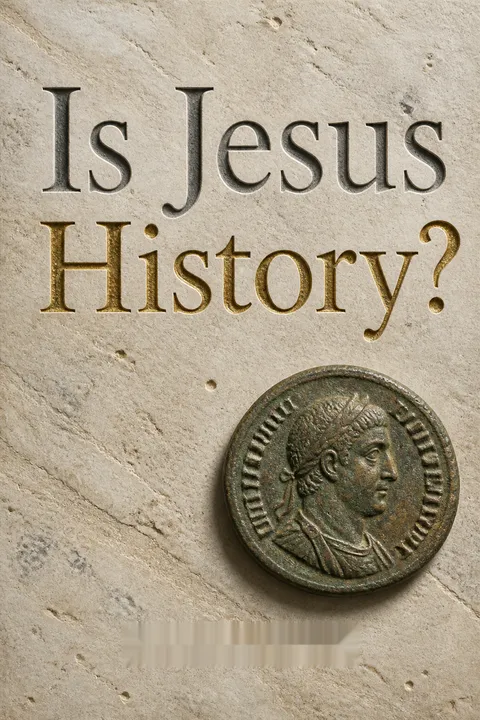
Fragments can still inform. Dickson’s Roman denarius, a coin struck during Tiberius’ reign, makes the past tangible: its metal, portrait, and inscription survive from the same world in which Jesus lived. The coin cannot tell its full story, but it can establish facts about Roman rule, imperial imagery, and the period in which it circulated.
Survival is uneven. The author estimates that less than one percent of ancient remains survive. Yet coins, inscriptions, buildings, and scattered writing can still reveal leaders, customs, prices, and particular lives. Pliny the Younger’s letters, for example, offer intimate glimpses of an aristocrat’s work and marriage, while no personal letters from Tiberius survive. Ancient history is therefore both patchy and informative: missing evidence limits certainty, but does not erase what remains.
The coin is a useful reminder that historical knowledge is built from traces rather than a complete recording. Archaeology and documentary history often work by convergence: a material object establishes a setting, while texts suggest what people did within it. The danger lies in turning a plausible reconstruction into a confident narrative about details no source preserves. Good historical writing makes the boundary visible between what an artefact shows and what imagination merely supplies.
Trust testimony critically, because almost all knowledge depends on other people.
Trust is ordinary, not irrational. People rely on testimony to learn about events they did not witness, from family news to school history to scientific findings. Historians do the same with ancient documents. Dickson argues that faith can mean reasoned trust in evidence or a witness, rather than belief without evidence.
Test the witness and the report. Historians ask whether an author could know the information, whether the author seems to report in good faith, whether the claims fit the known setting, and whether other sources broadly corroborate them. These questions resemble how a court assesses testimony. Trust should be calibrated, not automatic: an error in one detail may lower confidence in that detail without making an entire source worthless.
This approach avoids two bad extremes: accepting every inherited claim and demanding direct observation for everything. Testimony is a social technology for passing knowledge across time and expertise. Its reliability depends not only on a speaker’s honesty but also on access, memory, incentives, and independent checks. The courtroom analogy is helpful, though historical sources cannot usually be cross-examined, and historians often lack the additional evidence available in a modern trial.
Audit your preferred Jesus before deciding what the sources say.
Interpretation has motives. In the Enlightenment, Reimarus pictured Jesus as an anti-Roman rebel, Strauss treated Gospel miracles as symbolic myth, and Renan portrayed Jesus chiefly as a gentle moral teacher. Dickson argues that these portraits often reflected their authors’ own intellectual ideals more than the whole ancient record. Albert Schweitzer challenged this habit by insisting that scholars take the sources and Jesus’ Jewish setting seriously, even when the resulting portrait feels unfamiliar.
Doubt can be partisan too. Drawing on Aristotle’s account of persuasion and Jonathan Haidt’s work on moral psychology, Dickson warns that people often form intuitive commitments before assembling arguments. Intelligence may make someone more skilled at defending a position without making them better at seeing the opposing case.
The strongest implication is symmetrical self-suspicion. Religious readers can domesticate Jesus into a confirmation of doctrine, while sceptical readers can dismiss evidence that unsettles their assumptions. The discipline is not to pretend to have no commitments, but to ask what would count against a favored interpretation. Psychological explanations of belief do not decide whether a claim is true; they explain why evidence may be assessed unevenly, even by articulate and educated people.
Read Jesus inside first-century Judaism, not through modern political wish lists.
Context makes a portrait testable. Contemporary historical work assesses whether Gospel accounts fit the politics, customs, and religious debates of Jesus’ world. The Dead Sea Scrolls show that Jews argued about what Sabbath rest allowed. One strict community forbade rescuing even a person from a pit; Jesus’ reported defense of helping someone in danger fits the same live controversy and suggests a more permissive stance.
The kingdom was this-worldly hope. Jewish writings before Jesus used God’s kingdom language for justice and the overthrow of oppressive rule. The Gospels present Jesus in that conversation, while also depicting him as challenging violent expectations and welcoming the humble and outsiders. His Last Supper language about a sacrificial death also has context in Jewish texts that describe righteous martyrs as atoning for their people.
Historical plausibility is stronger than cherry-picking sayings that seem modern or convenient. A teacher becomes intelligible when placed among real arguments of his time, including arguments he may have resisted. Context, however, supports probability rather than proof of exact wording: a debate’s existence cannot establish precisely what Jesus said. It can show that the reported exchange belongs to a credible historical world rather than an obviously foreign one.
Paul's letters preserve a Jesus tradition within years, not centuries.
Paul is early evidence. His letters, written in the 50s and 60s, are earlier than the Gospels. Though they are not biographies, they assume readers already know details about Jesus: his Jewish background, brothers, teaching on marriage, final meal, crucifixion, burial, and reported appearances. Paul had met Peter and James, Jesus’ brother, and says that he received and passed on a concise summary of Christian belief.
The summary predates the letter. In 1 Corinthians, Paul repeats a tradition about Jesus’ death, burial, resurrection, and appearances. Scholars commonly place its formation within months or a few years of Jesus’ death. It shows that these claims were circulating early, though early circulation alone does not verify them. Paul’s letters are valuable partly because their passing references suggest that the Gospel narratives did not arise in a historical vacuum.
Paul’s letters are an unusual source: their incidental references can reveal what a community already knows, even when the writer’s purpose is unrelated to biography. This is a form of indirect evidence, and it is powerful precisely because the claims are woven into practical correspondence rather than presented as a full life story. Still, early belief establishes the age of a claim, not its truth. The distinction matters especially when the claim concerns a miracle.
Compare ancient sources by date, transmission, and corroboration, not by religious label.
Different figures leave different records. Alexander’s best surviving biography, by Arrian, was written about four centuries after Alexander’s death, though Arrian drew on earlier accounts now lost. The Gospels were written roughly 30 to 70 years after Jesus’ death, and their authors also used earlier material. Date matters, but it is only one test of reliability.
Transmission can be checked. Dickson notes roughly 5,500 Greek New Testament manuscripts, far more than survive for most ancient authors. Their variations help scholars reconstruct the text, but abundant copies do not prove the events described. Non-Christian writers add limited corroboration: Tacitus associates Jesus’ execution with Pilate, while Josephus mentions Jesus and his brother James. A Christian scribe appears to have altered part of Josephus’ passage, a reminder that texts need scrutiny, not blanket acceptance or rejection.
This comparison usefully corrects an uneven standard: religious sources should not be dismissed simply for being religious, any more than Roman historians are dismissed for writing from a Roman perspective. But source count, textual stability, and event accuracy are different questions. Many manuscripts can show what a text said, not whether its narrative is true. The best historical case comes from several kinds of evidence converging, while keeping each kind’s limits distinct.
Archaeology turns Gospel scenery into testable claims about Jewish Galilee.
Specific details can be checked. The Gospel of John describes a Jerusalem pool with five covered colonnades. After earlier searches found no such site, excavations in 1957 to 1962 uncovered a pool with the described arrangement. An inscription from Caesarea also confirms Pontius Pilate’s title as prefect, correcting Tacitus, who uses a later administrative title.
The wider setting matters more. Finds in Galilee include synagogues, ritual baths, limestone vessels associated with Jewish purity practices, Jewish burials, and a striking absence of pig bones at some sites. Together, these details support the Gospels’ picture of a strongly Jewish region. Archaeology also shows that Greek was used among Jews in the period, weakening the claim that Greek Gospel writing must reflect a distant, non-Jewish retelling.
Archaeology is most persuasive when it tests mundane context rather than claiming to prove a theological event. A pool, an official title, or local burial customs can expose an author’s geographical or cultural knowledge. The absence of an artefact is much harder to interpret, since excavation is incomplete and preservation is uneven. Material evidence therefore works best as a constraint on literary interpretation, not as a shortcut from a matching detail to total historical accuracy.
Treat the resurrection as a historical puzzle, not a laboratory result.
The evidence is testimonial. Dickson argues that the empty-tomb tradition appears in multiple early sources, including Paul’s summary and Gospel accounts. The accounts identify women as the first discoverers, despite women’s testimony being discounted in that society. Paul’s early list also names several people said to have encountered Jesus after his death, including former sceptics James, his brother, and Paul himself.
Evidence and explanation differ. Historians can assess whether people sincerely reported experiences and whether the tomb was probably found empty. They cannot reproduce a past event in a laboratory. The sources support the claim that early followers believed they saw Jesus alive; whether this resulted from divine resurrection or another explanation depends partly on prior beliefs about what the universe permits.
The distinction between historical evidence and scientific repeatability is essential: unique past events are not testable like recurring experiments. Yet sincerity is not a guarantee of accuracy, and costly commitment does not rule out misperception or mistaken interpretation. The argument is strongest when it establishes what the earliest witnesses claimed and how early they claimed it. Moving from those findings to a supernatural cause requires philosophical assumptions that historical method alone cannot supply.
History can establish good testimony, but cannot compel belief in Jesus as God.
Evidence does not erase interpretation. The book closes with James, a magistrate facing terminal cancer who examined the Gospels and Paul’s letters as a judge might assess witnesses. He came to regard the accounts of Jesus, including the resurrection, as good testimony, though he retained questions and did not simply adopt every Christian claim. The story embodies the book’s central distinction: historical inquiry can make a case for a real person and credible reports, but it cannot by itself settle every religious conclusion.
Self-awareness matters too. Dickson argues that life experience, philosophical commitments, social loyalties, and emotion affect how people weigh evidence. The invitation is not to suspend critical judgment, but to apply it both to the sources and to the assumptions brought to them.
James’s story gives the argument human stakes without turning a deathbed decision into proof. His legal background makes the comparison between historical judgment and testimony vivid, while his remaining doubts prevent the narrative from becoming a simplistic conversion tale. The broader lesson is that evidence can rationally shift a person’s position without dictating a single response. Intellectual honesty includes acknowledging both the reach of historical reasoning and the beliefs it cannot independently establish.
Analysis
Dickson’s central achievement is methodological: he asks readers to apply ordinary historical standards to Jesus rather than exempting the subject from scrutiny or demanding that religious sources meet an impossible standard of direct observation. His comparisons with Alexander, Tiberius, Tacitus, and Josephus make ancient evidence feel less exceptional. The strongest part of the case is cumulative. Early Christian writings, traditions embedded in Paul’s letters, non-Christian references, and archaeological context converge on a basic portrait of a Jewish teacher executed under Pilate.
That convergence supports a historical conclusion, but it does not make every source equally reliable or every claim equally probable. Manuscript abundance helps establish the wording of texts; it cannot verify the events they narrate. A source can be early and sincere yet mistaken. Nor does scholarly acceptance of Jesus’ existence entail acceptance of Christian theology. The book generally marks this boundary, especially when it distinguishes evidence that people reported appearances from the explanation that Jesus was raised by God.
The treatment of bias is also valuable because it applies to scepticism as well as belief. Still, diagnosing motivated reasoning should not become a substitute for evaluating an argument. A person’s commitments may explain why a conclusion feels attractive, but they do not determine whether it is true. The same caution applies to appeals to consensus: they are informative when experts share methods and evidence, but they remain revisable.
The book is best read as a case for historical seriousness, not as a proof that compels Christian belief. Its strongest conclusion is that the Gospels and Paul’s letters deserve engagement as historically relevant sources, and that Jesus’ existence and broad public career are not serious puzzles in contemporary scholarship. Its more ambitious invitation, to consider the resurrection as a live explanation, depends on philosophical premises about miracles that history can expose but cannot settle alone.
Review Summary
Is Jesus History? receives mostly positive reviews, with readers praising its accessibility, historical approach, and engaging writing style. Many find it a helpful introduction to the historical evidence for Jesus, appreciating Dickson's balanced perspective and use of primary sources. Some reviewers note its concise nature and recommend it for those new to the topic. A few criticisms include occasional use of Christian jargon and lack of critical analysis of certain viewpoints. Overall, readers find the book informative and thought-provoking, with a 4.30/5 rating on Goodreads.
Glossary
Historical Jesus
Jesus studied historicallyThe historical Jesus is Jesus of Nazareth as reconstructed through historical sources and methods, rather than as defined by later doctrine alone. Scholars assess writings about him alongside evidence for the politics, culture, language, and religion of first-century Galilee and Judaea. The method can support broad conclusions without confirming every saying or event.
criterion of historical plausibility
Contextual fit testA method for judging whether a report about Jesus fits what is known about the time and place in which he lived. Historians compare Gospel accounts with first-century Jewish writings, customs, politics, and archaeology. A strong fit makes a claim more plausible, but does not prove that a particular event or exact wording occurred.
criterion of double dissimilarity
Dissimilarity-based testAn approach that treated Gospel material as especially likely to come from Jesus if it seemed unlike both Judaism before him and Christianity after him. The logic was that neither Jewish predecessors nor Christian followers would be likely to invent such material. Critics argue that this isolates Jesus from the traditions and communities that shaped his life.
third quest
Context-centered Jesus researchThe name commonly given to a modern phase of historical Jesus research that places Jesus within the full setting of first-century Judaism. Rather than selecting sayings that seem unlike both Judaism and Christianity, scholars assess the overall Gospel portraits against the period’s writings, politics, culture, geography, and archaeology.
Q
Reconstructed sayings sourceQ, from the German word Quelle, meaning source, is a proposed collection of Jesus’ sayings used by Matthew and Luke. It is not a surviving manuscript. Scholars infer its existence from material shared by those Gospels that does not appear in Mark. Its proposed date and precise contents remain matters of scholarly reconstruction.
oral tradition
Remembered and retold materialOral tradition is information passed between people through speech and memory before, or alongside, written accounts. In the early Christian setting, teachers could pass on summaries and stories for students to learn and repeat. Retellings may preserve a stable core while varying in wording and detail; variation alone does not establish either invention or perfect accuracy.
Download PDF
Download EPUB
.epub digital book format is ideal for reading ebooks on phones, tablets, and e-readers.








