

Key Takeaways
Treat October 7 as a test of Israeli security and Western moral clarity
A shock with two fronts. Hammer begins with two places of mass death: Treblinka, where nearly one million Jews were murdered, and Kfar Aza, an Israeli community attacked by Hamas on October 7, 2023. At Kfar Aza, amid ruined homes and photographs of the dead and hostages, he encounters Orthodox men singing with soldiers and visitors. The moment becomes his image of Jewish endurance: grief does not erase a people’s determination to live. The attack killed about 1,200 people in Israel and took 247 hostages, according to the book.
The response matters too. Hammer argues that the massacre exposed security failures and shattered assumptions that Hamas could be restrained with money or incentives. He is equally alarmed by reactions abroad, including antisemitic harassment and campus leaders’ failure to clearly condemn calls for Jewish genocide. He reads these reactions as evidence of a deeper Western crisis.
The opening links physical vulnerability to a crisis of public judgment: societies reveal their principles not only through what they condemn, but through whom they protect. The singing at Kfar Aza offers a vivid counterpoint to images of destruction, showing communal ritual as a way of sustaining identity under trauma. Yet the book’s broad claim that hostility to Israel signals civilizational collapse requires careful testing. Protests, antisemitic threats, and criticism of Israeli policy are not interchangeable. Distinguishing them is essential both for protecting Jews and for preserving open political debate.
Ground human dignity in Sinai, not only in modern political theory
A theological foundation. Hammer’s central intellectual claim is that Western civilization rests on Jewish revelation at Mount Sinai. In his account, the Torah’s divine origin gives moral law authority beyond individual preference, while the teaching that humanity is made in God’s image gives each person inherent dignity. He contrasts this with pagan self-worship and with the idea that reason or science alone can determine what is right. Science can describe patterns in the natural world, he argues, but cannot by itself settle moral questions.
A universal minimum. The book also points to the Seven Noahide Laws, a Jewish account of basic duties for non-Jews: prohibitions on idolatry, blasphemy, murder, theft, and certain sexual relations, plus rules against eating flesh taken from a living animal and a requirement for courts. Hammer sees them as a foundation for justice beyond the Jewish community.
This argument usefully separates empirical knowledge from moral judgment. Data can show what an action causes, but deciding which outcomes matter involves values that measurement alone cannot supply. Religious traditions offer one source of those values, and the Noahide framework makes the book’s claim more than a story about Jewish inheritance: it proposes a universal ethical floor. The difficult question is how a plural society adjudicates competing accounts of revelation. A shared moral vocabulary can strengthen civic life, but public rules also need reasons accessible to citizens who do not share the same theology.
Hold individual dignity and communal duty together
Law shapes character. Hammer presents Halacha, Jewish law, as more than rules for worship. It is a comprehensive way of life meant to form ethical habits and maintain a relationship with God. The book connects this tradition to the Golden Rule, the duty to prevent harm, and the idea that each human life has unique worth. It contrasts this with utilitarianism, which assesses actions by their aggregate consequences, and with libertarian accounts of freedom that give priority to individual choice.
Neither isolated nor disposable. The Jewish framework, as Hammer describes it, holds individuals responsible for their communities while refusing to treat a person as expendable for a larger benefit. Maimonides’ emphasis on repeated good deeds illustrates how conduct trains character. The book also stresses a tension within this outlook: people have duties to others, but their own lives matter too. Freedom is framed less as escape from obligations than as the capacity to fulfill them.
The strongest feature of this framework is its resistance to two reductions: treating people as units in a social calculation, or imagining them as detached individuals without inherited obligations. Virtue ethics and civic republican thought make a similar point: habits and institutions can cultivate citizens capable of sustaining shared goods. The tension is real, however. Communities can use moral language to protect the vulnerable, but also to police difference. The practical test is whether communal duties preserve individual dignity in concrete cases, rather than merely invoking it as a principle.
Trace America's civic inheritance through Jewish scripture and law
A history of influence. Hammer calls the use of Hebrew biblical ideas in political thought “Political Hebraism.” He argues that Jewish texts and legal traditions shaped the English common law and the American political imagination. The book points to the common-law practice of precedent, which it connects to rabbinic legal reasoning, and to the influence of the Hebrew Bible on figures such as John Selden, who studied the Talmud while imprisoned in the Tower of London.
Founding-era examples. The Pilgrims imagined their migration through the story of the Israelites’ Exodus. Benjamin Franklin proposed Moses parting the sea as a possible national seal, while George Washington assured Newport’s Jewish community that religious liberty extended to them. John Adams praised the Jewish contribution to civilization and expressed support for an independent Jewish nation in Judea. Hammer’s point is that American political ideals did not emerge from Enlightenment reasoning alone.
This historical lens corrects a familiar blind spot: political traditions are often described through their later theorists while their scriptural and institutional predecessors disappear from view. The examples also show that influence can work through metaphor, legal practice, and civic memory, not only through explicit borrowing. Still, tracing resemblance does not always prove direct descent. A careful history distinguishes documented influence from shared ideas that arose in different settings. That distinction does not diminish the Hebrew Bible’s importance; it makes the account of its influence more persuasive.
Defend Jewish self-determination without treating Israel as beyond criticism
A national claim. Hammer presents Zionism as Jewish national self-determination in the land where Jewish history and religious life began. He points to archaeological discoveries, an enduring Jewish presence, biblical attachment to the land, and the international arrangements that preceded Israel’s 1948 founding. He argues that Israel’s legitimacy rests on three grounds: Jewish indigeneity, international recognition, and survival in war. For him, the return of Jews from places such as Poland, Morocco, Yemen, and Ethiopia is the modern expression of an older national bond.
A distinction worth keeping. The book argues that denying Jews, unlike other peoples, a right to national self-determination is antisemitic. It also acknowledges that Israeli policies can be criticized. Its broader claim is that Israel’s survival is bound up with the survival of the Jewish people, especially since roughly half of the world’s Jews live there.
The distinction between criticizing a government and denying a people’s right to collective self-determination is analytically important. It helps identify when political language applies a unique standard to Jews. At the same time, historical connection and state legitimacy do not automatically settle every question of borders, rights, security, or the claims of Palestinians. Those are separate questions requiring evidence and political judgment. Treating them as separate strengthens the defense of Jewish self-determination because it avoids making every dispute about policy a referendum on whether Israel may exist.
Build the US-Israel alliance around interests, not utopian crusades
Realism over remodeling. Hammer rejects the idea that American support for Israel must depend on trying to remake other countries in America’s image. He argues instead for a realist foreign policy: identify concrete national interests, deter threats, and work with allies even when they do not share every American political value. He sees Israel as a strategically useful partner against Iran and its regional armed groups, and points to Israeli intelligence and military operations as contributing to American security.
A diplomatic example. The 2020 Abraham Accords established relations between Israel and the United Arab Emirates, Bahrain, Morocco, and Sudan. Hammer presents them as evidence that strengthening Israel and building ties with Arab governments can advance regional cooperation without first resolving the Palestinian question. He also challenges annual US military aid of $3.8 billion, arguing that it can make Israel dependent on Washington and feed suspicions about foreign influence. He favors close ties and emergency assistance, but less permanent aid.
The chapter’s strongest strategic insight is that an alliance need not rest on identical values; it can be built around a shared threat and measurable mutual benefit. That is a useful corrective to foreign policy driven by ambitious theories of political transformation. The Accords illustrate the possibilities of interest-based diplomacy, though their durability depends on shifting domestic and regional incentives. The aid argument also raises a serious design question: assistance can strengthen an ally while creating leverage over it. The relevant debate is not simply aid or no aid, but what arrangement preserves both cooperation and independent capacity.
Test anti-Zionism carefully, and reject antisemitism across the political spectrum
A proposed diagnostic. Hammer uses the “Three Ds” framework, developed by Natan Sharansky, to distinguish criticism of Israeli policy from antisemitic anti-Zionism: demonizing Israel, denying its legitimacy, or applying standards not demanded of other states. He argues that many post-October 7 protests crossed this line, especially when demonstrators endorsed Hamas or targeted Jewish students and institutions. He also warns that antisemitism appears on the Right, including through racial hierarchy theories and conspiracy claims, not only in Islamist or progressive movements.
A second danger. The book criticizes DEI and “woke” politics for sorting people into oppressor and oppressed groups, a framework Hammer says can recast Jews as privileged oppressors and justify discrimination. He connects this to the antisemitic myth of hidden Jewish power. His call is to defend equal dignity and oppose bigotry wherever it appears.
A diagnostic framework can clarify debate when it focuses attention on double standards, dehumanizing comparisons, and denial of collective rights. It is most useful when treated as a prompt for scrutiny, not an automatic verdict. A protest may condemn Israeli conduct without rejecting Israel’s existence, and a claim of antisemitism should be supported by context and evidence. The same discipline applies to the book’s critique of DEI: policies can be assessed for fairness and effects without assuming every effort to address discrimination is itself anti-Jewish. Consistent standards protect both Jewish safety and principled dissent.
Make Jewish continuity a lived practice, not merely a response to danger
From identity to practice. Hammer tells the story of moving from a largely secular Jewish upbringing toward Orthodox observance. He describes his early uncertainty about religious education, his bar mitzvah, and his later discovery of Jewish tradition through study and practice. He argues that Jewish continuity depends on transmitting Torah, belonging to Am Yisrael, the Jewish people, and attachment to Eretz Yisrael, the Land of Israel. In his reading of Chanukah, the Maccabees’ struggle was not only against foreign rule; it was also a conflict over assimilation within the Jewish community.
The Maccabean imperative. Hammer uses this phrase for a call to resist assimilation by taking Jewish history, learning, and religious practice seriously. He also extends self-reliance to physical security, urging Jewish communities to prepare for threats, including through responsible firearm training. The deeper point is that identity, in his account, is maintained through repeated commitments, not inherited automatically.
The memoir makes a persuasive case that identity becomes durable through participation: recurring rituals, shared study, and relationships across generations give abstract belonging a daily form. This resembles research on social identity and habit formation, where repeated practices reinforce group attachment. The argument is strongest when it invites learning rather than shaming people who grew up outside observant communities. Its security emphasis deserves a separate practical standard: preparedness can matter, but it cannot replace professional protection, risk assessment, and measures that reduce violence. Community resilience needs both cultural continuity and responsible safety planning.
Turn Jewish-Christian solidarity into institutions that protect religious pluralism
A strategic alliance. Hammer argues that Jews and Christians share a biblical inheritance and face common pressures from antisemitism, anti-Christian hostility, political extremism, and cultural homogenization. He urges Christians to recognize Judaism’s foundational role in their own tradition and urges Jewish liberals to reconsider suspicion of Christian support for Israel. He also supports a more visible role for religion in public life, criticizing the idea that the First Amendment requires religion to be excluded from civic settings.
From sentiment to structure. The proposed alliance includes protecting religious practice, supporting Jewish schools and institutions, ensuring access to holy sites, and strengthening civic organizations rooted in religious traditions. Hammer sees the United States as a place where such work could begin, through new institutions and efforts to change existing ones. His proposal is not simply to celebrate shared history; it is to organize politically around it.
The appeal to shared inheritance can build coalitions across religious lines, especially when it produces concrete protections for worship, education, and community life. But an alliance that seeks greater religious influence in public institutions must also specify safeguards for people outside the dominant faiths. Religious visibility and religious coercion are not the same, yet law and policy can blur the distinction if minority rights are not explicit. The most durable version of the proposal would defend religious expression while preserving equal citizenship, ensuring that pluralism is a principle rather than a temporary concession.
Analysis
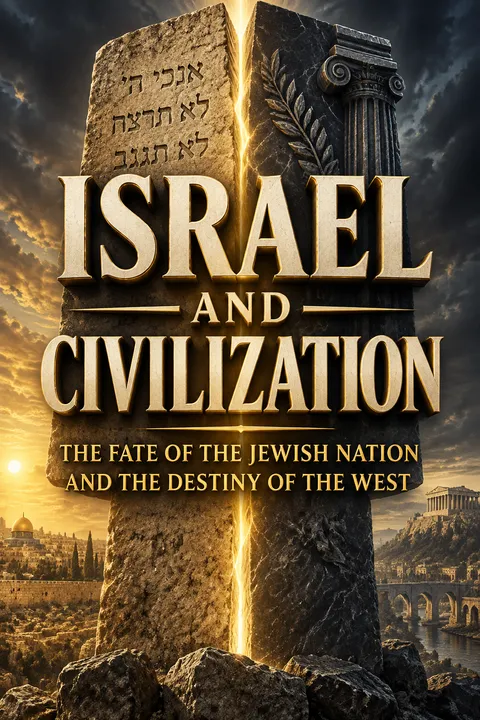
Israel and Civilization is a political manifesto, a personal religious memoir, and a selective history of Jewish influence on Western institutions. Its narrative begins with Hammer’s encounters with Treblinka and Kfar Aza, then widens from Jewish vulnerability to a sweeping account of civilization: Sinai supplies moral foundations, Jewish law informs Western legal tradition, Zionism restores Jewish national agency, and Israel becomes a strategic partner in defending the West. The final movement turns inward, urging Jews to renew religious practice and Christians to form a political alliance with them.
The book’s distinctive strength is its insistence that ideas about history, law, and religion shape present political loyalties. Its examples, from John Selden’s study of the Talmud to the founders’ use of Exodus imagery, help make a case that Jewish texts belong within the history of Western political thought. Its autobiographical passages also give the argument a human scale: the case for continuity is not only geopolitical, but a story of one person discovering practices and obligations that had been absent from his upbringing.
The central limitation is argumentative compression. The book moves from Jewish influence on Western institutions to the stronger claim that Western civilization depends on Jewish religious truth, and from Israel’s strategic value to broad conclusions about territorial policy. Those steps require additional argument. Its polarized account of political opponents can also blur distinctions among antisemitism, criticism of Israeli policy, progressive activism, and immigration or foreign policy disagreements. The reader should therefore distinguish the book’s historical evidence from its theological premises and policy prescriptions.
Its most useful underlying question is whether a society can preserve dignity, solidarity, and moral limits without a shared account of what people owe one another. Hammer answers through revelation, tradition, and national community. Readers who reject that answer can still engage the problem he identifies: a civilization that forgets its inherited sources may struggle to explain why its principles deserve loyalty. The book is most valuable as an urgent argument for recovering those sources, and most debatable when it treats one political program as their necessary consequence.
Glossary
Halacha
Jewish law and practiceHalacha is the body of Jewish law and practice, developed from the Torah, the Talmud, and later rabbinic interpretation. In the book, it is presented not as a narrow set of religious rules but as a comprehensive framework guiding worship, ethics, personal conduct, and communal life.
b’Tzelem Elohim
Humanity made in God's imageA Hebrew phrase meaning that human beings are created in the image of God. Hammer treats it as a basis for inherent human dignity and moral responsibility. The idea supports the claim that every person has worth that cannot be reduced to social usefulness, group identity, or political status.
Seven Noahide Laws
Universal basic moral dutiesA Jewish account of seven foundational obligations for non-Jews, associated with Noah and reaffirmed in the book’s account of Sinai. They prohibit idolatry, blasphemy, murder, theft, certain sexual relations, and eating flesh removed from a living animal, and require the establishment of courts and laws.
Political Hebraism
Hebrew ideas in political thoughtThe influence of the Hebrew Bible and Jewish legal or political traditions on political thinkers and institutions outside Judaism. Hammer uses the term for examples including English common-law thought, the Pilgrims’ biblical political language, and the American founders’ use of Hebrew scripture and Exodus imagery.
time-binding
Accumulating knowledge across generationsAlfred Korzybski’s term for humanity’s ability to preserve knowledge and achievements so later generations can build on them. Hammer connects this idea to civilization as accumulated learning, while arguing that progress needs moral direction rather than relying on reason and technical achievement alone.
Three Ds
A test for anti-Israel biasNatan Sharansky’s framework for identifying when criticism of Israel may become antisemitic: demonization, delegitimization, and double standards. In the book, demonization means portraying Israel in extreme, distorted terms; delegitimization denies Jewish self-determination; and double standards demand treatment not expected of other states.
Jacksonian realism
National-interest-centered foreign policyA tradition in American foreign policy that emphasizes national interest, national solidarity, and practical limits rather than efforts to remake other societies according to universal ideals. Hammer applies it to support for Israel and favors deterrence, alliances, and concrete security goals over expansive nation-building.
Maccabean imperative
Active Jewish continuity and self-defenseHammer’s name for the lesson he draws from the Maccabees, the Jewish rebels who resisted both foreign rule and assimilation within their community. It calls Jews to sustain religious practice, Jewish peoplehood, and attachment to Israel, and to take responsibility for communal security.
Abraham Accords
Israel's regional normalization agreementsAgreements reached in 2020 that established or normalized relations between Israel and the United Arab Emirates, Bahrain, Morocco, and Sudan. Hammer presents them as an example of diplomacy based on shared interests and regional security rather than making Israeli-Arab normalization conditional on resolving the Palestinian conflict.
Download PDF
Download EPUB
.epub digital book format is ideal for reading ebooks on phones, tablets, and e-readers.








