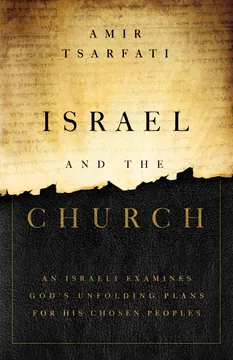


Key Takeaways
Keep Israel and the church distinct, while holding salvation in Christ common
Two peoples, one Savior. Tsarfati argues that Israel and the church have different identities and roles in God's plan, but neither has a separate route to salvation. Israel is a people and nation called in the Hebrew Scriptures; the church is the community of believers formed after Jesus' death and resurrection. In the author's reading, the church joins God's purposes without taking Israel's place. He treats the distinction as temporary in the broadest sense, ending when God's renewed creation no longer needs separate witnesses.
Reject the either-or choice. This position opposes Replacement Theology, the view that the church has taken Israel's place and inherited its promises. Tsarfati's central claim is that God can remain faithful to both peoples without making them interchangeable.
The distinction gives the book a clear organizing principle and resists a familiar historical danger: using Christian theology to erase Jewish identity. Its strongest ethical implication is that inclusion need not require replacement. At the same time, theological categories should not flatten the diversity within either group. Jewish people are not a single political or religious bloc, and Christians disagree about how biblical promises relate to modern Israel. The framework is most useful when it encourages humility and care, rather than turning complex communities into props in an end-times argument.
Israel's failures make covenant faithfulness, not human merit, the story
A people who fail. The book repeatedly points to Israel's rebellion, idolatry, and rejection of Jesus. Tsarfati reads those failures not as proof that God has discarded the Jewish people, but as the setting in which God's patience and commitment become visible. Isaiah's promise to gather Israel from distant lands supplies a key example: the author's own life in Israel represents, for him, a living sign that God's promises endure.
Discipline is not abandonment. The book distinguishes punishment that ends a relationship from discipline meant to correct and restore. It applies this logic to both Israel and the church: sin matters, but failure does not make God's character unreliable. Romans 11 is central to the case, especially Paul's insistence that Israel's unbelief does not cancel God's faithfulness.
This is the book's most powerful theological move: the focus shifts from whether a people deserve their place to whether God keeps promises. That move also offers a pastoral answer to religious anxiety, since belonging is grounded in divine character rather than flawless performance. The claim about modern Israel as evidence of prophecy, however, depends on a particular reading of biblical promises. Political events alone cannot settle that interpretation. The argument is strongest as a call to consistency and mercy, not as a shortcut for resolving every dispute about land or state policy.
Let Israel and the church sound as distinct witnesses, not competing heirs
A trumpet calls attention. Numbers describes two silver trumpets used to summon Israel, direct its movements, and sound alarms. Tsarfati treats them as a picture of Israel and the church: both testify to the same God, but in different ways. Israel's history, Scriptures, and continued existence display God's character; the church is sent outward to proclaim salvation through Jesus. In the author's memorable image, the instruments have no voice without God's breath, so neither community should boast as if its significance came from itself.
Different roles can cooperate. Tsarfati sees Israel's return to nationhood in 1948 as the moment when both witnesses again sound in the world. Their testimony is imperfect, he says, because both peoples are made up of imperfect people.
The trumpet image turns an abstract dispute into a memorable model of shared purpose: two voices can serve one message without becoming one voice. It also undercuts Christian triumphalism by depicting the church as dependent, not self-made. The proposed division between Israel's largely passive witness and the church's active mission is less tidy than the metaphor suggests. Each community contains varied forms of public witness, and each can fail badly. The image remains valuable if treated as a theological lens rather than a complete description of either community.
Keep the gospel free of ethnic credentials and religious add-ons
One basis for salvation. Tsarfati rejects the idea that Jewish people can be saved through the Mosaic law while Gentiles need faith in Jesus. He also rejects the opposite pressure on Gentile Christians to add Jewish customs or law observance to faith. His reading of the New Testament is that salvation comes through Jesus for Jew and Gentile alike, not through ancestry, circumcision, festivals, or personal moral achievement.
Grace is not a membership upgrade. Paul opposed teachers who insisted that Gentile converts must adopt additional requirements, and the early church council addressed the same dispute. Tsarfati's point is not that Jewish practice has no meaning, but that it cannot be made a condition of salvation. He warns against both a separate covenant for Jews and a Jesus-plus formula for anyone.
The argument protects the core claim of grace from two opposite distortions: making Jewish identity a spiritual disadvantage or treating Jewish observance as a superior route to God. A crucial distinction is between a practice chosen as cultural or religious expression and a practice imposed as a requirement for salvation. Without that distinction, criticism of legalism can sound like criticism of Jewish life itself. The book's clearest contribution here is to make the standard of salvation consistent across ethnic boundaries.
Read Revelation as a future forecast centered on Israel's restoration
A particular map of the end. Tsarfati reads Revelation through a futurist, premillennial framework. In this interpretation, the letters to seven churches address the church age; the church is then gathered to Christ in the rapture; a seven-year tribulation follows; Christ returns, Israel turns to him, and a thousand-year reign precedes the final judgment and new creation. The tribulation is understood as both judgment on an unbelieving world and discipline intended to bring Israel to repentance.
A disputed reading. The author dates Revelation to the late first century and rejects preterism, which sees much of the book's prophecy as fulfilled in the past, especially around Jerusalem's destruction in AD 70. He argues that the book's global judgments and future kingdom do not fit that account.
The framework makes Revelation's events easier to follow by giving them a sequence and explaining why Israel and the church occupy different places in it. It also treats apocalyptic prophecy as consequential rather than disposable. Yet Christians have long disagreed about Revelation's genre, chronology, and relation to first-century Rome. A futurist reading can take the text seriously without assuming that every detail has one uncontested interpretation. Readers benefit from distinguishing what the book says, what the framework infers, and what remains uncertain.
Let Revelation's seven churches examine yours before you decode headlines
Seven congregations, seven tests. Jesus' messages to the churches in Revelation commend or challenge specific qualities. Ephesus has sound teaching but waning love; Smyrna suffers; Pergamum tolerates false teaching; Thyatira permits moral compromise; Sardis has a living reputation but is spiritually dead; Philadelphia remains faithful; and Laodicea trusts its wealth and comfort. Tsarfati presents these letters as practical counsel for churches now, not merely as ancient correspondence.
Ask what the congregation is becoming. The warnings push readers to examine love, doctrine, holiness, spiritual vitality, perseverance, and self-reliance. A polished service or a strong reputation is not enough if a church has lost its allegiance to Christ. Revelation's promised blessing, in the author's view, belongs to readers who take its teaching seriously and live accordingly.
The letters work as a compact diagnostic because they separate different kinds of institutional failure. A congregation can be doctrinally vigilant yet loveless, or socially active yet spiritually hollow. That complexity is more useful than a single measure of church success. The challenge is to avoid turning each ancient church into a label for disfavored modern congregations. A fair diagnosis asks what practices and incentives shape a community, not simply whether it resembles a caricature of a biblical warning.
Let prophecy intensify your service, not your confidence about dates
The calendar belongs to God. Tsarfati argues that God appoints the timing of history, while believers are not given the exact date of Christ's return. He therefore cautions against claims based on eclipses, astronomical alignments, or supposedly secret knowledge. The book reads milestones such as the 1917 Balfour Declaration, the 1920 San Remo agreement, and Israel's establishment in 1948 as trumpet-like signs of restoration, but not as a calendar for predicting the end.
Use the time available. The practical response is prayer, hospitality, love, service, and sharing the gospel. The book links the delay of judgment with God's patience toward people who might still turn to him. Prophecy is presented as a reason to act faithfully now, not as permission to withdraw from ordinary responsibilities.
This practical emphasis is a needed counterweight to apocalyptic speculation. A prediction that produces compassion and service has a different social effect from one that rewards certainty and panic. The interpretation of particular political events as prophetic signs remains vulnerable to confirmation bias: events that fit a scheme draw attention, while those that do not can be explained away. The book's strongest counsel is therefore its restraint about dates and its insistence that uncertainty should make believers more attentive to their responsibilities.
Support Jewish people through prayer, truthful teaching, and material care
Support should become practical. Tsarfati urges Christians to pray for Jerusalem's peace, Israel's prosperity, and Jewish people's salvation. He asks churches to teach that, in his interpretation, God has not abandoned Israel, and he urges financial support for ministries serving Jewish communities. Paul gives the model: Gentile churches contributed material aid to believers in Jerusalem because they had received spiritual benefits through the Jewish people.
Care is not imitation. The book rejects antisemitism and Christian indifference, but also rejects treating Israel as an object of worship, adopting Jewish customs as a requirement, or proposing a separate salvation covenant. Its call is to bless Jewish people and oppose theological contempt without confusing support for a people with every political decision made by a state.
The move from doctrine to conduct is essential: a claim that Israel matters means little if it excuses neglect or hostility toward Jewish people. The distinction between solidarity and political endorsement is especially important in a polarized debate. Biblical commitments can motivate care without requiring agreement with every government policy. The book's own confident reading of modern events makes that distinction worth stating clearly. Support is most credible when it protects human dignity and listens to Jewish communities rather than assuming their needs or speaking over them.
Let the promised afterlife make today's choices urgent, not morbid
Death is a threshold, not an eraser. Tsarfati presents the Christian hope as bodily resurrection, judgment, and life with God in a renewed creation. He distinguishes physical death from the second death, understood as final separation from God, and argues that faith in Jesus changes a person's destiny. His account also assigns different moments of resurrection to church-age believers, Old Testament believers, and those killed for their faith during the tribulation.
Hope leads back to the present. The book uses Jesus' exchange with the Sadducees, who denied resurrection, to argue that life continues beyond the grave. It insists that death offers no later chance to choose salvation. For believers, the prospect of meeting Christ gives courage; for everyone, the uncertainty of life's length makes present choices matter.
The afterlife framework offers a strong source of consolation by placing grief within a larger story of resurrection and justice. It also gives moral urgency to the present rather than treating earthly life as disposable. The detailed sequence of postmortem destinations is a theological interpretation, not a claim that can be independently verified, and Christian traditions differ on its particulars. Even readers who do not share the framework can recognize its ethical force: convictions about death shape how people use time, treat others, and prepare for loss.
Analysis
Israel and the Church is an evangelical, futurist theological argument presented through biblical exposition, personal testimony, historical narrative, and vivid analogy. Its governing claim is that Israel and the church remain distinct in God's plan, while sharing salvation through Jesus. That thesis gives coherence to the book's many subjects, from Isaiah's promises and Paul's argument in Romans to the symbolic imagery and chronology of Revelation. The author is also writing as a Jewish Israeli Christian, a standpoint that gives the argument personal force and makes the subject more than an abstract dispute over biblical categories.
The book's main strength is its insistence that theology has ethical consequences. If Christians claim that God is faithful, they should be wary of doctrines that portray God as casually discarding a people. If they claim to oppose antisemitism, that opposition should include teaching, prayer, and material support. The seven church letters likewise keep the discussion from becoming only a forecast of future events: they demand self-examination in the present.
Its principal limitation is interpretive confidence. The book often treats a dispensational chronology and a futurist reading of Revelation as the plain meaning of Scripture, though Christians have read these passages in several ways. It also interprets modern political developments as prophetic signals, a method that can blur the difference between theological conviction and historical evidence. The author sometimes moves from support for Jewish people to claims about particular states, policies, and international agreements; those claims deserve separate evaluation rather than automatic acceptance as consequences of the biblical argument.
The most productive way to read the book is therefore as a strong case for covenant continuity, Christian responsibility, and hope, while recognizing its eschatological framework as a contested interpretation. Its enduring question is not only what happens at the end of the age, but whether believers can affirm God's faithfulness without diminishing the people through whom their own faith came.
Review Summary
Glossary
Replacement Theology
Church replaces IsraelA Christian theological position that understands the church as taking Israel's place in God's purposes and inheriting promises once given to Israel. Tsarfati strongly opposes this view, arguing that Israel remains a distinct people with a future role. Christian traditions differ in how they interpret the relationship between biblical Israel and the church.
rapture
Gathering believers to ChristIn Tsarfati's framework, the future event in which Jesus gathers church-age believers, including those who have died and those still alive, to meet him in the air. He places this event before the tribulation, so the church does not experience that period of judgment and discipline. Christians disagree about its timing and interpretation.
tribulation
Seven years of judgmentThe seven-year period Tsarfati places after the rapture and before Christ's return to earth. He interprets it as judgment on an unbelieving world and discipline intended to bring Israel to recognize Jesus as Messiah. The period includes the judgments described in Revelation and is also called the time of Jacob's trouble.
Day of the Lord
God's end-time interventionA biblical prophetic expression for a time when God acts decisively in judgment and deliverance. In this book, it refers especially to the end-time period following the church's gathering to Christ, when judgments affect the world and Israel undergoes discipline. The precise scope and timing of the phrase vary across biblical passages and Christian interpretations.
preterism
Prophecy fulfilled in the pastAn approach to biblical prophecy that understands some or most events in Revelation as having been fulfilled in the past, often in the first century around Jerusalem's destruction in AD 70. Tsarfati rejects this reading, arguing that Revelation describes future global events. Preterist views themselves vary in how completely they place Revelation's fulfillment in the past.
millennial kingdom
Christ's thousand-year reignThe thousand-year reign of Christ described in Revelation 20. Tsarfati interprets it as a future period on earth after Jesus' return, during which Satan is bound and Christ rules from Jerusalem. At its end, Satan is briefly released, a final rebellion is defeated, and the sequence moves toward final judgment and the new creation.
dual covenant
Separate paths of salvationThe view, as discussed by Tsarfati, that Jewish people may be saved through adherence to the old covenant while Gentiles are saved through faith in Jesus. He rejects this position, arguing that salvation comes through Christ for Jews and Gentiles alike. The term is used in Christian theological debate and can refer to differing formulations.
tribulation saints
Believers during tribulationPeople who come to faith in Jesus during the tribulation described in Revelation. Tsarfati distinguishes them from the church, which he believes has already been gathered to Christ. He points to the multitude in Revelation as believers who suffer persecution, with many being killed for their faith before Christ's return.
grafted in
Gentiles joined to God's peoplePaul's olive-tree metaphor in Romans 11, which Tsarfati reads as describing Gentile believers joining God's saving purposes without replacing Israel. The image emphasizes dependence: the added branches draw life from a root they did not create. The book uses it to argue that inclusion in the church is addition, not the transfer or cancellation of Israel's identity.
Download PDF
Download EPUB
.epub digital book format is ideal for reading ebooks on phones, tablets, and e-readers.








