

Plot Summary
Prologue
At twenty-one, Stella4 is confined to a psychiatric hospital after seeing a blood-soaked figure collapse in her family’s garden. Her mother5 tells the doctor that Stella4 was born after the genocide and had no direct experience of it, while Stella4 lies awake hearing the neighboring patient scrape along his walls.
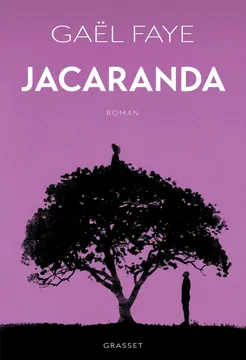
She cannot explain why the jacaranda, the tree she has loved since childhood, feels bound to her terror. The opening holds her distress as a mystery: the wound seems older than her own life, and the tree is more than a tree.
The prologue makes trauma arrive before its explanation. Stella’s mother treats the past as something that should not affect a child born afterward, but Stella’s body contradicts that tidy chronology. The hospital’s unanswered sounds also establish a world where pain is present without becoming communicable. The jacaranda is introduced as both refuge and clue, an intimate landmark whose significance cannot yet be named. This framing asks whether inherited history can be felt as personal injury, then delays the answer until the story has shown what the family has buried, and what it has failed to tell.
Television Opens the Door
In 1994, twelve-year-old Milan1 blames the war in his mother’s2 country for his poor grades, inventing a family anguish he has never heard her describe. The lie reaches his parents, earns him a humiliating reprimand from his father,9 and meets only his mother’s2 familiar silence. Yet Rwanda has entered the house.
Night after night, the family watches reports of massacres and refugees during dinner, while Venancia2 gives no visible response. Milan’s1 stomach aches as he absorbs images he cannot discuss. On July 14, a stray firework ignites the salt marshes near the family’s holiday home. Woken by smoke, Milan1 sees his mother2 standing alone in the garden, watching the flames. He does not know that the genocide has just ended.
Milan’s lie is less a cynical trick than an unknowing attempt to give shape to what his family refuses to name. The news broadcasts make distant violence a household presence, but the parents’ silence prevents it from becoming shared knowledge. His bodily pain registers a conflict that conversation cannot hold. The garden fire briefly gives Venancia’s hidden past a visible form, though Milan cannot yet read it. The scene establishes the novel’s central asymmetry: history is already shaping the family before Milan has the words, relationships, or facts needed to understand how.
Claude Sleeps Beside Him
That summer, Venancia2 brings Claude,3 a thin boy with a severe head wound, into the family home without preparing Milan.1 Claude3 barely speaks French, eats little, and stares toward the window as Milan1 tries rock music, games, and frantic air guitar to reach him. At night, Claude3 cries and speaks in his sleep.
Milan1 lies beside him, holds him, and repeats what comfort he can offer until the boy settles. The wound remains unexplained, and Claude’s3 silence makes every question feel dangerous. As Claude3 begins eating and responding to music, Milan1 imagines the cousinless, lonely boy as the younger brother he has always wanted. Their shared nights give Milan1 a first way to care for someone beyond himself.
Milan’s first genuine intimacy grows not through conversation but through bodily attention. He cannot understand Claude’s words or history, so he responds to the evidence he can perceive: shaking, tears, sleeplessness. The gesture is loving, but it also gives Milan a role he has long lacked, that of protector and older brother. Claude’s recovery is therefore never simply a medical matter. It becomes the ground on which Milan builds an imagined family bond, one whose emotional reality will outlast the adults’ decisions and their reluctance to explain them.
The Brother Leaves
At a fair, Claude3 laughs for the first time on a spinning ride, and Milan’s1 girlfriend Nadège10 later wins him the teddy bear Milan1 could not afford. Before Milan1 can give it to him, Venancia2 returns alone from Brussels and explains that Claude3 has gone back to Rwanda because relatives were found. Milan1 hears the news as another broken promise.
He runs away, boards a late train, and is brought home by railway police with the bear still in his hands. The family never speaks of Claude3 again. Four years later, after Milan’s1 parents announce their divorce, Venancia2 invites him to meet her relatives in Rwanda. He refuses, but Nadège’s10 rebuke and the lack of any other summer plan finally push him onto the plane.
The separation exposes the difference between adult necessity and a child’s experience of attachment. Venancia may believe Claude belongs with surviving relatives, but Milan experiences the decision as the sudden removal of the person who had made him feel needed. His runaway journey turns private grief into an actual escape from the family home, while the teddy bear becomes an object too late to deliver its intended comfort. The later trip to Rwanda begins under this unresolved injury. Milan does not travel from uncomplicated curiosity; he is drawn toward the country and family that his mother’s silence and Claude’s departure have made inseparable.
An Uncle in Nyamirambo
In Kigali, Milan1 meets his grandmother,11 whom Venancia2 has never described, and struggles through the heat, crowded streets, and unfamiliar household customs. Claude3 appears unexpectedly, now tall and fluent in French, with the same scar dividing his scalp.
In Nyamirambo, Claude3 takes Milan1 to Sartre,7 a sickly book collector who shelters street children in a crowded compound. There Milan1 learns that Claude3 is not his cousin but his uncle:3 Claude3 and Venancia2 share a father, Emmanuel.15
Claude3 also explains that he was an orphan taken in after returning from France. Milan1 cannot yet ask what that means for his family, but the revelation changes every remembered scene. Rwanda is no longer simply his mother’s2 country; it is the place where his own family’s silences began.
The kinship revelation unsettles Milan’s assumptions about age, family, and the authority of the stories adults tell children. The boy he had chosen as a brother is also his uncle, while the grandmother he meets as a stranger has been part of his history all along. Sartre’s compound offers an alternative family organized by shelter rather than genealogy, but it does not erase the damage of the past. Milan is learning that belonging cannot be inherited as a clean fact; it must be assembled from incomplete testimony, awkward recognition, and care offered in the present.
The Stadium’s Twenty-Two Posts
Milan1 spends his days in Nyamirambo, where Sartre’s7 books and records, the street children, and Claude’s3 company gradually make the neighborhood familiar. He meets Alfred,8 a soldier who once dreamed of acting, and hears how exile and family loss led him into years of war.
At the stadium, Milan1 expects a football match but sees twenty-two condemned prisoners shot before a cheering crowd. Claude3 regards the dead as genocidaires who deserved punishment; Milan1 cannot stop seeing the execution.
Their argument exposes how little Milan1 knows about Rwanda’s violence or France’s role in it. Later, he meets Eusébie,5 Venancia’s2 old friend, and her newborn daughter Stella.4 When an old family photograph is returned to Eusébie,5 her grief overwhelms her, and Milan1 comforts the baby.
The stadium scene strips away the distance Milan has used to make Rwanda manageable. He can enjoy music, food, and friendship while treating the country’s violence as background, but the execution refuses that separation. Claude’s anger is not a guidebook lesson; it is the reaction of someone whose family was targeted and whose present is shaped by the perpetrators’ fate. Meanwhile, Eusébie’s recovered photograph shows another form of historical injury: the destruction of family images is an attempt to erase proof that a life existed. Milan’s care for Stella offers a modest response, not an answer.
Nadège Chooses New York
Seven years later, Milan1 is a law student preparing research on Rwanda’s gacaca courts. His relationship with Nadège10 fractures when a New York gallery offers her an opportunity she cannot postpone, while his mother2 warns him not to question her relatives. Milan1 travels without Nadège,10 intending to stand beside Claude3 during the trial of the men accused of murdering Claude’s3 family.
Claude3 welcomes him to the Palais, where Sartre7 and the former street children receive him as one of their own. The reunion is warm, but Claude3 is afraid of testifying for the first time. Milan1 has come under the respectable cover of academic research; beneath it is a choice he did not make in 1998. This time he is returning because Claude3 needs him.
Milan’s departure marks a change from inherited or accidental movement to chosen responsibility. Nadège’s opportunity and Venancia’s resistance both expose how much of his life has depended on other people’s decisions or on his own avoidance. The academic project gives him a frame, but its emotional purpose is companionship: he wants Claude not to face the trial alone. The Palais, once an improvised refuge, receives him as family, suggesting that belonging can be made through repeated acts of presence. His return does not make him an expert; it makes him accountable to what he witnesses.
Claude Names the Dead
At the gacaca hearing, Claude3 identifies Gaspard,12 who exposed his family, and the man called the Cat,13 who struck him with a machete. He recounts how neighbors drove his relatives from the school where they had sought safety and how he escaped after being left for dead.
A woman who secretly treated him confirms his account. The Cat13 admits that Claude’s3 family was thrown into a latrine and buried beneath concrete; Gaspard12 receives thirty years in prison, while the Cat13 receives eighteen after confessing.
The family’s remains are later recovered, including Claude’s mother’s11 rosary, and prepared for dignified burial. Claude3 now knows where his relatives lie, but the trial does not give him peace. He tells Milan1 and Sartre7 that he intends to kill the Cat13 when he leaves prison.
The gacaca hearing makes justice a communal act of remembering, not merely a legal exchange between defendant and state. Claude’s testimony restores names, relationships, and the location of bodies to a history designed to hide them. Yet the Cat’s confession cannot transform knowledge into forgiveness. Claude’s planned revenge reveals how the court’s limited verdict leaves his personal need for recognition unresolved. The rosary found with the bones gives his loss a material object, but it cannot repair the absence of his family. The section refuses the comforting idea that speaking truth automatically heals the person required to speak it.
Rosalie’s Last Stories
In 2010, after Rosalie6 dies, Milan1 returns to Rwanda and finds Stella4 grieving, skipping school, and hiding in the jacaranda. Eusébie5 pushes her toward classes, but Milan1 recognizes the stomach pain of a child forced to swallow sorrow.
Stella4 asks him to help write a portrait of Rosalie6 using the recordings she made of her great-grandmother’s stories. The work expands into a history of generations shaped by monarchy, colonial rule, imposed ethnic categories, repeated exile, and the genocide.
Meanwhile, Claude3 visits his childhood hill to reclaim family land and is watched with suspicion by villagers. His new taxi-motorcycle business is then destroyed in a fire. When he asks Venancia2 for help replacing the fleet, she refuses. Milan1 decides to lend him much of his inheritance himself.
The recordings turn mourning into a collaborative practice: Stella preserves Rosalie’s voice, while Milan learns to help without taking ownership of the story. Their work gives intimate memory a historical scale, showing how identity categories were hardened by colonial power and then used to divide families and communities. Claude’s return to the hill gives memory a different, contested form, tied to land and the right to remain visible. The fire and Venancia’s refusal expose how fragile material recovery can be. Milan’s loan is not a cure, but it is a concrete refusal to repeat the abandonment that has marked his relationship with Claude.
The Palace Loses Its King
Stella’s4 school removes her winning portrait from its program after a minister’s son is given the place. Rather than let the work disappear, Stella4 asks to read it in Kinyarwanda at the Palais during its farewell party, before Claude3 and Sartre7 must leave the property.
Her account of Rosalie6 holds the crowd’s attention, and Eusébie5 embraces her daughter4 afterward. The performance gives Stella4 a public way to mourn when the school has turned her effort into collateral for political privilege.
Later, during the party, Milan1 tells Claude3 that Venancia2 refused financial help but promises to fund the motorcycles himself. The Palais becomes a place of farewell and chosen solidarity. Its residents will lose the compound, but the relationships formed there do not end with the eviction.
The school’s decision repeats a familiar hierarchy: institutional prestige and political proximity outweigh a child’s labor and grief. Stella answers not by pleading for the institution’s approval but by choosing an audience that knows what loss costs. Her reading converts private recordings into a shared act of remembrance. The Palais is similarly more than a building; its power comes from the care and history its residents have made there. Eviction threatens that physical shelter, yet Milan’s promise shows how people can carry its ethic elsewhere. The scene links narrative voice to dignity: Stella cannot control the school, but she can decide where her story is heard.
Sartre’s Borrowed Past
By 2015, Milan1 has settled in Kigali, obtained Rwandan citizenship, and moved in with Claude3 and Sartre7 after money and work troubles defeat his plans. Alfred,8 now out of the military, visits to buy Sartre’s7 collection of books and music.
He reveals that Sartre’s7 father was executed for participating in the genocide and that Sartre’s7 brothers were killers. Sartre7 had hidden his family history while presenting himself as an orphan and protector of street children. Claude3 feels betrayed because the Palais itself stood on ground tied to those crimes.
Sartre7 eventually gives Alfred8 the collection and leaves the neighborhood. Years later, Claude3 arrives at Alfred’s8 lake house with the Cat13 bound in a sack, intent on killing him. Alfred8 recounts his own descent into revenge, and Milan1 tries to stop Claude3 from firing.
Sartre’s concealed history complicates the moral comfort of the Palais. His genuine acts of shelter do not cancel the truth he withheld from the people who trusted him, especially Claude, whose family was murdered by men like Sartre’s brothers. The collection itself changes meaning: once a rescued archive, it becomes evidence of a past Sartre tried to control through omission. Alfred’s account of retaliatory violence gives Claude a possible future he has not yet chosen. Milan’s intervention is grounded in memory of Claude’s earlier abandonment, but the crisis cannot be solved by his affection alone.
The Jacaranda Comes Down
In 2020, Milan1 finds Stella4 hospitalized after Eusébie5 orders the jacaranda cut down to make room for rental apartments meant to finance Stella’s4 studies abroad. Stella4 says the tree held the dead siblings she never knew, along with Rosalie’s6 memory and the landscape of her childhood. Without it, she can no longer keep performing the dutiful student her mother5 expects, and she decides to leave her studies.
Milan1 visits Claude3 on his childhood hill, where the surviving ruin of his family home is being rebuilt. The Cat’s sons13 help Claude3 lay bricks, and Claude3 can now encounter former killers without wanting to shoot them. He has not forgotten what they did; he has found a way to work beside their children.
The felled tree removes the physical structure that allowed Stella to locate grief and inherited history in one place. Her crisis is not simply attachment to nature; the jacaranda has served as a living archive and private refuge, holding family loss that adults have not fully explained. Claude’s rebuilding offers a contrasting response to historical remains. He restores a home without pretending the past is repaired, and accepts practical help from the next generation. The juxtaposition distinguishes remembrance from fixation: Stella needs her loss acknowledged, while Claude’s labor begins to make coexistence possible without demanding that he forget.
A Mother’s Unspoken Past
Milan1 returns to Paris after learning that Venancia2 has terminal cancer. He sits with her through her final night and prays beside her, though faith has never been his own. After her death, his father9 explains that Venancia2 once nearly drowned in Lake Kivu and had learned to swim from him in Paris because of that experience.
Milan1 had never heard the fuller story. In Kigali, with Venancia’s2 ashes and the jacaranda gone, Eusébie5 finally explains that Venancia2 had a twin sister, Viviane.
During their 1973 escape across the lake, their overloaded boat capsized; Venancia2 survived, while Viviane and others disappeared. Their mother11 blamed Venancia,2 and the women did not reconcile for decades. Milan1 understands that his mother’s2 silence began in a loss she could not bear to narrate.
Venancia’s death closes the possibility of direct explanation, but it does not make understanding impossible. The near-drowning links her lifelong reticence to a specific catastrophe, transforming silence from mere coldness into a survival strategy built around guilt and blame. Her husband’s version is only a fragment; Eusébie’s account supplies the family context that he never knew to ask for. Milan’s own failure to know his mother is therefore relational, not simply informational: the adults around her also accepted the silence. His late comprehension cannot restore their lost conversations, but it changes how he holds them.
The Lake Keeps the Ashes
Before Rwanda’s pandemic lockdown begins, Milan1 rides with Claude3 and Stella4 to Alfred’s8 house on Lake Kivu, carrying Venancia’s urn. Alfred8 recognizes the family history and offers them shelter; his own childhood was shaped by an elder who passed down stories of Rwanda. On the lake, Milan1 sees fishing lamps and rows toward them, imagining that the water is summoning his mother.2
As dawn rises, he admits he has left the urn at the house. Venancia2 had spent her life trying to forget the country, and he will not make her ashes return to the lake she feared. He begins to cry at last. Claude,3 Stella,4 and Alfred8 stay beside him, and the grief he has carried as a solitary question becomes something he can share.
The ending refuses a simple symbolic return. Milan brings his mother’s remains to Rwanda, but does not impose a ritual that would turn her into a convenient emblem of reconciliation. Leaving the urn behind respects the difference between his chosen connection to the country and Venancia’s painful relationship with it. The lake’s lights draw him outward, yet his final movement is inward, toward grief he has postponed. The people beside him matter because they do not explain his mother away or ask him to be finished mourning. He reaches belonging not through a recovered origin, but through companionship and the freedom to choose what to carry.
Analysis
Jacaranda is a novel about the difference between inheriting history and being told it. Milan’s1 family has not lacked history; it has lacked a language through which that history can be shared. Venancia’s2 silence, Mamie’s11 guardedness, and Claude’s3 fragmented childhood each emerge from different pressures, so the book refuses to treat withholding as one simple moral failure. Their silences protect, injure, and distort at once. Milan’s1 growth depends on recognizing that fact without abandoning his desire to know.
The novel also resists the idea that memory is secured by testimony alone. The gacaca hearing establishes responsibility and locates bodies, but Claude’s3 wish for revenge persists. Stella’s recordings preserve Rosalie’s6 voice, while the lost family photograph and felled jacaranda show how vulnerable remembrance remains when its physical supports disappear. Each archive needs living listeners. Milan1 becomes useful not because he can resolve the past, but because he learns to stay with people whose accounts challenge his assumptions.
Across generations, the book questions easy versions of reconciliation. Claude3 rebuilding his family home with the Cat’s sons13 does not mean that the crime is forgotten or that trust is restored. It means that future cooperation can begin without pretending that the past has become harmless. Similarly, Alfred’s8 confession about his own revenge prevents violence from being assigned only to an enemy category. Moral responsibility remains necessary, but inherited guilt and inherited innocence are both inadequate substitutes for acknowledging what people did.
The jacaranda gives this argument its intimate scale. For Stella4 it is refuge, memorial, and witness; for the adults who cut it down, it is a piece of property. The conflict between those meanings reveals how modernization can erase emotional landscapes even when it promises material security. Milan’s1 final decision about the urn completes the novel’s quieter claim: belonging is not obedience to ancestry. It is the capacity to honor another person’s history without taking it over, and to accept companionship while grief remains unfinished.
Review Summary
Jacaranda receives widespread acclaim for its emotionally powerful exploration of the Rwandan genocide and its intergenerational trauma, earning an average of 4.43 stars. Many readers praise Faye's lyrical, tender prose and the novel's ability to humanize a devastating historical event through multiple generations of one family. The audiobook narrated by Faye himself is highlighted as particularly immersive. Some critics note weaker characterization, overly simple dialogue, and occasionally documentary-style passages that feel detached, drawing comparisons to his debut Petit Pays.
Characters
Milan
The searching sonMilan grows up in France inside a family that treats silence as good manners and emotional restraint as stability. Curious but initially self-absorbed, he often mistakes proximity for understanding and approaches Rwanda first as a visitor, then as a researcher. His deepest strength is his responsiveness to other people’s pain: he comforts Claude3, helps Stella4 preserve Rosalie’s stories, and gradually learns to remain present when history becomes difficult. He is not a natural scholar or a confident guide to his own identity. His development lies in accepting that knowing a place or a parent cannot be achieved by extracting facts alone; it requires attention, patience, and a willingness to be changed.
Venancia
The guarded motherVenancia is a Rwandan-born shopkeeper living in France who has built a quiet, controlled life far from the country she left. She is practical, hardworking, and protective, but her reserve makes affection difficult for Milan1 to recognize. She avoids discussing her relatives and treats questions about Rwanda as intrusions, leaving her son1 to invent explanations for the absences in his family history. Her silence is neither simple indifference nor a lack of feeling; it is a boundary shaped by painful experience. Venancia’s character asks how protection can become a form of isolation, especially when a parent believes that withholding the past will spare a child its burden.
Claude
The wounded survivorClaude is a Rwandan survivor who comes to Milan’s1 home as a child with a serious head wound and little ability to communicate in French. He is observant, proud, and emotionally guarded, with a strong need to define his own life rather than be treated as someone else’s responsibility. His bond with Milan1 combines affection with a painful awareness of what Milan1 does not know. Claude’s humor and ambition coexist with lasting grief, and he distrusts easy claims about forgiveness or reconciliation. He seeks tangible forms of dignity, including work, land, and the right to be seen as still present. His relationship with memory is active and unsettled, not merely an inheritance.
Stella
The keeper of storiesStella is Eusébie’s daughter5, born into a family and country still shaped by the genocide. Curious, imaginative, and emotionally perceptive, she finds companionship in the jacaranda and in the stories recorded by her great-grandmother Rosalie6. She is capable of discipline and ambition, yet the expectations placed on her can leave little room for grief or uncertainty. Milan1 becomes a trusted older relative because he listens without demanding that she recover on a schedule. Stella’s work with Rosalie’s6 voice shows her instinct to preserve people through narrative, while her questions expose what adults have left unsaid. She represents a younger generation trying to inherit history without being reduced to it.
Eusébie
The rebuilding auntEusébie is Venancia’s2 old friend, a capable professional and devoted mother who raises Stella4 while helping rebuild life in Rwanda. Warm and direct with Milan1, she contrasts with Venancia’s2 guardedness, though she too carries histories that are difficult to tell. Her energy comes from action: work, study, public service, and the practical care of those around her. She does not pretend that rebuilding guarantees healing, and her hope for the next generation is grounded in the imperfect institutions she helps create. Eusébie’s strength can make her demanding, particularly when she expects Stella4 to endure as she did. Beneath that toughness is a woman who has learned to continue without mistaking endurance for ease.
Rosalie
The family historianRosalie is Stella’s great-grandmother4, an exceptionally old woman whose memories reach back through major changes in Rwanda’s political and social life. She preserves family and national history through stories, songs, and everyday customs, determined that younger relatives understand where they come from. Her life is marked by faith, displacement, labor, and the repeated effort to make a home after upheaval. Rosalie is not a detached historian: her memories carry affection, grief, bias, and humor. The recordings Stella4 makes preserve that human texture. Through her, the novel presents memory not as a perfect archive but as a relationship between teller and listener, one that can outlive the voice that first shaped it.
Sartre
The bohemian caretakerSartre is a flamboyant book and music collector who shelters street children in the Palais, a crowded compound that becomes a surrogate home for Claude3 and others. His theatrical self-presentation masks a more complicated relationship with family history and public responsibility. He prizes books as objects worth rescuing, though his love of culture can become a performance of authority. Generous, volatile, and quick to turn a gathering into a celebration, he gives the Palais its unruly energy. His character complicates the distinction between the good one does and the truths one avoids, without making either the shelter or its residents’ gratitude unreal.
Alfred
The soldier seeking peaceAlfred is a former soldier whose experience of exile and repeated conflict has left him wary of both violence and easy moral certainty. He once dreamed of acting, a private ambition that sits beside his disciplined military life. Alfred speaks sparingly and watches closely; when he does recount his past, he describes how grief and revenge can deform a person who believes he is acting justly. His connection to the others grows through a chance meeting that gains meaning over time. He offers shelter and perspective, but does not present himself as morally untouched by the history he survived.
Philippe
The distant fatherPhilippe is Milan’s1 French father, a banker who values stability, practical planning, and conventional measures of success. He loves his son1 but often expresses concern through advice about work, money, and security rather than emotional inquiry. His marriage to Venancia2 appears harmonious from the outside partly because both parents avoid difficult conversation. Over time he becomes more attentive and willing to admit what he never asked his wife2. Philippe’s limitations are ordinary rather than cruel: he mistakes a lack of visible conflict for intimacy and assumes that a subject left unmentioned has been resolved.
Nadège
The first loveNadège is Milan’s1 outspoken girlfriend from adolescence, a photographer with a sharper sense of possibility than he has at first. Her directness challenges his inertia, including when she pushes him to travel to Rwanda. She is affectionate and energetic, but her ambitions are her own, and she will not organize her future around Milan’s1 needs. Their relationship carries the intensity of shared youth without becoming a promise that can contain both their lives. Nadège helps catalyze Milan’s1 first journey, then represents the painful fact that love and diverging choices can coexist.
Mamie
The formidable grandmotherMilan’s maternal grandmother1 is a devout, hard-working woman who has survived displacement and built a life through nursing, small businesses, and relentless self-reliance. She is hospitable in practical ways, especially through food, but guards family history and reacts sharply to questions about the past. Her habits of control reflect both strength and distrust, making her house feel safe yet difficult to enter emotionally. She and Milan1 share a bond expressed through visits and routines more readily than confession. Her character shows how a person may carry history in labor and vigilance even when she cannot or will not narrate it.
Gaspard
A neighbor under suspicionGaspard is a young man from Claude’s3 childhood community whose family ties place him close to the events surrounding Claude’s3 relatives. His presence in the gacaca process makes the village itself part of the story, rather than a distant backdrop to violence. He represents the difficult question of what neighbors saw, enabled, or later denied, and how a community must face the actions of its own members.
The Cat
The accused machete wielderKnown by the nickname the Cat, he is one of the men whose actions during the genocide remain central to Claude’s3 pursuit of truth. He is not presented as a faceless embodiment of evil; the gacaca proceedings place his account, choices, and claims before a listening community. His role forces the novel to distinguish confession, remorse, punishment, and forgiveness, which do not necessarily arrive together.
Stacie
Stella’s outspoken friendStacie is Stella’s4 friend and fellow student, impatient with the expectation that young Rwandans must carry national history as a permanent public duty. Her desire to study abroad and live more lightly gives voice to a generational tension that Stella4 also feels, though differently. She is not indifferent to the past; she resists being defined by it.
Emmanuel
The absent grandfatherEmmanuel is Milan’s maternal grandfather1, known mostly through sparse and conflicting family recollections. His life remains difficult to reconstruct, and his memory matters because it links people who have been kept apart by secrecy. Milan’s1 resemblance to him becomes one of the few concrete clues that the family has preserved.
Plot Devices
The jacaranda
A living family archiveThe jacaranda in Eusébie’s5 garden gives Stella4 a physical place for solitude, imagination, and connection to relatives she never knew. It shelters her while she listens to the world below and becomes a landmark through which Milan1 recognizes the family home years later. Its roots and branches suggest continuity without making history painless: the tree can hold memory, but it cannot explain what adults have hidden. Its eventual removal makes Stella’s4 distress visible to people who had mistaken her composure for wellbeing. The device is powerful because it is simultaneously ordinary landscape and private memorial.
Gacaca testimony
Truth spoken in communityThe local gacaca hearings bring survivors, accused perpetrators, judges, and neighbors together in public, allowing testimony to establish what happened and where victims were buried. Claude’s3 appearance makes the courtroom an intensely personal space, while the woman who rescued him supplies corroboration and the Cat’s13 confession reveals the family’s burial site. The process provides evidence and punishment, but it does not guarantee emotional reconciliation. The hearings expose the distance between a legal outcome and the private work of living with loss.
Rosalie’s recordings
A voice passed forwardStella records her great-grandmother telling family and national stories, preserving speech that might otherwise vanish with memory and age. Later, she and Milan translate and shape the recordings into a school portrait, turning an intimate archive into a shared account. The tapes make storytelling collaborative: Rosalie supplies memory, Stella supplies a listener’s devotion, and Milan helps arrange the material without replacing its source. They also enable the novel to move across generations without treating history as an impersonal lesson.
The family photograph
Proof against erasureA surviving black-and-white family photograph returns to Eusébie5 after she believes that the genocide has destroyed every image of her relatives. Its recovery gives grief a precise object and confirms that the family existed beyond the memories of its survivors. The photograph also links generations: Milan1 witnesses its emotional force, while Stella’s4 family story later makes such records part of a larger act of remembrance. The device is small but consequential, since preservation here means rescuing evidence of ordinary lives, not only recording atrocities.
The lake and urn
A choice about belongingLake Kivu connects several escape stories and becomes the setting for Milan’s1 final attempt to decide what to do with his mother’s2 remains. Its beauty and danger carry different meanings for different generations, so the lake cannot be reduced to a simple symbol of return. By bringing the urn there but ultimately leaving it at Alfred’s8 house, Milan1 respects the distance Venancia2 kept from Rwanda while acknowledging his own attachment to it. The device resolves the novel’s central tension without forcing mother and son to share the same relationship to home.
Download PDF
Download EPUB
.epub digital book format is ideal for reading ebooks on phones, tablets, and e-readers.








