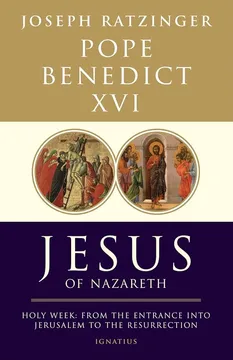


Key Takeaways
Read Jesus' royal entry as a claim to rule without violence.
A peaceable claim. As Jesus approaches Jerusalem, Bartimaeus calls him David's heir, and the crowd greets him as king. Jesus chooses a borrowed donkey, a sign of humble kingship rather than military force. Ratzinger argues that Jesus accepts the royal claim but redirects its meaning: his authority comes through obedience to God and self-giving, not revolt.
A temple for all. Jesus disrupts commerce in the Temple's Court of the Gentiles, defending its purpose as a place where all peoples can pray. The action challenges corruption and signals a new worship centered on Jesus. For Ratzinger, Jesus' zeal is expressed not in violence against opponents but in bearing suffering himself.
What's striking is that the entry stages a conflict over what power is for. The donkey is not merely a modest transport choice; it gives the crowd's political hope a different shape. Political movements often inherit symbols that can be read in competing ways, and the crowd's expectations show how easily a peaceable leader can be recruited into a more familiar story of conquest. Ratzinger's reading is compelling as theology, though the event's precise symbolism cannot be established by the gesture alone.
Treat end-time warnings as a summons to work, not forecast.
History and horizon. Jesus' eschatological discourse speaks of the Temple's destruction, Jerusalem's suffering, and the world's final judgment. Ratzinger distinguishes the Temple's historical end in A.D. 70 from the ultimate end: the discourse also anticipates a period in which the Gospel reaches the nations. Early Christians who fled Jerusalem, according to accounts cited in the book, understood Jesus' warning as a reason not to join the city's violent defense.
Vigilance means action. The discourse warns against false messiahs and anxious speculation. Its examples of watchful servants and waiting attendants point instead to ordinary faithfulness: doing one's work justly while the future remains unknown. The promise that history has a destination is not permission to abandon present responsibilities.
This interpretation turns apocalyptic language away from prediction markets and toward moral attention. In psychology, threat can either sharpen practical response or trap people in rumination; the difference often lies in whether a situation offers an actionable next step. Ratzinger makes vigilance concrete by linking it to justice and daily duty. His reading also guards against treating every crisis as proof that the end has arrived. The challenge is that religious communities can still claim certainty about events the text leaves unresolved.
Let grace cleanse first, then turn received care into service.
Gift before duty. In John's account, Jesus washes his disciples' feet, taking the place of a servant. Peter resists because the gesture overturns his idea of what a Messiah should do. Ratzinger reads the washing as a sign of Jesus' whole self-giving life: the disciples receive cleansing before being told to serve one another.
He uses two terms to describe this connection. Sacramentum means Christ's saving action and presence, which renew people from within. Exemplum means the pattern of conduct that follows from that gift. The command to serve is not a separate test of moral heroism. The chapter also connects the washing with confession: wrongdoing must be brought into the light rather than allowed to harden into denial.
The order matters. Care that is received can change a person's sense of what is possible, while care demanded as proof of worth can become another burden. This insight resonates with relational accounts of moral development, where trustworthy attachment supports generosity. The framework also resists reducing religion to either private consolation or public ethics: the gift generates an obligation. A useful caution is that receiving help does not automatically produce service. Communities still need practices that make care reciprocal rather than one-way.
Build unity from shared truth and mission, not institutional sameness.
A prayer for believers. In John 17, Jesus prays for the disciples and for those who will believe through them. Ratzinger reads this prayer against the Jewish Day of Atonement: Jesus prays for himself, his first followers, and the wider community. The prayer links knowing God with eternal life, asks that believers be sanctified in truth, and presents the revelation of God's name as God's presence among people.
Unity is not simply administrative agreement. Ratzinger argues that it must be visible enough to help the world recognize the mission of Jesus, yet it cannot be manufactured by organization alone. It grows from shared faith, Scripture, and a common mission. In this account, Christian unity is both a spiritual gift and a public responsibility.
The argument treats unity as evidence that a community can live by something other than competition and faction. That is a demanding public standard: cohesion should make a group's claims more credible, not merely make it more powerful. The distinction between shared purpose and uniformity is especially useful in plural communities. Still, visible unity can be produced by coercion or by suppressing dissent. A credible unity therefore needs shared commitments and honest room for disagreement, not just a polished appearance of consensus.
See the Eucharist as Jesus making self-gift the new Passover.
A debated calendar. Matthew, Mark, and Luke present the Last Supper as a Passover meal; John places it before the Passover meal. Ratzinger considers attempts to reconcile the timelines and finds John's chronology historically plausible, while acknowledging that details remain disputed. He argues that Jesus' meal can still be understood as his Passover: he gives himself to the disciples before his death, transforming the old feast's meaning.
A gift that gathers. In the Eucharist, bread and wine are shared with words that interpret Jesus' approaching death as a gift for others. The familiar act of breaking bread becomes a sign of communion with him and with one another. The early Church's Sunday gathering links this meal to the Resurrection, not simply to reenacting the final supper.
The meal joins memory to material practice. A community does not only affirm that generosity matters; it repeatedly handles and shares food as a sign of belonging. This makes the Eucharist both theological claim and social form. The book's account of the Last Supper's historical setting remains an interpretation of sources that disagree, not a settled reconstruction. Its strongest point does not depend on resolving every calendar question: the earliest Christian communities understood the meal through Jesus' death, Resurrection, and continuing gift.
At Gethsemane, human freedom reaches fulfillment by consenting, not disappearing.
A real struggle. In Gethsemane, Jesus asks to be spared the suffering ahead, then entrusts himself to the Father's will. Ratzinger insists that this is not a performance of effortless courage. Jesus has a human will that recoils from death, and a filial will that consents to his mission.
Drawing on Maximus the Confessor, the book argues that these are not rival personalities inside Jesus. His human will remains fully human, yet it comes into harmony with the divine will. The scene therefore does not portray obedience as the destruction of freedom. It shows Jesus bringing human resistance into a freely chosen relationship with God, while his anguish remains real.
This account offers a richer picture of agency than the idea that freedom means never yielding. Human choices are shaped by relationships and commitments; a person can consent to a difficult good without ceasing to choose. The theological language of harmony captures that possibility. It also needs careful handling: appeals to obedience can be misused to silence people facing coercion or abuse. The passage concerns Jesus' freely embraced mission, so it cannot serve as a blanket demand that others accept harm imposed by powerful people.
When order conflicts with truth, expediency can become injustice.
A political calculation. The Temple leadership fears that Jesus' movement could provoke Rome and endanger the Temple and the nation. Caiaphas argues that one man's death could protect the people. Ratzinger reads this as a politically calculated statement that, in the Christian interpretation, also takes on a meaning Caiaphas did not intend: Jesus dies for others.
Before Pilate, Jesus rejects the image of kingship built on armed force and identifies his mission with bearing witness to truth. Pilate finds no clear political threat but sentences him under pressure to preserve order. Ratzinger distinguishes the Temple authorities and the supporters of Barabbas from the Jewish people as a whole, rejecting collective blame for Jesus' death.
The scene poses a durable problem in political ethics: leaders can defend an unjust decision as the price of stability. Short-term calm may conceal the deeper damage done when law ceases to protect the innocent. Ratzinger's distinction between truth and expediency is powerful, though political decisions rarely offer perfect access to truth or consequences. The account also demands precision about responsibility. Broad accusations against an entire people replace historical analysis with scapegoating, the very mechanism the trial narrative exposes.
Understand atonement as God entering evil's cost, not outsourcing punishment.
A different account of sacrifice. Ratzinger interprets Jesus' death through the Day of Atonement, the Suffering Servant in Isaiah, and Paul's description of Christ as hilastērion. In the ancient ritual, blood was placed on the covering of the Ark of the Covenant. Applied to Jesus, the term points to him as the meeting place of God and humanity, where the world's wrongdoing encounters divine love.
The argument is not that God demands pain from an unrelated victim. God, in the Son, bears the consequences of human evil and transforms them through self-giving. Forgiveness does not pretend that cruelty is harmless; it confronts the damage without answering violence with more violence. The Cross is presented as reconciliation that draws people into a different way of life.
This model shifts attention from a transaction imposed on a third party to a God who accepts the cost of reconciliation. It has affinities with restorative justice, where repair requires acknowledging harm rather than merely declaring it cancelled. Yet a theological account of transformation must not eclipse the concrete needs of victims, including safety, restitution, and accountability. The book's claim is strongest when atonement deepens these demands, not when it is used to pressure injured people into premature forgiveness.
Treat resurrection as a new bodily mode, not a return to life.
More than resuscitation. Ratzinger distinguishes Jesus' Resurrection from the return to ordinary life attributed to Lazarus and others: those people eventually died again. Jesus, in this account, enters a new kind of embodied life beyond death. The empty tomb does not prove the Resurrection by itself, but the book argues that bodily Resurrection would be incompatible with the body simply remaining in the grave.
The earliest confession preserved by Paul says Jesus died, was buried, was raised, and appeared to witnesses. Gospel stories describe encounters that are bodily yet strange: disciples sometimes fail to recognize Jesus, while he can also eat with them and show his wounds. For Ratzinger, the Resurrection begins a future for humanity, rather than merely reporting a private survival after death.
The distinction prevents resurrection from shrinking into either a medical miracle or a metaphor for hope. It also clarifies why bodily identity matters: the claim concerns the whole person, not an immortal idea detached from material life. Historical inquiry can examine testimony, texts, and the early community's claims, but it cannot by itself establish the theological meaning of a transformed body. The book acknowledges that boundary while arguing that the witnesses reported encounters they did not expect or easily explain.
Live the Ascension as Christ's universal presence and the Church's mission.
Departure becomes presence. In the Ascension, Jesus is not described as travelling to a distant point in space. Ratzinger interprets the cloud as a sign of entry into God's reality: Jesus is no longer confined to one earthly location and is therefore present to people everywhere. The disciples' joy in Luke's account reflects this changed relation, not indifference to his departure.
Their task is to bear witness across the world, rather than calculate dates for the end. The book also draws on Bernard of Clairvaux's term adventus medius, the Lord's present coming through Scripture, the Eucharist, and lives shaped by faith. Christian hope looks toward a final fulfillment while treating the present as a time for action.
This reading makes hope active rather than escapist. A future promise can orient present conduct, much as a long-term public commitment can guide choices before its goal is fully achieved. The idea of Christ's present coming also explains why worship and witness belong together in the book: presence is not merely private comfort but a source of mission. The tension remains important. If future fulfillment is invoked to excuse present injustice, hope has become a sedative rather than a summons.
Analysis
Ratzinger reads Holy Week as a single unfolding answer to the question of Jesus' identity. The donkey, the Temple action, the footwashing, the meal, Gethsemane, the trial, the Cross, and the Resurrection are not isolated episodes. Each corrects a familiar picture of power: kingship is not conquest, cleansing is not violence, authority serves, obedience can remain free, and victory arrives through a death that gathers rather than retaliates. The narrative's movement from Jerusalem's public expectations to the disciples' changed understanding gives the book its dramatic spine.
Its method is as important as its theology. Ratzinger insists that historical criticism matters, yet argues that historical reconstruction alone cannot disclose the full figure of Jesus. He pairs historical reading with a faith-based reading that treats the Old and New Testaments as mutually illuminating. This lets him connect Gospel details to Israel's scriptures and early Christian worship. It also means some conclusions rely on theological premises that readers outside the faith may not accept. Scriptural echoes can illuminate meaning without independently proving that an event was intended as a fulfillment.
The book is most persuasive when it shows how a symbol or action gains meaning across the narrative, as with the donkey, the shared bread, or Jesus' prayer in Gethsemane. Its historical discussions are more provisional: the Gospels differ, and the author's preference among explanations does not erase that uncertainty. His treatment of the trial is especially important for modern readers because it rejects blaming Jews collectively and locates responsibility in particular authorities and political actors. Overall, this is not a neutral biography but a theological interpretation that takes historical questions seriously while insisting that the events matter because of what they disclose about God, human suffering, and the possibility of life beyond death.
Glossary
faith-hermeneutic
Faith-shaped interpretationA way of reading Scripture that treats faith as a legitimate interpretive perspective while remaining attentive to historical evidence and its limits. Ratzinger argues that it should work alongside historical interpretation, not replace it, so that readers can consider both the texts' historical setting and their theological claims.
Sacramentum
Christ's saving giftIn Ratzinger's discussion of the washing of the feet, sacramentum refers broadly to the saving mystery of Christ's life and death, not simply to one particular Church sacrament. It is the gift through which Christ draws near, cleanses, and renews people. The term describes the source of Christian action.
Exemplum
Gift's ethical patternMeaning example, exemplum describes the pattern of conduct Jesus gives his disciples, especially humble service after washing their feet. In Ratzinger's reading, this is not an independent moral demand or substitute for grace. It follows from the saving gift of Christ and expresses the new life that gift makes possible.
hilastērion
Atonement's meeting placeA Greek term used by Paul for Christ in Romans 3:25 and associated in the book with the covering of the Ark of the Covenant. In the Day of Atonement ritual, that sacred place was touched by sacrificial blood. Ratzinger applies the term to Jesus as the place where God and humanity meet and reconciliation occurs.
corporate personality
One person represents manyA biblical interpretive idea in which an individual can embody or represent a larger group. Ratzinger uses it to explain how Jesus can pray the Psalms as both himself and the representative of suffering humanity, and how figures such as Mary and the beloved disciple can carry meanings extending beyond their individual lives.
adventus medius
Christ's present comingLatin for the middle coming of Christ, a term Ratzinger draws from Bernard of Clairvaux. It describes Christ's presence in the period between the Incarnation and the final return, especially through Scripture, the sacraments, and events or people that renew faith. It makes the waiting period an active part of Christian life.
Times of the Gentiles
Era of worldwide missionA period in Jesus' eschatological teaching between Jerusalem's suffering and the end of history, during which the Gospel is proclaimed among the nations. Ratzinger argues that this is not merely a later invention by Luke. It is a task and historical interval recognized across the Synoptic Gospels, even though its duration cannot be calculated.
Resurrection of Jesus
Transformed bodily lifeFor Ratzinger, Jesus' Resurrection is neither a return to ordinary biological life nor the survival of a disembodied spirit. It is an embodied existence beyond death, described through Gospel encounters and the early Christian testimony. The event is historical in its effects and witnesses, yet its new mode of life exceeds ordinary historical experience.
Download PDF
Download EPUB
.epub digital book format is ideal for reading ebooks on phones, tablets, and e-readers.








