

Key Takeaways
Make Judaism felt, not merely followed or argued about
Begin with lived experience. Zalman Schachter-Shalomi invites readers to start with awe, longing, gratitude, grief, or anger, rather than first signing on to a theological system. His own search began in crisis: as a teenager fleeing Nazi persecution, he rejected the childish picture of God he had been taught and raged at promises of a distant afterlife. In Antwerp, a teacher answered his skepticism by reading Maimonides, who argued that people cannot picture the world to come any more than someone blind from birth can imagine color. The point was not to prove God, but to show that doubt had a place inside Jewish tradition.
Practice before certainty. Schachter-Shalomi treats spiritual life as an experiment: try a practice, notice what it awakens, and adapt it without pretending that one experience settles every question. Ritual matters when it opens a path to an experience, not when it becomes a substitute for one.
What's striking is the way this approach treats doubt as a form of participation rather than a defect to be corrected. That resembles experiential learning: a person tests a practice, observes its effects, and revises an interpretation. It can make inherited religion accessible to skeptics without demanding that they silence their judgment. Still, personal intensity is not proof that a spiritual explanation is true. The approach is strongest when it distinguishes the reality of an experience from claims about its ultimate cause.
Use God-language as a doorway, not a definition
Treat names as approaches. Words such as King, Father, Shepherd, and the feminine Shekhinah carry histories and emotional associations, but none captures the infinite. Jewish tradition offers many names and descriptions, called kinnuyim, each emphasizing a different way of relating to the divine. A person may need a comforting presence in one moment, an audience for anger in another, or a sense of unity with all life. Schachter-Shalomi even proposes imagining God as a verb, a process of being and becoming, rather than a thing with fixed properties.
Keep the hard questions open. The problem of innocent suffering has no neat answer here. The book recommends bringing grief and protest into prayer rather than disguising them as trust. A Hasidic reading of the tradition even imagines the divine presence as still developing alongside humanity.
This account makes religious language less like a verdict and more like a set of instruments. Cognitive science and psychotherapy both recognize that metaphors can shape attention and emotion: calling a situation a battle, for example, invites different responses than calling it a shared problem. The same flexibility can help people inhabit inherited prayer without treating every image literally. The risk is that endlessly adjustable metaphors may become unfalsifiable. Their value rests less on explaining suffering than on helping people meet it without denying its reality.
Protect one day from the marketplace to recover your soul
Trade clock time for human time. Schachter-Shalomi calls the schedule driven by work and commerce commodity time. Its demands can override hunger, rest, family attention, and the changing rhythms of the natural world. Shabbat offers a recurring break, or what he calls organic time: time shaped by bodily needs, relationships, community, and the cycles of day and season. He recommends beginning with a short weekly pause if a full day feels out of reach.
A shopkeeper made it real. In Managua, the Jewish merchant Pinkas closed his store on Saturday, the busiest market day, and spent protected morning hours studying Torah with his son. Seventh-day Adventists joined his staff because they also needed the day off. His store prospered. The example makes Shabbat more than a list of prohibitions: it is a deliberate space for rest, shared meals, prayer, music, and being present.
A recurring Sabbath is a practical answer to a problem that productivity culture often frames as an individual failure: people are tired because they have not managed their time well enough. A shared day of rest instead makes limits collective and predictable. That can protect relationships and reduce the pressure to remain constantly available. The practice also depends on social conditions. Workers with little control over their schedules may need workplace protections, not just a personal resolution to rest.
Make prayer speak in your own voice, body, and lived concerns
Give inherited words fresh life. Prayer is presented as conversation, not recitation for its own sake. A person can begin without a prayer book by naming a real fear, asking for help, or giving thanks. The siddur, the Jewish prayer book, can then serve as a set of outlines to fill with personal feeling. Schachter-Shalomi recommends translating familiar lines into the language one actually thinks in, and connecting them to concrete experience. He once took campers outside before dawn so a blessing about light could be felt as sunrise rather than heard as an abstraction.
Let prayer build. The morning service moves through physical blessings, songs of praise, reflection on the Shema, and the silent Amidah. This sequence engages action, emotion, understanding, and intuition. Movement, singing, silence, and personal requests can make the service a gradual ascent rather than a string of disconnected texts.
The book's account anticipates an insight common to embodied approaches to learning: people often understand an idea more deeply when gesture, sound, and place accompany words. A sunrise can make a prayer about light emotionally intelligible in a way that explanation alone may not. Personalizing liturgy can also repair the distance between sacred language and daily life. Yet communal prayer cannot be reduced to private expression. Shared forms and inherited words give worshippers a common vocabulary that individual improvisation alone cannot provide.
Treat mitzvot as repeated practice, not tests of instant belief
Let action lead understanding. A mitzvah is a commandment or sacred deed, understood here as an intentional act that connects ordinary life with a sense of the holy. Schachter-Shalomi groups mitzvot into three broad kinds: mishpatim, ethical duties such as protecting life; eduyot, practices that bear witness to communal memory, such as Passover; and chukim, rituals whose meaning cannot be fully explained by reason. The categories appeal to different parts of human experience, from moral judgment to shared identity and mystery.
Repeat with attention. Kavanah means the intention or focus brought to an act. Repetition can make a practice more natural and meaningful, but it is not meant to become automatic. Schachter-Shalomi recalls following a teacher's advice to use English in prayer for forty days. The words gradually became prayerful rather than merely familiar. A practice can carry someone through periods when inspiration fades.
This framework recognizes that people learn through more than argument. Ethical habits can be rehearsed, communal rituals can transmit memory, and symbolic acts can evoke feelings that are difficult to summon on command. Repetition is useful partly because it lowers the effort required to begin. But calling a practice mysterious should not make it immune to ethical scrutiny. The framework works best when ritual remains accountable to the care for people and life that its ethical obligations express.
Let Jewish food ethics include the labor and damage behind consumption
Ask what a purchase costs. Eco-kashrut extends the Jewish practice of distinguishing permitted from forbidden consumption. It asks not only where a product came from, but also what its production and use do to workers, animals, and the environment. A disposable container might meet traditional requirements because it has never touched forbidden food, yet contribute to overflowing landfills. Vegetables grown with heavy pesticide use, fish from depleted stocks, and goods made through exploitative labor raise similar questions. Unlike conventional kosher rulings, eco-kashrut is usually a matter of degree and personal judgment, not a simple yes or no.
Connect ancient duties to a shared home. The Torah's rules about letting farmland rest, protecting animals, and avoiding waste offer precedents for environmental responsibility. Schachter-Shalomi also draws on the Gaia hypothesis, the idea that life and Earth's physical systems interact to sustain conditions for life.
The move from food rules to supply chains is powerful because consumption is often treated as morally neutral once a product reaches the shelf. Attention to origins and consequences makes hidden labor and ecological costs part of the decision. Systems thinking supports the basic insight that local choices can contribute to larger feedback loops. The Gaia hypothesis, however, should not be treated as proof that Earth is conscious or as a settled account of planetary regulation. Its spiritual use is best understood as an ethical perspective, not a scientific conclusion.
Stay distinctly Jewish by serving a larger human whole
Choose identity without claiming supremacy. In 1989, the Dalai Lama asked Jewish teachers how their people had preserved spiritual life through centuries of exile. Schachter-Shalomi points to portable practices such as the Passover Seder, family ritual, study, and communal memory. He argues that a tradition need not dominate others or dissolve into a generic spirituality to participate in a shared world. His image is an organism: distinct organs have different functions, but none thrives by destroying the rest.
Share practice across boundaries. Schachter-Shalomi calls this a dialogue of devoutness, a conversation among people who remain rooted in their own traditions while learning from others. He describes Jews and Christians praying together at Jerusalem's Western Wall, and a Sufi gathering where shared devotion mattered more than debating doctrine. Jewish practices, including Sabbath time, lively study, and the capacity to sustain community in exile, are presented as contributions to a wider human inheritance.
The organism metaphor offers a useful middle path between religious competition and the assumption that differences do not matter. It frames cultural survival as a contribution to pluralism rather than a claim to superiority. Interfaith learning can also expose practitioners to capacities their own communities have neglected. The metaphor has limits: traditions are not neatly bounded organs, and their histories include unequal power and conflict. Dialogue is most credible when curiosity does not erase those histories or demand that anyone surrender a meaningful boundary.
Let messianic hope shape today's justice, not tomorrow's escape
Treat the future as a direction. Mashiach means anointed one and names the Jewish hope for a redeemed world. Schachter-Shalomi reinterprets that hope as more than waiting for a supernatural rescuer: it can motivate people to build a future with less violence, ecological harm, and injustice. He recommends briefly practicing the values of a fully righteous person, then carrying that orientation back into ordinary life.
Make hope materially useful. The book connects redemption to menschlichkeit, everyday decency, and gemilut chasadim, deeds of loving-kindness. Torah's protections for workers and the poor include prompt payment, leaving harvest for people in need, and preserving recipients' dignity. Kindness also means seeing the person, not just the need. A story about a beggar captures the idea: being addressed as a brother can itself restore a measure of human recognition.
Hope becomes more than consolation when it supplies a standard for judging present institutions and a reason to act. Research on future-oriented goals broadly supports the value of imagining a desired outcome, especially when the vision is paired with concrete steps. This section supplies that pairing through fairness and everyday kindness. Still, moral aspiration can become a substitute for structural change if it focuses only on personal goodness. The most durable hope joins humane encounters with policies that reduce preventable inequality.
Analysis
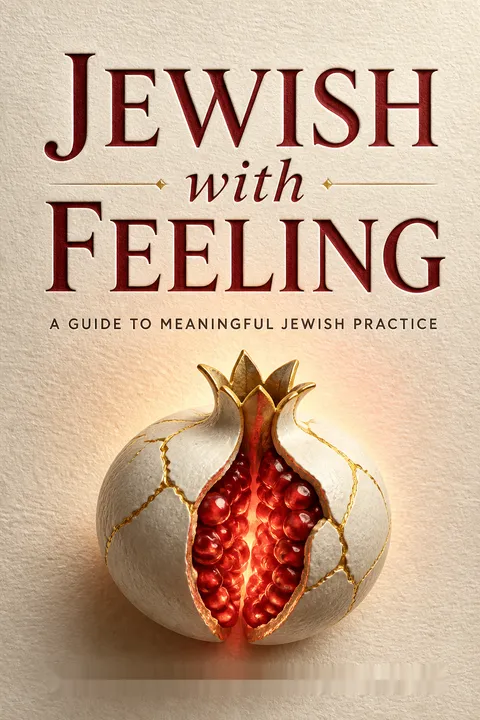
Jewish with Feeling is both spiritual memoir and practical invitation. Its organizing claim is that religious tradition becomes meaningful when practices lead to felt experience, and that experience can renew tradition rather than merely confirm it. The narrative earns this claim through a life shaped by dislocation: a boy fleeing Nazi Europe rejects simplistic theology, finds room for doubt in Maimonides, and later discovers that Jewish ritual can be made vivid without being treated as unquestionable doctrine. The book then moves outward, from personal prayer and weekly rest to ecological responsibility, interfaith learning, and a future-oriented account of redemption.
Its most distinctive contribution is its insistence that particularity and universality need not cancel each other. Sabbath, Jewish study, and the Seder are not obstacles to concern for the whole planet; they are practices through which such concern can be learned and transmitted. The recurring emphasis on trying a practice, adapting it, and attending to its effects gives the book an experimental character unusual in religious writing. It makes ritual legible to readers who are unsure about belief but still hungry for meaning.
The argument is strongest as a guide to practice and weakest when spiritual metaphor approaches factual explanation. The proposed image of God as an evolving presence and the use of Gaia as a divine face can inspire responsibility, but they do not resolve the problem of suffering or establish that the planet is literally an organism with intention. The text sometimes moves quickly between poetic and scientific registers. Readers can preserve its insight by treating these images as moral lenses rather than scientific findings.
The book's enduring lesson is therefore not that every inherited claim must be accepted, or that every ritual must be modernized. It is that a living tradition needs disciplined experimentation: enough continuity to carry memory, enough freedom to respond to present conditions, and enough humility to learn from other communities. Its test of spirituality is not private intensity alone, but whether awareness becomes care for people and the world.
Review Summary
Jewish with Feeling receives mostly positive reviews, with readers appreciating its accessible approach to Judaism and spirituality. Many find it inspiring and insightful, praising the author's inclusive perspective and emphasis on meaningful practice. Some readers, particularly those seeking a more traditional approach, find it too liberal or "new-agey." The book is noted for its environmentalist aspects and interfaith discussions. While some criticize the lack of clarity about the author's background, others appreciate its universal appeal, even to non-Jewish readers.
Glossary
organic time
Time shaped by human rhythmsSchachter-Shalomi's term for time organized around bodily needs, relationships, community, and natural cycles rather than the demands of work and commerce. Shabbat is its central example: a protected interval for rest and connection that interrupts the assumption that every hour should be productive.
ensoulment
Rest that renews awarenessThe book's interpretation of the biblical phrase describing God as refreshed after ceasing work on the seventh day. Rest is not simply inactivity. It creates room for renewed awareness of the soul and for reconnection with what matters beyond practical tasks.
eco-kashrut
Ethical ecological consumptionAn expanded approach to kosher discernment that considers both the source of what people consume and the consequences of producing and using it. It asks about environmental damage, treatment of animals, and labor conditions. Unlike traditional kosher rulings, it generally evaluates choices by degree and calls for individual judgment.
kavanah
Intention and focused attentionThe directed attention, purpose, or devotion brought to prayer or a mitzvah. Kavanah does not replace the physical act. It helps make the act conscious and personal, so repetition can deepen practice rather than turn it into empty routine.
devekut
Awareness of closeness to GodA Hasidic term for cleaving or loving closeness to God. Schachter-Shalomi describes the relationship as already underlying existence, since creation depends continuously on divine presence. Spiritual practice helps a person become more aware of this closeness rather than creating it from nothing.
mishpatim
Ethical commandmentsMitzvot concerning justice and moral conduct, such as protecting life, treating workers fairly, and caring for others. Schachter-Shalomi presents them as duties that readily connect with reason and shared human decency, while ritual intention can also make ordinary ethical actions spiritually significant.
eduyot
Rituals of communal witnessCommandments that preserve and enact memory. Practices such as Passover rituals or wearing tzitzit connect individuals to shared Jewish history and values, while transmitting that inheritance to future generations. Their force depends partly on active participation, not only on formal observance.
chukim
Rituals beyond explanationCommandments whose meaning cannot be fully accounted for by logic. In Schachter-Shalomi's framework, such practices can reach emotional and bodily levels that reason alone does not access. Their mystery may invite humility and vulnerability, though it does not remove the need for ethical reflection.
dialogue of devoutness
Interfaith learning among practitionersSchachter-Shalomi's model for exchange among people committed to distinct spiritual traditions. Participants share practices and insight without trying to prove one faith superior or erase differences. The aim is mutual learning that can deepen each participant's own tradition and contribute to wider human cooperation.
Mashiach
Hope for a redeemed futureLiterally, an anointed one, and the Jewish term for the Messiah. Schachter-Shalomi also uses it to describe an active hope for a more just and life-sustaining future. Rather than waiting passively for rescue, people can embody its values through repair, compassion, and responsible action.
Four Worlds
A layered map of prayerA Kabbalistic model that describes prayer as an ascent through four dimensions: physical action, emotional formation, intellectual creation, and intuitive spiritual presence. Schachter-Shalomi connects these levels to stages of the morning service, so prayer engages the body, feelings, understanding, and inward awareness.
About the Author
Other books by Zalman Schachter-Shalomi

Download PDF
Download EPUB
.epub digital book format is ideal for reading ebooks on phones, tablets, and e-readers.








