

Key Takeaways
Notice who disappears from progressive concern, not only who is openly attacked.
Absence is evidence. The book opens with a review of Charlie Kaufman’s novel Antkind that criticizes its narrator as privileged but never discusses the character’s Jewishness, despite the story’s repeated anti-Jewish abuse. A list of society’s most oppressed groups by comedian Sofie Hagen leaves Jews out, as do other public roll calls of people deserving protection. The point is not that every incomplete list proves prejudice. It is that repeated omissions can reveal whose suffering is not readily recognized.
A broader pattern emerges. The author distinguishes direct hostility from a quieter failure to notice, defend, or represent Jews. Even Alice Walker’s claims about what the Talmud supposedly teaches drew little comparable public scrutiny to an actress dismissed for homophobic posts. The title names this accumulating absence, not a claim that other minorities matter less.
Omissions are harder to establish than explicit slurs, but they matter because institutions often reveal priorities through what they repeatedly leave unmentioned. In organizational research, patterns across decisions can be more informative than a single conspicuous incident. The argument is strongest when several settings show the same gap, as here, rather than treating any one list or review as conclusive. There is also a useful discipline in separating unequal attention from a claim that every group faces identical conditions. Recognition can be shared without making histories interchangeable.
A myth of Jewish power can erase real Jewish vulnerability.
Power becomes a blindfold. The book argues that anti-Jewish stereotypes combine two seemingly opposite pictures: Jews as contemptible and weak, yet also wealthy, influential, and secretly in control. That contradiction helps explain why some progressives hesitate to place Jews among the oppressed. If Jews are presumed to be powerful, discrimination against them can look like resistance to power rather than racism.
The mural shows the mechanism. Street artist Mear One painted wealthy figures playing a property game on the backs of the poor, using imagery and names that local Jews recognized as echoes of conspiracies about Jewish financial control. Jeremy Corbyn supported the mural’s removal as an attack on capitalism, according to Baddiel, without registering its anti-Jewish coding. The author’s point is not that criticism of wealth is inherently antisemitic, but that old stereotypes can travel inside apparently radical imagery.
This section shows how a stereotype can function as a permission structure: if a group is imagined as dominant, hostility toward it can be recast as justice. Political psychology helps explain the appeal. People judge an act partly by the story they tell about who holds power, not only by the act itself. Still, the mural example calls for careful reading rather than a blanket rule. Depicting wealthy people is not enough to establish antisemitism. Relevant questions include which figures are signaled, what visual conventions are used, and whether the image invokes a familiar conspiracy.
Passing as white does not guarantee safety or erase Jewish identity.
Visibility is not simple. Jewish people vary in appearance, and many can be taken for non-Jewish, but that possibility does not eliminate discrimination. Baddiel describes Jewishness as an identity that can be concealed, sometimes making it seem less deserving of protection than identities that are immediately visible. The condition is revealing: Jews may be treated as ordinary until someone knows they are Jewish, at which point they can become targets.
Whiteness is unstable. The author treats whiteness not only as skin tone but as security and membership in the majority. Jews may be categorized as white when their vulnerability is being dismissed, then cast as alien or foreign when a racist needs an enemy. He cites a 2018 US figure: Jews were targets in 60 percent of religiously motivated hate crimes. That statistic does not describe every Jewish person’s experience, but it complicates the assumption that apparent whiteness means safety.
The distinction between appearance and social treatment is essential to understanding racialization. A person may be able to pass in one setting and still be marked through a name, community affiliation, or political stereotype in another. This also cautions against treating racial categories as fixed biological boxes. At the same time, the category of whiteness has different histories and consequences across societies, so the argument should not flatten Jewish experience into that of people who face routine visible racialization. The more useful question is how protection and exposure change with context.
Give Jewish testimony equal weight without turning racism into a contest.
Parity is the claim. Baddiel objects to a hierarchy in which some forms of racism are treated as urgent and others as secondary. He recounts hearing a man at a Chelsea football match shout anti-Jewish abuse for an extended period while stewards did not intervene, despite the club’s stated policy against racist abuse. Earlier, an anti-racist football organization questioned whether a campaign about anti-Jewish slurs would distract from other causes.
Comparison exposes unequal standards. The author compares responses to show that words or behavior targeting Jews can receive less alarm than similar conduct aimed at other groups. The purpose, he argues, is not to diminish racism against anyone else, but to make the same standard of concern apply. Different histories may require different remedies; difference in form does not make one group’s injury unworthy of attention.
The distinction between equal moral concern and identical treatment is important. A fair system need not prescribe the same intervention for every form of prejudice, because histories, risks, and institutional settings differ. But it should be able to explain why a case receives less attention without relying on the assumption that its targets are inherently powerful. Comparison is especially useful as an audit of inconsistent standards. It becomes less useful if it turns into a contest over whose suffering is greatest, which is precisely the competition this argument seeks to resist.
Check anti-capitalist art for Jewish conspiracy tropes hiding in plain sight.
Intent does not settle meaning. The book traces how Jewish figures have long been used to represent greed, finance, and hidden control. That imagery can survive in political art even when its creator sees the work as a critique of capitalism. In the mural discussed here, the names Rothschild and Warburg and the depiction of bankers prompted Jewish viewers to recognize a longstanding story about Jews manipulating the world’s wealth.
Read the whole image. Baddiel argues that Corbyn noticed the anti-capitalist message but not the antisemitic associations. He makes a similar point about claims that Jewish bankers control governments: the statement can be defended as criticism of capitalism while repeating a conspiracy about Jewish power. The practical lesson is to examine who is shown, which symbols are used, and whether the critique depends on a familiar ethnic scapegoat.
Political art is not interpreted in a vacuum. Images carry histories that may be unfamiliar to their creators but legible to the people repeatedly targeted by them. This makes intent relevant, but not decisive: a person can oppose racism and still reproduce its visual grammar. The analysis also needs boundaries. Criticism of banks, billionaires, or capitalism is not antisemitic merely because a Jewish person is among those criticized. The strongest case rests on a pattern of ethnic coding, secret-control narratives, or collective blame, not on the presence of a Jewish name alone.
Apply the same scrutiny to anti-Jewish claims and Jewish portrayals.
Standards should travel. Baddiel contrasts an actress removed from a London production after homophobic posts with Alice Walker, whose poem repeated false claims about the Talmud and Jewish beliefs without attracting comparable consequences. He also questions why non-Jewish actors can routinely play Jewish characters, including in stories centered on Jewish life, while casting debates about other minorities often prompt broader scrutiny.
The issue is respect, not a ban. The author does not call for non-Jewish actors to be barred from Jewish roles. He argues that the same questions of authenticity, employment, and stereotyped performance should be asked. When a non-Jewish performer plays a Jewish character through exaggerated mannerisms, the portrayal can turn a lived identity into a caricature. The double standard is the absence of serious public discussion, not any single casting decision.
Representation debates combine two distinct concerns: who gets access to work, and who gets authority to portray an experience. Separating those questions improves the discussion. A role can be played sensitively by someone outside a group, while an industry can still systematically deny that group opportunities. The section’s comparison invites consistency, but consistency need not mean mechanically applying every rule across unlike cases. The central test is whether Jewish identity receives the same attention to complexity, stereotype, and professional access that audiences expect when other minorities are represented.
Criticize Israel without assigning its actions to Jews everywhere.
Separate identities clearly. Baddiel is explicit that Israel can be criticized and that he does not treat the country as more deserving of concern than other places. His objection is to assuming that British Jews must answer for Israel, announce a position on it, or express shame before being heard on other subjects. Jewish identity, he argues, includes family, culture, religion, and history, not simply a relationship to a Middle Eastern state.
Watch for the forced connection. The book describes anti-Jewish hostility that redirects every discussion of Jewish safety toward Israel, as if Jews must have caused or earned the prejudice. In one example, after a deadly attack on a synagogue in Pittsburgh, a political figure tied the violence to Israel’s treatment of Palestinians. That move risks making Jewish victims responsible for violence against them. Criticism of state policy remains legitimate; collective blame is not.
The distinction between a state and a diaspora is a basic safeguard against collective responsibility. It also preserves room for political criticism: protecting Jews from antisemitism does not require defending every Israeli government action. The difficult cases arise when a debate about Israel uses language with a long history of targeting Jews, or when Jewish people are treated as representatives of a state they do not govern. A careful discussion asks what is being criticized, who is being held accountable, and whether the same standard of responsibility would be imposed on another diaspora.
Treat Jewish historical memory as present context, not an excuse.
History leaves a residue. A 1940 British government memo advised propagandists to reserve atrocity stories for people considered clearly innocent, excluding Jews from that category. Baddiel presents this as evidence that Jews have repeatedly been treated as less deserving of sympathy. He also describes how the Holocaust shaped his family: his mother fled Nazi Germany, while relatives were murdered and his grandfather lived with severe depression.
The past affects safety now. The author recounts contemporary attacks on Jewish people and sites, arguing that historical memory is not a claim that every present threat is equivalent to the Holocaust. Deborah Lipstadt’s term softcore Holocaust denial describes a dismissive response that treats present-day Jewish security as proof that Jewish suffering is over. Remembering history helps explain fear; it should neither silence discussion nor serve as a substitute for examining current evidence.
Historical memory is not simply a backward-looking record. It shapes what communities notice, fear, and transmit across generations. In this account, family trauma makes present signals intelligible rather than melodramatic. Yet memory can be invoked carelessly by any political group, and the Holocaust should not automatically settle a current dispute. The stronger approach is to use history as context, then test claims against present facts. That preserves the moral force of remembrance while avoiding the opposite errors of dismissing inherited fear or treating every analogy as conclusive.
Keep anti-Semitism from becoming a proxy battle over political teams.
Politics can eclipse people. In the book’s coda, an independent UK equality body finds that Labour failed to respond effectively to antisemitic conduct during Jeremy Corbyn’s leadership. The report briefly raises hopes that Jewish fears will be understood, but the argument quickly shifts to whether the findings are an attack on the political left. Baddiel’s concern is that Jews become symbols in a factional fight rather than people describing discrimination.
Intent is not the only test. He does not claim that every progressive who misses antisemitism consciously hates Jews. He distinguishes active prejudice from a blind spot that leads people to excuse, minimize, or fail to recognize it. The practical test is whether a movement can examine evidence about harm without immediately treating the allegation as a weapon used by its opponents.
Partisan identity can make people selectively skeptical: evidence that threatens a valued movement is more readily dismissed as hostile strategy. This is not unique to one political camp, but it is especially consequential for groups whose concerns are already viewed through stereotypes of power. A credible response should distinguish the truth of an allegation from the motives of whoever raises it. At the same time, claims of prejudice deserve evidence and due process. Taking Jewish testimony seriously does not require suspending scrutiny; it requires applying that scrutiny without a partisan discount.
Analysis
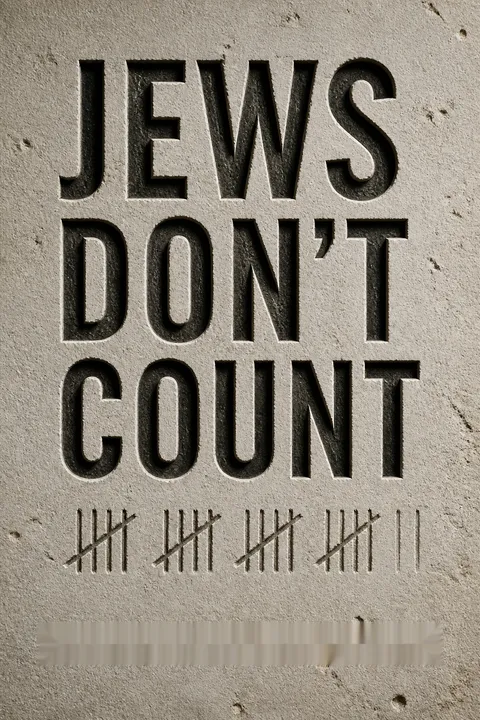
Jews Don’t Count is a polemic about recognition: its central charge is not simply that anti-Jewish hostility persists, but that progressive cultures often fail to identify it as a priority. Baddiel makes the case through accumulated contrasts across reviews, political speeches, football, casting, activist language, and social media. The method is deliberately rhetorical. Each example asks readers to notice the gap between stated anti-racist commitments and the treatment of Jews when their experience complicates a familiar story about power.
The book’s strongest conceptual contribution is its account of the double image of Jews as both degraded outsiders and hidden rulers. That combination can make Jewish vulnerability difficult to see: hostility is recoded as resistance to privilege, while Jewish testimony is treated as self-interested or politically suspect. The discussion of whiteness extends this insight by treating social safety, rather than skin tone alone, as a measure of belonging. The argument is most persuasive when it identifies a recognizable stereotype and demonstrates how it changes the response to a specific event.
Its limits follow from its form. A personal polemic can expose patterns and give emotional texture to experiences that aggregate data may miss, but selected examples cannot establish how all progressives or institutions behave. The claim of a hierarchy of racisms is also difficult to measure, and the book sometimes relies on comparisons that risk making unlike histories seem interchangeable. Baddiel’s own qualification matters: parity of concern need not mean identical histories, risks, or remedies.
The most productive reading is therefore neither dismissal nor total assent. The book offers an audit question for anti-racist practice: whose account is believed, whose safety is presumed, and whose identity disappears when political categories are applied? It also leaves a necessary discipline: distinguish criticism of Israeli policy from collective blame, and distinguish a genuine anti-Jewish trope from ordinary criticism of wealth or power. Recognition improves when both tests are applied together.
Review Summary
Jews Don't Count is a thought-provoking book examining how antisemitism is often overlooked in progressive circles. Baddiel argues that Jews are excluded from identity politics and anti-racism efforts, despite facing ongoing discrimination. The book uses examples from media and social discourse to illustrate this point. While some readers found it insightful and important, others criticized its reliance on Twitter and lack of academic depth. Overall, it sparked discussions about the nuances of modern antisemitism and its place within broader conversations about racism.
People Also Read



Glossary
Jews Don’t Count
Jewish concerns overlookedBaddiel’s description of a recurring failure to recognize Jewish people as a group deserving the same attention and protection from racism as other minorities. The phrase refers especially to omissions and minimized reactions in progressive culture, not only to explicit anti-Jewish abuse.
sacred circle
Groups seen as deserving protectionBaddiel’s metaphor for the set of minorities that progressive politics is prepared to champion and defend. He argues that Jews are often left outside this circle because stereotypes cast them as wealthy, powerful, or aligned with the oppressor, even when they face discrimination.
hierarchy of racisms
Unequal ranking of racist harmThe perceived ordering in which some forms of racism receive greater attention and moral urgency than others. Baddiel uses the phrase to describe how antisemitism may be treated as less serious in progressive settings. He argues for equal concern without claiming that all forms of racism have identical histories or effects.
Schrödinger’s Whites
Whiteness assigned inconsistentlyA phrase used in the book for the shifting classification of Jews as white or non-white according to the observer’s argument. Jewishness may be treated as evidence of extra privilege in one discussion, then as foreign or racially suspect in another. The term highlights the inconsistency rather than offering a fixed racial category.
softcore Holocaust denial
Dismissal of continuing Jewish vulnerabilityA term attributed in the book to historian Deborah Lipstadt. It describes a response that does not deny the Holocaust itself, but suggests that Jews are now sufficiently safe, prosperous, or powerful for the history to be set aside. Baddiel uses it to challenge the idea that past persecution has no bearing on present Jewish fears.
Jewface
Stereotyped performance of JewishnessA term used in a debate about non-Jewish performers playing Jewish roles. Baddiel applies it to portrayals that rely on recognizable Jewish mannerisms or caricatures, while noting that the word borrows a construction associated with other forms of racist impersonation. His argument is for scrutiny and discussion, not a blanket ban on non-Jewish actors.
Download PDF
Download EPUB
.epub digital book format is ideal for reading ebooks on phones, tablets, and e-readers.








