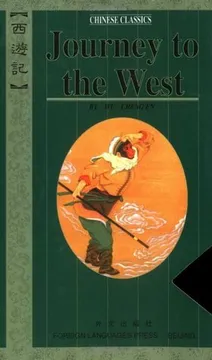


Plot Summary
A Stone Monkey Seeks Forever
An ancient stone on Flower-Fruit Mountain splits open and gives birth to a monkey1 whose golden gaze reaches Heaven. He wins the other monkeys’ loyalty by leaping through a waterfall and discovering the safe Water-Curtain Cave, then rules there for centuries. The thought of aging finally breaks his carefree life: he fears that death will erase everything he has built.
A fellow monkey tells him that Buddhas and immortals escape the cycle of birth and death. Determined to find them, the king1 leaves his mountain and crosses oceans. On the way, he sees people consumed by wealth and status, which only sharpens his desire to learn a way beyond ordinary life.
The opening gives Wukong two apparently opposite gifts: spontaneous freedom and a mind already troubled by limits. His kingdom offers shelter from rulers and weather, but it cannot shelter anyone from time. That fear converts play into purpose. His departure is not caused by deprivation; he leaves comfort because comfort cannot answer the question of what survives death. The story thus makes spiritual ambition begin not in serenity but in anxiety, and gives its hero a motive that can propel both genuine self-cultivation and dangerous overreach.
Subodhi's Secret Lessons
On the Mountain of Mind and Heart, Wukong1 persuades Patriarch Subodhi6 to accept him as a pupil and receives the name Sun Wukong.1 He studies for years, rejects practices he thinks cannot secure immortality, and correctly reads Subodhi’s6 coded instruction to meet him after dark. The Patriarch6 teaches him self-cultivation, seventy-two transformations, and a cloud-somersault that can cross vast distances.
Wukong’s1 excitement spills into display: he transforms himself into a pine tree for his fellow students. Subodhi6 expels him, warning him never to claim their connection. Returning to Flower-Fruit Mountain, Wukong1 discovers a monster has enslaved and robbed his monkeys. He kills the attacker, rescues the captives, and restores his rule.
Subodhi’s lessons reward Wukong’s intelligence, but they do not automatically give him judgment. He understands a secret hint that others miss, yet he cannot resist showing off once his skill becomes visible. The same quickness that makes him an exceptional student makes him dangerous to teach: ability arrives faster than restraint. His return to the mountain gives his new powers an immediate communal purpose, but his rescue of the monkeys also restores the identity of king he had left behind. Spiritual training has not erased ambition; it has armed it.
The Rod Defies Death
Concerned that wooden weapons cannot protect his growing monkey host, Wukong1 raids the armory of the nearby Aolai kingdom and returns with an army’s worth of arms. At the Eastern Ocean Dragon Palace, he rejects several weapons until a giant iron measuring rod shrinks to match his wishes. Its weight and obedience make it his signature weapon.
Later, Underworld officials summon him to die. Wukong1 fights his way to the death registers and crosses out his own name, along with the names of the monkeys. The Dragon King and rulers of the dead complain to the Jade Emperor.8 Rather than attack immediately, Heaven invites Wukong1 to take an appointment, bringing the self-made immortal1 into the bureaucracy he has already defied.
Wukong’s answer to vulnerability is not simply courage. He tries to alter the systems that make him vulnerable: he steals weapons instead of accepting military weakness, then erases the record that subjects him to death. The rod makes this impulse physical, changing size and force according to his will. Yet the Underworld episode also shows that his actions affect more than himself. By crossing out the monkeys’ names, he extends his personal revolt into a collective exemption from mortality. Heaven’s offer of office is an attempt to contain that disruption through recognition.
An Empty Heavenly Rank
At the Celestial Palace, Wukong1 is appointed supervisor of the imperial stables, a low-ranking post whose name initially conceals its status. Once he learns that Heaven considers it menial, he kicks over his desk, leaves the palace, and returns to Flower-Fruit Mountain. His followers urge him to claim a title equal to the Jade Emperor,8 so he raises a banner naming himself the Great Sage, Equal to Heaven.1
The first celestial forces sent against him fail to subdue him. Heaven then grants the title, but without duties or salary, hoping an honorary rank will quiet him. Instead, the promotion gives Wukong1 a place in Heaven without satisfying his demand to be treated as an equal.
The conflict is partly a collision between Wukong’s self-made status and a hierarchy that decides worth through rank. His anger is not merely vanity: he has proven his power, yet Heaven assigns him work that reduces him to a caretaker. But his response also exposes the trap in his idea of equality. A title without responsibility pleases him briefly because it confirms his self-image, while leaving the underlying desire for recognition untouched. Heaven mistakes symbolic appeasement for a cure, and Wukong mistakes a grand name for a settled identity.
Peaches Bring Heaven's War
With no real duties, Wukong1 is assigned the Garden of Immortal Peaches. He eats the ripest fruit, discovers that he has not been invited to the Queen Mother’s banquet, and immobilizes the maidens sent to pick more. He deceives the Immortal of Naked Feet, drinks the banquet wine, then wanders into Laozi’s palace and swallows the stored elixir.
He also carries wine back to his mountain followers. Once Heaven discovers the thefts, the Jade Emperor8 orders a vast army to surround Flower-Fruit Mountain. Wukong1 drives back the first celestial attackers, but the siege captures many of his allied monster kings. His defiance now has a price borne by those who trusted him, and Heaven summons Erlang13 to pursue him.
The peach garden turns Wukong’s grievance into appetite. He does not only demand recognition; he takes the very privileges that mark Heaven’s elite, then shares stolen wine with his own followers. The theft is comic in its audacity, but its consequence is political and personal: a cosmic army answers, and allies are captured. Wukong’s rebellion has become more than a contest between one hero and a dismissive court. His capacity to inspire loyalty makes his choices consequential for others, while his appetite still outruns his concern for the cost.
Five Phases Hold the Rebel
Erlang13 and the celestial gods finally capture Wukong1 with help from Laozi’s diamond snare. Blades, fire, and thunder fail to kill him, so Laozi seals him in the Eight Trigrams Brazier. Wukong1 survives in a sheltered compartment, then bursts out and renews his attack on Heaven. Buddha7 stops him with a wager: Wukong1 cannot leap beyond the Buddha’s7 palm.
His boastful journey reaches only the Buddha’s7 fingers, and Buddha7 pins him beneath the Five-Phases Mountain. Centuries later, Buddha7 decides to send scriptures east and commissions Guanyin5 to find a pilgrim. She recruits the condemned river spirit Sha Wujing,4 the exiled Marshal Zhu Wuneng,3 and a dragon prince12 to serve as the pilgrim’s companions and mount.
The brazier does not defeat Wukong by destroying his body; it reveals the limits of treating strength as proof of supremacy. His leap seems immeasurable to him, but Buddha’s palm makes distance itself a matter of perspective. Confinement turns a cosmic revolt into a long interval of enforced stillness. The scripture mission grows out of that cosmic settlement: the same world that contains Wukong’s rebellion also offers a path toward service. Guanyin’s recruitment of other disgraced beings suggests that reform will be built from flawed companions, not from untouched perfection.
A Family Reassembled by Fate
Before Xuanzang2 becomes the scripture pilgrim, his father, Chen Guangrui,10 wins the imperial examination and is appointed governor of Jiangzhou. Boatman Liu Hong murders Guangrui10 and seizes his wife, Wenjiao,11 who is pregnant. She places their newborn son on a river plank with a blood-written letter and a toe-mark identifying him.
Abbot Faming rescues the child, names him River Float,2 and raises him as a monk. At eighteen, Xuanzang2 learns his origins, finds Wenjiao,11 and follows her instructions to locate his grandmother and maternal grandfather. The court arrests Liu Hong, and the Dragon King,18 whom Guangrui10 once saved as a fish, restores the murdered father10 to life. Xuanzang2 repays Faming, then returns to religious life.
Xuanzang’s vocation is rooted in an inheritance of interrupted kinship. His mother’s letter and the missing toe make identity both intimate and verifiable: a child can be separated from his family without being severed from its history. His search for parents initially answers a personal wound, while the eventual reunion repairs several generations of loss. Yet Xuanzang does not abandon religious life after regaining his family. The story makes filial duty and spiritual discipline compatible, rather than asking him to choose one as proof of virtue.
A King Dies, a Monk Departs
A Dragon King of the Jing River18 alters a heavenly rain decree to win a bet against fortune-teller Yuan Shoucheng. Wei Zheng executes the dragon18 in a dream, despite Emperor Taizong’s9 promise to save him. The dragon’s18 ghost haunts Taizong,9 who dies and visits the Underworld; Judge Cui helps him return to life, and the emperor vows to hold a mass for the dead.
During the preparations, Guanyin5 reveals that the Great Vehicle scriptures can redeem the suffering dead and identifies Xuanzang2 as their worthy seeker. Taizong9 appoints him, supplies a travel permit, and treats him as a royal brother. Xuanzang2 accepts the dangerous mission, takes the name Tripitaka,2 and leaves Chang’an carrying the court’s mandate.
This sequence converts an imperial crisis into a religious undertaking. Taizong’s journey through the Underworld forces him to encounter consequences beyond the court, while his promise to the dead becomes public policy in the form of a mass. Guanyin redirects that penitence toward a practical task: bringing scriptures to China. Xuanzang’s acceptance is therefore motivated by several loyalties at once, including devotion to Buddha, gratitude toward the emperor, and concern for the living and dead. The royal permit distinguishes this fictional pilgrimage from a private quest.
A Pilgrim Frees His Guard
Xuanzang’s2 attendants are eaten by demons at Double-Fork Ridge, leaving him to be rescued by hunter Liu Boqin.14 Boqin14 shelters the monk, asks him to perform rites for his dead father, and escorts him toward the border. At the Mountain of Two Frontiers, a voice calls from beneath the rock: Sun Wukong1 has waited there for the Tang monk who can free him.
Xuanzang2 removes Buddha’s7 seal, and Wukong1 bursts out after five hundred years of confinement. He kills a tiger for clothing and promises to protect the pilgrim. Boqin14 returns home, while the newly joined pair continue west. Xuanzang2 has gained a powerful guardian, but Wukong’s1 confidence and readiness to use force immediately test the monk’s trust.
The first stretch of the road strips away Xuanzang’s expectation that an imperial commission can protect him. His attendants die, and his survival depends first on a hunter’s hospitality, then on releasing a being imprisoned for rebellion. Each act of rescue creates a new obligation. Wukong’s freedom is conditional from the outset: he needs the pilgrim’s help, and the pilgrim needs his protection. Their partnership is therefore neither simple friendship nor mere command. It begins as mutual dependence between a vulnerable traveler and a formidable, undisciplined ally.
The Fillet Binds the Monkey
When six highway robbers attack, Wukong1 kills them, arguing that he has protected his master. Xuanzang2 rebukes him for taking human lives, and Wukong1 leaves in anger. Guanyin5 appears disguised as an old woman and gives Xuanzang2 a cap with a hidden golden fillet, together with a spell that can make it tighten.
Wukong1 returns after the Dragon King reminds him that impatience can ruin his quest, but he puts on the cap before learning its purpose. Xuanzang2 recites the spell, and the band clamps painfully around Wukong’s1 head. Wukong1 agrees to continue the journey under restraint. Their first serious break is repaired, but obedience now depends partly on coercion rather than trust.
The robbers expose the difference between protecting someone and acting rightly on their behalf. Wukong measures the encounter by its immediate threat; Xuanzang measures it by the moral cost of killing. Neither can persuade the other in the moment, so the relationship is patched with a device that controls Wukong’s body. The fillet gives Xuanzang leverage, but it does not resolve the deeper disagreement. Its presence makes discipline visible and painful, turning an abstract lesson in restraint into a physical bond the two must carry together.
A Dragon Becomes a Horse
At Eagle Grief Stream, a dragon prince12 swallows Xuanzang’s2 white horse. Wukong1 fights him, but the dragon retreats underwater rather than surrender. Guanyin5 explains that she had already secured the prince’s life and ordered him to serve as the pilgrim’s mount. She transforms him into a white horse resembling the one he ate and gives Wukong1 three protective hairs for future danger.
The new horse carries Xuanzang2 across the stream, though it initially lacks tack. A local spirit, disguised as a shrine keeper, later supplies a saddle, reins, and other equipment. The Dragon Prince’s12 punishment becomes service, and the expedition gains transportation suited to the arduous road ahead.
The horse episode makes the pilgrimage’s support system visible. Xuanzang cannot cross the landscape on conviction alone; he needs a mount capable of surviving supernatural terrain. Guanyin turns a condemned dragon into that practical support, converting punishment into service without pretending the earlier offense never happened. Wukong’s impatience complicates the solution, since he attacks before explaining who the travelers are. The episode quietly establishes the party’s recurring problem: power can overcome an obstacle, but clear communication often prevents it from becoming a fight.
Hog Joins the Pilgrimage
At Gao Village, Wukong1 discovers that the household’s son-in-law is a hog-faced former heavenly marshal3 who has confined his wife, Green Orchid. Zhu Wuneng3 fights Wukong1 with his nine-pronged rake, then submits when he learns that Xuanzang2 is bound for the Western Heaven. He becomes Zhu Bajie,3 though his appetite and attachment to comfort remain.
The pilgrims later meet the Crow’s Nest Chan Master, who teaches Xuanzang2 the Heart Sutra and warns him about dangers ahead. Bajie3 recognizes the teacher but admits he once declined the chance to train with him. The new disciple adds strength and comic appetite to the company, while the Heart Sutra gives Xuanzang2 a portable discipline for facing future obstacles.
Bajie joins the journey through a mixture of repentance and bargaining. He accepts the religious path because it offers a chance to repair his heavenly disgrace, yet he keeps measuring sacrifice against comfort, food, and sexual desire. That tension makes his conversion credible as a beginning rather than a completed transformation. The Heart Sutra offers Xuanzang a contrasting resource: a compact teaching he can carry when experience threatens to overwhelm him. The pair of developments puts practical appetite beside contemplative discipline, two forces that the pilgrimage must repeatedly bring into balance.
Skulls Ferry the Monk
At the Flowing-Sand River, a man-eating monster attacks the travelers and fights Bajie3 to a standstill. The monster is the former Curtain-Raising Captain,4 exiled after breaking a celestial cup and condemned to prey on travelers. Guanyin5 sends her disciple Mokṣa to identify him and bring him into the pilgrimage. His nine floating skulls, joined with a gourd, form a vessel that carries Xuanzang2 across the river.
Sha Wujing4 joins as the quiet third disciple. Later, four holy women test the company’s resolve by offering marriage and wealth. Xuanzang2 and Sha Monk4 refuse; Bajie3 eagerly accepts, then is bound and abandoned when the women reveal themselves as bodhisattvas. The party continues with Bajie3 chastened, if not cured.
The river crossing transforms the monster’s trophies into a means of passage. Sha Wujing’s past violence does not disappear, but the skulls that mark it are rearranged into a vessel serving the pilgrimage. The test that follows distinguishes commitment from mere affiliation. Xuanzang and Sha Monk refuse worldly rewards, while Bajie’s quick surrender to desire reveals how fragile his vows remain. His humiliation gives the group a comic scene, but it also prevents a false conclusion: joining the journey is not the same as having mastered oneself.
Monks Against the Cart Slow Court
In the Cart Slow Kingdom, three Daoist masters17 have turned the Buddhist monks into forced laborers and persuaded the king to suppress their religion. Wukong1 disguises himself as a Daoist, learns how the masters17 gained influence during a drought, and discovers that five hundred monks remain imprisoned.
He kills two junior Daoists who refuse to release them, then gives the prisoners magical hairs for protection. At court, the king stages contests between Wukong’s1 side and the Daoists,17 including a rainmaking challenge.
Wukong1 secretly directs the weather gods and Dragon Kings, then defeats the masters17 in further trials. The supposed holy men are exposed as a tiger, deer, and antelope. The king frees the monks, certifies the travel permit, and restores religious balance.
The Cart Slow episode turns religious authority into a political question. The three masters win power by answering a drought, then use that history to justify the enslavement of monks and the destruction of their institutions. Wukong counters them through performance, investigation, and controlled spectacle, not simply superior force. His hairs let the prisoners protect themselves, extending his power to people who cannot fight their own captors. The king’s conversion is incomplete as a moral achievement, but the scene insists that rulers must be judged by how they treat vulnerable communities.
A Nation Without Men
In the women’s kingdom of Western Liang, Xuanzang2 and Bajie3 drink from the Child-and-Mother River and develop painful pregnancies. Wukong1 fetches water from the Abortion Stream, curing them before childbirth. The queen then proposes marriage to Xuanzang,2 hoping to secure a male heir for her kingdom. Wukong1 pretends to accept the match so the queen will certify the travel permit and escort them out of the capital.
Once the documents are secured, the pilgrims attempt to leave. Before they escape, a young woman appears and abducts Xuanzang2 in a cyclone. The courtship plot has been evaded without bloodshed, but the monk’s exposure to a new predator shows that sexual danger has not ended with the queen’s proposal.
The episode makes the body itself a site of comic vulnerability. A river imposes pregnancy on two male travelers, while the queen’s marriage offer turns Xuanzang into a political solution for a kingdom without men. Wukong protects his master by deception rather than violence, preserving both the permit and the lives of the women who would otherwise be opponents. But the final abduction prevents the party from mistaking escape for safety. Desire appears in several forms here, as social need, bodily consequence, and predatory appetite.
Two Monkeys, One Claim
A scorpion spirit abducts Xuanzang2 after Wukong1 and Bajie3 fail to defeat her. Guanyin5 directs Wukong1 to the star god Orionis, who reveals his rooster form and kills the scorpion. Later, Wukong’s1 anger at Xuanzang’s2 punishment drives him away again. A six-eared macaque16 copies Wukong’s1 appearance, voice, staff, and even the pilgrimage party, then strikes Xuanzang2 and steals the luggage.
Sha Wujing4 cannot distinguish the rivals; neither Guanyin,5 the Jade Emperor,8 nor the Underworld can identify the original. At last Buddha7 recognizes the macaque16 by its species and traps it beneath an almsbowl. Wukong1 kills the impostor and returns to Xuanzang,2 who accepts him back and resumes the journey.
The double episode pushes the story’s central problem beyond appearances. The macaque copies not only Wukong’s face but the signs by which authority has previously been recognized: speech, equipment, and shared history. Even supernatural courts fail to settle the dispute. Buddha’s discernment rests on knowledge of a category others have missed, exposing the limits of observation without deeper understanding. Wukong’s anger had already fractured the party, so the impostor exploits a real weakness rather than inventing one. The reunion restores the group, but it also shows why Wukong’s force must be joined to judgment.
The Scriptures Reach Home
After further ordeals, the travelers enter a kingdom where the ruler has vowed to kill ten thousand Buddhist monks. Wukong1 disguises the pilgrims as laymen and secretly shaves the king, his court, and palace attendants; confronted with their sudden tonsures, the ruler abandons his persecution and renames his country the Dharma-Honoring Kingdom.
The party reaches Spirit Mountain, receives scriptures, and first discovers that the scrolls are blank. Buddha7 explains that the two attendants withheld written texts because the pilgrims brought no offering.
Xuanzang2 gives up his alms bowl, and they receive five thousand and forty-eight written scrolls. Back in Chang’an, Taizong9 welcomes them. Xuanzang2 and Wukong1 become Buddhas, Sha Wujing4 an arhat, Bajie3 a temple servant, and the dragon horse a celestial dragon.12
The final stretch brings the pilgrimage’s external and internal arguments together. The monk-killing king’s reversal is comic, yet it makes political violence visible through the king’s own transformed body. At Spirit Mountain, even the sacred institution is not free of transaction: the first scriptures are blank, and the alms bowl becomes the price of access to written teaching. The ending grants different rewards to the travelers rather than flattening them into identical saints. Wukong and Xuanzang receive Buddhahood, while Bajie’s appetite shapes a humbler appointment. Completion means transformation, not sameness.
Analysis
Journey to the West makes spiritual development an adventure in managing power, appetite, and obligation. Wukong1 begins by trying to defeat every limit through skill: he learns transformations, erases his name from death’s register, and demands recognition from Heaven. Xuanzang’s2 pilgrimage offers him a different task, one in which strength is useful only when it protects another person and accepts direction. Their partnership never becomes frictionless. The fillet controls Wukong1 before trust can; repeated arguments over violence show that moral discipline is a practice, not a single conversion.
The book’s ensemble makes that practice social. Bajie’s3 hunger and lust, Sha Wujing’s4 former violence, the dragon prince’s12 punishment, and Xuanzang’s2 vulnerability all become part of the journey rather than reasons to exclude anyone from it. Guanyin5 repeatedly redirects offenders toward service, while Wukong’s1 powers rescue communities as often as they threaten them. The pilgrims’ progress depends on learning how different capacities can work together without becoming identical.
The story also refuses to separate religious seriousness from comedy. A demon can be exposed by a rain contest, a king’s persecution can be reversed by a sudden loss of hair, and sacred books can arrive blank because their keepers expect a gift. Such episodes puncture authority while preserving the importance of the teachings at stake. Buddhist, Daoist, and Confucian elements share a single imaginative landscape, where imperial duty, family loyalty, self-cultivation, and compassion continually overlap. The pilgrimage’s destination is not simply a cache of texts. It is a transformed way of carrying responsibility, in which even a stone-born rebel1 can become a protector, and even a flawed group can reach the goal by enduring the road together.
Review Summary
Readers universally praise Journey to the West as a monumental work of world literature, celebrating its unique blend of adventure, humor, philosophy, and religious themes. Many note its surprisingly accessible and entertaining nature despite its daunting length. Common criticisms include repetitive plot structures and underdeveloped characters like Friar Sand. Reviewers frequently highlight the brilliance of Monkey and Pig's dynamic, and several mention the challenges of translation. Many readers took months or years to finish, yet few regret the commitment.
Characters
Sun Wukong
The defiant mind monkeyBorn from a stone and crowned by the monkeys of Flower-Fruit Mountain, Sun Wukong is brilliant, restless, and hungry for freedom from death and subordination. His transformations, iron rod, and cloud-somersault make him the company’s strongest defender, but his confidence often outruns his judgment. He reacts fiercely to insult and can mistake control for respect, as his conflicts with Heaven and with Xuanzang2 show. Beneath the swagger is a genuine capacity for loyalty: once he accepts the pilgrimage, he repeatedly risks himself to protect his companions. His central tension is between self-rule and disciplined service, a struggle that makes his power both useful and dangerous.
Xuanzang
The scripture-seeking monkKnown as Tripitaka2 on the pilgrimage, Xuanzang is a devout monk whose commitment combines religious discipline, filial feeling, and loyalty to the Tang emperor. His childhood separation from his parents gives his vocation a personal history, but he does not turn that history into a claim to power. He is compassionate and steadfast, yet physically vulnerable and often unable to judge supernatural danger without his disciples. His insistence that Wukong1 answer for killing reveals a serious moral conscience, though his reliance on the fillet complicates his authority. Xuanzang’s courage is rarely martial. It lies in continuing west despite fear, grief, temptation, and repeated evidence that the journey may cost him his life.
Zhu Bajie
The hungry former marshalZhu Bajie, also called Wuneng3, is a former heavenly marshal whose fall leaves him in a piglike body and an uncertain relation to discipline. He is strong enough to carry the luggage and fight supernatural enemies, but he remains attached to food, sleep, comfort, and sexual desire. His complaints make him comic, yet they also give the pilgrimage an honest voice for exhaustion and bodily need. Bajie’s willingness to join Xuanzang2 offers a chance to atone, not proof that he has already changed. He can be generous and brave when circumstances demand it, even as he searches for loopholes in the vows he has accepted.
Sha Wujing
The steady river discipleOnce the Curtain-Raising Captain, Sha Wujing is exiled to the Flowing-Sand River after breaking a celestial cup. Guanyin5 redirects his violent existence toward service, and he joins Xuanzang2 as the youngest disciple. Sha Monk4 is quieter and more dependable than Wukong1 or Bajie3, carrying the luggage, protecting the group, and often trying to keep disputes from worsening. His past as a man-eater gives his conversion weight, while his steady conduct suggests that reform can be expressed through repeated, unshowy work.
Guanyin
The pilgrimage's guideGuanyin receives Buddha’s7 commission to find a scripture seeker and prepare a difficult route from China to India. She recruits former offenders as the pilgrim’s2 protectors, arranges the dragon-horse’s service, and helps bind Wukong1 to the mission. Her compassion is practical rather than indulgent: she offers a path back to virtue while using discipline when a disciple’s power threatens the journey. Guanyin understands that people rarely become trustworthy through instruction alone. She places them in relationships and duties that expose their weaknesses, then gives them room to choose whether to change.
Patriarch Subodhi
Wukong's secret teacherSubodhi accepts the stone monkey1 as a pupil and gives him the name Sun Wukong1. He recognizes unusual intelligence in the student and teaches him techniques of cultivation, transformation, and travel. His instruction is demanding and indirect, requiring Wukong1 to interpret hints rather than simply obey commands. When Wukong1 displays his powers to other students, Subodhi sends him away to protect the secrecy of his teaching. The relationship leaves Wukong1 with great ability but no easy claim to his teacher’s authority.
Śākyamuni Buddha
The cosmic adjudicatorBuddha intervenes when Wukong’s1 rebellion overwhelms Heaven’s forces. His wager reveals the limits of Wukong’s1 confidence, and his imprisonment of the monkey1 turns punishment into a long interval before possible reform. Later, Buddha commissions the delivery of scriptures to China and ultimately receives Xuanzang’s2 party at Spirit Mountain. He represents a scale of knowledge and authority that neither the Jade Emperor8 nor the other immortals can match, though the story also gives his institutions ordinary complications.
The Jade Emperor
Heaven's uneasy rulerThe Jade Emperor governs the Celestial Palace, where Wukong’s1 emergence becomes a political problem. He initially treats the monkey1 as a being who may be managed through appointment, then discovers that honorary rank cannot contain a grievance rooted in humiliation. His court’s formal hierarchy contrasts with Wukong’s1 insistence on self-defined status. The emperor is powerful but not all-knowing, and often relies on ministers, generals, and Buddha7 to manage crises.
Emperor Taizong
The pilgrim's royal sponsorTaizong commissions Xuanzang’s2 journey after his own encounter with death and the Underworld. He wants the scriptures brought to China and treats the monk as a royal brother, joining imperial duty to religious patronage. His experience makes him more responsive to the suffering of the dead and the value of Buddhist rites. Taizong’s authority can open roads and mobilize armies, but the pilgrimage depends on Xuanzang’s2 willingness to leave the security of court.
Chen Guangrui
Xuanzang's murdered fatherChen Guangrui is a successful examination candidate appointed governor of Jiangzhou. His journey to take up the post ends in violence when the boatman Liu Hong murders him and takes his pregnant wife. Guangrui’s earlier act of freeing a golden carp gives the Dragon King18 a reason to preserve his body and later restore him to life. His story ties Xuanzang’s2 family history to the supernatural world surrounding the pilgrimage.
Wenjiao
Xuanzang's determined motherWenjiao is forced into Liu Hong’s household after he murders her husband. To save her newborn, she sends him downriver with a letter in her own blood and a physical mark for identification. Her careful actions preserve the truth of her family’s history until her son2 can find her. Wenjiao’s endurance is shaped by danger and limited choices, not passivity; she acts strategically to protect her child and secure a path toward justice.
The Dragon Prince
The transformed pilgrimage mountThe son of the Western Ocean Dragon King is condemned after setting fire to his father’s palace. Guanyin5 secures his life by assigning him to serve the scripture pilgrim2. He first appears as a dangerous presence at Eagle Grief Stream, then becomes the white horse that carries Xuanzang2 across the western road. His role turns an offense into a long opportunity for service.
Erlang
Heaven's formidable hunterErlang is the Jade Emperor’s8 nephew, a powerful fighter whose transformations can match Wukong’s1. Guanyin5 recommends him when Heaven’s armies fail to capture the monkey1. His skill makes him one of the few opponents able to press Wukong1 seriously, though victory comes through a combined effort rather than strength alone. Erlang stands for disciplined force within the celestial order.
Liu Boqin
The borderland hunterLiu Boqin is a hunter who rescues Xuanzang2 from the demons of Double-Fork Ridge. He shelters the monk and asks him to perform rites for his deceased father. Though he lives by hunting, he treats Xuanzang2 with hospitality and helps him reach the Mountain of Two Frontiers.
The Great Immortal of Golden Head
The mountain guideThe Great Immortal of Golden Head lives near Spirit Mountain and welcomes Guanyin5 during her search for a scripture pilgrim. Later, he receives Xuanzang’s2 party and helps guide them toward the final ascent. His quiet service links the long earthly road to the sacred destination.
The Six-Eared Macaque
The uncanny imitatorA rare monkey spirit with exceptional hearing and an ability to imitate what it observes, the Six-Eared Macaque is difficult to judge by ordinary appearances. Its presence raises questions about identity, knowledge, and the difference between copying the signs of virtue and embodying it.
The Three Cart Slow Masters
Animal spirits in powerThe Tiger-Strength, Deer-Strength, and Goat-Strength Immortals gain the Cart Slow Kingdom’s favor after providing rain during a drought. They use that influence to persecute Buddhist monks and force them into labor. Their public reputation for spiritual power hides their predatory nature, making them both political oppressors and supernatural adversaries.
The Dragon King of the Jing River
The rain-bet petitionerThe Jing River Dragon King alters a heavenly rain order after learning that a fortune-teller has predicted the weather precisely. His attempt to protect his authority brings him into conflict with Heaven and draws Emperor Taizong9 into the Underworld’s affairs. Earlier in the story, his rescue connects the supernatural world to Xuanzang’s2 family history.
Plot Devices
The Compliant Golden-Hooped Rod
Power in a tiny formWukong1 obtains the rod from the Eastern Ocean Dragon Palace, where it once measured the depth of the Heavenly River. It changes size at his command, from a needle hidden in his ear to a weapon large enough for battle. The rod makes his force immediate and visible, but its obedience to his wishes also mirrors his belief that the world should yield to his will. During the pilgrimage it protects his companions, challenges divine authority, and gives his anger a physical outlet.
The Tightening Fillet
Restraint made physicalGuanyin5 gives Xuanzang2 a cap containing a golden fillet and a spell that tightens it around Wukong’s1 head. The device is introduced after Wukong1 kills the highway robbers and refuses Xuanzang’s2 rebuke. It makes the monkey1 submit when argument cannot, protecting the pilgrimage from his sudden departures and unchecked violence. Its usefulness comes with a cost: discipline imposed through pain can secure outward obedience without immediately resolving resentment or teaching self-restraint.
The Travel Rescript
A royal pass through kingdomsTaizong’s9 sealed travel document identifies Xuanzang2 as an authorized envoy traveling west for scriptures. Rulers along the route inspect and stamp it, making the pilgrimage legible to courts that might otherwise imprison, tax, or turn the travelers away. The document is also evidence of Xuanzang’s2 divided obligations: he seeks spiritual truth while acting under imperial commission. In the women’s kingdom and the Cart Slow Kingdom, certification becomes a concrete prize the travelers must secure before they can continue.
The Dragon-Horse
A condemned prince carries the monkThe Dragon Prince12 becomes Xuanzang’s2 mount after Guanyin5 arranges a way for him to atone for his offense against his father. His transformation solves a practical problem: an ordinary horse cannot reliably cross the supernatural rivers and mountains on the route to India. The prince12 first swallows the pilgrim’s2 horse, then takes its appearance and carries Xuanzang2 instead. The device joins transport to moral repair, while the horse’s changing nature reminds the travelers that appearances on the road are often unreliable.
The Three Scripture Baskets
A mission with a measured goalBuddha7 describes three collections of scriptures as teachings capable of guiding the living and redeeming the dead. Guanyin5 carries the mission east, and Xuanzang2 accepts the dangerous journey to bring the texts back to China. The final count of five thousand and forty-eight scrolls gives the enterprise a formal measure of completion. Yet the first texts the pilgrims receive are blank, forcing them to return and confront the gap between merely possessing sacred objects and understanding the conditions under which knowledge is transmitted.
Download PDF
Download EPUB
.epub digital book format is ideal for reading ebooks on phones, tablets, and e-readers.








