

Key Takeaways
Define quality by the customer's purpose, then remove what makes delivery fail
Customers set the standard. Quality has two sides: features that meet customer needs and freedom from failures. Better features can cost more, but preventing defects, delays, and errors usually lowers costs. The customer is not always just the person who pays. Users, intermediaries, regulators, and others affected by a product may have distinct requirements. A supplier that focuses only on its own technical specifications can miss what makes an offering useful in practice.
Listen beyond the request. Customers often describe a product they want when the real need is a benefit they seek. They may also value psychological or practical features that engineers overlook. A company that refused to accept orders for delivery in less than 48 hours lost business to competitors offering 24-hour delivery. The lesson is not to promise everything, but to discover which needs determine whether the customer chooses and trusts the service.
What's striking is the shift from quality as an internal property to quality as value experienced by someone else. That connects naturally to service design, where a technically sound process can still fail if it creates friction at the point of use. The idea also complicates the slogan that the customer is always right: customers may disagree with one another, lack technical knowledge, or ask for features that conflict with safety or affordability. Strong quality planning therefore combines listening with evidence, translation, and explicit decisions about whose needs matter most.
Manage quality through planning, control, and improvement, not inspection alone
Three jobs, one system. The Juran Trilogy is the linked set of managerial processes for designing quality, maintaining performance, and improving results. Planning identifies customers and designs products and processes to meet their needs. Control monitors actual performance against goals and responds to departures. Improvement removes chronic causes of waste and dissatisfaction. The processes resemble financial planning, financial control, and financial improvement, so quality can be managed as a core business responsibility rather than a specialist’s side project.
Separate spikes from chronic waste. In Juran’s illustration, operations restored a process after an unexpected spike in waste, but that only returned performance to its already poor baseline. A separate improvement effort reduced the ongoing waste. Troubleshooting a sudden failure and eliminating persistent waste require different work, authority, and methods.
This framework is useful because it distinguishes keeping a process stable from changing what the process can achieve. The distinction echoes a basic principle in control theory: stabilizing a system does not necessarily make its target desirable. An organization can reliably produce the wrong outcome. Conversely, constant redesign without operational controls can erase gains. The trilogy helps leaders ask whether a problem calls for better design, routine control, or a true performance breakthrough, instead of treating every quality issue as an inspection failure.
Treat chronic failure as a financial leak, not a technical nuisance
Waste consumes earnings. The cost of poor quality, or COPQ, is the expense that would disappear if failures were removed. It includes rework, scrap, extra inspection, warranty claims, complaint handling, late shipments, and lost repeat business. The handbook reports historical estimates of 15 to 20 percent of sales for manufacturing and 30 to 35 percent for services, based on sources available around 2003. These are not current universal benchmarks, but they show why leaders should investigate hidden failure costs. One manufacturer reported scrap and rework costs five times its annual profit.
Quality also sells. Better features can increase customer preference, market share, or willingness to pay, while fewer failures protect repeat sales and reputation. A COPQ estimate need not be precise enough for financial statements to help prioritize projects. It should be transparent, credible, and detailed enough to reveal where the biggest opportunities lie.
The financial framing is powerful because it translates defects into terms senior leaders already use. It also guards against a common mistake: cutting visible budgets while leaving the cost of redoing work untouched. Still, estimated savings are not automatically cash savings. Capacity released by fewer errors may create value without reducing headcount or immediate spending. A sound business case should distinguish avoided cost, newly available capacity, and realized profit, so improvement teams are rewarded for genuine gains rather than optimistic accounting.
Put executives on the hook for quality, and give workers control
Leaders own the conditions. Quality cannot be delegated entirely to an inspection department. Executives set priorities, fund improvement work, review results, remove obstacles, and align goals across functions. The handbook describes organizational change as a system-wide effort involving leadership, structure, performance, workplace norms, and the ability to adapt. Training alone cannot achieve that change if incentives and everyday practices continue to reward the old behavior.
Make good work possible. Self-control is the condition in which a worker knows what is expected, can see actual performance promptly, and has a capable process plus the authority and tools to correct it. Juran observed that control charts often failed on factory floors not because the charts were technically weak, but because their authority and relationship to existing specifications were unclear. Workers cannot reasonably be blamed for results they lack the power or resources to control.
The section links quality to the design of work, not merely to individual motivation. That is a valuable corrective to management systems that demand accountability without granting authority. It also resembles the distinction between autonomy and abandonment: genuine empowerment supplies standards, feedback, competence, and room to act. The model has a practical test. When defects occur, leaders should ask which part of the work system made the error likely before judging the person closest to it.
Design around real customer needs before choosing features or processes
Start with the need. Quality by Design is a structured approach to planning a new or revised good, service, or process. It begins by defining the project and identifying everyone who may affect or be affected by the result. Teams then discover needs, translate them into measurable requirements, develop product features, and determine whether the processes can reliably deliver them. Internal customers matter too: operators, maintainers, and service staff may determine whether a design works outside the drawing room.
Test the assumptions. Customers may state a solution rather than the benefit they want, and their actual use can differ from intended use. The handbook uses a screwdriver as an example: people also use it to pry or scrape. Designers must decide whether to accommodate foreseeable misuse, especially when safety is involved. They should also avoid perfectionism, improving a feature beyond what customers value or economics justify.
The method connects customer research to engineering choices instead of treating them as separate conversations. It also recognizes that products live in real environments, where users improvise and constraints collide. That makes observation and prototype testing essential complements to surveys. A caution follows: customers can reveal unmet needs, but they cannot always imagine a radically new solution. Effective design listens closely without asking customers to perform the designer’s job, and it tests whether a proposed feature creates value rather than merely adding complexity.
Solve chronic problems with evidence, then redesign controls to hold gains
Diagnose before fixing. Breakthrough improvement is organized, project-by-project work on a chronic problem. Teams define the problem, measure its size, investigate possible causes, test those explanations, implement remedies, and establish controls that prevent recurrence. Pareto analysis helps teams focus on the few contributors responsible for much of the loss. The approach applies to service and administrative work as well as manufacturing.
A floor tells a story. At a modular-housing factory, damaged linoleum accounted for 51 percent of rework. The team found that gouges clustered in kitchens and usually appeared where floor protection was missing. Installing protection sharply reduced damage. But the problem returned when new workers arrived without training and no formal plan required protection. The lasting remedy needed a written procedure, training, and supervision, not just the right protective material.
This case shows why a plausible fix is not the same as a durable fix. Root-cause analysis is strongest when it tests competing explanations against observed patterns, then checks whether the solution survives ordinary staffing and operating changes. The story also reveals a useful sociotechnical principle: a process is partly its equipment and partly its routines, training, and accountability. A remedy that changes only the physical setup may leave the organizational cause untouched.
Use data to separate process signals from ordinary variation
Variation is information. Statistical process control uses measurements over time to distinguish special causes, which signal an unusual change, from common causes, the routine variation built into the current process. A control chart helps operators avoid reacting to every fluctuation. Its control limits are not the same as product specification limits: a process can be stable yet consistently fail customer requirements, or meet specifications while showing signs of instability.
Check the measurement first. Data are only useful when the measurement system is accurate and repeatable. Graphs can reveal patterns hidden by averages. In one bank, teller transaction times formed two peaks. Further analysis showed that simple deposits took less time than complex account transactions, correcting the assumption that inexperienced tellers caused the delays. Capability analysis then asks whether a stable process can meet its specifications.
This is a disciplined alternative to managing by anecdote or the latest data point. It also clarifies that statistics help distinguish patterns, but do not automatically prove causes. A bimodal chart suggested different transaction types, while further categorization explained the pattern. The broader lesson is to let data sharpen questions, not replace judgment. Measurement itself can distort decisions, and a well-calibrated instrument cannot rescue a poorly defined customer requirement.
Make work flow at customer demand, not at the factory's convenience
Pull from real demand. Lean is an approach to improving flow and reducing work that consumes resources without adding customer value. A push system produces according to plans even when downstream steps are constrained, often creating excess work in progress. A pull system replenishes what the next step or customer has actually used. Value stream maps show the flow of materials and information, making delays, handoffs, queues, and rework visible.
Look beyond obvious waste. Lean also considers uneven work and overburden, not just visible scrap or waiting. The handbook describes a hospital interventional radiology team that reduced average patient holding-room time from 151 minutes to about 33 minutes by examining the process and improving coordination. Little’s Law links work in progress, throughput, and lead time, explaining why excess queues often mean customers wait longer.
The connection between flow and waiting makes Lean especially useful in services, where inventory may be invisible but queues are painfully real. The hospital example also shows that a faster process can improve both customer experience and employee frustration. Yet reducing buffers indiscriminately can make a system brittle when demand or supply fluctuates. Good Lean practice distinguishes waste from strategically useful slack, and examines whether speed at one step simply moves congestion elsewhere.
Treat suppliers as part of your process, not an external excuse
Quality crosses company lines. The handbook notes that purchases can represent more than 60 percent of sales dollars and may be the source of over half of quality problems. Supplier defects can trigger rework, production delays, warranty claims, and customer dissatisfaction. Under just-in-time production, weak incoming quality is especially costly because there is little inventory to absorb disruptions.
Build capability together. Effective supplier management starts with clear product and quality-system requirements, then evaluates design and process capability. Stronger relationships may include joint technical planning, shared data, supplier development, and ongoing performance feedback. Certification can reduce repeated inspections when a supplier has demonstrated reliable performance, but it is not a substitute for monitoring. Total cost of ownership matters more than the initial bid: a cheaper component can become expensive after inspection, downtime, repairs, and customer failures.
Supply-chain thinking expands responsibility without pretending that a buyer controls every supplier decision. The most useful shift is from blame after delivery to shared design and prevention before delivery. This resembles resilience planning: reliability depends on the connections between organizations, not just the strength of each organization in isolation. Partnerships also create risks around dependency and transparency, so cooperation works best with explicit standards, credible data, and clear accountability for failures.
Benchmark beyond your industry, then turn the gap into strategic goals
Compare to learn. Benchmarking is a continuous, structured comparison of performance that identifies leading practices and the reasons behind them. Xerox’s quality crisis in the 1970s helped popularize modern benchmarking; the company studied other organizations, including L.L. Bean’s logistics, instead of assuming competitors were the only source of useful ideas. Benchmarking is not a quick tour or a league table. It requires clear definitions, reliable data, fair comparisons, and a plan to adapt what is learned.
Make the findings operational. Strategic deployment translates a small number of long-term priorities into measurable goals, projects, owners, resources, and review points. Two-way discussion between leaders and the people responsible for execution improves realism. Standards such as ISO 9001 can establish a common management-system baseline, but certification alone does not guarantee superior results. Broader assessments examine outcomes, customer experience, improvement, and organizational capability.
Benchmarking becomes valuable when it changes decisions, not when it produces a presentation. Comparisons can expose hidden assumptions about what is achievable, while strategic deployment turns aspiration into work with owners and deadlines. The method also needs humility: another organization’s practice may depend on different technology, labor markets, or customers. Normalizing data and studying causes matters more than copying a visible technique. Standards provide a useful floor, but leadership must decide what excellence means in its own context.
Analysis
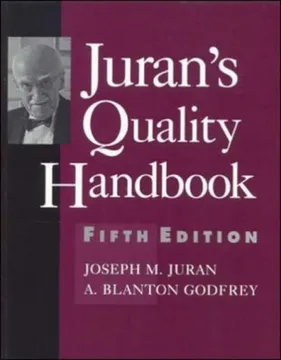
Juran’s Quality Handbook is best understood as an operating reference for managing an organization, not a single-method manual. Its chapters range from strategy and governance to statistics, supplier relations, audits, Lean, Six Sigma, and service design. The unifying claim is that quality is an enterprise responsibility: customer needs must shape design, operations must reliably deliver the design, and chronic failures must be removed through organized improvement.
The handbook’s most durable contribution is its insistence that different quality problems need different managerial responses. A sudden process upset calls for troubleshooting. Persistent waste calls for diagnosis and improvement. A new customer need calls for planning and design. This separation prevents inspection, training, or statistical tools from becoming rituals detached from results. The Juran Trilogy gives executives a common language for those distinct tasks.
The framework also exposes productive tensions. Customer-defined quality is persuasive, but customers, regulators, workers, owners, and communities can want incompatible things. Quality management therefore requires explicit choices, not a vague promise to satisfy everyone. Likewise, measurement can reveal cost and variation, yet imperfect metrics can distort priorities. Estimated COPQ is useful for deciding where to investigate, but should not be confused with realized savings. Benchmarking can challenge complacency, but comparisons fail when context and data quality are ignored.
The handbook’s cases make its abstractions memorable: a delivery promise lost customers, floor protection reduced factory rework, and a hospital redesigned patient flow. These examples show that quality is both technical and social. A process can be statistically capable and still miss the need; a sound remedy can fail if training and controls are absent. The resulting lesson is practical: define the customer outcome, understand the process that produces it, measure with care, and assign responsibility for sustaining what improves.
Glossary
Juran Trilogy
Three linked quality processesThe Juran Trilogy describes quality planning, quality control, and quality improvement as the core managerial processes for managing quality. Planning designs products and processes around customer needs. Control maintains performance against defined goals. Improvement removes chronic causes of failure and waste. The processes are related but solve different problems, much like planning, control, and improvement in financial management.
Cost of poor quality (COPQ)
Costs caused by failuresCOPQ is the cost that would disappear if failures in products, services, and processes were eliminated. It can include scrap, rework, warranty claims, complaint handling, excess inspection, late delivery, and lost repeat business. Organizations often estimate COPQ to identify and prioritize improvement opportunities. It is a management tool, not automatically an audited financial measure or realized cash saving.
Fitness for purpose
Customer-defined usefulnessFitness for purpose means that a good, service, or process does what its customer needs it to do. The relevant customer may include the purchaser, user, intermediary, regulator, or another affected party. The concept includes both useful features and freedom from failures. It is broader than simply meeting an internal specification at final inspection.
Self-control
Conditions for reliable workSelf-control is a work condition in which people know what is expected, can see how the process is performing, and have the capability and authority to regulate it. The process must be able to meet its goals, and workers need the tools, training, information, and access needed to act. When these conditions are missing, blaming workers for defects may be unjustified.
Breakthrough improvement
Project-based performance changeBreakthrough improvement is an organized effort to solve a chronic problem and achieve a new level of performance. It is conducted through specific projects, usually involving a team that measures the problem, diagnoses causes, implements remedies, and establishes controls to hold the gains. It differs from restoring a process after a one-time disruption.
Process capability
Ability to meet specificationsProcess capability describes the inherent variation of a process that is operating under stable conditions, compared with the specifications it must meet. Capability analysis helps determine whether a process can reliably produce acceptable output. A stable process is not necessarily capable: it may consistently produce results outside customer requirements. Capability estimates depend on suitable data and valid measurement.
DMAIC
Structured improvement methodDMAIC is a Six Sigma improvement method used to address existing processes. Teams define a problem and goal, measure current performance, analyze evidence to identify causes, improve the process, and control it to sustain results. Management selects and supports projects. The method emphasizes data-based diagnosis rather than jumping directly from symptoms to a preferred solution.
Design for Six Sigma (DFSS)
Customer-led design methodDesign for Six Sigma applies a structured design approach to new or substantially revised products, services, and processes. Its DMADV sequence means define, measure, analyze, design, and verify. Teams identify customer needs, translate them into measurable requirements, develop and test design alternatives, and verify that the final design can meet requirements in operation.
Value stream
End-to-end work flowA value stream includes the activities and information flows required to deliver a product or service, from initial planning through delivery. Mapping a value stream makes customer-value-adding steps, delays, handoffs, inventory, and rework visible. Teams use the map to design a better future process and reduce waste while preserving activities that customers or the organization genuinely need.
Hoshin kanri
Strategy-to-action deploymentHoshin kanri, also called policy or strategy deployment, translates a limited set of high-priority strategic aims into coordinated goals and actions throughout an organization. Leaders communicate priorities, lower-level teams propose practical means and resource needs, and the discussion proceeds in both directions. The process is intended to align plans, execution, and review rather than create a separate quality initiative.
Special and common causes of variation
Unusual and routine variationSpecial causes are unusual changes that disturb a process, such as a breakdown or a one-time error. Common causes are the ordinary variation produced by the process as it is currently designed. Control charts help distinguish the two. Special causes often call for local investigation and correction; persistent common-cause problems generally require improvement to the process itself.
Download PDF
Download EPUB
.epub digital book format is ideal for reading ebooks on phones, tablets, and e-readers.








