

Key Takeaways
Send the honest message to end limbo, not to guarantee romance.
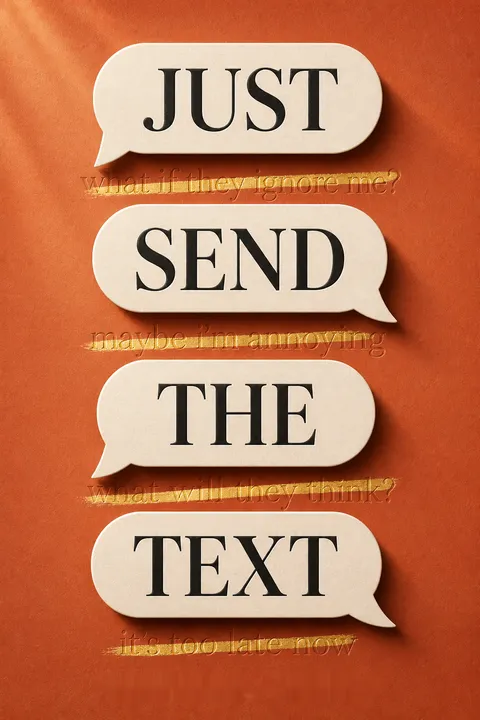
The point is freedom. In college, Jalili spent months trying to seem effortlessly cool to a man she had barely begun to know. When she finally sent a candid message about her feelings, he did not reply. The rejection hurt, but it also ended the exhausting effort to win his approval. The book’s central idea, “Just Sending the Text,” means acting on what feels honest instead of calculating how to appear more desirable. The “text” can be a message, a conversation, or a boundary, such as blocking someone whose posts fuel anxiety.
A result is not a verdict. A direct expression may lead to a relationship, as it did for Jalili’s friend Morgan, or to a clear rejection. Either way, it replaces prolonged guessing with information and gives both people a chance to meet the real person, not a performance.
The useful distinction is between vulnerability as a tactic and vulnerability as self-respect. If honesty is used to force a particular response, the sender remains dependent on approval. If it is used to communicate clearly and learn whether the connection is mutual, it restores agency regardless of the answer. The approach works best when the message is proportionate to the relationship and the other person is safe to address. Directness cannot make another person kind, available, or compatible. Its promise is narrower, and more credible: less time spent hiding what matters.
Use dating apps as doors, not anesthesia for one-sided feelings.
Options can soothe and unsettle. Dating apps make meeting people easier, but they also expose everyone to a seemingly endless stream of alternatives. Jalili describes swiping through other profiles whenever she worried about a man she actually liked. The activity felt like control, but mainly helped her avoid admitting what she wanted. In the book’s 2019 Match survey, 66 percent of app users said they were open to a relationship, while 9 percent said they used apps strictly for casual dating. A 2019 Stanford study cited in the book found that nearly 40 percent of heterosexual couples in the United States met through apps in 2017.
Take breaks without ceremony. If app use becomes a chore, a source of panic, or a way to dodge a feeling, delete the apps for a while. They can be a route to connection, not proof that no one will choose you.
The apps are best understood as infrastructure, not a dating philosophy. Their abundance can increase access while encouraging users to treat attention as replaceable, which makes a promising connection feel unusually fragile. Jalili’s distinction between using apps to meet people and using them to numb attachment is valuable because the same behavior can serve different needs. A break is not a declaration that the technology is bad; it is a way to notice what the technology is doing to attention and mood. The book’s 2017 figure is a snapshot, not a timeless measure of how couples meet.
Treat casual dating as discovery, then state what you want.
Slow beginnings can help. Hookup culture can make people feel that wanting commitment is embarrassing, even though the author cites a Match survey in which 63 percent of single millennials were looking for romantic love and 70 percent of Gen Z respondents wanted long-term relationships. Sociologist Lisa Wade describes casual stages as possible small steps toward commitment. Time together can reveal whether the person behind the great first date is actually a good fit.
Silence has a cost. In a 2020 YouGov survey of 254 single women, 25 percent of women ages 18 to 34 said they had experienced an undefined relationship during the prior year. Karen tried to hide her growing feelings to preserve a casual arrangement, while Nina later wished she had spoken sooner. The advice is not to demand commitment immediately. It is to stop pretending that an arrangement works when it does not.
This section resists two familiar extremes: treating every spark as a promise, and treating every desire for commitment as neediness. Gradual dating can allow observation before commitment, but ambiguity becomes costly when only one person is quietly hoping it will change. The important variable is not how many dates have passed; it is whether each person understands the arrangement well enough to choose it. Cultural scripts often reward emotional concealment, yet concealed preferences cannot be negotiated. A direct conversation is not a demand for a particular answer. It is a request for enough clarity to make an informed choice.
Build a satisfying single life before choosing a partner.
A partner should add, not rescue. Jalili connects dating anxiety to fairy tales, romantic comedies, and social expectations that portray coupledom as the proper ending for women. Her mother left two marriages without assuming that another partner would appear, deciding each time that solitude was preferable to an unhappy marriage. She later built a full life through friends, interests, financial independence, and a home she enjoyed, and entered a new romance without treating it as her only source of happiness.
Being single is not a diagnosis. A 2017 Mintel survey cited in the book found 61 percent of single women in the United Kingdom were happy being single. The author also describes research linking fear of being alone with settling for less in relationships. Wanting partnership is normal; treating it as necessary for a worthwhile life can make a poor match seem better than no match.
The strongest version of this argument does not romanticize isolation. It separates the legitimate desire for intimacy from the belief that a partner must certify someone’s worth or complete an otherwise defective life. Financial stability, friendships, meaningful activities, and a livable home make that distinction practical rather than merely inspirational. Still, the cited happiness figure describes a particular survey and population, not every person’s experience. Social and economic pressures can make single life materially harder for some people. The point is not that everyone should prefer being alone, but that fear should not be the sole reason to stay.
Choose people by their behavior, not their imagined potential.
Potential can disguise incompatibility. Jalili warns against investing in people whose actions repeatedly conflict with the relationship someone wants. Examples include a person who openly refuses commitment, someone who makes time only when convenient, and someone who shuts down every serious conversation. A promising connection can also be blocked by a real circumstance, such as distance, when neither person plans to change it. In each case, the imagined future can become more compelling than the actual relationship.
Look at the pattern. Ask whether effort, communication, and expectations are mutual. If a person says they do not want the same thing, believe that statement rather than treating it as a challenge. The book suggests tracking whether a difficult arrangement leaves you happy over a short period, then using that evidence to decide whether to continue. Ending a casual connection can still deserve grief; its lack of a label does not make the loss imaginary.
The book’s central screening question is practical: does this connection, as it exists, meet the reader’s needs? That question counters the tendency to confuse intensity with compatibility or imagined future change with evidence. Yet the categories should not become a rigid checklist for diagnosing strangers. A slow reply or a busy week is not, by itself, proof of disregard. Patterns matter more than isolated incidents, and circumstances deserve discussion when both people are willing to act. The line between a temporary constraint and a dead end often becomes visible through honest communication and consistent behavior.
Let rejection hurt without treating it as a verdict on you.
Pain is not proof. A Stanford study discussed in the book found that some people struggle to recover from romantic rejection when they interpret it as revealing a permanent flaw in their identity. Jalili contrasts that fixed interpretation with a more flexible one: rejection can mean that two people did not fit, not that one person is unlovable. Tessa spent years acting indifferent to avoid rejection, then remained stuck wondering whether a man would have chosen her if he had known the real her.
Feel the loss honestly. The author recommends acknowledging sadness, anger, or embarrassment rather than pretending not to care. Her “upward spiral” is a way of moving from pain toward perspective: a person can feel devastated and still remember that the rejection does not determine future relationships. Even a brief situationship can deserve real mourning, because the loss includes both the person and the future someone imagined.
This reframing is psychologically useful because it distinguishes an event from an identity. Rejection gives information about a particular connection, but it does not reliably measure a person’s general worth or predict every future relationship. The book also avoids the shallow demand to turn heartbreak into instant gratitude. Grief can be meaningful without being a lesson on schedule. One nuance matters: not every rejection is neutral or kind, and some experiences reveal harmful behavior worth examining. Self-compassion need not mean refusing reflection; it means reflection without converting one outcome into a life sentence.
Stop investigating online clues; ask the person who knows.
Digital traces invite stories. Jalili describes people checking story views, likes, location maps, and payment histories to infer what a crush feels or whether an ex has moved on. Her friend Penelope searched a former date’s social activity for an explanation after he ended things, but the clues never delivered real closure. In the 2020 YouGov survey, 66 percent of women said they had stalked a crush on social media, and 30 percent said they used social media to look for signs that someone was lying or hiding something.
Set a boundary on purpose. If checking a profile reliably intensifies anxiety, unfollow, hide, or block the account. If the real question is whether the relationship is going somewhere, ask the person directly when it feels safe. Online activity can provide context, but a story view or a delayed reply is too ambiguous to serve as a dependable answer.
The key problem is not curiosity itself but the false precision of digital clues. A timestamp feels like evidence because it is measurable, yet it rarely explains motive. This is a classic gap between data and interpretation: more information can increase confidence without increasing accuracy. The book’s practical boundary advice protects attention from a loop that rewards checking with brief relief, then renewed doubt. At the same time, direct conversation is not the only valid response to evidence of dishonesty or danger. A person can seek outside support and prioritize safety instead of confronting someone who may react badly.
Let authenticity screen for fit instead of performing for approval.
The performance has a price. Jalili calls the collection of dating rules intended to manufacture attraction “The Game.” It includes delaying replies, pretending to like someone’s interests, hiding feelings, and using another person to provoke jealousy. A 2019 study cited in the book associated authenticity with greater attraction to authentic partners, while people who preferred game-playing were more drawn to similar behavior. The point is not to reveal everything immediately. It is to avoid building a connection on a false version of yourself.
Aim for mutual knowledge. Jalili’s friend Mayen decided not to hide a personal habit she considered important, so a date could know her honestly from the start. More generally, share preferences and concerns at a pace that feels appropriate. If someone is put off by a reasonable, genuine expression of who you are, that response helps reveal a mismatch rather than a failure of performance.
Authenticity works here as a compatibility test, not a guarantee of universal appeal. That is a more realistic promise than advice that teaches people to optimize every detail for maximum attraction. It also clarifies why performance can backfire: a person may win attention for a persona they cannot or do not want to sustain. Still, “be yourself” should not mean abandoning tact, privacy, or gradual trust. Selective disclosure is not automatically deception. The relevant question is whether a person is expressing their actual preferences, or suppressing them mainly to prevent the other person from leaving.
Use friends for support, not to outsource your instincts.
Advice can drown out desire. Jalili describes screenshotting messages and consulting multiple friends before responding. Her friend Allie found that asking too many people to interpret a situation left her own feelings hard to hear. Friends can offer comfort and point out patterns, but they cannot know another person’s intentions from a short text. Their advice may also reflect their own habits, fears, or preferred pace rather than what the person asking actually wants.
Choose before you consult. Decide what you are leaning toward, then ask one trusted person to help think through the options or identify a risk. The book’s practical shift is from asking friends to choose the move to telling them the move and asking for support. If their advice clashes with a clear, considered instinct, the decision remains yours. For serious concerns, outside perspective can be protective; the aim is not isolation, but retaining ownership.
Social support is valuable, but constant consultation can turn a private decision into a committee process. The more voices involved, the easier it becomes to confuse consensus with self-knowledge. A useful role for friends is reflective rather than directive: they can ask what outcome matters, notice recurring patterns, and help someone stay grounded after a hard conversation. There are exceptions. People facing manipulation, coercion, or safety risks may need trusted outside judgment because isolation itself can distort perception. The distinction is between seeking help to think clearly and seeking permission to feel what one already feels.
Have the relationship talk when ready, then honor the answer.
Clarity needs a clear ask. Jalili calls the conversation about feelings, exclusivity, or a relationship “The Big Send.” In the book’s 2020 YouGov survey, 13 percent of women said they had initiated this talk in any of their past three relationships, while 42 percent said they had avoided it. The author advises choosing the moment based on readiness, not on a fixed dating timetable. A 2019 Match survey found that single people waited an average of four months, but time together matters more than copying an average.
Name what you mean. Say how you feel and specify what you are asking for, since “a relationship” can mean different things to different people. If the other person wants something else, accept the information and step away rather than agreeing to an arrangement you resent. The conversation may be awkward or painful. Staying in unwanted ambiguity can be painful too.
This is the book’s most concrete application of agency: replace hints with a question whose answer can guide a decision. Specificity matters because people often use the same label for different expectations about exclusivity, commitment, or future plans. The four-month figure is descriptive, not a prescription; readiness depends on knowledge, context, and personal needs. The most difficult step is not speaking but treating the answer as information rather than an opening bid. A conversation can clarify compatibility, but it cannot negotiate someone into wanting the same future.
Analysis
Just Send the Text turns dating advice away from the usual goal of securing another person’s interest and toward preserving the self while seeking connection. Its narrative engine is a contrast: Jalili’s months of acting strategically around Jack produced anxiety and little genuine intimacy, while the eventual candid message produced painful rejection and relief. That opening establishes the book’s defining measure of success. A good move is not one that guarantees a partner; it is one that reduces self-abandonment and clarifies whether two people want the same thing.
The seven-step structure moves from recognizing anxious habits to acting differently: identify the “Eunice” pattern, question the cultural ideal of coupledom, screen out mismatches, reinterpret rejection, stop searching for hidden signals, act authentically, and initiate the defining conversation. Anecdotes make abstract advice concrete, while survey figures and cited studies lend it a broader frame. The best insight is that modern dating tools are not simply villains. Apps can expand access, social media can connect people, and casual stages can support discovery. Their effects depend partly on how people use them to manage uncertainty.
The approach has limits that matter. Its 2020 survey sampled 254 single women, and the author explicitly centers straight women’s experience, so its statistics and examples cannot stand for every dater. Nor is directness universally safe or wise in coercive relationships. The advice is strongest when the issue is ordinary ambiguity between people who can speak freely, not abuse or danger. It can also understate structural constraints, such as discrimination, disability, or financial dependence, that make dating and single life less equally navigable.
Within that scope, the book offers a useful discipline: distinguish what is known from what anxiety invents, state a preference clearly, and make choices from the other person’s demonstrated behavior. Its most humane promise is modest. Rejection may still hurt, and dating may remain uncertain, but neither requires a person to become a strategist auditioning for approval.
Review Summary
Just Send the Text received mixed reviews, with an average rating of 3.70. Readers appreciated its empowering message and modern approach to dating, finding it helpful for those with dating anxiety. Many found the book relatable and encouraging. However, some criticized its repetitive style, overuse of statistics, and fictional character "Eunice." Critics felt the advice could be too forward and questioned the scientific validity of some claims. Overall, readers found it a light, fun read with useful insights, though not groundbreaking.
People Also Read






Glossary
Eunice
Anxious dating personaJalili’s name for the anxious mode of dating in which a person assumes a crush cannot like them as they are, then overthinks messages, consults friends, monitors social media, or performs indifference to avoid rejection. The term describes a pattern of self-protection, not a diagnosis or a fixed personality.
Just Sending the Text
Acting on honest intentThe book’s central approach: express what feels true in a dating situation instead of following rules designed to appear cooler or more desirable. The “text” can be a literal message, a conversation about expectations, an invitation, or a boundary such as blocking an ex. Its purpose is clarity and self-respect, not control over another person’s response.
The Big Send
The defining relationship talkJalili’s term for a conversation in which someone shares their feelings and asks what the other person wants from the connection. It can clarify exclusivity, labels, or whether the relationship has a future. The conversation should happen when the person is ready, and the request should be specific enough to avoid assuming that both people mean the same thing by “a relationship.”
The Game
Performance to win approvalJalili’s label for dating rules that encourage people to manage how desirable they appear, such as delaying replies, hiding interest, pretending to share a crush’s interests, or provoking jealousy. The book distinguishes playful effort and reasonable pacing from a pattern of self-censorship that prevents a potential partner from knowing the real person.
Do They Like Me Game
Searching for romantic cluesThe cycle of trying to infer another person’s feelings from social media activity, message timing, remembered interactions, or friends’ interpretations. Jalili argues that these clues are often ambiguous and can intensify anxiety without providing a reliable answer. Directly asking the person, when appropriate and safe, is presented as a clearer alternative.
relationship purgatory
An undefined romantic situationA dating arrangement that continues without a shared understanding of what it is or where it is going. One person may accept the ambiguity while privately hoping for commitment, making every message or change in behavior feel loaded. The term highlights how avoiding a conversation can prolong uncertainty without protecting someone from disappointment.
upward spiral
Pain followed by perspectiveJalili’s term for responding to rejection by acknowledging painful feelings while resisting the conclusion that rejection proves a person is unlovable. The response makes room for sadness, anger, or embarrassment, then returns attention to compatibility and the possibility of future connection. It contrasts with a downward pattern of treating one rejection as permanent evidence of personal inadequacy.
FAQ
What's "Just Send the Text" about?
- Modern dating challenges: The book addresses the stress and anxiety associated with modern dating, particularly for millennial women.
- Empowerment through authenticity: It encourages readers to embrace their true selves and communicate openly in relationships.
- Rejecting traditional dating games: The author, Candice Jalili, challenges the notion of playing games to win affection and instead promotes direct communication.
- Personal anecdotes and expert advice: The book combines personal stories with insights from relationship experts to provide practical guidance.
Why should I read "Just Send the Text"?
- Relatable experiences: If you've ever felt anxious or stressed about dating, this book offers relatable stories and solutions.
- Practical advice: It provides actionable steps to improve your dating life by being authentic and direct.
- Empowerment focus: The book emphasizes self-worth and encourages readers to prioritize their own needs and happiness.
- Humorous and engaging: Candice Jalili's writing style is humorous and engaging, making the book an enjoyable read.
What are the key takeaways of "Just Send the Text"?
- Be yourself: Authenticity is more effective than playing games in dating.
- Communicate openly: Direct communication can prevent misunderstandings and unnecessary stress.
- Value yourself: Recognize your worth and don't settle for less in relationships.
- Embrace rejection: Rejection is a part of dating and can be a learning experience.
What is the "Just Send the Text" method?
- Metaphorical "Text": The "Text" represents your truth, whether it's expressing feelings, setting boundaries, or ending a relationship.
- Authenticity over games: The method encourages being genuine rather than playing traditional dating games.
- Self-care focus: It emphasizes prioritizing your own needs and mental health in dating.
- Empowerment through action: Taking action, even if it's scary, is a form of self-empowerment.
How does Candice Jalili suggest dealing with rejection?
- Reframe rejection: View rejection as a reflection of the other person's needs, not your self-worth.
- Allow yourself to feel: It's okay to feel sad or hurt, but don't let it define you.
- Learn and grow: Use rejection as an opportunity to learn about yourself and what you want in a partner.
- Move forward: Focus on finding someone who appreciates you for who you are.
What are some common dating anxieties addressed in "Just Send the Text"?
- Fear of rejection: Many people fear rejection and let it prevent them from being authentic.
- Playing games: The pressure to play dating games can cause stress and anxiety.
- Uncertainty in relationships: Not knowing where you stand with someone can be a major source of anxiety.
- Comparing to others: Feeling inadequate compared to friends or societal expectations can affect self-esteem.
What advice does Candice Jalili give for being authentic in dating?
- Be honest: Share your true feelings and desires with your partner.
- Avoid pretending: Don't pretend to like things you don't or hide parts of yourself.
- Communicate needs: Clearly express what you need from a relationship.
- Trust your instincts: Rely on your own judgment rather than seeking constant validation from others.
How does "Just Send the Text" redefine happily ever after?
- Beyond romance: The book suggests that happiness doesn't solely depend on finding a romantic partner.
- Self-fulfillment: Emphasizes creating a fulfilling life on your own terms.
- Rejecting societal norms: Challenges the traditional narrative that marriage is the ultimate goal.
- Focus on self-love: Encourages readers to fall in love with themselves first.
What are the best quotes from "Just Send the Text" and what do they mean?
- "Be yourself; everyone else is already taken." This quote emphasizes the importance of authenticity in dating.
- "Rejection is redirection." It suggests that rejection can lead you to better opportunities and partners.
- "You are enough just as you are." A reminder to value yourself and not feel pressured to change for others.
- "Dating should enhance your life, not define it." Encourages readers to view relationships as a complement to their lives, not the sole focus.
How does Candice Jalili address the role of social media in dating?
- Potential stressor: Social media can amplify insecurities and lead to overthinking.
- Avoid stalking: Recommends not using social media to obsessively check on partners or exes.
- Focus on reality: Encourages focusing on real-life interactions rather than online personas.
- Set boundaries: Suggests setting boundaries with social media use to protect mental health.
What are some signs you're playing "The Game" in dating?
- Waiting to text back: Deliberately delaying responses to appear less interested.
- Pretending disinterest: Acting aloof to make someone chase you.
- Using jealousy tactics: Trying to make someone jealous to gain their attention.
- Ignoring red flags: Overlooking issues to maintain the illusion of a perfect relationship.
How can "Just Send the Text" help improve your dating life?
- Reduce anxiety: By encouraging authenticity, the book helps reduce the stress of dating.
- Empowerment: It empowers readers to take control of their dating lives and make decisions that prioritize their well-being.
- Clarity in relationships: Promotes open communication, leading to clearer and healthier relationships.
- Self-discovery: Encourages self-reflection and growth, helping readers understand what they truly want in a partner.
Download PDF
Download EPUB
.epub digital book format is ideal for reading ebooks on phones, tablets, and e-readers.








