

Key Takeaways
Treat the urban boom as bargaining leverage, not proof of shared prosperity
Growth creates openings. Cities have become essential hubs for finance, specialized services, and global business coordination. That boom brings gentrification, unstable low-wage work, and public spending that favors developers, but it also gives organizers new pressure points. Many service businesses depend on being in a particular place and cannot credibly threaten to move when workers demand better standards. Companies also rely on public investment, trained workers, transit, and development approvals, all of which give cities potential bargaining power.
Leverage is uneven. Chicago illustrates the boom’s contradictions: investment and rising property values coexist with service cuts and displacement. Detroit, shaped by manufacturing decline and segregation, has fewer of the same advantages, though residents still won a citywide development agreement. Urban growth creates opportunity, not automatic fairness.
What's striking is the reversal of a familiar economic assumption: attracting investment is not the only job of city government. When businesses need public infrastructure and location-specific advantages, local authorities and residents may negotiate conditions for growth. This resembles bargaining in supply chains, where a strategically placed worker or supplier gains leverage from being difficult to replace. But that leverage is neither evenly distributed nor permanent. A city dependent on one major employer, or constrained by state preemption, may have little room to maneuver. The useful question is not whether cities can act, but which dependencies create influence, and who has the organization to use it.
Join labor and community power by putting race beside wages
Coalitions changed their terms. Economic and racial justice coalitions, or ERJ coalitions, connect unions, community groups, and advocacy organizations to address economic inequality as part of racial inequality. Their approach grew through several imperfect phases: neighborhood campaigns sought fairer public investment; living-wage campaigns brought unions and community groups together; community benefits campaigns tied development to local gains. After the Great Recession, organizers increasingly combined these lessons, made racial justice explicit, and worked across neighborhoods, cities, and issues.
Chicago shows the shift. Grassroots Collaborative had once campaigned mainly on wages. After a failed retail wage bill and austerity measures affecting schools and public services, it centered race and public finance in its work. The authors argue that this framing expanded alliances and made it easier to connect workplace demands with housing, education, and public spending.
The coalition’s strength comes from treating race not as an additional concern to be accommodated, but as a way to understand how economic opportunity is allocated. That is consistent with intersectional analysis, which examines how social categories interact rather than treating them as separate checkboxes. It can also improve coalition design: groups that once competed over whose issue mattered most can identify shared causes and targets. Still, a common frame does not erase unequal power inside a coalition. Representation, leadership, and control of resources matter as much as public language. Explicit racial commitments are most credible when they change those internal arrangements too.
Build campaigns as networks that can move policy between cities
Organizing can travel. Urban policy entrepreneurs are activists, policy specialists, and coalition members who develop proposals, adapt them to local conditions, and seek political venues where they can win. The book explains their work through the multiple streams approach: a problem must attract attention, a workable policy must be available, and political conditions must favor action. When these elements align, a window opens for change.
Cities offer many doors. Organizers can use protests, local media, elections, ballot measures, public hearings, and city councils to create attention and pressure. National networks circulate research and model legislation, while local groups tailor it. In Seattle, a public campaign and an electoral challenger made a wage increase hard to ignore; in Chicago, organizers adapted those tactics to a stronger mayoral system and a less protest-oriented political climate.
This model makes policy diffusion more than imitation. A law travels with organizing tactics, research, relationships, and practical knowledge about what opponents may do. That resembles organizational learning: experience becomes reusable when groups record it, share it, and adjust it to a new setting. The framework also helps distinguish luck from prepared responsiveness. Yet networks can reproduce their own blind spots, and a policy that moves efficiently may still fit local needs poorly. Effective transfer therefore requires both a portable core and meaningful local authority to revise the design.
Use a visible wage target to make inequality electorally costly
A simple demand traveled. The Fight for $15 turned low pay into a clear public issue and connected strikes in different cities to a shared campaign. SeaTac, Washington, became the first U.S. city to approve a $15 minimum wage in 2013, but its ballot campaign won by only 77 votes and required intensive door-to-door organizing. Its main contribution was proof that the target was politically possible.
The next campaigns adapted. In Seattle, socialist council candidate Kshama Sawant made the wage a central election issue. A ballot measure threat and public pressure helped push the mayor’s working group toward a law. Chicago organizers used a nonbinding referendum, approved by more than 80 percent of voters, to pressure Mayor Rahm Emanuel. The city first adopted a $13 wage, then moved toward $15.
The wage campaign succeeded partly because its central measure was legible: people could compare a proposed hourly rate with their own experience of work. In agenda-setting terms, a clear demand lowers the effort required for the public to recognize a problem and evaluate a remedy. The campaign also shows how symbolic votes can alter negotiations even when they do not directly change law. But simplicity has a cost. A wage floor cannot by itself fix unpredictable hours, weak enforcement, or unequal access to better-paid jobs. Its value lies in being a strong, comprehensible entry point, not a complete definition of economic justice.
Tie public investment to hiring, then budget for enforcement
Access needs rules. Targeted hiring policies use public contracts, construction projects, or development assistance to expand job access for local residents and groups historically shut out of better jobs. They range from requiring employers to recruit through public job services to setting hiring targets. Unlike a wage floor, these policies need detailed design, reliable worker preparation, employer cooperation, and public oversight.
The examples show why. New Orleans adopted Hire NOLA after community groups used an airport expansion to focus attention on exclusion from construction work. Seattle created Priority Hire after research found that city residents performed only 6 percent of hours on city-funded construction projects, and low-income residents only 3 percent. Both programs required compromise and local customization. The book emphasizes that a promise to hire marginalized workers means little without reporting, accountability, and sustained community participation.
Targeted hiring exposes a core distinction in public administration: a policy’s stated intent is not the same as its operational capacity. Agencies need staff, usable data, clear definitions, and authority to follow up with contractors. Otherwise, ambitious targets can become ceremonial compliance. The approach also raises a distributional question: whether the program expands the pool of good jobs or simply reallocates a limited number. Connecting hiring targets to apprenticeships, training, and project demand can help, but training alone cannot create employer obligations. Accountability must cover both access to jobs and the quality of those jobs.
Treat schedules and care as labor policy, not private inconvenience
Time is part of job quality. Low-wage workers may be sent home early, called off with little notice, or required to keep every day open for possible shifts. A clopening, for example, means closing a workplace late at night and returning before dawn to open it. Such schedules can make childcare, transit, education, and a second job impossible to coordinate. Paid sick time and fair workweek laws try to give workers more control over time away from work and more predictability on the job.
The issue is hard to see. Federal work statistics capture total hours more readily than shift changes, cancelled work, or time lost to unstable schedules. The book reports that about twenty cities had paid sick time laws, while only a small number had fair workweek laws. These campaigns often advanced through political pressure, even when the public problem and the policy solution were harder to explain than a wage increase.
This argument connects labor policy to feminist economics, which counts caregiving and household coordination as essential work even when it is unpaid. A schedule is not merely an employer’s administrative choice: it distributes time, risk, and the ability to care across workers and households. Better measurement matters because what institutions fail to count is often difficult to regulate. At the same time, city ordinances can only partly address the problem. Without enforcement and worker power at the workplace, formal predictability may not translate into actual control. Recognizing care as economic infrastructure broadens the policy question beyond scheduling rules alone.
Use racial analysis to make technical budget fights legible
A budget needs a story. City finance can involve complex arrangements that are difficult to explain in a meeting or campaign. Tax increment financing, or TIF, directs future property tax growth in designated areas into a special fund, often for development. In Chicago, organizers struggled to make the system’s effects clear through technical presentations. They found that linking public spending to racial inequality helped residents connect financial decisions with unequal schools, services, and neighborhood investment. The book calls this pattern fiscal racism: public revenue and spending arrangements that burden marginalized communities while channeling advantages toward wealthier, often white areas.
The frame widened campaigns. Chicago teachers joined school closures and underfunding to racial segregation, building support for a strike that won concessions. Organizers also challenged TIF subsidies flowing to development in high-value neighborhoods. In Colorado, community partnerships helped reshape a tax-credit policy during the pandemic to include workers previously left out.
Racial framing can do two kinds of work at once: it can accurately identify unequal outcomes, and it can translate a technical system into a politically recognizable cause. That translation matters because public attention is scarce. It also challenges the assumption that complex problems require experts to speak only in technical language. A useful caution is that a compelling frame should open the door to evidence, not replace it. Campaigns are stronger when they show how a particular rule produces a particular distribution, and when they distinguish structural patterns from unsupported claims about individual intent.
Count wins by durable power and delivery, not laws alone
A law is a beginning. The book’s cases repeatedly separate policy passage from policy performance. Targeted hiring can lack monitoring, sick time can be hard to enforce, and local labor standards can be weakened by state preemption. Organizers therefore have to build implementation into the campaign, including clear responsibilities, public reporting, and a route for workers to raise complaints. Seattle’s Office of Labor Standards emerged as a response to the enforcement demands of new workplace laws.
Campaigns also build capacity. Early efforts often fell short: living-wage laws offered limited gains, and Chicago’s first hiring program faded after political leadership changed. Yet those campaigns created relationships, policy knowledge, and organizing techniques that supported subsequent action. As ideas traveled through national networks, campaigns became less resource-intensive. This is why the authors assess success not only by immediate policy outcomes, but also by whether movements can learn, collaborate, and keep pressing for change.
The distinction between adoption and implementation is central to policy research: a statute records a promise, while staffing, enforcement, and user access determine whether the promise affects daily life. Measuring those stages separately prevents headline victories from obscuring weak delivery. The coalition’s accumulated relationships are also a form of institutional memory, allowing knowledge to survive individual campaigns and political turnover. But capacity cannot substitute indefinitely for material results. Evaluation should track who benefits, whether benefits persist, and which groups remain excluded, alongside the growth of the movement itself.
Analysis
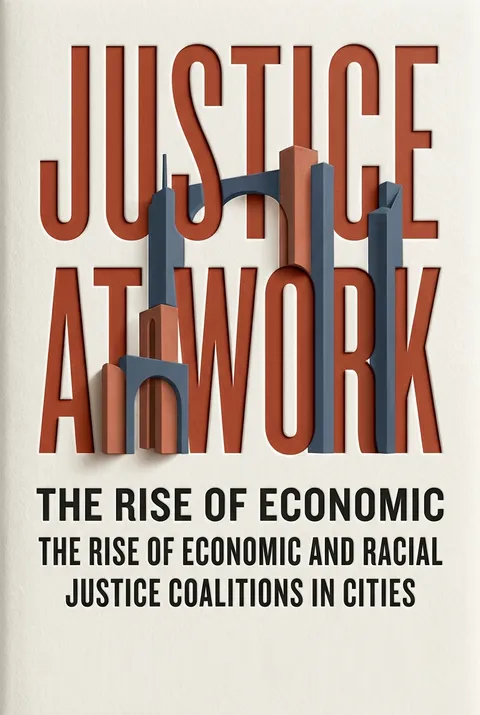
Justice at Work is a research-based account of urban politics, built around a historical narrative and comparative case studies. Its central claim is that economic globalization has not simply weakened city residents against mobile capital. The service economy, real estate development, and the growing dependence of businesses on dense urban places have created new points of leverage. Organized movements have used those openings to win workplace standards and challenge unequal public spending.
The book’s most important analytical move is to place grassroots coalitions inside the machinery of policy change. Economic and racial justice coalitions generate public pressure, while policy specialists develop and adapt workable proposals. The multiple streams approach helps explain how a recognized problem, an available policy, and favorable political conditions can converge. The cases show that activists sometimes help create those conditions rather than waiting for a crisis to deliver them. Seattle’s wage campaign is a particularly clear example of local organizing, electoral pressure, and policy expertise reinforcing one another.
The account also makes racial justice organizationally consequential. Explicit attention to race helps movements connect wages, hiring, schools, care, housing, and budgets, areas often treated as unrelated. This is more than a moral correction to class-only analysis. It is a practical strategy for building alliances and making opaque policies publicly intelligible. The chapters on social reproduction and austerity show, however, that some issues remain difficult to make visible, measure, and regulate.
The argument is strongest when it describes mechanisms and constraints rather than promising a universal recipe. Urban leverage varies with local institutions, union strength, state law, economic structure, and movement capacity. Political wins can also be undone or diluted through weak enforcement and preemption. The book’s optimism is therefore conditional: networks and repeated campaigns can build durable power, but they cannot guarantee equal outcomes. Its lasting contribution is a way to study where leverage exists, how movements convert it into policy, and whether that policy changes lived conditions.
Review Summary
Justice at Work receives high praise from readers, boasting a perfect 5-star rating on Goodreads. One reviewer found it particularly useful for writing an academic book review, highlighting its strengths in discussing how progressive policies gain political momentum in urban settings. The book's insights appear to be valuable for academic and policy-oriented audiences interested in urban politics and social justice issues. Its in-depth exploration of policy implementation in cities has resonated well with its readership.
Glossary
Economic and racial justice (ERJ) coalitions
Cross-movement justice alliancesNetworks of labor unions, community organizations, and advocacy groups that pursue economic reforms while addressing racial inequality as part of the same political problem. They work across neighborhoods, cities, issues, and levels of government. The book presents them as a newer form of urban organizing that combines workplace campaigns with demands involving public services and community resources.
Urban policy entrepreneurs
Strategic local policy actorsActivists, policy specialists, and coalition participants who develop policy proposals, adapt them to local law and institutions, and seek political settings where reform can advance. They work alongside grassroots coalitions, connecting public pressure with technical research, legal design, and legislative negotiation. Their ability to compare cities and move between jurisdictions distinguishes them from policy advocates focused on a single arena.
Multiple streams approach
Model of policy changeA framework for understanding how policy change occurs when three partly independent elements converge: public recognition of a problem, a plausible policy response, and political conditions that support action. Advocates may prepare proposals in advance and connect them to an opening created by events or elections. The book adapts this framework to show how city-based organizers can shape the agenda more directly.
Community benefits agreements
Development-linked community commitmentsAgreements negotiated between community organizations and developers, usually around projects requiring public approvals or assistance. They can include local hiring, living wages, affordable housing, community facilities, and protections against displacement. These agreements give residents a way to seek benefits from development, but negotiations can consume substantial time and resources, and promised outcomes may be difficult to enforce.
Targeted hiring
Hiring access requirementsPolicies that use public construction, contracting, or development activity to improve access to jobs for local residents or populations historically excluded from good employment. Approaches include requiring recruitment through public employment services, setting local hiring goals, or prioritizing disadvantaged workers. Their effectiveness depends on policy design, implementation capacity, employer compliance, and ongoing monitoring.
Social reproduction
Work sustaining daily lifeThe paid and unpaid activities that maintain households and communities, including caregiving, cooking, cleaning, and supporting children’s development. The book uses the term to show how unstable work schedules and inadequate leave policies interfere with life outside the workplace. It argues that justice at work cannot be separated from the resources and time people need to care for themselves and others.
Fiscal racism
Racialized public financeThe unequal distribution of public costs and benefits through tax systems, budgets, and spending decisions. In the book, the term describes arrangements that place heavier burdens on low-income households and communities of color while directing resources toward investments and services that disproportionately benefit wealthier or white communities. It gives organizers a framework for connecting technical financial choices to racial inequality.
Tax increment financing
Development-focused tax allocationA public financing tool that assigns future growth in property tax revenue from a designated district to a special fund, often for redevelopment. The book examines how TIF can support development while limiting revenue available for general public services. Because the details vary across places, it can be difficult to explain and compare, making it a challenging but important organizing target.
Download PDF
Download EPUB
.epub digital book format is ideal for reading ebooks on phones, tablets, and e-readers.








