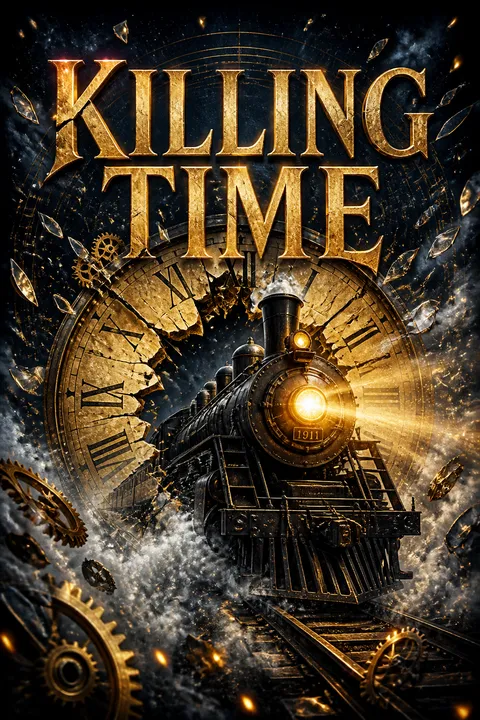


Plot Summary
Team 236 Splinters
At Time Police headquarters, Jane Lockland, Luke Parrish, and Matthew Farrell are ordered to settle the fight that has shattered their unconventional Team 236. Luke apologizes for lashing out after learning Jane is related to the Portmans, the family he despises, but Jane remains shaken by discovering her own family history and her grandmother’s death.
Luke considers leaving the Time Police to care for his newly rediscovered mother and Imogen Farnborough, still recovering from Portman abuse. Hay’s other troubles crowd the same morning: the Portman brothers have died in a suspicious crash, Ernesto has vanished, and Lieutenant Filbert has died in custody. The team begins a secret vote on whether to stay together, but a fire alarm interrupts before Jane reveals her choice.
The fractured team makes private injury an operational problem: these officers cannot separate personal trust from survival because their work depends on acting together under pressure. Luke’s apology is significant but incomplete. He still frames departure as a way to escape the damage he causes, while Jane has not yet decided whether loyalty to the team means accepting his return. The interrupted vote turns their uncertainty into suspense without resolving it. Around them, Hay’s matter-of-fact reports of suspicious deaths and institutional scarcity show a workplace that treats catastrophe as routine, even as its members struggle to manage the more intimate crisis in their own office.
Mikey’s Sticky Experiment
While Commander Hay meets consultant Mikey, the inventor reports progress on rapidly hardening string, a restraint meant to immobilize fleeing suspects. Her volunteer test succeeds too well: officers are left rigidly cocooned against corridor walls and fixtures, unable to free themselves.
One partly coated officer crawls toward the Pod Bay, falls onto a fire alarm, and triggers a rush of panicked staff. The Senior Mech’s anger sends Mikey away to address the damage, while the immobilized personnel leave headquarters short-handed.
Major Ellis responds by assigning Jane and Luke to the public reception desk and sending Matthew to help Mikey. The team’s vote remains unfinished, but the emergency now gives Jane a chance to encounter a case that cannot wait for their reconciliation.
Mikey’s failed test turns comic ingenuity into a concrete institutional hazard. The gag matters structurally: it removes trained officers from circulation and forces a damaged team into a public-facing assignment, where Jane’s patience becomes more useful than the force the Time Police usually prefer. The episode also establishes a pattern of improvised technology behaving beyond its designer’s control, a pattern the Zanetti crisis will magnify into something far deadlier. Hay and the Senior Mech respond not by restoring order neatly, but by reallocating whoever remains. In this workplace, disaster does not pause the mission; it determines who is available to face it.
Nora’s Missing Boys
At reception, Jane notices Nora Adesina’s fear and moves her to a quieter interview room rather than dismissing her hesitant account. Nora explains that her fifteen-year-old son, Jay, and his friend Devan Kumar are passionate about steam trains and have not returned from an illegal trip through time.
Their note names the date and place they intended to visit. Jane recognizes that the boys may have built a pod, learns they are already two days overdue, and calls Major Ellis.
He orders a search of Nora’s home and sends the case up the chain. Jane then joins Ellis’s briefing team. In the lift, Lieutenant Grint warns that Jane may inherit her grandmother’s property, prompting her to consider that her future could extend beyond the Time Police.
Jane’s first decisive act is not technical expertise but careful attention. Nora’s pauses and reluctance could easily be mistaken for uselessness; Jane instead creates a setting in which a frightened parent can disclose a dangerous truth. Her instinctive mercy does not erase the institution’s punitive machinery, but it gets the missing boys onto the rescue map. Grint’s conversation about inheritance quietly echoes the larger question of whether Jane has a life outside the service. She rejects neither possibility, but her future is no longer only a matter of staying useful to other people. The case begins because Jane notices the human cost before the official system has a name for it.
The Vanishing Zanetti
At the mission briefing, Lieutenant North explains the mystery behind the boys’ destination. In 1911, the Zanetti company’s celebrated train left Rome for Milan and vanished inside a Lombardy tunnel.
Witnesses later reported it in distant eras and countries, while accounts claimed passengers from the train appeared in Mexico decades before its departure. The Time Police are not authorized to investigate the anomaly; their assignment is to arrest Jay and Dev and locate their illegal pod.
Jane and Luke will pose as contemporaries at the launch, while Lieutenant Grint leads Team 235 in a search for the pod. North’s warning that two people once escaped the train offers a thin precedent, but the officers are ordered not to approach it. The teams depart with a mystery already threatening to eclipse their mission.
The briefing establishes the gap between institutional categories and lived danger. The Time Police classify the boys as offenders and the train as a dormant anomaly, yet the historical record describes a hundred people displaced across time with no reliable way home. North’s information gives the reader a causal map without giving the officers a workable solution. That limitation is important: expertise can describe a phenomenon without mastering it. The order to ignore the train sounds rational within the agency’s remit, but it becomes increasingly untenable once the officers are physically aboard. Knowledge here is not control. It is a list of warnings that the characters will have to reinterpret under pressure.
Sawney Boards First
In Rome, Jane and Luke scan the packed station for Jay and Dev, disguised in school clothes among the 1911 crowd. As the Zanetti train arrives, Jane recognizes ex-Lieutenant Sawney, a former officer whose presence was never part of their assignment.
He pushes through the spectators toward the boys, who react to him with alarm. Jane loses sight of Luke in the crush, then sees the train doors closing and realizes Jay and Dev have been forced aboard.
She follows them into the carriage before it pulls away, while Luke finds another way onto the same train. Their communications fail amid the station noise and interference. The officers have not arrested the boys or secured the pod, and now the entire pursuit is moving away from Rome with Sawney aboard.
The crowded platform makes procedure physically difficult: Jane is separated from Luke, the boys are obscured, and Sawney can exploit the disorder. Her choice to board the train is an act of responsibility, but it is also the first step into a trap she cannot yet recognize. The train’s spectacle invites the officers to watch rather than act, and their brief hesitation lets the target become part of the event they were meant to control. Sawney’s appearance converts a routine arrest into a question of motive. The contrast between the celebratory launch and the boys’ fear signals that this journey has already been shaped by a coercive adult presence.
The Crate Breaks Time
Inside the baggage area, Luke reasons that the train’s luxurious carriages lack the facilities for a real journey to Milan. Jane reveals she voted to end Team 236, and Luke decides he will leave when they return. Their argument leaves them exposed when Sawney confronts them with a weapon. Jane knocks it away and beats him with her baton, while Luke gets him talking.
Sawney admits he helped Jay and Dev build their pod and intended to use them as test subjects for an employer. Before they can secure him, a fight and a jolting track send two weapons into a disguised pod hidden in a crate. The pod flashes, vanishes, and tears a smooth hole through the carriage. Italy disappears beyond it. The train itself has been thrown out of ordinary time.
The rupture grows from accumulated failures: Luke and Jane’s damaged trust, Sawney’s manipulation, and the officers’ inability to keep weapons away from experimental machinery. The hidden pod is not merely a surprise device; it gives material form to Sawney’s exploitation of the boys, who were useful to him precisely because they were curious and inexperienced. Jane’s anger briefly gives her power over him, while Luke’s willingness to imitate Sawney’s prejudice lets him extract information. Yet neither emotional force nor tactical cunning can stop the accidental activation. Their private conflict has become part of a much larger disaster, and the train’s passengers now bear its consequences.
The Lombardy Leap
With the landscape gone and the train’s crew disappearing one by one, Dev concludes that the train, not the crate, is jumping through time. Luke learns that the locomotive is heading toward the Lombardy Tunnel, the only known point where passengers once escaped. As the train slows, Sawney tries to seize the boys, but Jane and Luke push Jay and Dev through the hole in the carriage.
The boys land near Grint’s team and are recovered alive. Jane and Luke cannot jump before the train plunges into darkness and vanishes. Grint searches the tunnel but finds no trace of them, only the two rescued teenagers. He must leave his colleagues behind and return with the boys, while the train carries Jane, Luke, Sawney, and its original passengers onward.
The first rescue is partial, and that incompleteness sharpens rather than relieves the danger. Luke and Jane choose the boys’ immediate survival over keeping all prisoners contained, an ethical decision that costs them their own chance to escape. The tunnel’s darkness becomes a threshold no one can cross safely without timing and knowledge. Grint’s inability to recover his officers is not incompetence; he has witnessed a phenomenon that leaves no physical evidence behind. The episode also reverses the expected hierarchy: the two young offenders are safe, while the trained officers are now the ones lost and dependent on others. Competence does not guarantee protection from the unknown.
Matthew Finds the Thread
Back at headquarters, Matthew uses the giant Time Map to search for the train’s route, despite his broken arm and the Map Master’s strict limits. He isolates the Rome and Lombardy sections and spots a minute moving anomaly that expands into a major temporal disturbance at the tunnel.
By tracing a distinctive silver thread, he identifies the train’s signature and begins locating its jumps. The task overwhelms his senses: immersed in the Map’s light and patterns, Matthew loses his orientation and seems to hear the Map answer his question.
He returns with coordinates for later sightings, but the Map has been damaged by the strain of his work. Meanwhile, repairs to the corridor outside the Pod Bay uncover a hidden space that alarms the Senior Mech, who orders the area sealed.
Matthew’s gift is not simply intelligence but an unusual capacity to perceive relationships across a system too large for ordinary attention. His method turns an anecdotal ghost story into a trackable pattern, yet the discovery comes at the cost of bodily and cognitive stability. The Map’s apparent response unsettles the boundary between instrument and agent, suggesting that knowledge may be reciprocal rather than wholly controlled by its user. The simultaneous discovery behind the corridor wall adds another kind of institutional blind spot: headquarters has concealed something from its own personnel. Both revelations challenge the Time Police’s confidence that every anomaly can be mapped, classified, and safely contained.
The Wrong Crimean War
With pods grounded during emergency repairs, Matthew persuades Mikey to use experimental wrist devices to reach Grint and pass on the coordinates. Their first jump is miscalculated, landing them amid the Charge of the Light Brigade in 1854 instead of Balaclava in 1955.
They shelter in a shell crater while horses and soldiers are killed around them, then use the bracelets again before their limited power runs out. Reaching Grint’s position in Balaclava, they find the Zanetti train about to appear.
Mikey throws Matthew’s scratchpad to Grint, who catches the coordinates after it strikes his head. The data points Grint toward Modena and Mexico. Matthew and Mikey disappear back to headquarters, injured and disoriented, just as the train arrives.
The mistaken jump makes the cost of improvisation immediate and bodily. Matthew’s ability to read the Map has produced useful information, but it has not made him immune to error; Mikey’s device can bridge a crisis only by exposing both of them to another one. The soldier’s death and Mikey’s attempt to comfort him underline a recurring moral distinction between explaining a catastrophe and helping someone endure it. The comic delivery of the coordinates does not diminish the risk. It dramatizes how precariously the Time Police now operate, with world-saving intelligence conveyed by a thrown machine while the system that should support it is temporarily unavailable.
Modena Closes the Door
Following Matthew’s coordinates, Grint’s team waits in medieval Modena beside a monastery, expecting Jane and Luke to emerge from the train. When the locomotive arrives, it carries its passengers but moves too fast for the officers to board safely.
Sawney and the guard Tommaso jump off; Sawney lands badly and Varma captures him, while Tommaso joins the Time Police. Inside the carriage, Luke and Jane try to escape, but Sawney strikes Jane and jumps before they can follow. The train brakes hard, then disappears into darkness with the pair still aboard.
Grint discovers that the passengers remain on the train, while Jane and Luke are missing. With his pod resources dwindling and prisoners in custody, he returns to headquarters rather than risk trapping his whole team in pursuit.
Modena offers the rescue team its clearest opportunity and then turns it into another failure. Grint’s restraint is painful but deliberate: he cannot treat his own attachment to Jane as permission to endanger everyone under his command. Meanwhile, Sawney’s violence converts resentment into direct sabotage, making Jane’s earlier confrontation with him costly in ways she could not control. His capture prevents him from escaping, but it cannot undo the blow that keeps the two officers aboard. The episode distinguishes courage from recklessness. A leader may want to charge after someone he loves, yet responsibility sometimes means withdrawing and trusting a larger plan.
Passengers Reach Mexico
Knowing they cannot wait indefinitely, Luke and Jane prepare the passengers to leave at the next safe stop, assigning younger men to help others down and asking an elderly passenger to coordinate the carriages. When the train finally slows in Mexico City in 1840, they jump onto the paving stones and help the passengers gather.
Luke urges the group to keep their account of departing Rome on record so the Time Police can trace them. A silver cigarette case dated 1907 supports their story, but soldiers arrive and take the entire group away. The authorities cannot make sense of their sudden appearance and send them to the Hospital de San Hipólito, a religious asylum. Jane and Luke are separated into women’s and men’s wards.
The protagonists turn captivity into a collective problem rather than an individual escape. Luke’s plan is imperfect, but he understands that the passengers’ testimony can become a beacon for rescuers if it survives official disbelief. Jane helps make the evacuation orderly, while Luke persuades the group to accept a risk they cannot fully understand. Their arrival in Mexico is a kind of release from the train, not from danger: the state’s response to the inexplicable is confinement. The cigarette case makes the impossible tangible, yet it does not persuade the authorities. Evidence can exist and still fail when institutions have no framework for interpreting it.
The Asylum Divides Them
At San Hipólito, Jane finds the women’s ward crowded, filthy, and controlled by wardens carrying canes. She asks the passengers to obey instructions and remain together, then helps an older Italian woman guide the others through the first tense moments.
In the men’s ward, Luke realizes that loudly repeating their story may draw the attention of a doctor, even if it worsens his own situation. He tells Luigi de Luca, an elderly passenger, that they are in Mexico in 1840, decades before their births.
Luigi understands why Luke intends to keep the account alive in official records and agrees to help steady the passengers. The two former teammates cannot support each other directly, so Jane and Luke take separate roles: one maintains order, the other insists on being heard.
The asylum tests the two officers in different forms of leadership. Jane’s authority is quiet and relational; she tries to protect a group of frightened women by making cooperation feel like their best available choice. Luke’s approach is more exposed. He accepts that the story may make him look delusional because silence would make the passengers harder to find. Luigi’s decision to support him gives that stubbornness a communal purpose. Separated by gendered wards and institutional power, the pair cannot rely on their familiar teamwork. They instead reproduce its function at a distance, each helping strangers endure a system designed to render them helpless.
The Cost of Speaking
The asylum imposes a daily routine of prayer, poor food, cleaning, and sewing. Jane works alongside the other women, but when her needle breaks and blood marks a sheet, a warden has her restrained and beaten six times with a cane. Her fellow patients quietly help her return to the task by giving her a role she can still manage. Luke, meanwhile, refuses to abandon his account of the train.
Dr. José Saxino treats him as either a deluded patient or a suspected spy, and orders repeated cold baths when Luke will not change his story. By the third day, guards lower him into an ice-filled bath and leave him there. The physical punishment separates them further, but neither has surrendered the effort to keep the passengers safe or discoverable.
The asylum’s discipline is not an accidental cruelty; it is a method for making people compliant by turning ordinary mistakes into punishable offenses. Jane’s broken needle becomes an excuse to mark her body and publicly establish the wardens’ power. The other women’s quiet cooperation offers a counterforce, not by defeating the institution but by keeping Jane from being isolated afterward. Luke’s resistance is equally costly. His insistence on truth is principled, but it also exposes him to a treatment regime he cannot control. Together, their punishments show how a person can be made vulnerable not only through confinement but through the authorities’ power to define what counts as sanity.
The Hospital Breakout
Once the repaired Pod Bay reopens, Major Ellis leads a rescue force to San Hipólito using Matthew and Mikey’s coordinates. Lieutenant North and Grint enter the women’s ward, where Jane identifies the passengers and calms them enough to leave.
Elsewhere, Ellis and trainee Clore break into the treatment rooms and find Luke submerged in an ice bath, unresponsive and nearly lifeless. Grint helps wrench open the cover, and the medical team works to warm Luke while the rescue continues.
Bells summon armed soldiers, turning the withdrawal into a running fight. The officers evacuate the women, men, and other Italian passengers through the hospital grounds and into the pods. Jane reaches safety, but Luke remains under medical care as the team returns to 1911 Rome.
The rescue succeeds because earlier acts of care become operational assets. Jane’s credibility with the women lets North move them without a second confrontation; Luke’s decision to keep speaking has preserved a record that gives the Time Police a destination. Yet the scene refuses a clean victory. The army’s arrival forces the officers to carry out an evacuation under fire, and Luke’s condition leaves the emotional outcome uncertain even after the physical extraction. Grint’s intervention in the bath is especially revealing: his disciplined restraint in the field gives way to urgent bodily effort when Luke’s life depends on it. Institutional procedure matters, but so does the willingness to exceed its emotional distance.
The Team Chooses Again
In MedCen, Luke slowly recovers from hypothermia while Jane receives treatment for the wounds on her legs. Matthew is also hospitalized after his Map excursion and battlefield jump, his arm broken and his senses scrambled.
When Jane sees Luke awake, she admits she lied about voting against him: she had voted to keep Team 236 together. Her confession releases the fear that had been driving Luke toward resignation, and the two reconcile as Grint watches nearby. Hay and Ellis decide the team is worth preserving, but place it under North and Ellis’s closer supervision while its members rebuild trust.
Hay also promotes Varma to lead security. The officers have returned from the train, but headquarters remains strained by the rescue, the Map damage, and the unexplained danger behind the broken corridor wall.
Jane’s confession corrects the emotional distortion that has shaped the story: Luke believed he had been rejected by the people whose approval he most needed, and Jane let anger make that belief seem true. Her honesty does not erase his behavior, but it gives the team a shared fact from which to begin again. The leadership decision likewise avoids both sentimental forgiveness and punitive dismissal. Team 236 is retained, with oversight that recognizes its potential and its volatility. Varma’s promotion extends the book’s concern with earned authority: competence can challenge inherited assumptions, but new responsibility also tests the alliances that made competence visible.
What Headquarters Conceals
As the corridor is sealed, the Senior Mech tells Mikey that earlier officers failed to return from a past incident and were quietly erased from the official account. He asks her to keep the discovery secret while the damaged area is rebuilt.
Elsewhere, bounty hunters Lady Amelia Smallhope and Pennyroyal interrogate Ernesto Portman, who reveals his role in the schemes involving Imogen Farnborough and the Portman family. They plan to sell their information to Raymond Parrish and deliver Ernesto to the Time Police, while taking a new contract to reach Luke’s vulnerable mother, Alessandra.
Ernesto later turns up at headquarters in their custody. The Portman danger is not finished, and the Time Police’s own concealed loss remains unresolved. Even after the train’s passengers are safe, the institution has secrets capable of reopening the crisis.
The aftermath refuses to equate rescue with resolution. The hidden corridor shows that the Time Police have previously protected institutional reputation by suppressing the fate of their own people, making the agency’s present mission inseparable from its unacknowledged past. Mikey’s responsibility is complicated: she caused the physical breach, but the concealment predates her and belongs to a culture of secrecy. The bounty hunters add a different form of accountability, trading information and protection through contracts rather than law. Their intervention may help expose the Portmans, yet their next target is Alessandra, whose vulnerability makes private justice dangerous. The novel closes its central rescue while keeping both institutional and family threats alive.
Epilogue
After recovering, Jane and Grint take adjoining rooms at a seaside hotel, each uncertain how to turn their long, hesitant courtship into intimacy. Their awkward dinner gives way to a private moment, but the Time Police interrupt with an emergency: a dinosaur’s body has been found in Wales.
Grint and Jane must leave before their carefully prepared evening can begin. The interruption is both a comic reversal and a promise that their personal lives will keep colliding with the service they cannot easily escape.
The hotel scene offers intimacy not as a reward neatly separated from work, but as something the characters have to make room for inside a life repeatedly interrupted by danger. Grint and Jane’s hesitation mirrors their wider difficulty with emotional risk: both are capable in crisis and uncertain when they must name what they want. The emergency call prevents the expected romantic consummation, yet it does not cancel their progress. They have chosen to travel together and to attempt closeness. Ending on the dinosaur preserves the series’ comic logic, where even a private evening can be overtaken by the absurd scale of the next public emergency.
Analysis
Killing Time makes time travel less a fantasy of mastery than a test of what people do when their instruments stop obeying them. The Zanetti train escapes the categories available to the Time Police: it is simultaneously vehicle, prison, historical legend, and apparent agent. The official system can map its traces, but only through Matthew’s risky perception, Jane’s attention to a frightened mother, and Luke’s willingness to make himself look irrational in order to preserve a record.
The novel’s parallel institutions reveal different forms of coercion. The Time Police can be chaotic and punitive, yet its officers ultimately organize a rescue. San Hipólito, by contrast, treats compliance as proof of health and resistance as justification for pain. Jane’s beating and Luke’s ice baths show how easily a person’s credibility can be taken from them when an institution controls both the diagnosis and the punishment. Their survival depends on solidarity: Jane keeps the women together, Luke persuades Luigi to help, and each creates a small structure of care inside confinement.
The team’s emotional plot follows the same principle. Luke’s swagger conceals shame and a fear that he ruins what he touches; Jane’s restraint conceals anger and a wish to be chosen without having to earn safety through perfect conduct. Their false account of the vote worsens the rupture, while her confession restores a shared reality. The ending does not make Team 236 stable or the Time Police innocent. It grants the team another chance under supervision and leaves the agency’s hidden losses, the Portman threat, and a new emergency in play. Repair here is not a clean return to normal. It is the decision to keep working together while knowing how much remains unresolved.
Review Summary
People Also Read

Characters
Jane Lockland
steady, reluctant leaderA conscientious Time Police officer whose patience with frightened people often proves more useful than the force her institution prefers. Jane has spent much of her life being underestimated, and her habit of following rules can look like passivity until a crisis requires someone to make a humane decision. She is still sorting out revelations about her family, her grandmother, and her own identity, while trying to judge whether loyalty to a team is compatible with self-respect. Her relationship with Luke is unusually volatile because she sees both the damage he causes and the better person he can be. Jane’s quiet courage grows through practical acts: listening, organizing, and refusing to let vulnerable people become invisible.
Luke Parrish
reckless team leaderA charismatic, wealthy Time Police officer who often uses humor, bravado, and flirtation to outrun guilt. Luke knows that his impulsiveness has harmed people, and his memories of past failures make him fear that leaving the service may be safer for everyone around him. He is especially reactive where the Portman family is concerned, but his loyalty to his father and his newly rediscovered mother gives that anger a personal history. Luke’s instinct is to take responsibility alone, even when doing so becomes a form of self-punishment. Beneath the swagger, he is capable of improvising, persuading strangers, and placing other people’s survival ahead of his own.
Matthew Farrell
Time Map prodigyThe thoughtful, technically gifted member of Team 236, Matthew is most comfortable working with systems that others find overwhelming. He understands the Time Map deeply, though his ability to perceive its patterns sometimes carries him beyond ordinary limits of concentration and safety. Matthew is gentler than Luke and less inclined to confront conflict directly, but his quiet loyalty to Jane and Luke gives him a firm sense of responsibility. He wants to help by finding the information no one else can see, and that urge can make him ignore his injuries or the instructions meant to protect him. His curiosity is both his central strength and the source of his greatest risks.
Lieutenant Grint
unyielding field leaderA physically imposing Time Police officer who leads Team 235 and approaches danger with discipline, bluntness, and deep loyalty to his people. Grint is not naturally fluent in emotional conversation, so affection often emerges through protection, practical advice, or an awkward attempt to stay near someone in need. His feelings for Jane make him vulnerable to the temptation to abandon sound judgment, but his identity as an officer is built around responsibility for the whole team. He values competence over charm and can be impatient with dithering, yet he is more thoughtful than his intimidating manner suggests. His relationship with Jane develops slowly because neither is practiced at asking clearly for what they want.
Mikey
unruly inventorThe Time Police’s civilian consultant, Mikey approaches technical problems through invention, experimentation, and a willingness to test ideas before they are fully safe. Her improvised devices can be brilliant, disastrous, or both, and she is often more concerned with solving the problem than with imagining every consequence. Beneath her chaotic methods is genuine care for the officers who volunteer for her trials and a strong desire to be useful in an organization that regards her with suspicion. Mikey’s relationship with Matthew combines technical collaboration with a protective, almost sibling-like concern. She does not mistake affection for permission to let him endanger himself, even when she ultimately joins him.
Commander Hay
wry commanderThe commander of the Time Police, Hay manages recurring emergencies with dry humor, political caution, and a keen sense of what the organization can afford. She knows that official distance is sometimes necessary, particularly when the Parrish and Portman families are involved, but she also understands the value of officers whose methods defy convention. Her authority rests less on spectacle than on deciding where responsibility belongs and when a subordinate deserves support. Hay’s battered appearance and composed manner do not make her indifferent; they make her careful about what she reveals.
Officer Varma
hard-edged security officerA formidable security officer with a direct style and a strong instinct for reading people. Varma favors practical action over ceremony and is willing to use force when she believes delay will make a situation worse. Her authority comes from experience rather than rank, which leaves her alert to the resistance that can greet an ambitious woman in a male-dominated department. She is not without compassion, but she expresses it through clear instructions and decisive protection rather than softness. Varma’s working relationship with Grint is built on mutual respect and an ability to challenge each other without losing sight of the mission.
Major Ellis
mission-minded deputyA senior Time Police officer who oversees investigations and expects discipline from teams that frequently deliver chaos. Ellis recognizes Jane’s strengths early and gives her room to handle Nora’s interview, while remaining alert to Luke’s tendency to create problems. He is pragmatic about the limits of the organization, but not so rigid that he cannot revise a mission when the facts demand it. His humor is often dry and his patience is finite, yet he is invested in the people under his command and willing to argue that a difficult team is worth saving.
Sawney
disgraced former officerA former Time Police officer whose pride and resentment shape how he interprets changes in the organization. Sawney believes the service once gave men like him a clearer place and status, and he sees women’s authority as a personal diminishment. His self-image depends on being important to someone, which makes him receptive to employers who reward his skills and flatter his sense of grievance. He is experienced enough to understand the danger of his work, but his contempt for others repeatedly clouds his judgment. Sawney’s history with Jane and Luke makes him a particularly volatile presence around Team 236.
Nora Adesina
fearful, protective motherJay’s hard-working mother, Nora supports her household through several part-time jobs and occasionally rents out a room. She is proud of her son and his friend, which makes approaching the Time Police to report their illegal experiment painful. Nora’s fear does not stop her from acting when the boys fail to return. Her careful, hesitant manner reflects the precarious position of someone with little power facing a formidable institution, but she is not passive: she brings the note that gives the rescue team its first precise lead.
Jay Adesina
curious young train fanNora’s fifteen-year-old son, Jay is gifted at mathematics and captivated by historical trains. He and his friend Dev are clever enough to build a pod, but not experienced enough to understand the danger of using it. Jay is affectionate toward his mother and accustomed to thinking of his life in ordinary terms, including school and chess club. His curiosity is genuine rather than malicious, yet he underestimates how easily adults can turn his talents toward their own purposes.
Devan Kumar
inventive teenage friendJay’s close friend and a gifted student of science, Dev contributes the technical imagination that makes their illegal time-travel experiment possible. He tends to explain his reasoning carefully, especially when frightened, and recognizes the strange mechanics of the train before the adults do. Like Jay, he is not trying to harm anyone; he believes curiosity and technical skill can be separated from their consequences. His encounter with Sawney exposes how easily an inexperienced young person can be manipulated through encouragement and access to equipment.
Tommaso
Zanetti train guardA guard aboard the Zanetti train, Tommaso begins as a working railwayman trying to keep passengers calm when the world outside becomes impossible. He is practical and responsible toward his colleagues, even when the evidence around him defeats every explanation he knows. His presence gives Luke and Jane a link to the train’s ordinary human routines. When he reaches the Time Police, his knowledge of the passengers and his willingness to cooperate make him useful to the rescue effort.
Luigi de Luca
passenger elderAn elderly Italian passenger who becomes a stabilizing presence among the men held at San Hipólito. Luigi is educated, attentive, and willing to listen even when Luke’s account seems impossible. Once he understands the passengers have been carried to a time before their births, he grasps why preserving their story matters. His age and social standing give him the quiet authority to help the others remain together, while his concern for his wife keeps the crisis rooted in ordinary attachments.
Dr José Saxino
asylum physicianThe physician at San Hipólito, Saxino regards Luke’s account as either delusion or espionage and applies the harsh treatments accepted in his institution. He can converse in English and is not wholly without intellectual curiosity, but his authority is bounded by a system that equates suffering with effective treatment.
Ernesto Portman
anxious family fixerA member of the Portman family with a heart condition and a record of managing schemes for more powerful relatives. Ernesto is driven by a wish to secure approval and protect his position, which makes him willing to involve himself in coercive plans. He lacks the power and confidence of the family figures he serves, and his sense of self-preservation competes with whatever loyalty he feels toward them.
Imogen Farnborough
recovering political heiressThe daughter of a prominent politician, Imogen is recovering from captivity and abuse by the Portmans. Luke cares about her and wants to give her time and safety rather than force her back into public life. Her experience makes her understandably wary of the world outside her refuge, while her mother’s political position draws her into events much larger than her private recovery.
Lady Amelia Smallhope
calculating bounty hunterA professional bounty hunter who prefers information, negotiation, and carefully chosen pressure to unnecessary violence. Smallhope has a polished manner and a clear understanding of how fear can move people, but she is also practical about the limits of charm. She treats dangerous assignments as contracts to be completed and is comfortable working in morally ambiguous territory.
Pennyroyal
Smallhope’s dangerous partnerSmallhope’s associate is known for a formidable reputation and a readiness to use force when persuasion fails. Pennyroyal prefers direct action, but he accepts that his partner’s softer approach can produce better information. Their partnership balances menace with strategy.
The Senior Mech
worried Pod Bay chiefThe Senior Mech oversees the Pod Bay and its maintenance crews, where every technical failure can become a threat to the Timeline. He is frequently exasperated by Mikey’s experiments, but his anger is tied to real responsibility for staff and infrastructure. When the corridor is damaged, his fear suggests that his job includes knowledge he cannot freely share.
Captain Farenden
commander’s precise adjutantHay’s efficient adjutant, Farenden manages briefings, personnel updates, and the small administrative tasks that keep the Time Police functioning. His dry humor lightens grim reports, though he rarely lets it interfere with his work.
Lieutenant North
armed history instructorNorth leads the Records and Historical Briefing section and delivers precise accounts of the past with a sharp, intimidating manner. She expects officers to listen closely and is comfortable using forceful demonstrations to keep their attention. Her knowledge gives the teams context, but she is equally clear about the limits of what history can prove.
Alessandra Parrish
Luke’s vulnerable motherLuke’s mother is recovering in a private nursing home and is gradually rebuilding her relationship with him. Her memory is unreliable, so their reconnection must proceed patiently. Her vulnerability makes her a concern for the Parrish family and those around her.
Commander Callen
quiet senior officerThe Time Police’s second-in-command, Callen is notably reserved in a headquarters full of loud personalities. His decisions carry institutional weight, even when he remains outside the most visible action.
Plot Devices
The Zanetti Train
mobile temporal anomalyThe Zanetti train begins as a historical disappearance: it leaves Rome in 1911 and fails to emerge from the Lombardy Tunnel. Later sightings place it in different eras and countries, while its passengers appear to have ended up in Mexico City in 1840. The concealed pod’s activation transforms the train into a moving temporal anomaly that jumps unpredictably through time and space. Its apparent agency, vanished crew, intermittent landings, and ability to disappear without physical trace frustrate both the passengers and the Time Police. For Jane and Luke, it is a prison and a vehicle; for the rescue teams, it is a target that cannot be intercepted by ordinary pursuit.
Time Police pods
controlled time travelThe Time Police use pods to travel through time and space, locate illegal travelers, and retrieve personnel. Their operation depends on coordinates, functioning equipment, and trained crews, so a pod is not a simple escape vehicle. The boys’ homemade pod demonstrates how dangerous unauthorized travel can be, while Sawney’s concealed experimental device triggers the train’s displacement. Pods also impose practical limits on rescue planning: every jump consumes resources, interference can disrupt communications, and returning to headquarters is not always a safe option.
The Time Map
route through temporal historyThe Time Police’s immense Map displays jumps and historical events as a dense, shifting network of lines. Matthew uses it to isolate the Zanetti train’s signature, trace its movement, and find coordinates for later sightings. Its scale and complexity make tracking slow, while its apparent responsiveness to Matthew raises questions about whether it is merely a tool. His effort damages the Map and leaves him disoriented, but it supplies Grint with the locations needed to pursue the train and gives the rescue operation a chance to succeed.
Mikey’s jump bracelets
emergency personal transportMikey’s experimental wrist devices allow Matthew and Mikey to jump without a pod. Their limited power and unproven safeguards make them a dangerous workaround when headquarters grounds its fleet. A coordinate error sends the pair into the Charge of the Light Brigade before they reach Grint in Balaclava. The bracelets let them transmit the train’s crucial coordinates, but the misjump leaves them injured and contributes to the wider strain on the Time Police’s equipment and personnel.
Rapidly hardening string
experimental restraint systemMikey develops a sprayed substance that quickly hardens into a web capable of immobilizing a moving suspect. The test initially appears successful, but the string does not soften on schedule and traps a dozen officers against walls and fixtures. The rescue effort damages a corridor and exposes a hidden area, while an improvised attempt to break the hardened shells sends officers down stairs. The experiment creates a staffing shortage that pushes Jane into the public reception assignment where Nora’s report begins the central mission.
About the Author


Download PDF
Download EPUB
.epub digital book format is ideal for reading ebooks on phones, tablets, and e-readers.








