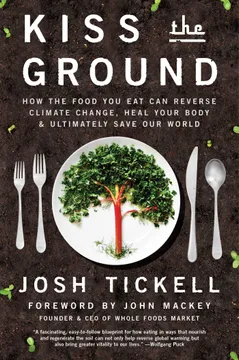


Key Takeaways
Treat food as a climate choice by asking how its soil was grown
The daily hinge. Tickell begins with a family planting a garden on land recently treated with harsh chemicals. The work of tending it makes his central argument tangible: food is not an isolated product, but the end of a chain linking soil, water, farming, health, and climate. Choosing what to eat can influence how that chain is managed.
A system, not a slogan. The book argues that healthy food depends on healthy soil, and that farming practices can either deplete or rebuild it. This does not mean one meal determines the climate. It means repeated choices, multiplied across consumers and institutions, can change what farmers are paid to grow and how they grow it.
The strongest move here is to connect a private habit with a public system without pretending the individual controls the whole system. Consumer demand can reshape supply, but only when paired with infrastructure, standards, and policy that make better options available. Climate action also depends on reducing fossil fuel use, so food choices should complement, not replace, energy transitions. The garden offers a useful scale for thinking: stewardship begins locally, while its broader effects depend on coordination across farms, markets, and governments.
Keep soil covered and biologically active to hold water and carbon
A living foundation. Soil organic matter, or SOM, is decomposed plant and animal material, together with products made by soil organisms. Tickell describes plants feeding microbes through their roots; those organisms help cycle nutrients and build stable soil structure. Healthy soil can hold more water, support crops, and store some of the carbon plants draw from the air.
The underground story. At Rodale Institute, soil scientist Kristine Nichols emphasizes the importance of mycorrhizal fungi, which associate with plant roots and help move nutrients through soil. The book presents this network as a key part of productive ecosystems. Soil is not merely a surface for applying fertilizer. It is a community whose condition affects what grows above it.
This perspective aligns with systems ecology: a field's productivity emerges from interactions among roots, microbes, water, and minerals, not from a single input in isolation. It also suggests a practical shift in measurement, from crop yield alone to indicators such as soil structure, infiltration, and organic matter. Yet soil carbon is not an unlimited storage vault. Its capacity varies by place, and stored carbon can be lost if management changes. Restoration matters, but claims about climate benefits require careful measurement over time.
Replace the chemical treadmill with diverse, low-disturbance farming
A wartime inheritance. Tickell traces modern industrial agriculture through the Haber-Bosch process, which made synthetic nitrogen fertilizer by combining nitrogen from the air with hydrogen. The technology greatly expanded food production. The book then follows how wartime chemical manufacturing and machinery helped supply postwar farming with fertilizers, pesticides, and powerful equipment.
More output, more dependence. Monocultures make it easier to produce and market vast quantities of a single crop, but they can also require repeated inputs to manage weeds, pests, and declining soil function. Farmers may be pushed to produce more while earning less, especially when commodity prices and crop insurance favor a narrow set of crops. Tickell calls this a treadmill: higher production does not necessarily mean healthier farms or more secure livelihoods.
The historical arc makes an important point: technologies do not arrive in a vacuum. Their effects depend on the institutions, incentives, and markets built around them. Synthetic fertilizer helped avert severe food shortages and supported population growth, so the issue is not that chemistry is inherently misguided. The sharper question is whether a production system can reduce its dependence on inputs that damage water and soil, while preserving reliable harvests and farmer income. Diversification offers a direction, not an automatic solution.
Bare fields can intensify drought by breaking local water cycles
Water returns through plants. The small water cycle is the local movement of water from soil and vegetation into the air, followed by its return as rain, mist, or dew. Tickell argues that trees, grasses, and crops help sustain this cycle by shading soil, absorbing rainfall, and releasing water through their leaves. When vegetation is removed and soil is left bare, more water can run off or evaporate.
A landscape matters. In California's Central Valley, the author contrasts the region's former wetlands and diverse vegetation with extensive cleared farmland. He argues that degraded, exposed soil can worsen local heat and water stress. The practical implication is to protect soil cover and improve infiltration, rather than treating every drought as a problem that can be solved only by pumping or importing more water.
The useful insight is that land management can influence local hydrology, making drought resilience partly a design problem. Vegetation and permeable soil can slow runoff, shade the ground, and support moisture cycling. But this mechanism should not be stretched into a single-cause explanation for drought. Rainfall patterns also depend on large-scale atmospheric conditions, and water shortages reflect extraction, storage, and allocation decisions. Restoring land can reduce vulnerability; it cannot promise rainfall or erase the need for water governance.
Use grazing animals as tools only when movement and recovery are managed
Repair through disturbance. Regenerative agriculture is farming intended to rebuild soil and strengthen ecological function while producing food. Tickell describes practices such as keeping soil covered, reducing tillage, growing varied crops, using trees and compost, and moving grazing animals so land can recover. Managed intensive rotational grazing, or MIRG, means concentrating livestock in an area for a limited period, then moving them and allowing plants time to regrow.
A costly lesson. Allan Savory recounts directing the killing of tens of thousands of elephants in an effort to halt land degradation. The land worsened, challenging the assumption that too many animals were the cause. His later work explored whether carefully managed herds could help restore grasslands. The story is a warning against diagnosing ecological problems by appearances alone.
The emphasis on timing and recovery is more important than the simple presence of livestock. Grazing can stimulate plant growth and return nutrients to soil, but it can also strip vegetation and compact land if animals remain too long or are too numerous. The book's contrast between pasture and feedlots usefully separates two very different systems. Any regenerative claim should be evaluated by outcomes on the actual land, including vegetation recovery, water retention, emissions, and animal welfare.
Build farm resilience through many crops, products, and income streams
One farm, many outputs. North Dakota farmer Gabe Brown describes shifting from heavy tillage and a narrow crop mix toward no-till planting, cover crops, varied crops, and integrated livestock. His operation sells grains, vegetables, meat, eggs, and honey rather than depending on one or two commodities. The model spreads income across different products and links crops, grazing, and soil management.
A reported change. Brown says the ranch's soil organic matter rose from about 1.7 to 1.9 percent when he took it over to roughly 6 percent. Based on the book's estimate that each percentage point can hold 20,000 to 25,000 gallons of water per acre, that represents a substantial increase in potential water storage. The figures describe his farm, not a guaranteed result elsewhere.
Diversification resembles portfolio theory: spreading risk across products can make a farm less exposed to a price crash or crop failure. It can also create ecological benefits when crops and animals support one another. Brown's farm is compelling as a working example, but a successful case study cannot establish that the same economics fit every region, farm size, or labor market. Transition costs, access to buyers, and suitable equipment matter. Replication requires local experimentation rather than copying a recipe wholesale.
Make plants the center of the plate, and meat the accent
A plate shaped by place. Chef Dan Barber calls for a plant-centered meal with a smaller portion of meat, rather than treating a large piece of protein as the meal's anchor. His rotation risotto uses grains such as buckwheat and millet that can support a farm's main crop by improving rotation and soil management. The dish makes a farming necessity part of the cuisine.
Demand can redirect fields. Tickell argues that what restaurants and households buy influences what farmers grow. He recommends more vegetables, fruits, and whole foods, less processed food, and less meat, particularly meat from intensive feedlot systems. The goal is not a rigid diet identity. It is a more varied menu that can support diverse farms and reduce reliance on commodity crops.
Barber's idea turns an ecological constraint into a cultural opportunity: crops that are useful to the farm can become desirable foods when cooks give them attention. This is a powerful way to link culinary creativity with agricultural diversity. The approach also has limits. Plant-based meals are not automatically regenerative, and sustainable sourcing can be costly or hard to access. Improving the plate therefore requires both consumer interest and food systems that make nutritious, responsibly grown ingredients affordable.
Shift food demand toward regenerative farms, but don't mistake soil carbon for a climate cure
A proposed target. At the 2015 Paris climate conference, French agriculture minister Stéphane Le Foll promoted the 4 for 1,000 initiative. It proposed increasing soil carbon stocks by an average of 0.4 percent per year, alongside better soil management and food production. Tickell presents the initiative as a way to make agriculture part of climate action, rather than treating farms only as sources of emissions.
Start with practical choices. The book's recommendations include buying organic where possible, asking restaurants and grocers where food comes from, shopping at farmers' markets, composting scraps, and changing meals gradually. It also calls for public policies that reward soil-building practices and support farmers through transition. The point is not perfect consumption. It is consistent pressure for a more restorative food system.
The initiative is useful as a mobilizing target because it gives soil health a place in climate policy. But a uniform percentage goal can obscure large differences among soils, climates, and farming systems. Carbon gains must be additional, measurable, and durable to count as climate mitigation, and agricultural sequestration cannot substitute for cutting fossil fuel emissions. The broader argument remains valuable: climate policy becomes more complete when it accounts for land management, food security, and farmer incentives alongside energy.
Analysis
Kiss the Ground is most persuasive when it asks readers to see soil as infrastructure: a living foundation that connects food production, water retention, biodiversity, and rural livelihoods. Its reporting gives that argument a human scale. A family garden, a farmer's soil samples, and a chef's menu make an underground process easier to picture than abstract carbon inventories. The book also notices an important political economy problem: farmers can be locked into narrow commodity systems by machinery, debt, insurance rules, and buyers, even when those systems degrade the land they depend on.
Its weakest move is turning a promising pathway into a sweeping remedy. Soil restoration can improve resilience and store carbon, but storage varies, has limits, and may reverse. Claims about the amount of emissions that agriculture could offset need careful accounting, especially when carbon stocks, annual flows, and carbon dioxide equivalents are discussed together. The book's criticism of climate diplomacy is also too dismissive when it treats emissions agreements as theater rather than imperfect coordination. Neither soil practices nor consumer purchases remove the need to rapidly reduce fossil fuel emissions.
The strongest interpretation is therefore not that soil alone can reverse climate change, but that food systems belong inside climate strategy. Regenerative practices can contribute to adaptation, soil fertility, water management, and, under measured conditions, carbon removal. Their success depends on locally appropriate methods, credible monitoring, fair transition support, and markets that do not demand cheap abundance at any cost. The book's call to eat differently is most useful when joined to policy and access. A premium market for conscientious consumers cannot transform agriculture on its own. The deeper invitation is to judge food not only by price or appearance, but by the ecological and economic relationships that made it possible.
Glossary
Regenerative agriculture
Farming that rebuilds soilA family of agricultural practices intended to restore soil function while producing food. In this book, it includes reducing tillage, maintaining plant cover, increasing crop diversity, integrating trees and compost, and managing livestock to support vegetation and soil life. It is presented as an alternative to systems that rely heavily on monocultures and synthetic inputs.
Agroecology
Ecology applied to farmingAn approach that organizes agriculture around ecological processes while also considering economic and social outcomes. The book describes the French model as combining farm viability, environmental performance, and the role of farmers. Its aim is to work with natural processes, such as soil biology and crop diversity, rather than treating the environment as agriculture's opponent.
Haber-Bosch process
Industrial nitrogen fertilizer productionAn industrial method for converting atmospheric nitrogen into ammonia, which can be used to make synthetic fertilizer. Developed by Fritz Haber and scaled for industry with Carl Bosch, the process greatly expanded the supply of reactive nitrogen for agriculture. The book also traces its connection to wartime industrial chemistry and the growth of input-dependent farming.
Small water cycle
Local land-to-air water circulationThe movement of water from soil and vegetation into the atmosphere, followed by its return to nearby land as rainfall, mist, or dew. The book contrasts this local cycle with ocean-driven weather systems and argues that vegetation, healthy soils, and water infiltration can help maintain local moisture and reduce runoff.
Managed intensive rotational grazing
Planned livestock movement and recoveryA grazing approach in which livestock are moved through limited areas for controlled periods, followed by enough rest for plants to recover. Managers consider forage, manure distribution, hoof impact, and the condition of the land. The method aims to imitate some effects of moving herds while avoiding the soil damage associated with continuous or excessive grazing.
Soil organic matter
Decomposed material in soilThe mixture of decomposed plant and animal material, microbial products, and other organic compounds within soil. It helps support soil organisms, improve structure, and retain water and nutrients. The book treats soil organic matter as a practical indicator of soil condition and as a reservoir that contains carbon.
Polyculture
Multiple crops grown togetherA cultivation system that intentionally grows several plant species in the same area rather than relying on a single crop. The book's example is Gabe Brown's mixed garden, where vegetables and other plants occupy shared ground. Different roots and plant functions can support soil organisms, provide varied harvests, and reduce dependence on one commodity.
4 for 1,000
Soil-carbon policy initiativeAn initiative launched by France at the 2015 Paris climate conference to encourage agricultural and forest practices that increase soil carbon. Its name refers to a proposed average annual increase of 0.4 percent in soil carbon stocks. The book presents it as a way to link soil fertility, food production, and climate action.
The third plate
Vegetable-centered meal designChef Dan Barber's idea for a meal that is neither centered on a large serving of meat nor strictly vegetarian by definition. Vegetables, grains, and other crops that support farm rotations form the main event, while meat plays a smaller role. The concept connects what diners enjoy with the diversity farmers need to grow.
Download PDF
Download EPUB
.epub digital book format is ideal for reading ebooks on phones, tablets, and e-readers.








