

Key Takeaways
Treat the mind as evolutionary repair work, not a precision-built machine
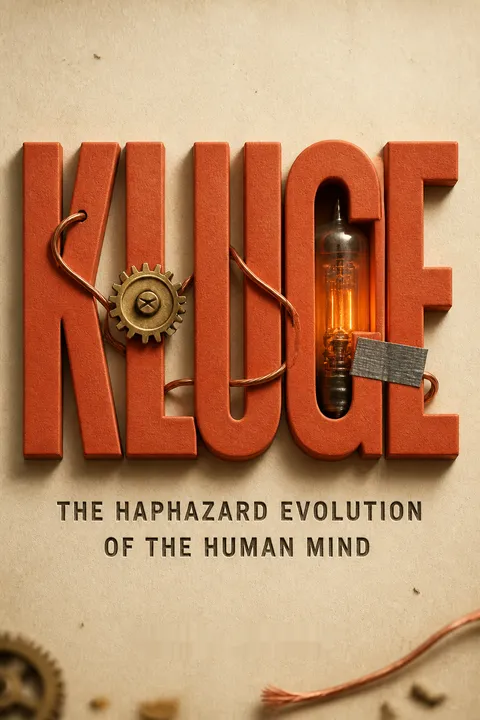
Evolution edits, never redesigns. A kluge is a makeshift arrangement that works despite being awkward or inefficient. The book opens with the Apollo 13 crew, whose failing air filter was replaced by a jury-rigged device made from materials already aboard. Evolution works in a similarly constrained way: it modifies what exists rather than starting fresh. The human spine carries the strain of upright walking, while the retina faces backward and leaves blind spots. These are useful enough, but not ideal.
History shapes the mind. Natural selection favors workable changes available now, not perfect designs that might be possible in the distant future. Evolutionary inertia describes this tendency to build on existing structures. The mind, including memory and reasoning, is a recent layer on older biological systems. Its inconsistencies are clues to that history, not proof that every feature is defective.
The engineering analogy makes path dependence memorable: systems inherit earlier decisions, including decisions that become expensive to undo. In software, technical debt accumulates when quick fixes are layered rather than replaced; in biology, survival leaves no convenient maintenance window. The analogy also usefully resists the idea that every trait must be optimally designed. Still, a clumsy feature alone cannot establish exactly how it evolved. Evolutionary explanations need evidence about inheritance, function, and alternatives, or they risk turning every quirk into a just-so story.
Use external cues because memory stores gist better than precise episodes
Memory searches by association. Contextual memory retrieves information through cues, such as the place or situation in which it was learned. The book contrasts it with postal-code memory, a computer-like system in which each item has a known address. People usually cannot locate a memory directly, so a question or clue has to activate the right one. This makes recall quick when the cue fits, but unreliable when similar experiences compete.
Context can mislead. Scuba divers who learned a word list underwater recalled it better underwater than on land. In Elizabeth Loftus's car-crash experiments, stronger wording in a question produced higher estimates of speed, even though everyone saw the same event. The practical fix is not to demand perfect recall: use checklists for repeatable tasks, and put keys or important items in consistent places.
The comparison with computer storage clarifies why a memory can feel vivid yet be wrong about details. Human recall is not a hidden video archive; it is cue-driven reconstruction. That design also has strengths, because associations support generalization and help past experience guide new situations. A useful division of labor follows: people interpret context, while records, checklists, and timestamps preserve specifics. In high-stakes settings such as legal investigations, neutral questions and corroborating evidence are safer than confidence alone. The computer analogy remains a metaphor, not a literal description of how brains store files.
Test beliefs against disconfirming evidence, not just what comes easily
Beliefs inherit mental noise. Mental contamination is the influence of irrelevant cues, moods, and memories on judgment. In the Forer demonstration, people treated a broadly worded personality description as if it had been written specifically for them. In another experiment, participants given the sequence 2, 4, 6 tried examples that supported their first theory, but often failed to test examples that could disprove it. They missed that the rule was simply three numbers in ascending order.
Motivation bends scrutiny. Confirmation bias favors evidence that supports an existing belief. Motivated reasoning means people examine unwelcome conclusions more critically than welcome ones. Together, these tendencies can make weak beliefs feel well supported. Before accepting a claim, ask what evidence would count against it, and whether the sources and examples being recalled are representative.
The key insight is that confidence can arise from the ease of retrieving supporting examples, not from the strength of the evidence. This is why scientific practice relies on methods that expose claims to possible failure, including replication and independent review. The same principle can help outside research: write down what would change a judgment before learning the result. That procedure is not a guarantee of objectivity, since people can still reinterpret contrary findings, but it makes the standard of evidence more visible and harder to move after the fact.
Precommit before temptation makes your long-term priorities feel abstract
Two systems compete. The ancestral system is fast and automatic, guiding familiar responses. The deliberative system supports conscious reflection, but takes effort and can be distracted or overruled. In Walter Mischel's study, preschoolers could eat one marshmallow immediately or wait for a larger reward. Some children tried to wait by turning away, covering their eyes, or distracting themselves. The task captures a common conflict: an immediate reward feels concrete, while a later benefit is easy to discount.
Make the choice earlier. The book describes people who favor a smaller payment now over a larger one years away, even when waiting offers the better return. Precommitment can protect a considered plan from a tempting moment: decide in advance, remove the easy opportunity to change course, or use a specific if-then plan. This is not proof that every impulse is foolish. Quick responses can be excellent when they rely on well-practiced skills.
Precommitment shifts self-control from an exhausting contest at the point of temptation to a decision made under calmer conditions. The idea connects to commitment devices in economics, from automatic savings to limits on access to addictive products. It also suggests a humane interpretation of lapses: people are not always choosing between two equally present options, because the future reward may feel psychologically distant. Delay tasks should not be read as pure measures of character, however. A child who doubts that promised rewards will arrive may rationally favor what is available now.
Judge options by outcomes, not by framing or relative prices
The presentation changes preference. Framing is the effect of describing the same choice in different ways. In a classic disease scenario, people often preferred a program described as saving 200 lives to a risky alternative. When the identical outcomes were described as deaths, preferences shifted. The facts had not changed; the wording had.
Compare in common units. People may drive across town to save $25 on a $100 microwave, yet decline the same savings on a $1,000 television. The percentage differs, but the money saved and the trip are identical. A pause helps: write down the actual outcomes in neutral terms, then compare costs, benefits, and alternatives. This does not mean all decisions have a single objectively correct value. It means the frame should not quietly substitute for the values a person intends to consider.
Reframing is a small but powerful form of analytical friction. It can reveal when a label, percentage, or starting point is doing more work than the underlying consequences. This matters in public policy as well as shopping, because descriptions such as lives saved and deaths avoided can cue different emotional responses. There is no perfectly neutral frame for every choice, since people may care about different outcomes. The useful test is whether the preference survives a second, mathematically equivalent description and whether the chosen measure reflects the decision-maker's actual priorities.
Treat language as useful but structurally prone to ambiguity
Speech uses inherited equipment. Human language depends on a vocal system built from breathing, sound production, and movements of the mouth and tongue. The book argues that these parts were adapted for speech rather than designed from scratch. Their timing limits help explain why a tongue-twister becomes harder at speed, and why sounds shift depending on neighboring sounds.
Meaning needs repair. A sentence such as Put the block in the box on the table can describe more than one action. Listeners usually resolve ambiguity using context and shared knowledge, but those clues can fail, especially over email, phone calls, or in safety-critical exchanges. Language is flexible and productive, yet its irregular words, vague categories, and ambiguous structures make exact communication harder than speakers often realize. When precision matters, use shorter instructions and ask the listener to confirm what they understood.
Language is not merely a code for transferring fully formed thoughts. Meaning also depends on shared context, turn-taking, gesture, and the listener's expectations. That flexibility makes ordinary conversation efficient, but it creates predictable risks when context is thin or consequences are high. Aviation and medicine respond with closed-loop communication: the receiver repeats a critical instruction, and the sender checks it. Such procedures do not make language perfect. They add a second channel of verification where fluent conversation can otherwise create a false sense of mutual understanding.
Do not mistake intense pleasure or higher income for lasting happiness
Reward is a rough guide. Pleasure can motivate eating, social contact, and other useful behaviors, but the brain's reward mechanisms are broadly tuned. Sweet tastes can reward candy as well as nutritious fruit; entertainment can capture attention without improving long-term wellbeing. The book notes that Americans spent several hours a day watching television, while heavier viewers tended to report lower happiness. That association does not prove television caused their unhappiness.
Circumstances lose their novelty. Psychological adaptation is the process of becoming accustomed to a change. A promotion, a new possession, or a rise in income may feel exciting at first, then become part of the background. The book reports that, in studies it discusses, people above the poverty line were happier than those below it, but higher income among already affluent groups predicted comparatively little additional happiness. Relative standing can keep expectations rising even when living standards improve.
The distinction between immediate reward and durable wellbeing helps explain why markets can profitably sell experiences that people later judge as poor uses of time. It also fits research on hedonic adaptation, the tendency for emotional responses to return toward a baseline after many changes. Still, income is not trivial: security, health care, and freedom from material hardship can make a substantial difference. The book's broader point is strongest when applied above that threshold. More money can solve real problems without guaranteeing that the next purchase will produce lasting satisfaction.
Expect fatigue to restore reflexes before your carefully made plans
Strain weakens reflection. Cognitive load is the demand placed on attention and working memory. When people are distracted or mentally taxed, the book reports that they become more likely to rely on quick judgments, including stereotypes and immediate appetites. In one experiment, people choosing between a fruit salad and chocolate cake were more likely to choose cake while also holding a long number in memory.
Failure is common, not mysterious. Procrastination, mind wandering, and missed intentions show the gap between setting a goal and acting on it. The book cites estimates that 80 to 95 percent of college students procrastinate. It also discusses mental disorders as recognizable patterns of breakdown, while acknowledging that genes and environments both contribute. A cited twin comparison found that when one identical twin had schizophrenia, the other did not invariably share the diagnosis. Evolutionary history may shape vulnerabilities, but it is not a complete explanation of illness.
This account is valuable because it links everyday lapses to conditions that reliably make careful thought harder, rather than treating every failure as a character defect. It also supports practical design: protect high-stakes decisions from fatigue, simplify tasks, and use reminders when attention is divided. The extension to mental illness needs a firmer boundary. Shared cognitive biases may illuminate vulnerability, but they do not reduce complex disorders to bad reasoning or replace clinical explanations and care. A systems perspective should expand compassion, not turn diagnosis into a metaphor for ordinary indecision.
Practice checking your reasoning, because skepticism is learned, not automatic
Make thinking observable. Metacognition means reflecting on how one knows something and how reliable that knowledge is. The book argues that critical reasoning needs practice rather than assuming education or intelligence will produce it automatically. In a program called Philosophy for Children, students aged 10 to 12 discussed philosophical questions for about an hour a week over 16 months. Researchers reported gains in measures including verbal and nonverbal intelligence, confidence, and independence.
Build a repeatable check. The book's practical advice can be condensed into four habits:
1. List plausible alternative explanations before settling on one.
2. Restate a choice in a different, neutral frame.
3. Check sample size and distinguish correlation from causation.
4. Turn a vague goal into a specific if-then plan.
These steps do not remove bias, but they make it easier to notice when a first impression is steering the conclusion.
The emphasis on teachable reasoning is important in an information environment where access to claims is easier than judging their credibility. Metacognition turns invisible mental habits into something that can be discussed, practiced, and corrected with others. The reported classroom gains are promising, but a course effect does not automatically transfer to every decision in adult life. Skills need repeated use in realistic settings. Institutions can help by making evidence, assumptions, and alternatives explicit, so sound judgment does not depend solely on an individual remembering to be skeptical.
Analysis
The book's central argument is not that human cognition is simply irrational. It is that the mind is a historically layered system: abilities that evolved for rapid action now support language, deliberate reasoning, and modern institutions, despite imperfect integration. That framing explains why people can be exceptionally capable in one domain and unreliable in another. Skilled reaching, for example, can calculate risk with little conscious effort, while abstract money choices invite framing, anchoring, and present bias.
The most productive implication is architectural. If memory is cue-driven, records and checklists can preserve details. If attention is vulnerable, important choices can be delayed until concentration improves. If belief is motivated, decision-makers can state in advance what would count as disconfirming evidence. These are not merely personal tricks. They are ways to distribute cognition across people, tools, and procedures. A courtroom that demands corroboration, or a hospital that uses checklists, can compensate for predictable human limits rather than asking individuals to become flawless.
The evolutionary explanation is illuminating but uneven in evidential strength. Anatomical constraints such as the backward retina provide relatively direct clues to history. Claims about the evolutionary origins of specific biases, pleasures, or psychiatric symptoms are harder to establish. A trait can persist without being beneficial, but that possibility does not identify its cause. Some examples in the book also rely on research traditions whose findings have since faced questions about replication and generalizability, especially brief priming effects. The argument is strongest as a warning against assuming optimality, not as a complete evolutionary account of each mental quirk.
The resulting view is neither cynical nor celebratory. Human reason is real, but it is not a sovereign system operating on clean data. It depends on perception, memory, emotion, and culture. Wisdom therefore means knowing when intuitive skill is dependable, when careful analysis is needed, and when the safest move is to build an external safeguard. The mind's rough construction is not only a source of error. Once its limits are visible, those limits become design constraints that individuals and institutions can work with.
Review Summary
Kluge explores how the human mind evolved haphazardly, resulting in a "kluge" - an imperfect but functional solution. Marcus argues our brains are cobbled-together systems prone to errors in memory, belief, and decision-making. He provides examples of cognitive biases and evolutionary explanations for our mental quirks. While some readers found the book insightful and accessible, others felt it rehashed familiar concepts or relied too heavily on outdated studies. Many appreciated Marcus's suggestions for overcoming our brain's limitations and the implications for debates on intelligent design.
Glossary
Kluge
Awkward but workable solutionA kluge is a clumsy or inelegant solution assembled from available parts that nonetheless works well enough. Marcus uses the term for products of both engineering and biological evolution. A kluge can be effective without being optimal, and its awkward features can reveal the history and constraints that shaped it.
evolutionary inertia
Evolution's dependence on existing structuresEvolutionary inertia is the tendency for natural selection to modify inherited structures rather than replace them entirely. New traits must function alongside what already exists, and changes that offer immediate benefits are more likely to persist than changes whose advantages emerge only in the long term. The result can preserve workable but suboptimal arrangements.
progressive overlay of technologies
New systems layered over old onesProgressive overlay of technologies describes the layering of newer biological systems on top of older ones instead of rebuilding an organism from scratch. In the brain, newer capacities such as language and deliberate decision-making depend in part on older systems that evolved for more basic functions. The layering preserves earlier machinery and can produce conflicts between systems.
contextual memory
Cue-based memory retrievalContextual memory retrieves information through cues associated with the memory, such as a place, situation, or related idea. It can make relevant information quickly accessible when the present context resembles the original one. But similar memories can interfere, and a poor or misleading cue can make precise details difficult to retrieve or encourage distortion.
postal-code memory
Address-based information storagePostal-code memory is Marcus's analogy for a system in which each item has a specific, known location, as in a computer's addressable storage. Such a system could retrieve, update, or replace an exact memory directly. Humans do not generally know a memory's location in the brain, so they rely more heavily on contextual cues and associations.
ancestral system
Fast, automatic mental processesThe ancestral system is Marcus's term for fast, automatic processes that make quick judgments and guide familiar actions. It relies heavily on older neural systems and operates without requiring deliberate awareness. It can be highly effective in well-practiced or urgent situations, but its quick responses may be shortsighted or influenced by irrelevant cues.
deliberative system
Effortful, reflective reasoningThe deliberative system is Marcus's term for the more recent capacity to consciously consider evidence, goals, and consequences. It can support planning and logical analysis, but it is effortful, vulnerable to distraction, and dependent on information supplied by other mental processes. Its presence does not guarantee that a person will reason objectively or correctly.
mental contamination
Irrelevant influences on judgmentMental contamination occurs when information that should be irrelevant influences a judgment or belief. A prior question, a person's appearance, a mood, or a recently encountered idea can shape what comes to mind and how it is interpreted. The influence may be hard to detect because people often experience the resulting judgment as objective.
motivated reasoning
Reasoning steered by desired conclusionsMotivated reasoning is the tendency to scrutinize evidence more harshly when it challenges a preferred conclusion and to accept supportive evidence with less examination. It can protect self-esteem or existing commitments, but it may also preserve false beliefs. Unlike confirmation bias, which concerns what evidence is noticed, motivated reasoning emphasizes how evidence is evaluated.
hypernormal stimuli
Amplified reward-triggering experiencesHypernormal stimuli are unusually intensified or polished experiences that can produce stronger responses than ordinary ancestral cues. Marcus applies the idea to modern products and entertainment designed to exploit broadly tuned reward systems, including artificial foods and video games. Their appeal can be powerful even when they do little to advance long-term wellbeing.
moral dumbfounding
Moral certainty without clear reasonsMoral dumbfounding is the experience of judging an action to be wrong while being unable to provide a convincing reason for the judgment. The concept highlights a possible gap between immediate moral intuition and deliberate explanation. A person may continue to feel certain even after proposed justifications are challenged.
FAQ
What's Kluge: The Haphazard Evolution of the Human Mind about?
- Exploration of cognitive flaws: The book argues that the human mind is a "kluge," a clumsy yet effective solution shaped by evolutionary history, leading to cognitive imperfections.
- Focus on evolutionary psychology: It examines how mental faculties like memory and decision-making are influenced by evolutionary pressures, challenging the notion of rational cognition.
- Interdisciplinary approach: Gary Marcus combines insights from psychology, linguistics, and evolutionary biology to illustrate the complexities of human cognition.
Why should I read Kluge by Gary F. Marcus?
- Insight into human nature: The book provides a deeper understanding of cognitive limitations and encourages reflection on personal thought processes.
- Engaging writing style: Marcus presents complex ideas in an accessible manner, using relatable examples to illustrate key concepts.
- Challenges conventional wisdom: It invites readers to reconsider beliefs about rationality and human behavior, promoting critical thinking.
What are the key takeaways of Kluge?
- Human cognition is flawed: Our cognitive processes are influenced by evolutionary history, leading to biases and errors in judgment.
- Evolutionary inertia: Mental faculties are built on older systems not designed for modern challenges, resulting in a "kluge" of cognitive processes.
- Memory and belief unreliability: Memory distortions and belief biases can lead to poor decision-making, highlighting the need for informed choices.
What are the best quotes from Kluge and what do they mean?
- "Living organisms are historical structures": Emphasizes that cognitive processes are shaped by evolutionary history, not intelligent design.
- "The human mind is a kluge": Suggests that cognitive abilities are a patchwork of clumsy solutions, reminding us of our irrational thinking.
- "Bad luck is better than no luck at all": Reflects the unpredictability of cognition, highlighting resilience despite flawed processes.
How does Kluge explain memory?
- Context-dependent memory: Memory retrieval is influenced by environmental cues, leading to potential distortions and inaccuracies.
- Prone to distortion: People often misremember details or conflate events, impacting situations like eyewitness testimony.
- Strategies for improvement: Understanding memory flaws can help develop better strategies, such as using external aids and being context-aware.
What does Kluge say about belief formation?
- Contextual influence on beliefs: Beliefs are shaped by irrelevant information and contextual cues, leading to biases in evidence evaluation.
- Confirmation bias: People seek information supporting existing beliefs, ignoring contradictory evidence, which hinders critical thinking.
- Motivated reasoning: Individuals rationalize beliefs based on emotions or self-interest, resulting in distorted reasoning.
How does Kluge address decision-making?
- Weakness of will: Explores struggles in making rational choices when faced with immediate temptations, illustrated by the marshmallow test.
- Framing effects: The presentation of choices can significantly influence decisions, often leading to irrational outcomes.
- Emotional influences: Emotions play a crucial role in decision-making, often overshadowing rational considerations.
What is the significance of the term "kluge" in Kluge?
- Definition of kluge: Refers to a clumsy yet effective solution, serving as a metaphor for the human mind's patchwork of cognitive processes.
- Implications for cognition: Emphasizes that cognitive abilities are adaptations accumulated over time, not perfect designs.
- Challenges rationality: Frames the mind as a kluge, challenging the idea of humans as rational decision-makers.
How does Kluge relate to evolutionary psychology?
- Critique of evolutionary psychology: Marcus argues that it often overlooks imperfections and kluges in cognitive processes.
- Historical context of cognition: Cognitive abilities are shaped by historical constraints, leading to mismatches with modern challenges.
- Evolutionary inertia: Cognitive processes are built on older systems, not well-suited for contemporary life, highlighting areas for improvement.
What cognitive biases does Kluge discuss?
- Confirmation bias: Leads individuals to favor information confirming preexisting beliefs, distorting understanding and decision-making.
- Anchoring effect: Initial information unduly influences subsequent judgments, affecting estimations and decisions.
- Motivated reasoning: Tendency to process information aligning with desires and emotions, leading to irrational conclusions.
How does Kluge explain the evolution of language?
- Language as a kluge: Evolved as a complex system prioritizing communication over clarity, resulting from various adaptations.
- Phonemes and context: Production of phonemes is influenced by surrounding sounds, complicating language learning.
- Recursion in language: Allows for complex sentence construction but can lead to comprehension difficulties.
How does Kluge address the concept of happiness?
- Pleasure as a guide: Evolved as a motivator for survival-enhancing behaviors, but modern pursuits can lead to maladaptive choices.
- Happiness is fleeting: Many sources provide temporary satisfaction, encouraging the search for sustainable joy.
- Adaptation to circumstances: Individuals adjust to circumstances over time, diminishing the impact of significant life changes on happiness.
Download PDF
Download EPUB
.epub digital book format is ideal for reading ebooks on phones, tablets, and e-readers.








