

Key Takeaways
You do not need certainty to begin a life-changing choice
Ambivalence can be the starting point. Michelle Tea had spent years unsure whether she wanted a child. At twenty-seven, reading Ariel Gore’s The Hip Mama Survival Guide made pregnancy seem possible for someone poor, queer, and unconventional. But the desire ebbed and returned. At forty, faced with frightening claims about declining fertility, Tea cried at the prospect of losing her chance. She took that grief as evidence that the question mattered, not as proof that motherhood would complete her.
The decision opens the story. Tea starts trying without knowing whether she is destined to become a parent. She can imagine alternate lives: moving to Paris, adopting, or remaining child-free. The memoir treats those futures as real possibilities, even as this path gathers momentum. Its central idea is that a birth story begins with choosing to enter uncertainty, not with perfect confidence.
What's striking is the refusal to treat ambivalence as a defect that must be solved before action. Major decisions often become clearer through contact with their consequences, rather than through endless private deliberation. Yet this approach has limits: fertility is time-sensitive, and a choice made under biological pressure is not the same as a choice made with abundant time and resources. Tea makes that pressure visible without pretending it yields a clean answer. Readers can take the permission to act without certainty while still asking whose choices are constrained by urgency, money, or access.
Build family through chosen trust, not biology alone
A child begins with a team. Tea’s first donor is Quentin, a gay friend who agrees to provide sperm. Her best friend Rhonda helps with the home inseminations, while Tea’s new partner, Orson, becomes part of the process and eventually shares the wish to raise a child. The improvised gatherings are intimate, sometimes awkward, and held together by affection. The donor is not automatically a co-parent, but neither is he merely a biological detail.
Kinship involves future questions. Tea cites a 2005 study in Human Reproduction reporting that 80 percent of surveyed donor-conceived children aged twelve to seventeen wanted to meet their biological father. That finding makes the choice of a known donor feel consequential. Orson worries about boundaries and extended family; Tea sees possible extra sources of care. Their family planning is therefore about relationships and trust as much as conception.
This account expands the idea of family beyond a couple plus a child. The people who help with conception already form part of the child’s social world, whether or not they take on parental roles. That distinction is useful: biological connection, caregiving responsibility, and emotional closeness are related, but they are not identical. The survey Tea describes also gives a future child’s perspective weight in a decision adults might otherwise frame around convenience. At the same time, one survey cannot predict what every donor-conceived person wants. The practical lesson is to make room for the child’s future questions rather than assume them away.
Fertility care prices hope, then makes the price feel normal
The bill changes the decision. Tea begins with home insemination partly because sperm-bank sperm and fertility treatment seem unaffordable. A clinic estimates an IUI cycle, or intrauterine insemination, at $800 to $1,000 with Clomid, plus $1,500 for donor screening. A different medication protocol could cost $2,500 to $3,500, again before screening. Later, IVF medications for Orson alone cost nearly $3,500. The eventual IVF estimate feels like relief partly because Tea and Orson had feared a much higher bill.
Comparison can distort judgment. Tea calls this the Barneys Effect: after seeing truly extravagant prices, a still-expensive item begins to look like a bargain. She recognizes the same shift when fertility treatment costs become familiar. Insurance, savings, and a partner’s income make treatment possible, but the system’s paperwork and assumptions also make queer patients feel misrecognized.
The Barneys Effect names a common cognitive trap: a price can feel reasonable because it is lower than a more frightening reference point, not because it is affordable. In fertility care, that distortion meets a genuine deadline and the emotional force of wanting a child. The memoir also shows how administrative language carries social assumptions, as when staff initially presume a spouse or use categories that do not fit the couple. Individual kindness from clinicians matters, but it cannot by itself resolve unequal access or confusing costs. A useful response is to separate the emotional value of treatment from the financial question of what a household can safely spend.
Let medical evidence change your plan without dictating your desire
New facts redirect the route. Tea’s early home attempts fail in part because she misunderstands when ovulation tests signal the fertile window. Later, a fertility specialist discovers large fibroids and fewer-than-average eggs, with many unlikely to be viable at her age. The diagnosis makes natural conception seem much less likely, but it does not decide what she should want. Tea and Orson consider several paths, including treatment with Tea’s eggs, adoption, Orson carrying a pregnancy, and using Orson’s eggs instead.
IVF makes one option possible. In vitro fertilization, or IVF, uses medication to stimulate egg production, retrieves eggs, fertilizes them outside the body, and transfers an embryo into a uterus. Orson’s eggs offer better prospects, and Tea can still carry the pregnancy. The arrangement lets both partners participate biologically, but it requires extensive procedures, medication, and money.
The shift from wishful home experimentation to medical information is not a surrender of personal agency. It gives Tea and Orson a clearer set of choices, including one neither had initially pictured. This is a useful model for decision-making under uncertainty: evidence can narrow or redraw the options without assigning moral value to them. It also matters that the medical facts arrive through a system that can be expensive and emotionally intimidating. Clinical probabilities are estimates, not promises, and the book’s numbers belong to this patient’s circumstances. A diagnosis can inform a decision, but it cannot settle what trade-offs a particular family should accept.
A wanted pregnancy can end in loss without making the joy false
Hope and grief overlap. After an earlier transfer fails, Tea becomes pregnant following another IVF attempt. The pregnancy stops developing at about eight weeks, and she learns this the day before her wedding to Orson. They marry surrounded by friends and family while carrying the shock privately. Several days later, Tea has a D and C, a procedure to remove the nonviable pregnancy. She describes the experience plainly, resisting the expectation that she must perform a particular kind of grief for other people.
A loss does not cancel what came before. The wedding remains joyful and meaningful, though it is not the day they imagined. Tea’s account also shows how ordinary obligations continue through sorrow: appointments, family gatherings, photographs, and a honeymoon. The story does not present resilience as feeling fine. It shows a person moving through a painful week without pretending that the loss was small or that happiness was impossible.
The account makes room for mixed emotion without turning either feeling into a lesson about how loss should be handled. That matters because public narratives often split experience into triumph or tragedy, leaving little language for a wedding that is both loving and heartbreaking. Tea’s insistence on describing the medical procedure as part of the story also challenges the silence surrounding miscarriage and abortion care. Her experience is specific, not a template for mourning. The broader insight is that a life event can retain its value even when its hoped-for outcome disappears; meaning is not a reward reserved for success.
Tell the truth about pregnancy without making it sacred theater
The body is not a greeting card. Tea sets out to avoid treating motherhood as her most sacred or defining identity. Her comic, unsentimental style makes room for ovulation tests, constipation, swollen body parts, strange cravings, fatigue, and sexual frustration. She jokes about drinking an entire jar of pickle juice, then describes the bloating that follows. The humor does not make pregnancy trivial; it makes its physical reality speakable.
Irreverence can welcome outsiders. Tea’s perspective comes from being queer, financially uncertain, and outside the familiar image of a middle-class, conventionally feminine mother. She wants readers to see parenthood as one identity among many, not a moral ranking of adult lives. The result is a birth story that includes desire and discomfort, excitement and fear, without demanding that every moment appear beautiful.
Humor here functions as a form of access. It punctures the polished language that can make reproductive experiences seem available only to people who fit an idealized maternal image. It also offers a way to discuss bodily details without either shame or forced reverence. Still, jokes are not universal armor: readers facing infertility, pregnancy loss, or medical trauma may experience the same details differently. Tea’s tone works because it is clearly her own, not a prescription for how everyone should narrate their body. The important distinction is between refusing shame and requiring cheerfulness.
Respect the body’s limits without calling them a failure
Birth does not follow the ideal plan. Tea hopes for a vaginal birth, but her baby remains breech and is considered too large for a safe attempt. An external cephalic version, in which clinicians try to turn the baby by pressing and manipulating the pregnant abdomen, does not work. Tea eventually has a C-section. During the operation she loses substantial blood and needs urgent attention, making clear that childbirth is not simply a test of courage or naturalness.
Care can still feel profound. After the medical team stabilizes her, the newborn is placed on her chest and begins nursing. Tea connects this moment to her interest in epigenetics, the study of how experiences and environments can affect gene activity. She wonders whether attentive care can interrupt family patterns of trauma, while presenting this as a hope, not a guaranteed cure.
The section resists a moral hierarchy in which vaginal birth is virtuous and surgery signals defeat. Tea wants a particular experience, tries a procedure to make it possible, then faces the limits of what her body and circumstances allow. That is a more useful account of birth than treating a plan as a promise. Her thoughts about intergenerational trauma also connect caregiving to family history, but epigenetics should not be made to carry more than it can establish. Nurturing care can matter deeply without guaranteeing that inherited pain disappears. The value lies in responsiveness, not in controlling every outcome.
A relationship can end without making the family it created unreal
The ending is not a tidy one. Six years after the marriage, Tea and Orson separate. The afterword acknowledges that the relationship she once experienced as a fairy tale has ended, and that the breakup brings real hurt. Yet their son remains the center of an ongoing family life, shared through a fifty-fifty custody arrangement. Tea also keeps bonds with people who helped make the child’s arrival possible, including Rhonda and Quentin.
Parenthood keeps changing shape. Tea finds that part-time parenting brings grief and relief, time with her son and time for work, friends, and a new partner. The memoir does not pretend divorce leaves the original romance intact. Instead, it refuses to treat the marriage’s end as proof that its love, its child, or the queer community around them was unreal.
This ending complicates the familiar memoir arc in which a hard journey is vindicated by a permanent couple and a happy household. The relationship changes, while the family’s practical and emotional ties continue in altered forms. That distinction is valuable: a bond can be consequential without lasting forever, and a child’s family may include more than the two people who once married. The account is also candid about the relief of shared custody, a feeling some parents may hesitate to admit. This is one family’s workable arrangement, not evidence that separation is easy or that every co-parenting relationship can remain cooperative.
Analysis
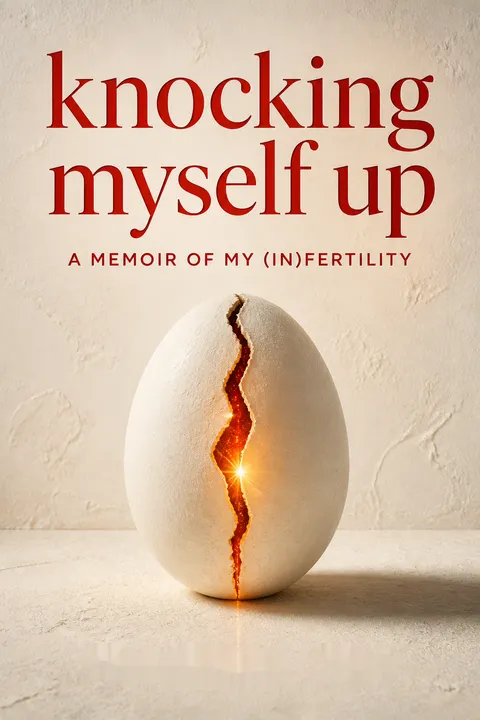
Knocking Myself Up is a memoir about reproductive choice, but its deeper subject is how a private desire gets assembled into a life. Tea begins with uncertainty, then encounters biological time, friendship, romantic love, medical bureaucracy, cost, and the body’s unpredictable responses. Each stage changes the meaning of the original question. The book’s structure follows that movement rather than offering a universal fertility protocol, which is why its strongest insights come through scenes: friends coordinating a home insemination, a specialist finding fibroids, a wedding shadowed by pregnancy loss, and an emergency unfolding around a C-section.
Its humor is not decorative. It counters the reverent language that often surrounds pregnancy and gives awkward, intimate details a social life. The jokes make the process accessible without claiming it is easy. That voice also lets Tea interrogate class and queer exclusion while remaining alert to the generosity of individual clinicians and friends. The memoir avoids a simple opposition between natural conception and technology. Medical intervention can be frightening, expensive, and indispensable at once.
The book’s account of family is similarly expansive. Quentin’s role as donor, Rhonda’s practical help, Orson’s egg contribution, and the later custody arrangement all challenge the assumption that biology, marriage, and caregiving must belong to one fixed pair. Yet the narrative does not idealize chosen family: decisions require boundaries, difficult conversations, and attention to a future child’s possible questions. Nor does the successful birth validate every sacrifice as worthwhile for everyone. The book is most useful when read as an intimate record of one person’s decisions, not medical guidance or a promise that persistence produces a baby. Its final complication is essential: motherhood transforms Tea, but it does not preserve her marriage. The child and the relationships around him remain meaningful even after the original family structure changes. The result is a birth story that includes conception, loss, surgery, love, divorce, and ordinary parenting, without pretending those events resolve into one neat moral.
Review Summary
Knocking Myself Up received mostly positive reviews, with readers praising its humor, honesty, and unique queer perspective on pregnancy and fertility. Many appreciated Tea's candid writing style and relatable experiences. Some readers found the tone occasionally flippant or uncomfortable. The book was lauded for its representation of non-traditional family-building journeys. Several reviewers noted learning about various fertility options. While some were put off by certain comments or attitudes, overall the memoir was well-received for its raw, funny, and heartfelt approach to a challenging topic.
People Also Read

Glossary
The Barneys Effect
Price comparison distorts affordabilityTea’s name for the way exposure to extremely expensive luxury goods can make merely expensive items seem affordable by comparison. She applies the idea to fertility treatment: after hearing larger estimates, a substantial bill can feel like a bargain. The term highlights how emotional reference points can influence spending decisions without changing what a service actually costs.
In/Fertility Industrial Complex
Fertility care and its systemsTea’s critical label for the institutions, costs, procedures, and administrative assumptions surrounding fertility treatment. Her experience includes high fees, insurance exclusions, extensive paperwork, and language that does not readily recognize her queer family. The phrase describes her perspective on a system she finds intimidating and costly, while the memoir also portrays individual clinicians who are caring and supportive.
Sperm Club
A community insemination ritualTea’s playful name for the recurring home insemination gatherings involving donor Quentin, friend Rhonda, and, eventually, partner Orson. The ritual has practical steps, but it also becomes a way for the group to share an intimate project and grow closer. The name captures how conception in this story is both a medical and social process.
TTC
Trying to conceiveAn abbreviation used by online communities and people attempting pregnancy. Tea encounters the terminology while researching ovulation, pregnancy tests, and fertility. The TTC community offers information and shared experience, but its acronyms and constant attention to bodily signs can also intensify uncertainty and make the process feel obsessive.
POAS
Peeing on a pregnancy stickAn informal abbreviation for taking a urine pregnancy test, especially as used in online trying-to-conceive communities. Tea uses the term while describing the cycle of testing, waiting, and interpreting results. The shorthand makes a repetitive private ritual communal, while also reflecting how closely people trying to conceive may monitor each possible sign.
IVF
Fertilization outside the bodyIn vitro fertilization is a fertility treatment in which medication stimulates egg production, eggs are retrieved, and eggs and sperm are combined outside the body. An embryo is then selected for transfer to a uterus, and remaining embryos may be frozen. In Tea’s case, Orson provides the eggs and Tea carries the pregnancy.
IUI
Sperm placed in the uterusIntrauterine insemination is a fertility procedure in which sperm is placed directly into the uterus, often around ovulation. In the memoir, a clinic discusses IUI as a possible step involving medication and additional costs. Tea initially attempts home insemination instead, before later pursuing IVF with Orson’s eggs.
Epigenetics
Environment can affect gene activityA field studying how biological and environmental conditions can influence the activity of genes without changing the underlying DNA sequence. Tea connects the idea to family histories of trauma and wonders whether attentive parenting can help interrupt painful patterns across generations. The memoir presents this as a meaningful possibility, not proof that loving care can erase inherited trauma.
2005 Human Reproduction survey
Study of donor-conceived adolescentsA study Tea cites from the journal Human Reproduction that surveyed donor-conceived children aged twelve to seventeen. She reports that 80 percent of those surveyed wanted to meet their biological father. The finding influences her thinking about known versus anonymous sperm donation, while representing the surveyed group rather than a universal preference among all donor-conceived people.
About the Author
Other books by Michelle Tea
Download PDF
Download EPUB
.epub digital book format is ideal for reading ebooks on phones, tablets, and e-readers.








