

Key Takeaways
Use philosophy to turn vague intuitions into claims you can actually test
Start with a puzzle. Theseus’s ship is repaired plank by plank until none of its original pieces remain. Is it still the same ship? Rebuilding the discarded planks creates a rival candidate, but measuring either vessel cannot settle what “same ship” means. The puzzle exposes a philosophical question: what do our concepts commit us to, and do our answers cohere with one another?
Aim for clear thought. Huemer presents philosophy as disciplined reasoning about broad questions, not as the exchange of unsupported opinions. It differs from experimental science because its arguments often begin with ordinary experience and intuitions rather than specialized experiments. The goal is not guaranteed certainty. It is to make claims precise enough to assess, and to notice when a question itself needs revision.
The ship puzzle is useful because it separates two tasks that often get blurred: establishing what happened and deciding how to classify it. The same distinction matters in law, medicine, and public policy, where evidence may be strong while the categories used to interpret it remain contested. Philosophy can clarify those categories before people argue past one another. A caution is that thought experiments do not settle questions by themselves. Their value depends on whether the imagined case isolates a relevant feature rather than smuggling in an assumption.
Treat opponents as collaborators in truth, not targets to defeat
Judge beliefs by their grounds. Rationality, as Huemer uses the term, concerns whether a belief is supported by the evidence available to a person, not whether it happens to be true. A student who expects to become rich through no plan or evidence remains irrational even if a stray lottery ticket later wins millions. The lucky result does not improve the reasoning that preceded it.
Watch for motivated judgment. Objectivity means resisting the pull of personal interests, emotions, and group loyalties. A practical test is to describe the strongest opposing argument fairly, check whether the same standards are applied to both sides, and look actively for evidence against one’s own view. In discussion, clarify ambiguity, accept the hypothetical as stated, and avoid distractions that leave the central argument untouched.
This approach resembles adversarial testing in science: competing explanations become useful when each is exposed to the strongest available challenge. It also connects to motivated reasoning, the tendency to scrutinize disliked conclusions more harshly than congenial ones. Fairly reconstructing an opponent’s view is not just courteous; it can reveal hidden assumptions in one’s own position. Still, objectivity is not achieved merely by sampling both sides. Sources differ in expertise and incentives, so evidence must be weighed, not counted as if every viewpoint had equal reliability.
Disagreement shows that beliefs differ, not that truth changes with them
Separate belief from truth. The argument for relativism from cultural disagreement moves too quickly: societies hold conflicting beliefs, therefore truth supposedly varies between societies. But disagreement alone is also compatible with one side being mistaken, or both being mistaken. If two cultures disagree about whether a practice is wrong, the contradiction cannot be resolved by declaring both claims true without explaining what “true for each culture” means.
Tolerance needs no relativism. Huemer argues that people can defend tolerance as an objective moral principle or as a matter of individual rights. A mistaken belief does not automatically justify coercing its holder. He favors a correspondence account of truth: a claim is true when the world is as the claim says it is. That view allows respectful disagreement while preserving the idea that evidence can favor one answer.
The distinction between disagreement and truth is essential in a pluralistic society. Cultural variation can be evidence that people’s judgments are shaped by history, incentives, or social learning, but it does not by itself establish that no moral fact exists. The same pattern appears in scientific disputes: disagreement can prompt investigation without making the underlying phenomenon observer-dependent. A deeper challenge is that tolerance is not always simple. Respecting people’s freedom does not require treating every practice as harmless, and objective moral claims still need careful justification.
Trust appearances provisionally, then let better evidence correct them
Begin somewhere defensible. Global skepticism argues that knowledge collapses because every reason needs another reason, or because we cannot first prove our senses reliable without using them. Foundationalism rejects the demand for an endless chain: some beliefs can be justified directly, such as noticing present pain or seeing an object nearby.
Use appearances with care. Phenomenal Conservatism is Huemer’s view that an experience which makes a claim seem true gives initial justification, unless there is a specific reason to doubt it. A stick can look bent in water, but touch may reveal that it is straight. A brain-in-a-vat story is possible, yet the book argues it predicts no particular pattern of experience, while ordinary perception fits the stable, coherent world we encounter. Direct realism offers another response: perception can justify beliefs about external things directly.
This is a fallibilist starting point: experience earns provisional trust without becoming infallible. In everyday inquiry, that avoids two extremes, treating every appearance as fact and demanding impossible proof before believing anything. The view also makes correction central, since conflicting experiences can defeat an initial impression. Its pressure point is that appearances may be shaped by bias or defective conditions that are hard to detect. The practical lesson is to ask what could undermine a seeming, rather than either worshipping intuition or dismissing it wholesale.
Stop expecting one neat definition to capture every useful concept
A true belief may still be luck. The traditional analysis says knowledge is justified, true belief. Gettier examples challenge its sufficiency. In the stopped-clock case, someone checks a clock that has stopped at three, happens to look at it when the time is three, and forms a justified true belief. Yet the accuracy is accidental, so it does not seem like knowledge. Proposed repairs, including reliable processes and the absence of false assumptions, face further counterexamples.
Concepts may have fuzzy boundaries. Huemer argues that ordinary words are generally learned through use, not by memorizing hidden definitions. Speakers acquire dispositions to apply terms in roughly the same situations as their community. This helps explain why philosophers can understand “knowledge” while failing for decades to agree on necessary and sufficient conditions for it. A useful concept need not have a clean formula.
The failed search for a definition is not wasted effort. Counterexamples expose what people take a concept to include, and where their judgments become unstable. This resembles how prototypes and family resemblances can organize categories without a single feature shared by every case. Yet linguistic usage is not the only possible aim: researchers may stipulate a precise technical definition when a task requires one. The key distinction is between clarifying ordinary meaning and designing a tool for a specific theory or measurement.
Weigh fine-tuning against suffering before declaring what created the universe
Not every God argument works. The ontological argument tries to derive existence from a definition of a perfect being; Huemer says definitions can tell us what a term would mean if something satisfied it, not establish that anything does. Cosmological arguments appeal to a first cause or an explanation for contingent facts, but their premises about beginnings, infinity, and universal explanation are disputed. Evolution, meanwhile, offers a stronger account of life’s complex adaptation than a direct appeal to design.
The evidence remains mixed. Fine-tuning arguments point to physical parameters that appear to fall within ranges compatible with life. A designer could explain that fit, while a multiverse is a competing proposal. Against a perfectly powerful and good creator stands extensive suffering with no clear pattern of purpose. Huemer’s conclusion is agnosticism: some evidence may support a creator, but none settles the question.
The chapter’s strength is comparative rather than triumphalist. It distinguishes arguments that merely sound decisive from arguments whose premises deserve scrutiny, and it treats the problem of suffering as evidence rather than as a quick proof. Fine-tuning debates are especially sensitive to assumptions about probability and what counts as an explanation. The multiverse also faces questions about testability and selection effects. The sound approach is to compare how much each hypothesis explains, while resisting the temptation to treat an incomplete explanation as proof of its favorite alternative.
Keep responsibility meaningful without pretending physics has settled free will
Randomness is not freedom. Huemer defines free will through both alternatives and control. A robot may direct its own movements but always follow its programming; a radioactive atom may have more than one possible outcome but does not control which occurs. Neither is a clear model of human choice.
The debate turns on possibility. Compatibilists say an action can be free when it flows from a person’s motives and would succeed if attempted, even if those motives have causes. Libertarians hold that free choice is incompatible with determinism. Huemer favors the latter view, pointing to experience, responsibility judgments, and arguments that determinism undermines rational deliberation. He acknowledges that how agent causation or nonphysical mental states could produce free action remains unclear. He also treats freedom as a matter of degree, affected by coercion, disorder, and impaired self-control.
The contrast between determination and randomness identifies a genuine explanatory gap: a choice must be caused in some intelligible way, yet not simply forced by conditions outside the agent’s control. Compatibilist accounts address this by focusing on reasons-responsive agency, while libertarian accounts preserve alternative possibilities. Neither label settles the issue without a workable account of control. Degrees of freedom add practical value even amid disagreement, since coercion, addiction, and impaired capacity can affect how responsibility should be assigned.
Test identity theories against clones, amnesia, and branching, not memory alone
Sameness has two meanings. Qualitative identity means two things share characteristics; numerical identity means they are one and the same thing. A perfect copy of a person could match every memory and personality trait without being numerically that person. The teletransporter thought experiment sharpens the stakes: it disassembles a traveler and reconstructs an indistinguishable person elsewhere, leaving open whether the traveler survived.
Simple tests fail. Body theories struggle with brain transplants, while brain theories struggle with changes to mental content. Memory and psychological continuity face amnesia and cloning cases; adding spatial continuity creates problems when one person branches into two. Huemer argues that a soul, an immaterial subject that persists through change, best preserves identity as one-to-one, transitive, intrinsic, and objective. He concedes this view leaves many cases unknowable and depends on a controversial entity.
These cases reveal that practical continuity and numerical identity may come apart. Memory, personality, and bodily organization are powerful grounds for treating someone as the same person, but duplication shows that similarity cannot by itself guarantee identity. This matters for imagined technologies and also for ordinary questions about responsibility and survival. The soul theory offers a clean account of a continuing subject, but its explanatory cost is substantial: it posits something inaccessible to ordinary observation. The competing theories may still guide practical decisions even if they do not settle metaphysics.
Keep moral claims objective while treating disputed intuitions cautiously
Moral language makes claims. Huemer rejects the idea that moral statements merely express emotion or report social approval. They behave like ordinary claims: people ask whether they are true, argue for them, and place them inside conditional statements. He also rejects nihilism, which implies that even a plain prohibition on torturing babies for amusement is false, and naturalism, because proposed reductions of goodness to pleasure or survival lack the independent empirical support found in scientific reductions such as water to H2O.
Intuition can be defeasible evidence. Ethical intuitionism holds that some objective moral truths are irreducible and known through intellectual seemings. Disagreement weakens confidence in controversial intuitions, Huemer grants, but does not erase widely shared judgments such as the wrongness of causing harm for no reason. Moral reasoning must balance confidence with openness to correction.
The central insight is that moral disagreement does not automatically turn values into preferences. At the same time, shared intuition is not a simple certificate of truth: agreement may reflect common interests, upbringing, or blind spots. The analogy with perception is helpful because both can provide evidence while remaining corrigible. A careful moral inquiry therefore tracks which judgments are widely stable, which are contested, and what independent reasons support each. This preserves moral seriousness without treating conviction, consensus, or unfamiliarity as decisive proof.
Count distant suffering as morally real, then give where help works
Consequences matter, but not alone. Utilitarianism says to maximize total welfare, yet cases such as killing one healthy patient to save five challenge the idea that outcomes always override rights and promises. Absolute rules face the reverse problem: refusing every rights violation can lead to disaster. Huemer finds moderate deontology, which weighs duties against consequences, the least troubled of these approaches, while acknowledging unresolved questions about where limits belong.
Distance does not erase need. Peter Singer’s shallow-pond case asks whether a passerby must save a drowning child at modest cost. The analogy suggests an obligation to help people in extreme poverty, though Huemer rejects the demand to give until one’s life is ruined. Effective altruism directs aid toward programs that do more good per dollar. The animal-ethics case adds that roughly 74 billion animals were slaughtered for food worldwide in 2016, mostly in factory farms; small pleasures do not readily justify such suffering.
The practical force comes from making remote harms emotionally legible without confusing emotion with moral importance. Cost-effectiveness adds a consequentialist discipline: good intentions are not enough if another intervention helps far more. Yet measurement is imperfect, and duties to family, promises, and rights can resist aggregation into a single welfare score. The book’s combination of partial obligations and effective giving captures that tension, though the proposed limit on sacrifice remains intuitive rather than precisely derived. The animal example presses the same question where social habits make victims easy to overlook.
Analysis
Huemer’s book is both an introduction to major philosophical disputes and an argument for a particular intellectual temperament: define the claim, distinguish it from nearby claims, test its premises, and take counterexamples seriously. Its breadth is a strength because the same habits recur across epistemology, metaphysics, and ethics. Skepticism asks whether evidence can justify ordinary belief; moral theory asks whether consequences can override rights; identity puzzles ask whether continuity is enough for sameness. In each case, the work is less about collecting slogans than locating the inference that carries the weight.
The strongest unifying commitment is fallibilist common sense. Ordinary perception, moral judgment, and responsibility begin with considerable plausibility, but they remain open to defeaters. This avoids the skeptic’s demand for impossible certainty and the relativist’s escape from disagreement. It also explains the appeal of Phenomenal Conservatism: a seeming can justify a belief without being infallible. The tension is that intuitions serve both as starting evidence and as the measure by which theories are assessed. Huemer recognizes disagreement as a reason for caution, but readers may still ask how to distinguish a reliable seeming from a culturally inherited bias.
The book is notably candid about unsettled issues. It ends without a decisive verdict on a creator, admits uncertainty about how libertarian freedom works, and favors a soul theory that many readers will find metaphysically costly. That candor supports its pedagogical goal, though Huemer’s forceful tone can make his own judgments sound more conclusive than the arguments warrant. His strongest practical legacy is methodological: do not mistake technical labels for explanations, do not treat disagreement as proof that truth is relative, and do not let a satisfying conclusion outrun its evidence. The reader leaves with several defended positions, but more importantly with a way to challenge them.
Review Summary
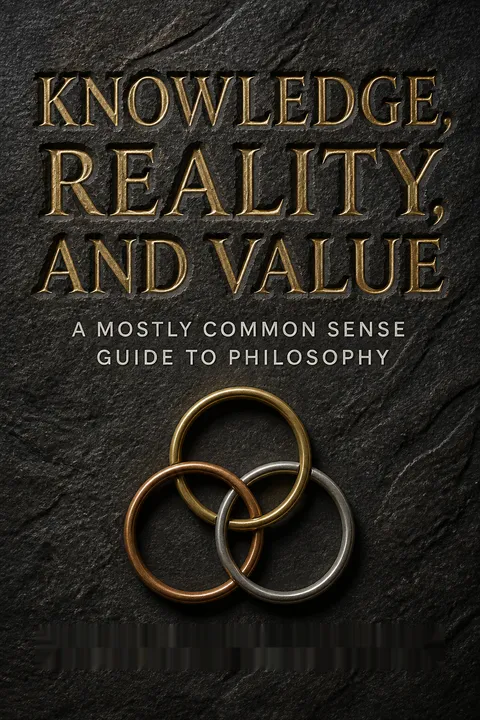
Knowledge, Reality, and Value receives mixed reviews as an introduction to philosophy. Many praise its clarity, accessibility, and comprehensive coverage of key topics. Readers appreciate Huemer's engaging writing style and logical approach. However, some criticize the author's bias and arrogance in presenting his views. While some consider it the best introductory philosophy book available, others find it too opinionated and lacking in historical context. Overall, it's seen as a thought-provoking read that encourages critical thinking, despite its limitations.
People Also Read


Glossary
Phenomenal Conservatism
Appearances provide initial justificationAn epistemological theory holding that if something seems true to a person, that seeming gives the person initial justification for believing it. The justification can be defeated by specific reasons to doubt the appearance, such as conflicting sensory evidence. It treats perception, memory, introspection, and intellectual intuition as basic sources of justification.
Moorean response
Reject the weakest premiseA strategy for answering an argument by comparing the initial plausibility of its premises and conclusion. When an argument conflicts with an especially obvious belief, the response may reject a less obvious premise rather than surrender the obvious belief. In external-world skepticism, ordinary knowledge claims can be treated as more plausible than the skeptical assumptions used to challenge them.
Gettier examples
True belief by epistemic luckHypothetical cases designed to show that justified true belief may still fail to be knowledge. In the stopped-clock case, someone reads a clock that has stopped at three, when it happens to be three o’clock. The belief is justified and true, but its truth is accidental, prompting the search for an additional condition on knowledge.
fine tuning
Life-permitting physical parametersThe observation that some broad physical parameters of the universe appear to fall within narrow ranges that permit life. Examples discussed include the gravitational constant and the early universe’s energy density. The observation is used as evidence in arguments for a designer, although it does not by itself establish that a conscious being selected those values.
compatibilism
Free will fits determinismThe view that determinism and free will can both be true. Compatibilists commonly understand freedom in terms of acting from one’s own motives, or being able to perform an action if one tried, rather than requiring an undetermined choice. Huemer presents this as a major philosophical position while arguing that it conflicts with ordinary intuitions about alternatives.
psychological continuity
Connected mental life over timeA family of accounts that identify a person across time through continuity in memory, personality, beliefs, or other psychological traits. These theories aim to explain why a later person counts as the earlier one. Huemer argues that amnesia challenges their necessity, while cloning and branching challenge their sufficiency for numerical identity.
ethical intuitionism
Intuition reveals objective moral truthsA metaethical view that moral truths are objective and not reducible to descriptive facts, and that people can know some of them through ethical intuition. An intuition is an intellectual seeming that a claim is true, not a conclusion reached through an argument. The view allows intuitions to be challenged by conflicting evidence or other intuitions.
moderate deontology
Duties can yield to greater stakesAn ethical position between consequentialism and absolute deontology. It holds that duties and rights can prohibit actions even when they produce somewhat better outcomes, but that sufficiently grave consequences may justify violating them. The view accommodates common judgments against sacrificing one person for a small benefit, while allowing intervention to prevent catastrophe.
effective altruism
Direct aid toward greatest impactAn approach to charitable giving that emphasizes identifying and supporting interventions that produce the greatest benefit per unit of money. Rather than treating sacrifice itself as the goal, it evaluates where donations can help most. The book points to charity evaluators as resources for comparing organizations and causes.
FAQ
What's Knowledge, Reality, and Value about?
- Introduction to Philosophy: The book serves as an introduction to philosophical issues, covering topics like free will, the existence of God, and objective values.
- Clear and Accessible: Michael Huemer emphasizes clarity, making complex ideas more accessible compared to traditional textbooks.
- Comprehensive Overview: It covers major branches of philosophy, including epistemology, metaphysics, and ethics, providing a broad understanding of the field.
Why should I read Knowledge, Reality, and Value?
- Engaging and Relevant: The book discusses philosophical questions relevant to everyday life, such as free will and the nature of knowledge.
- Affordable and Expertly Written: Huemer offers a more accessible option compared to expensive textbooks, drawing on his extensive teaching experience.
- Critical Thinking: It encourages readers to think critically about philosophical issues, promoting intellectual growth.
What are the key takeaways of Knowledge, Reality, and Value?
- Philosophical Thinking: Encourages critical and clear thinking about philosophical issues, helping avoid common confusions.
- Arguments and Evaluations: Presents philosophical arguments fairly, with Huemer providing his own evaluations for deeper understanding.
- Intellectual Virtues: Emphasizes rationality and objectivity in forming beliefs, guiding effective philosophical discussions.
What is Phenomenal Conservatism in Knowledge, Reality, and Value?
- Definition: Phenomenal Conservatism posits that appearances or mental states provide foundational justification for beliefs.
- Types of Appearances: Includes sensory experiences, memory, introspection, and intuitions as grounds for belief.
- Rejection of Skepticism: Counters skepticism by asserting foundational beliefs do not require verification, defending against skeptical arguments.
How does Huemer address skepticism in Knowledge, Reality, and Value?
- Foundational Beliefs: Argues skepticism arises from misunderstanding foundational beliefs, which are inherently justified.
- Two Kinds of Reasons: Distinguishes between personal belief reasons and justification reasons, clarifying rational belief holding.
- Reliability Argument: Critiques the skeptic's need for verifying belief-forming methods, asserting foundational methods don't require it.
What is the Ship of Theseus, and why is it important in Knowledge, Reality, and Value?
- Classic Problem: The Ship of Theseus raises questions about identity and change, illustrating complexities in defining sameness over time.
- Philosophical Inquiry: Demonstrates how philosophical questions differ from scientific or religious inquiries, often lacking straightforward answers.
- Critical Thinking: Invites reflection on beliefs about identity and continuity, fostering deeper philosophical engagement.
What is the Ontological Argument as presented in Knowledge, Reality, and Value?
- Definition: Posits that God, as the greatest conceivable being, must exist because existence is a perfection.
- Anselm's Version: Concludes that if God can be conceived to exist, He must exist, as existence is necessary for a perfect being.
- Critiques: Discusses objections, including the idea that existence is not a property and reductio ad absurdum with concepts like a "perfect pizza."
How does Huemer refute nihilism in Knowledge, Reality, and Value?
- Objective Moral Properties: Argues nihilism fails because moral language describes objective facts, like "Murder is wrong."
- Moral Intuition: Suggests moral intuitions indicate objective moral truths, supported by widespread agreement on principles.
- Counterarguments: Critiques nihilism's implausibility, arguing rejection of objective moral values leads to absurd conclusions.
What is ethical intuitionism as presented in Knowledge, Reality, and Value?
- Definition: Ethical intuitionism holds that there are objective moral truths known through intuition, challenging nihilism and subjectivism.
- Moral Knowledge: Asserts moral knowledge comes from direct awareness of truths, not empirical evidence or deduction.
- Intuitive Judgments: Emphasizes intuitive judgments as a foundation for ethical beliefs, indicating reliable moral truths.
How does Huemer critique utilitarianism in Knowledge, Reality, and Value?
- Counterintuitive Implications: Points out utilitarianism can justify morally questionable actions, like sacrificing innocents for the greater good.
- Moral Intuitions: Argues utilitarianism often conflicts with common moral intuitions, suggesting it may not be reliable.
- Alternative Theories: Advocates for ethical intuitionism as a more plausible alternative, aligning better with moral intuitions.
What is the significance of free will in Knowledge, Reality, and Value?
- Definition: Free will is the ability to choose among alternatives and control one's actions, emphasizing alternate possibilities and self-control.
- Determinism vs. Indeterminism: Explores implications for free will, arguing both present challenges to its concept.
- Compatibilism: Discusses compatibilism, the view that free will and determinism can coexist, widely accepted among philosophers.
How does Knowledge, Reality, and Value address the duty of charity?
- Moral Obligation: Argues individuals have a moral obligation to donate to charity, particularly to alleviate global suffering.
- Effective Altruism: Promotes donating to effective charities that maximize good per dollar, emphasizing significant impact.
- Counterarguments: Anticipates objections, emphasizing the moral imperative to help those in need despite challenges.
About the Author
Other books by Michael Huemer
Download PDF
Download EPUB
.epub digital book format is ideal for reading ebooks on phones, tablets, and e-readers.








