

Key Takeaways
Learn Hangul itself because romanized spellings blur Korean sounds and spelling.
Start with the script. Hangul is Korea’s alphabet, built from consonants and vowels arranged into square syllable blocks. The book teaches 24 basic letters, then adds doubled consonants, aspirated sounds, and vowel combinations. Its historical introduction links Hangul’s 1446 creation under King Sejong to wider access to reading and writing. Roman letters are an unreliable substitute: different spellings can preserve a word’s sound or its original spelling, while obscuring the other.
Read sound and spelling. A bottom consonant, called 받침, closes a syllable. Its pronunciation may shift when syllables meet in speech. Practice reading the Korean script aloud so that spelling, sound, and listening develop together, rather than relying on English approximations.
The book’s strongest opening move is to treat literacy as the foundation of language learning, not as optional preparation for conversation. A learner who depends on romanization must repeatedly translate sounds through a second writing system. Hangul removes that detour. The caution is that an alphabet does not make pronunciation effortless: the book itself introduces sound changes because written syllables can behave differently in connected speech. The practical lesson is to use the script as the dependable map, while still training the ear against real spoken Korean.
Put Korean’s verb at the end, and let markers organize the rest.
Save the action for last. Korean commonly places the subject first, the object next, and the verb at the end. A sentence equivalent to I drink coffee therefore follows the order I coffee drink. This is the pattern underlying the book’s examples, from expressing preferences to describing where someone is going. Once the verb arrives, it completes the thought, so listeners use the words before it to anticipate the action.
Build in Korean order. The book advises practicing this structure early instead of composing an English sentence and rearranging it word by word. Korean also often leaves out a pronoun or noun when the context already makes the reference clear. Adverbs usually appear before the verb they describe, and plural endings are often unnecessary when the meaning is evident.
Verb-final order changes more than word placement. It asks the learner to hold a sentence’s participants in mind while waiting for the action that completes it. That makes short, self-generated sentences especially useful: they build familiarity with the order as a thinking pattern, not just a translation trick. The textbook’s English-shaped glosses help beginners see the contrast, but literal glosses can become a crutch. The aim is not to speak English with Korean words rearranged, but to recognize each Korean phrase as a unit in its own sequence.
Read particles as role labels, not interchangeable grammar decorations.
Track each noun’s job. Korean particles attach to nouns and clarify how those nouns relate to the sentence. The Object Marker, 을 or 를, marks what receives an action. The Subject Marker, 이 or 가, marks the subject. The Topic Marker, 은 or 는, signals what the sentence is about, often with a sense of contrast. Their English translations can look similar, but their functions are not identical.
Watch the location too. 에 can mark a destination or where something exists. 에서 can mark where an action happens, or a location someone is leaving. The book treats particles as clues that help interpret a sentence even when Korean omits pronouns or leaves the same noun in different positions. Their form often depends on whether the preceding word ends in a vowel or consonant.
Particles are the book’s answer to a common beginner’s puzzle: if Korean often drops pronouns and places the verb last, how can a listener tell who is doing what? These small endings supply much of the sentence’s navigation. The useful editorial caution is not to turn each particle into a fixed English equivalent. In particular, topic and subject markers encode different kinds of emphasis, even when an English translation hides the difference. Treating them as functional signals, rather than decorative endings, makes the examples easier to generalize.
Start with polite formal endings, then add the conversational 요 form.
Build verbs from stems. A Verb Stem is made by removing 다 from a dictionary-form verb. The book first attaches formal endings such as ㅂ니다 or 습니다 for statements, and ㅂ니까 or 습니까 for questions. It chooses this starting point because the patterns are relatively regular and erring toward politeness is safer for a beginner. It also warns that this formal register is not the usual choice for ordinary conversation with friends.
Learn the everyday form. The 요 form is polite but less formal. Its conjugation depends on the verb’s final vowel and includes several special patterns. To make the past tense, the book first forms the 요 version, removes 요, and adds ㅆ before the chosen ending. It presents the forms as tools for different social situations, not interchangeable styles.
This sequence makes a sound teaching tradeoff: predictable formal endings lower the initial burden of conjugation, while the later 요 form addresses everyday speech. The approach also shows that grammar includes social choices, not merely sentence construction. Its risk is practical: a learner who stops after the early chapters may sound more formal than intended. The book helps counter that risk by supplying familiar dialogues in the conversational form as practice. A useful study habit is to learn a sentence together with the situation in which its ending fits.
Choose number systems by the thing counted, then attach its counter.
Match the counting system. Korean uses Sino-Korean numbers for money, measurements, dates, minutes, and seconds, among other uses. Pure Korean numbers are common for counting people, animals, objects, ages, and hours. The learner must know both systems, because a number’s job matters as much as its value. Some Pure Korean numbers also change form before a counter: 하나 becomes 한, and 둘 becomes 두.
Name what you count. A counter is a word paired with a number to identify the kind of unit being counted. The book uses 명 for people, 마리 for animals, 개 for general items, 권 for books, and 장 for flat objects. In time expressions, hours use Pure Korean numbers, while minutes use Sino-Korean numbers. Context can make the counted noun unnecessary, but the counter still signals the category.
The two number systems can seem like needless duplication until the learner sees that Korean counting is organized around categories. A counter answers what the number measures, much as a label on a container clarifies what is inside. This is a more useful learning target than memorizing long number lists in isolation. The complication is real: number choice depends on convention, and a counter must be learned alongside the noun. The book’s examples, from Won to people and time, make those conventions visible in practical settings.
Let context drop pronouns, but choose Korean address terms with care.
Do not translate every pronoun. Korean often leaves out I, you, he, or she when the speaker and listener can infer the reference. Repeating a name or noun can sound unnecessary, so a short answer may be more natural than a full sentence. But omission does not mean that social relationships are unimportant. The book recommends using a person’s name with a title such as 씨, or an appropriate role such as 선생님, rather than casually reaching for a direct translation of you.
Notice relationship-specific words. Korean has different everyday terms for an older brother or sister depending on whether the speaker is male or female. It also distinguishes relatives on the mother’s and father’s sides in some cases. The book warns that 당신 can sound distant or rude outside a few limited situations.
This is a valuable correction to the instinct to translate English sentences word for word. Korean makes shared context do work that English often assigns to pronouns, while names and titles help express respect and relationship. The family vocabulary makes that social dimension concrete: even a simple kinship term may depend on who is speaking. The challenge for a beginner is that omitting a word and choosing an address form require different judgments. Grammar practice alone cannot settle every situation, so these expressions are best learned with their conversational context attached.
Tell inability from refusal: 못 marks cannot, while 안 marks not.
Choose the kind of negative. The book teaches two common ways to negate a verb: place 안 before it, or attach 지 않다 after its stem. Both can express that an action is not happening. For some verbs, both patterns work; when unsure, the book recommends 지 않다 as the safer general option. Some verbs already have a negative counterpart, such as 모르다 for not knowing and 없다 for not existing or not having something.
Separate choice from capacity. 못 indicates that someone cannot do something, while 안 indicates that the action is not being done. The book also teaches a construction with a verb stem plus 을 or ㄹ 수 있다 for can, and 수 없다 for cannot. This distinction matters in ordinary requests and explanations: not doing a task is different from being unable to do it.
The contrast between 안 and 못 gives learners a compact way to express agency. One says the action is not being done; the other points to inability. That distinction prevents a small grammar choice from changing the implied reason for someone’s behavior. The book also shows why negative vocabulary deserves attention: Korean may express the opposite through a separate verb rather than attaching a general negative. The limitation is that a learner cannot infer every verb’s most natural negative pattern from a single rule, which is why the textbook encourages listening and practice.
Build descriptions by conjugating Korean descriptive verbs before nouns.
Treat adjectives as verbs. Korean descriptive verbs can describe a subject at the end of a sentence or be changed into a form that sits directly before a noun. For example, a statement that a person is kind becomes a phrase meaning a kind person. Most descriptive verb stems take ㄴ after a vowel or 은 after a consonant in this noun-modifying form. Stems ending in ㅂ or ㄹ follow additional patterns, and 있다 becomes 있는 before a noun.
Connect related ideas. The ending 고 can join actions or descriptions, allowing a sentence to say that someone is studying and then going, or to describe something as both large and tasty. The book repeatedly builds from single clauses to these combinations, showing how a small set of endings expands what a beginner can say.
Calling these forms descriptive verbs helps explain why Korean adjectives change with the grammar around them. It also discourages the assumption that an English adjective can simply be inserted unchanged. The progression from a description at sentence end to a noun-modifying form is an efficient way to show how one idea can serve different roles. The irregular endings add a memorization burden, however. The best payoff comes from learning each pattern inside complete phrases, where the learner can see what the form describes and where it belongs.
Link clauses with Korean endings that show purpose, contrast, and cause.
Make the relationship explicit. Korean endings can connect ideas while showing how they relate. The book introduces 고 for adding or linking actions, 지만 for contrast, and 때문에 after a noun or verb stem to express a reason. It also teaches 으러 or 러 before a movement verb to express going or coming in order to do something. These forms let a beginner move beyond isolated statements without changing the core verb-last pattern.
Use them in situations. A learner can explain that a plan changed because of work, contrast two preferences, or say why someone is heading somewhere. The chapters also place grammar inside dialogues about greetings, restaurants, shopping, and family. Polite commands such as asking someone to bring or do something give another practical bridge from a memorized phrase to a sentence pattern.
A language becomes more useful when it can express relations between ideas, not just name objects or report isolated actions. The book’s connectors make those relations visible: addition, contrast, cause, and purpose each receive a different form. This is also why its dialogues matter. A grammar rule attached to a real conversational task is easier to interpret than one presented only as a chart. The caution is that English conjunctions do not map neatly onto Korean endings. Learners need to retain the relationship being expressed, rather than copy English word order.
Practice Korean in frequent, productive sessions, not vocabulary-only marathons.
Make practice active. The author recommends regular short sessions, self-quizzing, writing, speaking, and creating sentences with newly learned words and grammar. The concrete schedule offered is 30 minutes a day, five days a week, rather than 150 minutes in one sitting. The book also suggests using its exercises in order because each chapter relies on earlier material. Free audio supports listening and pronunciation, and conversations can be reread aloud in both formal and conversational forms.
Use grammar to make meaning. The author argues that a learner with basic grammar can communicate more coherently than someone who knows many words but cannot assemble a sentence. Vocabulary lists are therefore resources, not the destination. When a sentence feels impossible, the book advises checking for an unfamiliar form or missing word instead of rushing ahead.
The study advice is unusually well matched to the book’s design: concepts accumulate, and the exercises ask the learner to retrieve and use them rather than merely recognize them. Short, recurring sessions also make practice easier to fit into ordinary life. The key distinction is between exposure and production. Seeing a verb is not the same as selecting its ending and building a sentence. The suggested schedule is a workable example, not a universal prescription; consistency matters most when the learner actually uses the session to recall, speak, or write Korean.
Analysis
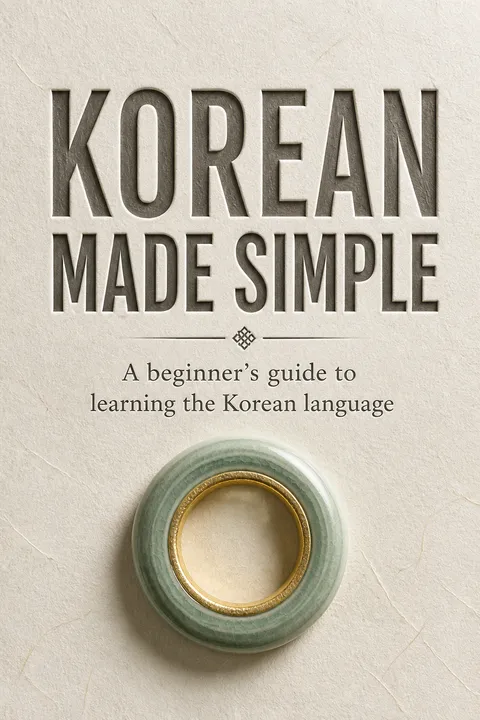
Korean Made Simple is a cumulative beginner’s textbook, not a phrasebook or a descriptive survey of Korean. Across twenty chapters, it moves from Hangul to sound changes, sentence patterns, markers, verbs, descriptive forms, numbers, social language, and past tense. Its central teaching choice is to delay conversational 요 endings until learners have practiced more regular formal patterns. That ordering trades immediate everyday naturalness for a gentler introduction to conjugation and politeness.
The book’s most useful idea is that Korean grammar should be learned as a set of interacting signals. Verb position establishes a broad sentence pattern; particles mark relationships; verb endings carry tense, mood, and social register; counters show what a number measures. The system can initially seem full of exceptions, but each new form becomes easier to interpret when connected to a sentence the learner can actually use. The recurring dialogues support that transfer by placing grammar in greetings, restaurants, shopping, and family conversations.
The greatest challenge for an English-speaking beginner is that an English translation can conceal the Korean structure. Topic and subject markers may receive similar translations, pronouns often disappear, and Korean descriptive verbs do not behave exactly like English adjectives. The book addresses these gaps directly, but its many rules and exceptions require repeated use, not one-time reading. Its advice to proceed in order and make sentences is therefore essential, not optional enrichment.
The text is deliberately an introduction, and it says so. Its explanations simplify patterns to make early progress possible; they should be treated as practical entry points rather than a complete account of every context. Likewise, starting with formal speech is useful as a cautious first step, but learners need exposure to the conversational form to avoid mistaking textbook politeness for ordinary speech. The adaptation’s core message is simple: learn to read Hangul, understand the roles marked in a sentence, and use each new grammar pattern in context until Korean stops feeling like translated English.
Review Summary
Korean Made Simple receives mostly positive reviews, with readers praising its clear explanations and effective teaching method for beginners. Many appreciate the comprehensive coverage of Hangul and grammar concepts. Some find the later chapters overwhelming, suggesting it's better suited for intermediate learners. The book's pacing and structure are generally well-received, though a few reviewers note that additional audio content and more contextual vocabulary would be helpful. Overall, it's considered an excellent resource for self-study, particularly for its grammar explanations and cultural insights.
People Also Read

Glossary
Hangul
Korean writing systemHangul is the alphabet used to write Korean in both North and South Korea. Its consonant and vowel letters combine into square syllable blocks, which then form words and sentences. The book introduces 24 basic letters, followed by doubled consonants, aspirated consonants, vowel combinations, and pronunciation rules.
받침
Bottom consonant받침 is the consonant or consonants at the bottom of a Hangul syllable block. The term literally means support. A 받침 affects how a syllable is pronounced on its own and can change sound when combined with the following syllable in speech. Learning its patterns helps connect written spelling with spoken Korean.
Topic Marker
Marks the sentence topicThe Topic Marker is 은 after a consonant and 는 after a vowel. It marks the person or thing the sentence is framed around, often with a contrastive sense similar to as for. It differs from the Subject Marker, even though English translations may look alike. Its exact nuance depends on context.
Subject Marker
Marks the grammatical subjectThe Subject Marker is 이 after a consonant and 가 after a vowel. It identifies the subject of a sentence, such as the person or thing doing an action or being described. The book especially highlights its use when a question asks specifically about someone or something.
Object Marker
Marks a verb’s objectThe Object Marker is 을 after a consonant and 를 after a vowel. It follows the noun that receives the action of a verb. In a Korean sentence, that object generally appears before the verb. The marker can help clarify a noun’s grammatical role, though it may be omitted in some natural contexts.
Verb Stem
Base for verb endingsA Verb Stem is the base form used to add Korean grammatical endings. To form it from a dictionary entry, remove 다, as in turning 가다 into 가. The resulting stem takes different endings for tense, questions, politeness, negation, desire, and connections between clauses.
니다 form
Formal polite speechThe 니다 form is a formal, polite style used for statements, commonly with endings such as ㅂ니다 or 습니다. Its question counterparts include ㅂ니까 and 습니까. The book teaches this form early because its basic conjugation is regular and it helps beginners avoid sounding too casual in formal situations.
요 form
Conversational polite speechThe 요 form is polite speech that is less formal than the 니다 form and is common in ordinary conversation. It is formed by changing the verb stem according to its vowel and other patterns, then adding 요. Some stems follow special rules, so learners must practice common forms and exceptions.
Sino-Korean numbers
Numbers from Chinese rootsSino-Korean numbers are the Korean number words derived from Chinese. The book uses them for Won, measurements, dates, years, minutes, and seconds, among other purposes. They also provide the usual system for counting numbers on their own. Their place-value structure allows a small set of number words to build large quantities.
Pure Korean numbers
Korean-origin number wordsPure Korean numbers developed within Korean rather than coming from Chinese. They commonly count people, animals, objects, ages, and hours. Some change form before counters, including 하나 to 한 and 둘 to 두. For many larger quantities, speakers switch to Sino-Korean numbers.
Counter
Unit word for countingA Counter is a word used with a number to identify the unit or category being counted. The book gives 명 for people, 마리 for animals, 개 for general items, 장 for flat items, and 권 for books. In Korean, the counted noun usually comes before the number and counter, though context may allow it to be omitted.
Descriptive verbs
Verbs that describe qualitiesDescriptive verbs are Korean verbs that express qualities or states, and often serve the role of English adjectives. They can be conjugated at the end of a sentence or changed into a form placed before a noun. Their noun-modifying patterns vary, with special forms for some verb endings.
Sound Change Rules
Pronunciation shifts in speechSound Change Rules describe how Korean consonants and syllables are pronounced when they occur at the ends of syllables or meet in connected speech. For example, a final consonant may be pronounced differently before another consonant, or its sound may carry into a following vowel. The book recommends learning them through repeated aloud practice.
FAQ
What is "Korean Made Simple" by Billy Go about?
- Beginner’s Korean Textbook: "Korean Made Simple" is a comprehensive beginner’s guide to learning the Korean language, written by Billy Go, a Korean translator and educator.
- Step-by-Step Approach: The book starts from the absolute basics, assuming no prior knowledge, and gradually builds up to more complex grammar and vocabulary.
- Focus on Hangul: It emphasizes learning Hangul (the Korean alphabet) from the start, ensuring readers can read and write Korean accurately.
- Practical Language Skills: The book covers essential topics like greetings, sentence structure, verbs, adjectives, numbers, and cultural notes, aiming to equip learners for real-life communication.
- Audio and Practice: Free audio files and numerous exercises are provided to reinforce pronunciation and understanding.
Why should I read "Korean Made Simple" by Billy Go?
- Clear Explanations: Billy Go breaks down Korean grammar and concepts in a way that’s easy for absolute beginners to understand, avoiding common mistakes found in other resources.
- Cultural Insights: The book includes "Culture Notes" to help learners understand not just the language, but also Korean customs and etiquette.
- Progressive Learning: Each chapter builds on the previous one, ensuring a logical progression and solid foundation.
- Practical Focus: Emphasis is placed on practical language use, including polite and informal forms, so learners can communicate appropriately in various situations.
- Supportive Resources: Free downloadable audio and answer keys make self-study more effective and interactive.
What are the key takeaways from "Korean Made Simple" by Billy Go?
- Master Hangul First: Learning the Korean alphabet is essential for accurate pronunciation and reading; Romanization is discouraged after the basics.
- Understand Sentence Structure: Korean uses a Subject-Object-Verb (SOV) order, which is different from English and crucial for forming correct sentences.
- Markers and Particles Matter: Grasping the use of topic, subject, and object markers is vital for clarity and meaning in Korean sentences.
- Politeness Levels: The book teaches both formal (니다 form) and informal (요 form) speech, explaining when and why to use each.
- Practice and Consistency: Regular practice, self-quizzing, and exposure to real Korean (including audio) are emphasized for effective learning.
How does "Korean Made Simple" by Billy Go teach Hangul, and why is it important?
- Step-by-Step Hangul Instruction: The book dedicates early chapters to teaching Hangul, including stroke order, pronunciation, and syllable formation.
- No Reliance on Romanization: After initial pronunciation help, the book switches to Hangul-only, encouraging learners to read and write in Korean script.
- Sound Change Rules: It covers basic and advanced sound change rules, helping learners pronounce words naturally and understand spoken Korean.
- Practice Exercises: Learners are given reading and writing exercises to reinforce Hangul mastery.
- Foundation for All Learning: Mastery of Hangul is presented as the foundation for all further Korean study, enabling accurate reading, writing, and pronunciation.
What is the sentence structure in Korean, according to "Korean Made Simple" by Billy Go?
- SOV Structure: Korean sentences typically follow a Subject-Object-Verb order, unlike English’s Subject-Verb-Object.
- Markers Indicate Roles: Subject, object, and topic markers (이/가, 을/를, 은/는) clarify the function of each word in a sentence.
- Flexible Word Order: While SOV is standard, Korean allows some flexibility due to these markers, but the verb almost always comes last.
- Examples Provided: The book gives numerous examples and practice sentences to help learners internalize this structure.
- Essential for Communication: Understanding and practicing this structure is crucial for forming correct and natural Korean sentences.
How does "Korean Made Simple" by Billy Go explain and use Korean markers and particles?
- Detailed Marker Explanations: The book thoroughly explains the use of topic (은/는), subject (이/가), and object (을/를) markers, with clear examples.
- Function and Nuance: It discusses how markers affect meaning, emphasis, and nuance in sentences.
- Other Particles Introduced: Additional particles like 도 (also), 만 (only), 에 (to/at/in), and 에서 (from/at/in) are introduced with usage rules.
- Practice in Context: Learners practice using markers in real sentences, dialogues, and exercises.
- Foundation for Advanced Grammar: Mastery of markers is shown as essential for understanding more complex Korean grammar later on.
What are the main verb forms and conjugations taught in "Korean Made Simple" by Billy Go?
- Present Tense (니다/요 Forms): The book teaches both the formal (ㅂ니다/습니다) and informal (아요/어요/해요) present tense conjugations.
- Past Tense: Learners are shown how to form the past tense by adding ㅆ to the verb stem and then conjugating as usual.
- Negative Sentences: Two main methods for negation are covered: using 안 before the verb or 지 않다 after the verb stem.
- Special Verbs and Irregulars: The book addresses irregular verbs, descriptive verbs (adjectives), and verbs with special conjugation rules.
- Politeness and Context: It explains when to use formal vs. informal forms, and how verb endings change based on the situation and relationship.
How does "Korean Made Simple" by Billy Go approach teaching Korean numbers and counters?
- Two Number Systems: The book explains both Sino-Korean and Pure Korean numbers, detailing when to use each.
- Counting and Counters: It introduces common counters for people, animals, objects, and time, showing how to combine them with numbers.
- Practical Usage: Examples include telling time, counting money, ages, and quantities, with exercises for practice.
- Pronunciation Tips: Special pronunciation rules and exceptions (like 16 being pronounced 심뉵) are highlighted.
- Real-Life Application: The book ensures learners can use numbers and counters in everyday situations, such as shopping and scheduling.
What cultural insights and etiquette does "Korean Made Simple" by Billy Go provide?
- Bowing and Greetings: The book explains the importance of bowing, handshake etiquette, and appropriate greetings in Korean culture.
- Politeness Levels: It discusses when to use formal vs. informal language, and the social hierarchy that influences speech.
- Family and Relationships: Korean family terms, titles, and the significance of age and status are covered in detail.
- Common Customs: Notes on food, holidays, and daily interactions help learners avoid cultural faux pas.
- Language and Culture Connection: The book emphasizes that understanding culture is essential for speaking Korean naturally and respectfully.
How does "Korean Made Simple" by Billy Go help learners practice and reinforce what they learn?
- Practice Exercises: Each chapter includes exercises for reading, writing, and speaking, with answer keys provided at the end.
- Audio Resources: Free downloadable audio files allow learners to hear native pronunciation and practice listening skills.
- Vocabulary Lists: Chapters end with vocabulary lists, and a comprehensive glossary is included for review.
- Review and Repetition: The book encourages regular review, self-quizzing, and sentence creation to reinforce learning.
- Supplemental Materials: Appendices cover typing in Korean, Hangul charts, and advanced sound change rules for further study.
What are the best quotes from "Korean Made Simple" by Billy Go and what do they mean?
- “Do not expect to be speaking fluent Korean by the end of this book.” – Sets realistic expectations and encourages steady progress.
- “Grammar is more important than vocabulary.” – Emphasizes that understanding structure leads to better communication than memorizing words alone.
- “It’s better to be too polite than to be rude.” – Highlights the importance of erring on the side of formality in Korean culture.
- “Hangul is the only true way of learning to correctly read and write Korean.” – Stresses the necessity of mastering the Korean alphabet for genuine proficiency.
- “My only hope is that this book will serve as a strong, first step toward your personal language learning goals.” – Encourages learners to see the book as a foundation for lifelong learning.
What unique methods or advice does Billy Go offer in "Korean Made Simple" for effective Korean language learning?
- Start with Hangul: Billy Go insists on learning Hangul first, rather than relying on Romanization, for accurate pronunciation and literacy.
- Focus on Grammar First: He advises prioritizing grammar over vocabulary for beginners, as it enables meaningful sentence construction.
- Use of Culture Notes and Advanced Notes: The book includes special notes to deepen understanding and introduce important concepts early.
- Practice with Real Sentences: Learners are encouraged to create their own sentences and practice with native speakers whenever possible.
- Consistent, Short Study Sessions: Billy Go recommends regular, manageable study periods over cramming, to build lasting language skills.
Korean Made Simple Textbooks Series

Download PDF
Download EPUB
.epub digital book format is ideal for reading ebooks on phones, tablets, and e-readers.








