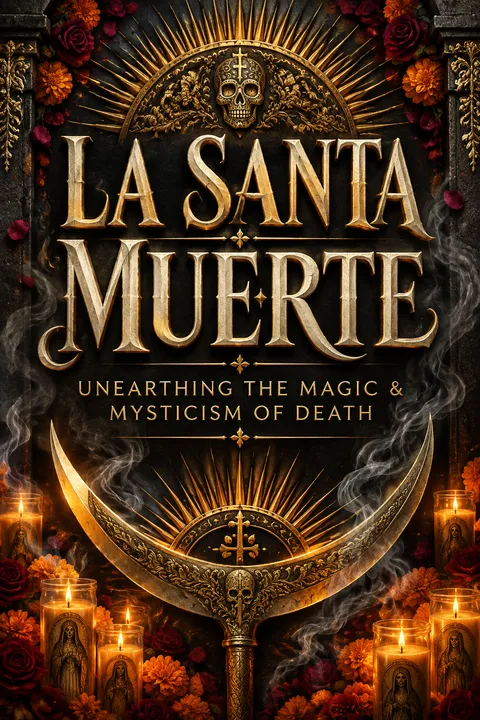


Key Takeaways
Let mortality make today feel rented, not guaranteed.
A dare becomes an education. Prower begins as a Catholic-raised death skeptic. A friend's dare takes him into a candlelit gathering around a towering skeleton, where a brief conversation with a devotee sparks his study of Santa Muerte. What first looks like devotion to something frightening becomes, for him, a way to face the fact that life ends instead of hiding from it.
Attention changes with time. The book treats death not as a manual for dying, but as a lens on living. Ancient burial practices and myths of journeys beyond death suggest that people have long understood endings as transitions. Prower's practical conclusion is to stop postponing meaningful work, affection, and experience on the assumption that there will always be another chance.
What's compelling is the shift from mortality as an abstract fact to mortality as a discipline of attention. Existential psychology similarly treats awareness of death as capable of clarifying priorities, though it can also provoke avoidance or rigid attachment to familiar beliefs. The book's invitation is most useful when it leads to specific acts of care and creation, not a demand to dwell on death constantly. Mortality can sharpen life without making every decision urgent or turning ordinary pleasure into a performance of profundity.
Choose a nonjudging ally with eyes open to her neutrality.
Refuge without a verdict. The book presents La Santa Muerte as a feminine personification of Death who comes to everyone regardless of wealth, status, identity, or moral record. That impartiality draws people who feel condemned or excluded elsewhere, including LGBTQ people, self-directed women, people with criminal records, and workers in dangerous or stigmatized jobs. The author describes her as a spiritual companion who can fit alongside, rather than replace, a devotee's prior religion.
Neutrality cuts both ways. In the book's theology, Santa Muerte does not screen petitions for the supplicant's greater good. The same force that comforts someone seeking protection may answer a request meant to harm another. This is why the author links devotion with self-discipline: being welcomed without judgment is not the same as being guaranteed wise outcomes.
The distinction between acceptance and moral approval matters well beyond religion. Social services, counseling, and community groups often work best when people can disclose stigmatized experiences without first defending their worth. Yet unconditional welcome needs boundaries when one person's relief could become another person's danger. The book makes that tension unusually explicit. Its account is a theological claim, not evidence that prayers reliably produce outcomes, but the social insight stands: nonjudgment can create belonging, while accountability remains necessary for living together.
Read Santa Muerte as a layered tradition, not a fixed creed.
A shared image, many roots. Prower traces the familiar skeletal figure to a blending of Spanish depictions of Death, called La Parca, with Mesoamerican traditions. He connects her to Mictecacíhuatl, an Aztec underworld goddess associated with the dead, and Coatlicue, a goddess of life, death, and rebirth. This account describes a cultural synthesis, not a single, fully documented chain of transmission.
History remains incomplete. The book cites eighteenth-century clergy records describing people addressing skeletal figures as Santa Muerte, while accounts of public devotion place its beginnings in Mexico City in the 1940s or Hidalgo in the 1960s. Doña Queta's public shrine in Mexico City's Tepito neighborhood, opened to view in 2001, became a prominent gathering place. Oral transmission, varied beliefs, poverty, and sensational news coverage all shape how the tradition is understood.
What's valuable here is the refusal to treat a living tradition as a sealed doctrine with one authorized origin story. Religious identities often develop through contact, translation, and adaptation, particularly under colonial pressure. The account also shows how media attention can turn a complex practice into a shorthand for violence. Its historical synthesis should be read as the author's interpretation, since oral histories and incomplete records cannot establish every link with certainty. That qualification strengthens, rather than erases, the story of a changing community.
Make devotion a relationship, not a costly performance.
A small altar is enough. The book describes the altar as the tradition's most common devotional space and spellwork station. Its form is personal and practical: a dedicated surface, a clean covering, and an image of Santa Muerte are the basic features. It need not be elaborate, expensive, or visible to the public. Other deities, the author says, should have separate altars.
Gifts express connection. Cigarettes, a modest pour of alcohol, and flowers are common offerings, but the devotee's sincere regard matters more than the object's price. Doña Queta's Tepito shrine illustrates how a private devotion can become communal: after displaying a statue outside her home, she welcomed visitors and helped establish regular gatherings. The book also notes that many devotees remain solitary, discreet practitioners; public ritual is an option, not a requirement.
The altar works as both symbol and setting: a repeated place can make private reflection easier to begin, much as a designated workspace supports attention. The emphasis on inexpensive, personal offerings also resists the idea that spiritual seriousness can be measured by spending. Community practice adds something different, namely shared recognition and mutual support. Still, private devotion and public belonging are not interchangeable, and secrecy may protect people from stigma while also limiting access to community. The book leaves room for either choice.
Use colors and objects to concentrate intention, not outsource it.
Symbols are working tools. The book calls Santa Muerte's color-coded forms her aspects, meaning versions associated with different kinds of magic. Black is linked to protection and hexes, white to purification and broad use, red to love and sex, gold to money, green to legal matters, blue to wisdom, and purple to healing and transformation. Candles, incense, plants, and minerals are selected through these associations and through their appearance, history, or practical qualities.
A tool focuses the practitioner. The author says objects help align conscious intention with the symbolic, less deliberate mind; they do not do the work alone. Blessing a candle, for example, means assigning it a clear purpose before lighting it. The book also recommends learning what plants and materials are safe and legal. Its correspondences are part of a magical worldview, not a scientific test showing that color or shape produces supernatural effects.
Ritual objects can change attention even for people who do not share the underlying metaphysics. Color, scent, and repeated actions can cue mood and memory, making an intention easier to hold in mind. The book's system gives those cues a coherent cultural vocabulary, which is more powerful than treating them as interchangeable decoration. A useful limit is to distinguish psychological effects from claims about external forces. The first can be explored through observation; the second remains a matter of faith within this account.
Give each spell a clear target, then do your half in daylight.
A spell has three parts. The book adopts a framework of altering consciousness, focusing will, and directing energy. In plain terms, enter a concentrated state, define what is wanted as precisely as possible, then use prayer, visualization, movement, or symbolic tools to give that intention force. Prower adds a fourth discipline: stop anxiously checking for results, since persistent doubt can undermine the focus the spell was meant to create.
Intention needs an obstacle map. Santa Muerte spellwork is framed as removing barriers to an outcome, including barriers created by the practitioner's own habits or assumptions. A love petition, for instance, may require working through old relationship patterns, not merely asking for a partner. The author also insists on ordinary follow-through: someone seeking a relationship should create chances to meet people. In this vocabulary, co-creational magic means the devotee and the deity act together.
This framework resembles goal-setting methods that pair mental rehearsal with specific behavior. Clarifying an outcome can expose hidden conflicts, and taking concrete steps increases the chance that an opportunity can be noticed or used. The advice to release obsessive monitoring is also psychologically astute: constant checking can heighten anxiety without improving the result. The framework does not establish that supernatural energy is being directed, however. Its practical value can be assessed separately by asking whether the ritual improves clarity, persistence, and action.
Never let a spell replace medicine, consent, or ordinary effort.
The examples have boundaries. The book offers spells for money, love, lust, healing, protection, and legal trouble, but repeatedly emphasizes specificity and practical participation. Its soulmate spell is not meant to compel a named person; it asks for a compatible partner and calls for the practitioner to make opportunities to meet one. Its debt spell is presented as a way to orient attention toward ways of paying, not as a promise that bills vanish.
Healing is supplementary. Prower explicitly says healing magic is not a substitute for modern medicine and describes it as support alongside medical care. The same practical logic applies elsewhere: a legal petition does not replace legal representation, and a protection visualization is not a substitute for avoiding danger when possible. The book's approach is strongest when spiritual practice supports, rather than displaces, informed real-world choices.
These limits are essential because ritual can offer comfort and a sense of agency precisely when people feel powerless. That support is most responsible when it complements competent medical, legal, or social help. The book's insistence on consent in love magic is also a meaningful distinction: an intention can shape one's own conduct without granting control over another person's feelings. Its weaker moments are claims that illness originates in thought or that spells reliably manifest. Those should not be allowed to become reasons for blame, delayed treatment, or false certainty.
Treat every petition as a consequential choice, not a harmless wish.
Power carries a price. The book pairs cosmic reciprocity, the idea that actions return consequences, with the Law of Equivalent Exchange, its belief that gaining something requires giving up energy of comparable value. It offers everyday changes, such as abandoning a harmful habit, as possible exchanges for health or love. These are spiritual principles within the tradition, not experimentally established laws.
Do not turn hurt into permission. Because Santa Muerte is described as neutral, the author warns that harmful requests may not be filtered out for the practitioner's protection. He refuses to provide instructions for hexing, arguing that revenge can consume attention and injure the person who carries it. A legal-release spell, by contrast, is presented as requiring sincere remorse and a plan to repair harm. Accountability, not a clever ritual, is the measure of ethical practice.
The exchange idea gives desire a useful ethical friction point: what obligations, habits, or costs accompany the outcome being requested? That question can interrupt impulsive magical thinking and encourage responsibility. It also resembles consequentialist reasoning, which evaluates choices partly by their effects on others. The limitation is that cosmic payback can imply a fairness the world does not reliably provide, while misfortune is not proof that someone deserves it. The book's strongest safeguard is therefore not metaphysical certainty, but its practical refusal to help convert anger into harm.
Analysis
This book is at once a memoir of spiritual conversion, a popular history of Santa Muerte, and a practical spell manual. Its central argument is not simply that death should be worshipped. It is that conscious mortality can make life more vivid, while devotion to a deity portrayed as impartial can offer belonging to people rejected by other institutions. The three strands reinforce one another: the author's personal encounter supplies narrative authority, historical syncretism gives the practice cultural depth, and spell instructions translate belief into action.
The most distinctive tension is between neutrality as liberation and neutrality as danger. A nonjudging spiritual figure can provide solace without demanding that the devotee first become socially respectable. Yet a power that does not filter requests also places responsibility on the practitioner. The book's cautions against hexing, its concern with exchange, and its insistence on practical follow-through are not incidental moral notes. They are the ethical structure needed to make its idea of spiritual power livable.
Readers should distinguish several kinds of claim. The social history is presented through records, oral accounts, and the author's interpretation of a tradition whose history is partly undocumented. The symbolism of colors and objects describes an internal magical language. Claims that spells cause external events, that disease follows thought, or that energies obey universal laws are matters of belief, not established medical or physical findings. That distinction need not make the book's practices useless. Ritual can focus attention, organize emotion, and prompt action even when supernatural causation remains unverified.
The adaptation's most reliable lesson is therefore practical and ethical: remember impermanence, make intentions specific, take real-world steps, and do not confuse welcome with permission to harm. Santa Muerte's appeal is inseparable from the people who seek her protection and the stigma surrounding them. A respectful reading keeps both the spiritual meaning and the material conditions in view, without reducing devotion either to a sensational crime story or to a universal metaphor detached from its Mexican and Latino context.
Glossary
Santa Muerte Mysteries
Death-centered spiritual pathThe author's name for the beliefs and practices surrounding devotion to La Santa Muerte. He describes it as a spiritual lens that can supplement a person's existing religion rather than replace it. It includes a philosophy of death, devotional relationships, symbolic tools, and spellwork, but has no single governing theology or universally accepted organization.
Co-creational magic
Practitioner-deity collaborationThe book's term for spellwork understood as a partnership between the devotee and La Santa Muerte. The practitioner clarifies an intention, works with prayer, meditation, or symbolic tools, and takes practical steps; Santa Muerte is believed to contribute spiritual assistance. The term contrasts with expecting a deity to produce an outcome without the practitioner's participation.
aspects
Color-coded magical domainsThe colors associated with forms of La Santa Muerte and particular kinds of spellwork. The book's common palette includes black for protection, white for purification and general use, red for love and sex, gold for money, green for legal matters, blue for wisdom, and purple for healing and transformation. The color is usually represented by the figure's cloak.
Synchronicity of Colors
Color-based correspondencesA magical principle described in the book: objects sharing a color are treated as having similar symbolic or energetic properties. Red, for example, is connected with sex through associations with blood, warmth, and desire. Practitioners use these perceived connections to choose spell materials and to focus attention. The principle belongs to the book's magical framework, rather than a demonstrated scientific law.
Doctrine of Signatures
Shape-based correspondencesA traditional magical and herbal idea that an object's shape or visible features suggest its uses or symbolic qualities. The book extends the idea beyond plants: a spiny plant may represent protection, while an object resembling a body part may be associated with that part. Such symbolic associations can guide spell choices, but resemblance alone does not establish medical effectiveness.
Sympathetic magic
Symbolic action with intended effectsA form of magic in which a practitioner uses resemblance, color, shape, or other perceived connections to represent an intended outcome. A symbolic object is treated as a way to communicate with spiritual forces through signs rather than literal language. In the book's account, the symbols also help focus the practitioner's conscious intention and subconscious associations.
Law of Correspondence
Patterns echo across levelsA Hermetic principle summarized in the book as correspondence between larger and smaller patterns, or between spiritual and physical realities. Santa Muerte practitioners use it to explain why objects that share colors, shapes, or associations may be treated as energetically connected. It functions as a premise within the magical worldview, not as a scientific law.
Three building blocks of a spell
Attention, intention, energyA framework the book attributes to Christopher Penczak: altering consciousness, focusing will, and directing energy. The practitioner first enters a concentrated state, then defines the desired outcome, and finally uses prayer, visualization, movement, or tools to express the intention. Prower adds letting go as a further discipline, warning that anxious doubt can disrupt focus.
cosmic reciprocity
Actions return consequencesThe book's broad spiritual principle that harmful or beneficial actions eventually produce corresponding consequences, often compared with karma. The timing and form of the return may vary. In the author's ethical framework, this idea discourages harm by suggesting that damaging another person also endangers the practitioner and those connected to them.
Law of Equivalent Exchange
Gain requires comparable sacrificeA principle in the book that receiving an outcome requires giving up something of comparable energetic value. The exchange is not necessarily financial or literal. The author offers changing harmful habits, helping others, or relinquishing a valued behavior as possible forms of payment. He presents this as a spiritual law used to guide choices, not an empirically verified mechanism.
Download PDF
Download EPUB
.epub digital book format is ideal for reading ebooks on phones, tablets, and e-readers.








