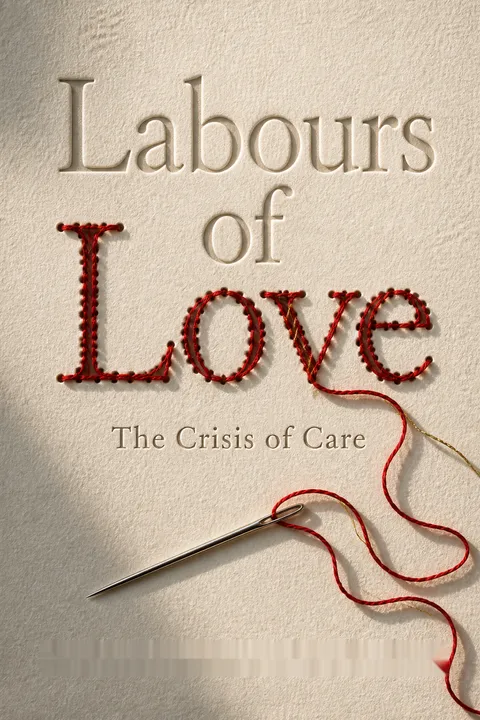


Key Takeaways
Treat care as social infrastructure, not a private act of virtue.
Care holds daily life together. From infancy to frailty, people rely on hands-on help, attention, trust, and knowledge. Yet this work is often treated as a private family matter or a natural talent, rather than something society must organize and fund. Bunting describes the crisis in two forms: care can be missing, or present in a degraded, hurried form. Both are growing as people live longer, long-term illness rises, and families become more geographically dispersed.
Need is growing faster. The number of people over eighty-five needing round-the-clock care was projected to double by 2035, while existing institutions and policies were not built for that scale. A closed care-home garden and children marched in restrictive groups become signs of a larger failure: services can exist yet still deny people dignity and room to flourish.
What's striking is the shift in scale: a kindness between two people is also part of the infrastructure that allows families, workplaces, and public services to function. That resembles social reproduction, the work of sustaining people and communities that conventional economic measures often overlook. The infrastructure metaphor also sharpens accountability: a broken care system is not simply a collection of individual disappointments. Still, naming care as infrastructure should not reduce it to another service-delivery target. Its distinctive value lies in relationships that cannot be fully specified in advance.
Fund skilled judgment, because care cannot be reduced to repeatable tasks.
Care is situational work. A Taylor-style management model divides work into measured tasks, then seeks the least costly way to complete them. Bunting argues that this can be dangerous in healthcare, where the same procedure may lead to different outcomes and staff must notice exceptions. Nurse and mathematician Alison Leary describes a chemotherapy line procedure that seemed routine until managers considered assigning it to less-qualified staff. A collapsed lung was a possible complication, one a trained nurse would know how to manage.
The task list misses the person. In a workload study, technical duties such as medication rounds took priority, while communication, explanation, and relationship-building were left undone. These are not decorative extras. They help patients understand what is happening and allow workers to detect needs that a checklist cannot anticipate.
This argument fits a broader distinction between standardization and judgment. Protocols can protect people from avoidable errors, but they work best as supports for skilled workers, not substitutes for them. The important question is not whether care should be measured, but whether measures capture the conditions that make good judgment possible, including adequate staffing and time to communicate. Bunting's critique is strongest when directed at false predictability, rather than at efficiency itself. In complex settings, efficiency that ignores exceptions often transfers costs to patients and workers.
Count unpaid care as work before asking families to absorb more.
Care has been hidden at home. For centuries, economic thought centered market activity and treated domestic labor as women's natural duty. Bunting traces how this division shaped expectations: women entered paid employment in rising numbers, but public provision and men's share of household work did not keep pace. The result is the double shift of paid work and care, often intensified for women caring for children and ageing parents at once.
The imbalance persists. In the UK figures cited in the book, women do about sixteen hours of housework a week, compared with six for men. Around 6.5 million adults provide care for older or disabled relatives, and many carers devote extraordinary hours to it. Bunting's point is not that care should remain a family duty, but that unpaid work must be recognized when governments and employers make decisions about services, jobs, and budgets.
The book's account makes a useful distinction between valuing care and assigning it to women. Care can be meaningful and still be unfairly distributed, poorly paid, or impossible to combine with employment. That distinction matters because praise for devotion can become a quiet substitute for resources. A policy that celebrates family solidarity while leaving families without respite or reliable services may deepen the very gender inequalities it claims to honor. Recognition must therefore change who provides care, who pays for it, and who has the freedom to refuse it.
Protect time for care, even when it produces no visible achievement.
Care runs on interruptions. Parenting taught Bunting that plans are routinely displaced by a child's needs, and that care follows a cyclical rhythm of feeding, cleaning, waiting, and starting again. That rhythm clashes with workplaces that reward speed, measurable output, and completed goals. A task such as walking to a shop with young children can expand into a slow series of pauses and discoveries, producing little that looks like conventional achievement.
Maintenance deserves recognition. Artist Mierle Laderman Ukeles developed Maintenance Art, a practice that treated cleaning, childcare, and other repetitive work as worthy of public attention. She also met and thanked 8,500 New York sanitation workers for keeping the city functioning. Her work reveals the labor beneath the polished surface of daily life: continuity depends on someone doing what must be done again tomorrow.
The contrast between clock time and care time helps explain why caring work is so easily misjudged. A timed output can be counted; calming a frightened person or staying available through a difficult transition may leave no visible product. Ukeles's artistic intervention makes that hidden labor legible without pretending it becomes glamorous. There is a necessary caution, however: celebrating maintenance should not sanctify endless, unequal responsibility. Repetition can sustain life, but those who perform it also need rest, choice, and a fair share of the work.
Make continuity and attentive listening part of healthcare's clinical equipment.
Listening is diagnostic work. In the general practice Bunting observes, doctors hear tangled accounts of symptoms, family pressures, and fear, then connect them with medical knowledge. The book cites an estimate that 85 percent of diagnostic evidence comes from what patients say. Yet a standard appointment may last only ten minutes, and rising workloads leave less time for the conversation that can reveal what is wrong.
Continuity improves judgment. One doctor estimates making roughly 300 significant decisions each day. Knowing patients and families over years helps make those decisions faster and more accurately; colleagues at the practice also review cases together. This knowledge is difficult to capture in a target or data field, but the book notes research associating discontinuity of care with more hospital admissions. Relationship is not a soft alternative to clinical expertise. It is one of the ways expertise works.
The general practitioner in this account functions partly as a longitudinal observer. Like a clinician tracking a changing condition, the doctor can interpret a new symptom against a history that a one-off appointment cannot supply. This makes continuity a form of information, not merely a pleasant experience. It also complicates simple appeals to patient choice and convenience: access to any available clinician matters, but so does a sustained relationship. The challenge is designing systems that protect both, rather than treating one as an obvious replacement for the other.
Do not demand emotional performance when good care requires boundaries.
Empathy is not the whole job. The word has shifted in meaning since it entered English in 1909. It can mean understanding another person's perspective, but that ability does not automatically motivate ethical action. A person may read someone else's feelings accurately without helping them. In care work, this distinction matters because competent action may be possible even when a worker does not feel affection for every person they serve.
Compassion needs conditions. On a hospital ward, nurse Sam keeps a calm, reassuring manner while caring for nine patients, chasing medication, and managing constant requests. The work involves emotional skill, but also a professional boundary that lets her leave the ward and recover. Bunting challenges policies that try to measure care through smiles or scripted warmth. Such performances cannot make up for workloads that leave staff without time to listen or respond.
This insight resonates with emotional labor, the effort of managing outward feeling as part of a job. Emotional skill can reassure a patient, but compulsory cheerfulness can turn a human relationship into a display assessed by supervisors. The distinction between sincere feeling and reliable care is also important: patients need competence, respect, and responsiveness, not proof that a worker personally likes them. Boundaries are not evidence of indifference. They help prevent care from depending on limitless self-sacrifice, an expectation that is both unsustainable and historically gendered.
Stop financing care by exploiting workers' vocation and families' endurance.
Cheap care shifts the cost. Bunting visits home-care services where workers may spend long days traveling between clients, with gaps unpaid and hours insecure. One worker describes fifteen-minute visits that left no time for conversation and sometimes not enough time to make a hot drink. The low price is not an efficiency miracle. It is paid for through workers' lost time, families' unpaid labor, and clients' unmet needs.
The workforce is unstable. The book reports that nearly half of care workers leave their jobs each year, while many roles offer low pay and zero-hours contracts. Local-authority cuts also pushed an estimated 1.4 million older people outside state provision. When providers cannot afford enough staff or time, continuity disappears, workers burn out, and patients can end up in hospital waiting for care at home.
A system that saves money by making labor invisible can appear efficient on a narrow balance sheet while generating costs elsewhere. Unpaid family hours, repeated recruitment, delayed hospital discharge, and preventable distress are real costs even when they sit in different budgets. This is a classic problem of fragmented accounting: institutions optimize their own line items while the burden moves to households and workers. Better funding is essential, but it should accompany stable contracts, training, and a say for care workers in how services are organized.
Defend each person's dignity beyond diagnosis, productivity, or independence.
Families become case managers. Parents of disabled children describe years spent seeking diagnoses, educational support, and respite. One mother says the application for disability benefits required her to document her child's worst days across more than fifty pages. The form turned intimate knowledge of her child into evidence of deficits, while appeals and professional assessments repeatedly exposed family life to scrutiny.
A person is more than a needs score. Bunting argues that care makes collective judgments about whose life is worth supporting. A disabled person who may always depend on others is not less valuable because they cannot earn a living or act independently. At the same time, care can become controlling. Disability-rights advocates rightly insist that support should protect rights and agency, not merely place someone under another person's authority.
This section brings dignity into contact with administrative design. Eligibility systems need rules to allocate limited resources fairly, but a form that asks families to narrate only incapacity can distort both the person and the relationship. The alternative is not to abandon assessment, but to pair it with the individual's own aims and the knowledge of those close to them. Dignity should not be confused with either independence or sentimental protection. It includes being supported without being reduced to a diagnosis, a burden, or a file.
Treat dying as shared human work, not a hospital failure.
The final journey is social. Bunting describes dying as unfamiliar territory for families and professionals alike. Modern medicine can extend life, but the prolonged decline of frail people often falls between systems designed for acute treatment and families with limited capacity. The book notes that the final year of life includes, on average, nearly three emergency hospital admissions, even though many people would prefer to die at home.
Presence still matters. A palliative-care nurse describes bearing witness: staying with a person in distress, offering practical comfort, and knowing when silence is better than advice. In Kerala, a community network trained 12,000 volunteers to support people who were dying at home. Its example suggests that death need not be left to professionals alone. Families, neighbors, and trained workers can share the work, provided they are supported rather than simply left to cope.
The account challenges the idea that a good death can be reduced to a preferred location or a clinical outcome. Home is not automatically safer or kinder if caregivers are isolated, and a hospice is not a failure if it allows a family to remain together. The more useful question is whether the dying person and those around them are held by a dependable network. That is a public-health question as much as a personal one. It asks communities to prepare for dying with the same seriousness given to birth and illness.
Build care networks where relationships matter as much as technology.
Practical alternatives exist. Bunting describes social pedagogy, a professional approach that develops care through relationships, creativity, and reflection. She also points to Schwartz Rounds, where health workers discuss the emotional demands of their work, and social prescribing, which connects patients with community activities such as gardening or choirs. These approaches make time for human connection part of the design, rather than relying on individual kindness to survive hostile systems.
Technology should support contact. Tools that assist diagnosis or handle routine administration can be valuable, but monitoring screens and robots cannot be treated as replacements for human companionship. The book also presents care as a gift economy: giving, receiving, and returning support across relationships and generations. Such reciprocity does not replace public funding. It shows why care has value beyond a price, and why communities need both dependable services and everyday networks of help.
The proposals combine institutional reform with community participation, a useful answer to the false choice between state services and private goodwill. Technology can remove repetitive burdens and improve access, but its gains depend on what happens to the time released. If savings simply reduce staffing, automation can deepen isolation. Community models also need boundaries: volunteer networks can enrich care, but should not become a rationale for withdrawing skilled, paid provision. A durable system treats relationships as essential and makes sure the people sustaining them are themselves supported.
Analysis
Labours of Love moves from intimate scenes to the design of public systems, showing how the same moral problem appears in a nursery, a GP consultation, a care home, and a deathbed. Its central claim is that care is neither a private feminine instinct nor a soft supplement to technical work. It is skilled labor and a relationship, and both depend on time, trust, continuity, and material support. The book is especially effective when it lets workers' accounts expose the distance between the language of person-centred service and the reality of timed visits, forms, and shortages.
Its strongest analytical move is to connect cultural invisibility with institutional incentives. When value is defined by measurable output, the work of noticing, explaining, reassuring, and preserving dignity becomes easy to ignore. Yet the answer cannot be simply to reject measurement or markets. Public systems need transparent allocation, and technologies can help with diagnosis or routine administration. The question is whether such tools expand human attention or displace it, and whether efficiency gains return to staff and recipients as more time and better support.
The feminist history is crucial, but it also requires care in its own framing. Linking care with a feminine ethic helps explain persistent undervaluation, yet it can inadvertently preserve the expectation that women will perform it. Bunting resists that implication by insisting that care is a social responsibility, not a female essence. That distinction should remain central: celebrating the meaning found in care must never excuse unpaid labor, low wages, or coercive dependence.
The book's vision is therefore political as well as personal. Care cannot be secured by exemplary individuals alone. It requires public investment, decent work, local relationships, and a culture that accepts dependence as part of ordinary human life. Its most durable lesson is that dignity is made in daily encounters, but whether those encounters are possible is a matter of collective choice.
Review Summary
Labours of Love receives high praise for its insightful exploration of the care sector in the UK. Readers appreciate Bunting's thorough research, compelling interviews, and thought-provoking analysis of the undervalued care industry. Many consider it essential reading, praising its ability to evoke emotions and challenge perspectives. Some find it academic and occasionally dry, but most agree it effectively highlights the crisis in care work and the need for societal change. The book is seen as timely and important, especially in light of recent events and demographic shifts.
People Also Read





Glossary
Invisible heart
Unpaid care behind marketsEconomist Nancy Folbre's term for the often unseen care work that sustains people and households alongside the market economy. Where market exchange is conventionally described through prices and self-interest, the invisible heart points to labor motivated by responsibility and relationships, especially work historically assigned to women. The metaphor exposes how economies depend on care while routinely failing to count or reward it.
Maintenance Art
Art that reveals upkeepArtist Mierle Laderman Ukeles's practice of treating cleaning, childcare, and other maintenance work as art and as cultural labor. Her projects moved routine work from behind the scenes into public view, including a year-long effort to meet New York sanitation workers and acknowledge their contribution. The term challenges the prestige given to novelty and achievement while ongoing upkeep remains overlooked.
Sorge
Care as engaged existenceMartin Heidegger's German term, usually translated as care, for a basic way human beings exist in the world. It refers not simply to an emotion or a task, but to being involved with people and surroundings, paying attention, and being vulnerable to change and loss. Bunting uses the idea to connect care with the human condition, including anxiety and responsibility.
logic of care
Ongoing collaborative adjustmentAnnemarie Mol's account of healthcare as a continuing process in which patients and professionals adjust knowledge, treatments, and routines to changing bodies and lives. It contrasts with a model that treats care mainly as a consumer's informed choice among fixed options. The logic of care accepts uncertainty and places emphasis on sustained cooperation and practical improvement over time.
social pedagogy
Relationship-based human developmentA professional approach, developed especially in parts of Europe, that supports human growth through relationships and community life across the lifespan. Social pedagogues may work with children, older people, or people with disabilities or mental illness. Training emphasizes personal development, creativity, patience, and reflection, joining practical knowledge with emotional and social understanding.
gift economy
Support that circulates through reciprocityA way of understanding value in which giving, receiving, and returning gifts create ongoing relationships rather than one-time market exchanges. Bunting applies the idea to care: help may be offered now and returned by another person, family, or generation later. Reciprocity does not mean a precise repayment, and it does not remove the need for fair wages or public services.
Ulysses syndrome
Homesickness among older migrantsA phrase used by a GP in Bunting's account for profound homesickness and displacement among some older migrants. People who left their original homes decades earlier may also find that their British-born children have moved away or grown distant from the culture they know. The term describes a social and emotional experience, not a formal medical diagnosis.
Download PDF
Download EPUB
.epub digital book format is ideal for reading ebooks on phones, tablets, and e-readers.








