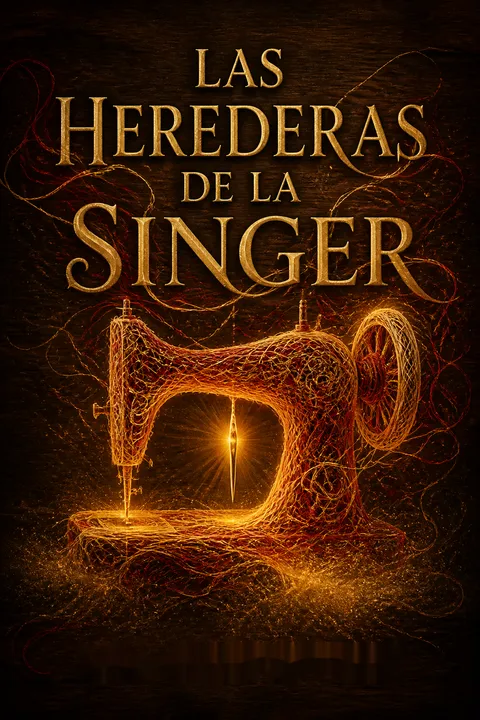


Plot Summary
The Singer in the Corner
In 2019, Ana remembers the Singer as part of the household long before she understands its history: her mother, Águeda, and great-grandmother Aurora sewing while the country absorbed Franco's death. Decades later, Ana lives in a vast Madrid house that belongs to her wealthy husband, Carlos, and feels as diminished there as the old machine in its corner.
Her daughter Alba once asked to borrow the Singer for an art project about women's liberation. Ana refused, weary of Aurora's complaints about seeing it on display, and put it away. The request brings the family heirloom back into view. Its dark stain, passed over as a blemish for generations, holds a story none of the younger women yet knows.
The machine enters as both an object and a measure of women's place in the family. It is stored, displayed, rejected, and inherited, much as each generation negotiates the roles available to it. Ana's comparison between herself and the Singer gives the opening its quiet unease: comfort and wealth have not made her feel free. Alba's request then turns a household disagreement into a question of what history has been hidden inside ordinary domestic life.
A Girl Sent Underground
Aurora grows up in Turón, Asturias, under the authority of Frutos, a miner who spends wages on drink and sex and abuses his daughter while her mother, Olvido, chooses silence. In 1938, a falling beam breaks Frutos's back and leaves the family without his pay.
Because there is no son to replace him, Aurora must shovel coal outside the mine. The work tears her hands and exhausts her, while the sight of women descending illegally into the tunnels makes clear how little protection their labor receives.
When the foreman, Ceferino, circles the women, Aurora sees a chance to escape the shovel. She secures a telephone operator's post through him, using the leverage her beauty gives her, though the bargain deepens her sense that men decide what her body is worth.
Aurora's first workplace choice is neither uncomplicated empowerment nor passive surrender. She reads the narrow options around her and acts strategically, but her strategy has been shaped by her father's abuse and by a labor system that treats women's survival as a private problem. The mine makes that coercion visible: men control the jobs, while women absorb the danger and the poverty. Aurora's sharpness is real, yet it cannot turn an unequal bargain into a free one.
Blood on the Singer
While Aurora and Olvido sew a wedding dress in 1940, two drunken soldiers from Franco's Moroccan troops force their way into the house and assault both women. Aurora obeys at first, trying to keep the violence from escalating, but when one soldier turns toward the stove to threaten Olvido, she grabs a poultry knife and cuts the other man's throat.
Olvido strikes the second attacker with a burning poker, and Aurora binds his hands and feet as he lies unconscious. The women embrace amid the bodies, then clean the kitchen and wrap the dead men in scraps from the sewing basket. Blood soaks into the Singer's wooden table. That stain becomes the only physical trace of a killing the women cannot safely report.
The attack turns sewing from an image of domestic confinement into the means by which Aurora and Olvido survive. The scraps meant to construct clothing become bindings for a body, while the machine absorbs evidence. Aurora's violence is not framed as a triumphant transformation: she acts under immediate threat, then understands that survival has created a new danger. The stain preserves what official history would erase, but it also makes memory material, impossible to scrub away.
A Priest Buried Below
Paulino, Aurora's intended husband, and Frutos return to find the women and the corpses. Paulino brings in his godfather, Father Pedro, a retired priest who has helped people escape political persecution. Pedro advises them to hide the bodies in the cellar and behave normally until they can move them without attracting notice.
Soon the Civil Guard arrests Frutos after a neighbor reports the soldiers entering the house. Aurora seeks help from Ceferino, who reveals that Frutos is being held over the disappearance.
To save her father and herself, Aurora tells Ceferino about the killings and names Pedro. Ceferino uses his influence to trade the priest's life for Frutos's release. Pedro is executed, Frutos returns badly beaten, and Paulino believes his own family betrayed the man who saved them.
The secret becomes a chain of unequal exchanges. Pedro's practical kindness places him in danger, while Aurora's attempt to protect her family transfers that danger to someone with less power to escape it. The choice is not morally clean, and the novel preserves its cost through Paulino's resentment and Aurora's silence. Under dictatorship, a private act of self-defense becomes political evidence, and survival depends on deciding whose life can be risked when the state controls the rules.
The Child Who Wasn't Held
Aurora marries Paulino and receives the used Singer as a wedding gift, but marriage does not free her from the sexual violence that has shaped her life. Their daughter Águeda is born in January 1941, conceived during Aurora's assault by the soldiers. Aurora recoils from the infant and leaves Olvido to care for her; when Olvido dies of cancer two weeks later, Aurora retreats into sewing while Águeda cries hungry in her cradle.
Paulino becomes the child’s tender parent, though his affection cannot soften Aurora's rejection. The girl grows up learning to be quiet and unnoticed. The machine gives Aurora work and income, but its steady rhythm also lets her shut out her daughter and the memories attached to the birth.
Aurora's refusal to bond with Águeda is a consequence of trauma, not a simple verdict on her character. The baby embodies an assault Aurora cannot yet name or bear to remember, so emotional distance becomes a crude form of self-protection. Paulino's care offers Águeda a counterexample to the household's inherited harshness, but it cannot undo neglect. The Singer's rhythm functions as both livelihood and dissociation, showing how useful labor can shelter a person while also keeping pain unprocessed.
A Lover's Useful Protection
After Ceferino rejects Aurora as an unsuitable wife, she marries Paulino and tries to build a life with him. Years later, she resumes the affair with Ceferino, who is now married to Pilar, an aristocratic woman with influence.
Aurora bears Ceferino's twin sons, Pedro and Paulino, while Paulino believes they are his. Pilar knows enough to keep Aurora close rather than expose her, arranging paid sewing work and training for the Falange's women's service.
When Franco visits the mining valley, Pilar makes Aurora appear as a regime-approved success story, although Aurora's own history contradicts the performance. The work brings money and clients, but the public display isolates her from neighbors and from Ramona, the blunt carbonera who has become her closest friend.
Aurora's rise is built through accommodation, not conversion. She accepts Pilar's work because it feeds her children, and the regime turns that necessity into propaganda about women's proper place. Her affair with Ceferino offers intimacy but reproduces the same imbalance that governs her employment. Ramona's withdrawal marks the social cost of Aurora's choices. The section asks whether agency can exist inside compromised arrangements, and answers without absolution: Aurora can choose, but never from a position untouched by power.
The Singer Becomes an Exit
Paulino's lung disease ends his mining work, and he dies after a long decline. Aurora struggles to support her three children through sewing; Frutos, increasingly violent and drunken, steals her savings and later turns up dead after Ramona confronts him.
Aurora suspects Ramona killed him, but neither woman confirms it. In 1976, demolition crews uncover the two soldiers' preserved bodies in the cellar of Aurora's childhood home. Fearing interrogation and the exposure of her family's secret, Aurora seeks help from the dying Ceferino.
He gives her money and a contact in Seville. She leaves for El Palmar de Troya, where she can pass as a devout outsider, and rebuilds her livelihood sewing robes for the religious group. The Singer travels with her, carrying the stain and the evidence she cannot leave behind.
The discovery of the bodies transforms a buried event into an immediate threat, even though decades have passed. Aurora responds as she always has, by making a practical route out: money, a new town, an occupation. Yet escape is not the same as release. The Singer accompanies her because the secret is not merely evidence; it is part of the self she has had to construct around fear. Ramona's possible act of protection echoes Aurora's own survival choices without making either woman morally simple.
Águeda Chooses Her Own House
Águeda grows up under Aurora's severe discipline and leaves school early to sew alongside her mother. Her closest companion is Florita, a friend who shares her card readings and dreams of a different life. At twenty-five, Águeda meets Jesús at a dance and marries him soon afterward.
In Oviedo, she struggles with class prejudice and her mining-valley accent, then uses sewing to help support the household. When Aurora arrives to help with the work, she brings clients and turns the family's small apartment into a busy atelier.
Águeda and Jesús raise their daughter Ana there. Jesús is gentle and dependable, though Águeda gradually realizes that his desire is directed toward men. She keeps the knowledge private and continues building a business that will give Ana choices she never had.
Águeda's idea of freedom differs from Aurora's. She wants stability, respectability, and education for her daughter, not escape through a lover or a sudden break with convention. Her sewing enterprise is both economic independence and a continuation of the labor that constrained her childhood. Her marriage with Jesús shows that affection can survive a mismatch in desire, but silence still organizes the relationship. Águeda repeatedly protects others by withholding difficult truths, even when that means postponing her own recognition.
Florita's Many Bargains
Florita marries Marcelo, a principled miner, and joins women supporting the 1962 mining strike. The police arrest them; officers beat Florita so severely that she loses her pregnancy, while Marcelo dies in prison.
Later, Florita follows a married man to Paris, where he keeps his wife in comfort and Florita in a servant's attic. She returns pregnant, and her son Roberto, born with a profound disability, lives only a little over two years. Florita then supports herself through paid relationships, eventually marrying Fermín, a retired Civil Guard officer who admits near death that he ordered and permitted torture.
She stays with him until his death. These choices are not a single fall or redemption. They are Florita's repeated attempts to find shelter after institutions and men have taken options from her.
Florita's subplot offers a parallel to the other women's survival strategies while resisting a simple moral ranking. Political violence takes her pregnancy; romantic fantasy takes her to Paris; paid intimacy gives her material security but exposes her to danger. Her marriage to Fermín makes love and complicity collide, since his tenderness cannot erase his role in repression. Florita's endurance is not presented as proof that suffering ennobles her. It is the labor of someone trying to keep living in circumstances she did not choose.
The Night Ana Disappears
As a teenager in Gijón, Ana falls for César, a handsome engineering student who later becomes paraplegic after a motorcycle crash. Their brief romance feeds her first ideas of love, but she leaves Asturias to study architecture in Madrid. At the exclusive Oh! Madrid nightclub, Ana accepts drinks from Nacho and his wealthy friends, loses her memory, and wakes in a men's bathroom with injuries that tell her she has been raped.
Carlos, who had noticed her vulnerability and refused the group's drugs, arranges a chauffeur-driven ride back to her residence. Ana does not report the assault. Carlos's protection becomes the beginning of their relationship, while the shame and silence of that night remain lodged in her life for decades.
Ana's experience exposes how privilege can rescue someone physically without giving her the language or social conditions needed to name what happened. Carlos's intervention is real, but it also becomes part of a romantic story that helps Ana bury the assault. Her silence is not evidence that the event was slight; it reflects the limited credibility and privacy available to a young woman in that setting. The novel later contrasts Ana's choice with Alba's public action without treating either response as the only valid one.
A Wedding Paid in Silence
Ana and Carlos move through courtship into a lavish marriage shaped by Carlos's wealthy family. When a broken contraceptive leaves Ana pregnant before the wedding, Paloma, her future mother-in-law, pressures her to terminate the pregnancy rather than disrupt the planned ceremony.
Ana agrees, then carries grief and guilt privately. Years later, she loses her first baby to a placental emergency, and a doctor's dismissive reassurance deepens her isolation. Carlos's work keeps him absent, while Paloma manages Ana's appearance and social role.
Ana's friend Beba succeeds in finance by navigating a workplace that punishes women for ambition and motherhood. Their contrasting lives expose the price of the protection Ana receives: comfort arrives with dependence, and her own professional identity quietly disappears.
The marriage appears to deliver the security Águeda hoped for her daughter, but it converts security into a system of managed choices. Paloma decides which version of Ana is socially acceptable, while Carlos's absence makes that management seem normal. Ana's abortion and later miscarriage are distinct losses, yet both are met with silence rather than shared mourning. Beba functions as a counterpoint, not because her career frees her from gendered power, but because it makes the costs of each woman's bargain visible.
Alba Refuses the Inheritance
Alba grows up loved but increasingly rejects the paths laid out for the women before her. She tells her family she is lesbian, studies fine arts instead of business, and eventually leaves home when Carlos threatens to stop funding her.
Her first major installation gathers symbols of patriarchy in Madrid's Retiro Park; Alba sets it alight without permission and receives criminal charges, though family lawyers keep her out of prison. At the same time, Aurora's dementia diagnosis leads her to request a move to a Madrid residence, where she can watch Alba's fierce independence.
Alba becomes the one relative who can draw Aurora into conversation. Their closeness begins with a bargain to take the old woman to see the Pope and grows into a rare alliance across generations.
Alba interprets family history politically, sometimes too neatly, but her art forces the older women to see their lives as more than private misfortune. Her coming out also tests whether the family's apparent tolerance can withstand public visibility. Aurora's interest in Alba is less a conversion than recognition: she sees a descendant willing to act where she once had to calculate. Their bond creates a channel through which buried history can travel without reducing either woman to a lesson for the other.
César Comes Back
After her father Jesús dies, Ana spends a summer in Gijón with Águeda and reconnects with César, now a successful engineer, wheelchair athlete, father, and divorcee. Their attraction returns quickly, and Ana spends a night with him, breaking the rules of her comfortable marriage to Carlos.
When her old friend Cova tells her that César was married to their mutual friend Ángela, Ana panics and cuts off contact rather than face the complicated truth of the past. In Madrid, Águeda notices Ana's extreme dieting and injured knuckles, helps her reach a psychologist, and moves closer to support her. Ana begins therapy but still struggles to understand how much of her life has been chosen for her and how much she has accepted to avoid conflict.
Ana's reunion with César briefly unsettles the identity she has built around being the grateful, dependable wife. Her retreat is not simply a rejection of him; it is a return to the familiar protection of avoidance. Águeda's attention to the signs of bulimia shows a different kind of care from the silence she inherited from Aurora. Even so, care cannot immediately restore agency. Ana must first recognize the small routines through which dependence has become a life.
The Marriage Behind the Door
Ana's marriage deteriorates as she raises the children largely alone and tries to meet Paloma's standards. Beba's own life also shifts: after repeated fertility treatments and a marriage of convenience to a younger immigrant, she divorces and keeps building her career.
In 2014, Ana overhears Carlos and Paloma discussing a possible divorce but avoids asking him directly. Five years later, after Águeda dies of lung cancer, Carlos finally tells Ana he wants to separate and will provide for her.
Beba then admits she and Carlos have been in love since their youth and that he had considered leaving Ana years earlier. Ana calls Beba a betrayer and throws a drink in her face. The truth breaks the last illusion that her marriage was simply unhappy by accident.
The revelation does not reduce Ana's life to a contest between two women. Beba's history with Carlos predates Ana, but the secrecy has allowed the people with power to manage the truth while Ana remains dependent on them. Carlos's offer of financial security repeats the marriage's central bargain even as he ends it. Ana's anger at Beba is partly displaced grief, but it is also a first refusal to behave graciously for the comfort of the family.
Aurora Names the Violence
In 2020, Aurora returns to Asturias with Ana and Alba, visits the vanished site of her parents' house, and seeks Manuel Menéndez Miranda, a journalist whose father once investigated the soldiers' deaths. She agrees to tell her story only after Alba arranges legal safeguards. Over several days, Aurora describes the assault, the killings, the bodies, the priest's fate, and the life she built around the Singer.
Ana learns that Águeda was conceived in the attack, not by Ceferino, whose money later helped the family. Aurora's account also explains her lifelong fear of Moroccan soldiers and the Civil Guard. For the first time, her descendants can connect the stain on the machine to the trauma that shaped their family.
Aurora's decision to testify changes a private survival tactic into an act of authorship. She does not offer a clean confession or ask the family to approve every compromise; she supplies the missing causal history. Alba's legal conditions recognize that testimony can be exploited, especially when family wealth and public reputation are involved. Ana's shock also reveals how silence has worked across generations: it protected the living from immediate danger, then left descendants to misread its consequences.
The Night Alba Is Attacked
After an evening out with Aurora and Ana at a lesbian bar in Gijón, Alba walks home with Deva, a teacher she has just met. Six young neo-Nazis chase them, beat Alba, and force both women into a van. The men sexually assault them, injuring Alba, then abandon them in a field. Deva refuses to go to hospital or report the attack, afraid her family and school community will learn she is lesbian.
Alba reaches the hospital, gives evidence, and refuses Ana's suggestion that she protect the family's reputation by staying quiet. Aurora waits outside to see her. The following morning, after helping Alba to bed, Ana discovers Aurora has died. The family loses its oldest witness just as the youngest woman begins her own public fight.
The attack makes the book's generational comparison brutally concrete without equating different historical conditions. Alba has a supportive father, medical care, and access to a lawyer, yet she still faces the same demand that victims manage other people's comfort. Deva's refusal to report is rooted in real social risks, not lack of courage. Aurora's death immediately afterward removes the person who could have recognized the violence across time, leaving Ana and Alba to carry that recognition themselves.
A Case Becomes a Foundation
Alba identifies the attackers and testifies at trial, while refusing to expose Deva's identity. The court convicts two men, including the leader who injured her, and sentences them to prison; others are acquitted.
Deva is later identified online by women from the bar, harassed, rejected by her family, and driven to a suicide attempt. Alba urges her to leave Asturias and offers her work with La Alborada, the foundation she has established for survivors of sexual violence.
Ana, meanwhile, writes down the rape she endured in Madrid and sends the account to Alba instead of deleting it. Her daughter accepts her without judgment. Ana joins the foundation, and Deva eventually comes to Madrid and agrees to help. Their work gives the women's testimony practical form.
The court outcome is neither total justice nor narrative closure. Some perpetrators are imprisoned, others escape conviction, and Deva pays a steep price for a choice she had made to protect herself. La Alborada responds to that gap by offering support that does not require every survivor to prosecute. Ana's disclosure matters because she stops treating silence as the price of keeping her marriage and social standing intact. The foundation turns testimony into care, legal guidance, and collective capacity.
The Life Ana Did Not Live
After reading Aurora's published story, Ana tries to find César, hoping to act differently than she did when she first reconnected with him. A neighbor tells her that César died of a heart attack about a year earlier and had remarried. The news closes a door Ana had left ajar, but it does not send her back to passivity.
She accepts responsibility for La Alborada's renovation and leadership, while Alba turns toward work in Carlos's company, intent on changing it from within. Ana also agrees to present Aurora's book, despite fearing what the family will think. The Singer's story no longer belongs only to the dead or to the woman who remembers it. Ana begins choosing work, truth, and a future of her own.
Ana's late search for César is an attempt to practice the psychologist's advice to act, not a promise that romance will repair her life. His death denies the fantasy of returning to a missed first love, so Ana must build meaning without that rescue. Taking charge of the foundation and participating in Aurora's publication are modest but consequential acts of self-definition. The family legacy shifts from inherited silence to chosen responsibility, without pretending that the past can be undone.
Epilogue
At the first anniversary celebration of La Alborada in 2022, Ana and Alba look up at the old Singer suspended inside a transparent cube above the foundation's entrance. Alba designed the installation; Ana helped make it real. The machine that once carried a secret now hangs in public, no longer confined to a household corner or a single woman's memory.
Alba tells Ana she intends to join Carlos's company and work toward leadership, while Ana takes charge of the foundation's expansion. The four generations have not arrived at one shared answer to freedom. They have, instead, made room for each woman to act in her own way.
The Singer's final transformation does not erase its history or cleanse the violence attached to it. Suspending it above a survivor-support center makes the machine visible while changing its function: it is no longer merely a tool of paid labor or a private container of evidence. Ana's role in designing the foundation and Alba's decision to enter business show two different forms of agency, neither of which requires rejecting the other. The ending makes inheritance active. The women preserve the past not by keeping it untouched, but by deciding what it can support next.
Analysis
Las herederas de la Singer tracks how women inherit not only possessions but strategies for surviving systems that offer them unequal choices. Aurora uses beauty, sexual bargaining, sewing, and flight to keep herself and her children alive; Águeda tries to make security through marriage and business; Ana accepts wealth as protection and gradually recognizes its cost; Alba converts inherited stories into art and institutional work. None of these strategies is presented as pure liberation. Each solves one problem while creating another.
The Singer concentrates this argument. It earns wages, occupies domestic space, bears the mark of violence, and passes between women whose relationships to sewing differ. Its stain is both evidence and burden: concealed because disclosure could bring punishment, preserved because no one can fully remove it. The family learns the truth not through official justice but through Aurora's late decision to narrate it.
The novel also distinguishes silence from consent. Aurora, Águeda, Ana, and Deva each withhold information for different reasons: fear of state violence, learned obedience, social shame, or the need to preserve privacy. The story does not rank their responses by bravery. Alba's public testimony becomes possible partly because she has resources and support that earlier women lacked, while Deva's refusal to report reminds the reader that public disclosure can carry its own danger.
By the end, inherited trauma has not vanished, and the legal system delivers only partial accountability. What changes is the family's use of memory. Ana stops treating her own assault as a private failure, and the women build La Alborada to offer practical help without making prosecution the condition of care. The book's strongest claim is therefore not that storytelling heals everything, but that truthful stories can change who has to face pain alone.
Review Summary
Las herederas de la Singer tells the story of four generations of women—Aurora, Águeda, Ana, and Alba—connected by a Singer sewing machine that holds a family secret. Readers praised the non-linear narrative structure with temporal jumps, though some found it initially confusing. Aurora emerges as the strongest, most compelling character. The novel effectively portrays women's struggles across Spanish history from the Civil War to present day, set primarily in Asturias and Madrid. While most reviewers appreciated the well-developed characters and historical detail, a few felt overwhelmed by the narrative style or found certain sections slow-paced.
People Also Read
Characters
Aurora
The determined seamstressAurora is a beautiful, sharp-minded woman raised in Asturias's mining country, where poverty and male authority shape her earliest choices. She uses what leverage she has to find work, protect her family, and build a living through sewing. Her wit can be cutting, and her self-protection often appears as hardness, especially toward her daughter Águeda. The Singer is her constant companion: a source of income, a hiding place for memory, and a link between generations. Aurora distrusts easy moral judgments because she knows that women often make choices under threat, hunger, or dependence. Her strongest attachment is to people who meet her without trying to own or correct her.
Águeda
The dutiful builderÁgueda is Aurora's daughter, raised to work quietly and avoid provoking her mother's anger. She is observant, reserved, and drawn to the reassurance of cards and familiar routines. Sewing is never her dream, yet she turns it into a business that can give her daughter Ana an education and a more secure life. Her marriage to Jesús is grounded in care and companionship, even as she encounters truths about his private desires that she does not know how to discuss. Águeda's deepest motive is to spare the next generation the humiliations she endured. Her loving intentions can become controlling, because she often mistakes protection and respectability for freedom.
Ana
The sheltered daughterAna is Águeda's only daughter and Alba's mother. Beautiful and accommodating, she is raised to believe that a wealthy marriage will protect her from the insecurity her forebears knew. She is neither foolish nor simply passive; she is skilled at reading social expectations and adapting to them, but often treats compliance as the price of belonging. Her education and architectural training remain unused as she becomes a wife and mother in Carlos's world. Ana's humor and self-awareness surface even when she is uncomfortable, and she gradually begins to question the life she has accepted. Her relationship with her mother and daughter reveals how affection can coexist with silence, dependence, and misunderstanding.
Alba
The outspoken artistAlba is Ana's daughter, a confident artist who rejects the expectation that she should inherit her father's business simply because she is a Fresno. She is lesbian, politically engaged, and impatient with the quiet assumptions that shape women's lives. Her directness can unsettle her family, especially Ana, whose caution Alba interprets as acquiescence. Beneath her certainty, Alba is emotionally perceptive and capable of loyalty; her bond with Aurora develops because she listens to the old woman's stories rather than reducing her to a symbol. Alba wants to make private histories useful to others, and art, activism, and organizing give her ways to act on that desire.
Florita
Águeda's steadfast friendFlorita is Águeda's childhood friend, a lively and affectionate woman whose beauty draws attention but does not guarantee safety. She dreams of romance and a life beyond the mining valley, and repeatedly takes risks in pursuit of both. Her warmth makes her a source of courage for Águeda, while her willingness to endure hardship often hides how much she has lost. Florita's life brings together labor activism, intimate relationships, survival work, and the need for companionship. She is not defined by one choice or one injury. Her most lasting strength lies in the friendships she maintains and the ability to keep imagining a future after disappointment.
Ramona
The fierce carboneraRamona is a miner and Aurora's closest friend, a physically powerful woman whom her community describes through insults about her appearance and temper. She is blunt, protective, and deeply suspicious of authority, but her toughness is not cruelty. She intervenes when women are threatened and understands the cost of choices made under poverty better than most. Ramona's friendship with Aurora rests on practical loyalty rather than constant confession; they can share cigarettes and silence without demanding explanations. Her independent life challenges the assumption that women must measure success through marriage. She gives Aurora a rare kind of companionship, one built on recognition instead of rescue.
Olvido
Aurora's silenced motherOlvido is Aurora's mother and Frutos's wife. She loves her daughter but has learned to survive by obeying the rules imposed on women in her household. When Aurora tries to reveal her father's abuse, Olvido silences her rather than confronting the man who controls the family's income and authority. Her choice wounds Aurora, yet it also reflects the narrow and dangerous options Olvido believes are available. She finds tenderness in caring for the infant Águeda, offering the child a brief refuge from Aurora's distance.
Frutos
The violent mineworkerFrutos is Aurora's father, a miner whose sense of entitlement governs his home as much as his workplace. He spends money on drink and sex, expects his wife and daughter to serve him, and uses his authority to conceal his own abuse. His injury exposes the family's dependence on a wage earner, but does not make him more compassionate. Frutos can feel fear and shame, especially when state violence turns against him, yet he rarely accepts responsibility for the harm he causes.
Paulino Muñiz
Águeda's gentle fatherPaulino is a disabled miner who becomes Aurora's husband and Águeda's father. He is patient, conscientious, and unusually attentive to his daughter, offering her comfort in a household where affection is scarce. His physical pain and pride keep him working long after his health has deteriorated. Paulino's decency does not make him immune to the patriarchal assumptions around him, but his care gives Águeda a model of kindness she carries into adulthood.
Ceferino
The influential foremanCeferino, called Ferino, is a mine foreman whose authority gives him access to jobs, political favors, and social protection. Aurora loves him, but their relationship is shaped by age, class, sexual bargaining, and his existing family obligations. He can be tender and helpful without offering equality or the commitment Aurora wants. His influence later touches the lives of Aurora's children, making him part of the family's history even when he is absent.
Pilar
The strategic patronPilar is Ceferino's aristocratic wife, a politically connected woman who understands how patronage can protect and control at once. She gives Aurora access to paid sewing work and uses her skill to support the image of the regime's approved woman. Pilar's generosity toward Aurora is practical rather than sentimental, shaped by her own interests and her desire to manage her husband's past. She is capable of recognizing a woman's vulnerability while still exercising power over her.
Herminia
The card-reading protectorHerminia is Florita's grandmother, a Galician woman who reads cards and offers practical care to children and adults around her. She gives Águeda a glimpse of a life beyond her mother's house and becomes an important source of comfort when Florita faces hardship. Her readings do not reliably predict events, but they give frightened people a way to speak about hopes they cannot otherwise name.
Jesús Muñiz
The courteous husbandJesús is Águeda's husband and Ana's father, a kind department-store worker who values order, gentleness, and family loyalty. He supports Águeda's sewing business and treats her with respect, though he keeps his attraction to men private in a society that punishes open homosexuality. His decency is genuine, but his secrecy also leaves Águeda without a full account of their marriage. He is a quiet counterweight to the more domineering men in the family.
Carlos Fresno
Ana's wealthy husbandCarlos is a successful businessman who first helps Ana when she is stranded and distressed in Madrid. He is decisive, protective, and comfortable using wealth and connections to solve practical problems. Those same instincts can leave little room for Ana to make decisions herself, even when he believes he is helping. Carlos cares about his children and retains a complicated connection to Beba, while his marriage to Ana gradually becomes a polished public arrangement rather than an intimate partnership. He is neither a simple villain nor a fairy-tale rescuer; his strengths and blind spots grow from the same confidence.
Beba
The formidable financierBeba is Ana's friend, a brilliant financier who earns her place in a male-dominated industry through relentless work and strategic relationships. She is candid about the compromises women make to gain access to power, though her own choices can appear cold to someone protected from the same pressures. Beba wants both professional authority and personal intimacy, but she refuses to pretend that either comes without cost. Her loyalty to Ana is real, even when their different needs and histories pull them into conflict.
César
Ana's first loveCésar is the handsome engineering student Ana idealizes during a summer in Gijón. After a motorcycle crash leaves him using a wheelchair, he rebuilds his life through engineering work and adaptive sport. His confidence and warmth challenge Ana's assumptions about disability, though she struggles to separate him from her adolescent fantasies. César represents a path Ana might have taken, but he is a full person with a life beyond her memories.
Deva
The guarded survivorDeva is a mathematics teacher Alba meets in Gijón. She is lesbian, professionally accomplished, and careful about who knows her private life because she understands the risks of public exposure. After a traumatic assault, Deva makes choices that differ from Alba's, prioritizing privacy and the work she has built. Her experience forces Alba and the foundation to confront the fact that solidarity cannot mean demanding that every survivor respond in the same way.
Nacho
The predatory socialiteNacho belongs to the wealthy social circle surrounding Carlos and Beba. He uses charm, drugs, and access to exclusive settings to exploit young women, while his friends and associates help keep consequences at bay. His influence reaches Ana's life far beyond the night of the assault, because the people around him treat his conduct as an inconvenient secret rather than a crime.
Father Pedro
The rescuing priestFather Pedro is Paulino's godfather, a retired priest who has helped people escape political persecution. He responds to the family's crisis with calm practical judgment and asks for no reward. His willingness to aid people across political lines makes him a rare figure of moral courage in the mining valley.
Marisa
The Palmar friendMarisa is Ceferino's daughter-in-law and a businesswoman in Seville who gives Aurora shelter when she flees Asturias. She treats Aurora as a friend and helps her establish a new livelihood, while her own marriage carries disappointments she rarely voices. Her kindness is sincere, but trust becomes difficult when the boundaries of friendship and desire are crossed.
Fermín
Florita's retired officerFermín is a retired Civil Guard officer who becomes Florita's husband late in life. He is courteous and attentive, offering her companionship after years of instability. His professional past complicates the comfort he provides, making their relationship an uneasy meeting of intimacy and political memory.
Paloma Sánchez San Francisco
The controlling matriarchPaloma is Carlos's mother and Ana's formidable mother-in-law. She values elegance, wealth, and social control, and treats women's appearance as part of the family's public standing. Her influence helps Ana enter a protected world but also narrows the choices Ana is permitted to make. Paloma's judgment is often severe, though she has her own history of ambition, compromise, and grief.
Manuel Menéndez Miranda
The patient journalistManuel is a journalist who inherits his father's unfinished investigation into the two soldiers found in Turón. He approaches Aurora with persistence, but ultimately gives her time to tell the history in her own order. His role is less to solve the mystery than to provide a listener and a record.
Plot Devices
The Singer sewing machine
A witness passed downAurora receives the secondhand Singer as a wedding gift and uses it to earn money across decades. Its table bears a stain left during the 1940 attack, and the machine remains in the family as a practical object, a contested heirloom, and a physical clue to the past. Ana hides it, Alba wants it for an exhibition, and Aurora's memories eventually explain why she cannot bear to see it treated as ordinary decoration. Its final display at La Alborada changes the Singer from a private witness into a public emblem of testimony.
The Spanish playing cards
Hope made tangibleHerminia introduces Águeda to card readings, and Águeda later uses the cards to imagine possible futures when she feels trapped by her mother's plans or anxious about family decisions. The readings never function as reliable prophecy. Instead, they give the women a ritual for voicing hopes and fears when direct speech feels dangerous or improper. The cards offer comfort, but they can also encourage a person to interpret uncertainty in the direction she already wants.
The buried soldiers
A secret with consequencesThe soldiers' bodies are hidden in the cellar after Aurora and Olvido defend themselves during an attack. Their burial protects the women from immediate retaliation but implicates the family in a political crime, costs Father Pedro his life, and shadows Aurora for decades. When construction uncovers the bodies, the past becomes a renewed threat and sends Aurora into hiding. The secret connects the Singer's stain, Águeda's origins, and the family's silence.
The intergenerational frame
Memory changes the presentThe novel moves among Aurora, Águeda, Ana, and Alba, often interrupting one generation's account with another's memories. These shifts show how the women inherit consequences without inheriting explanations. Ana begins with only fragments, including the Singer and family stories; Alba's curiosity draws Aurora into fuller testimony. The frame makes the family history cumulative: a later generation's questions alter what an earlier generation is able to say.
Aurora's testimony
Silence becomes evidenceThe journalist's investigation gives Aurora a reason to recount her life, but the decisive act is her choice to speak on her own terms. Her account links private sexual violence to poverty, political repression, work, and family decisions. Alba witnesses the telling and helps negotiate its conditions; Ana must then reconsider the stories she has accepted about her mother and herself. The testimony turns memory into a record without pretending that narration repairs what happened.
Download PDF
Download EPUB
.epub digital book format is ideal for reading ebooks on phones, tablets, and e-readers.








