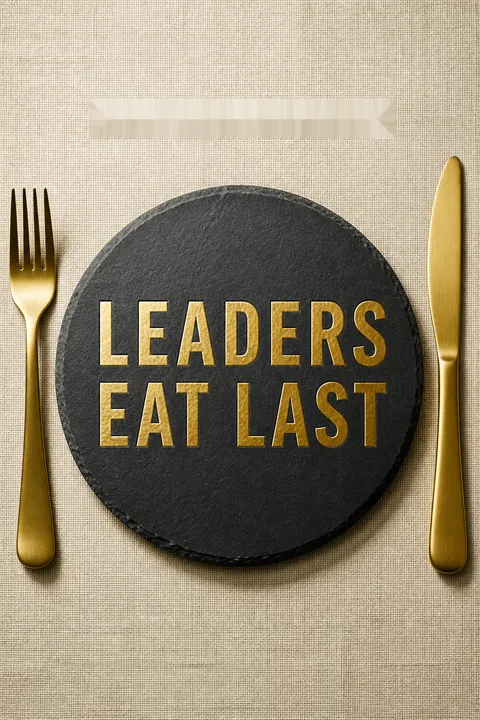


Key Takeaways
Protect people first, and they will protect the mission.
Leadership means going first. In 2002, A-10 pilot Mike Drowley descended through storm clouds into a dark Afghan valley to support 22 American troops under fire. He could not see them, but empathy made their danger feel immediate. He and his wingman kept returning until the team was safe. Sinek uses the story to define leadership as accepting risk on behalf of others, not merely directing their work.
Care creates commitment. The troops later embraced Drowley like an old friend, though they had never met. In a healthy organization, people do difficult work not only for recognition from above, but because they trust their colleagues and leaders to protect them in return.
The story makes care concrete: it is not a warm attitude, but a willingness to accept costs when others are exposed. That reciprocity helps explain why people can commit intensely without a bonus or public praise. Still, personal courage cannot substitute for sound systems. Organizations need leaders who protect people through everyday decisions, not only dramatic acts of rescue.
Show trust in the rules of work, not just in speeches.
Trust becomes visible in practice. When Bob Chapman took over HayssenSandiacre, factory workers described a workplace where bells controlled breaks, time clocks tracked their movements, and access to spare parts required permission. They felt less trusted than office staff. Chapman removed the clocks and bells, opened the locked parts cage, and made phones available without asking permission.
Small changes altered behavior. Workers began helping one another, sharing paid leave with a colleague facing a family crisis, and taking better care of equipment. Theft remained rare after the barriers came down. The company’s revenue rose from $55 million to $95 million, though the book notes that acquisitions contributed to that growth. Chapman’s lesson: trust is not a prize people earn after proving themselves. It is a condition leaders can choose to create.
The power of this example lies in the way routine procedures communicate a theory of human nature. A locked cage says, in effect, that workers are risks to be contained. Removing it invites responsibility. Trust does not mean abandoning safeguards or accountability; it means matching oversight to actual risks rather than using suspicion as the default. A workplace can test that distinction in its everyday rules.
Make coworkers feel safe enough to face outside threats together.
Safety redirects attention. Sinek calls a workplace-wide sense of protection a Circle of Safety. Inside it, people spend less energy guarding against humiliation, office politics, or arbitrary punishment, and more energy solving problems together. Marine recruits learn to replace individual self-protection with responsibility for fellow Marines. The image echoes Aesop’s oxen: united, they repel a lion; divided, each becomes vulnerable.
Control matters more than rank. The book cites the Whitehall Studies, which found that workers lower in the hierarchy faced greater health risks, linked not simply to job demands but to limited control and a poor balance between effort and reward. A supportive workplace does not remove standards. It gives people the agency and security to meet them without constant fear.
The Circle of Safety is useful because it treats collaboration as an outcome of conditions, not a command leaders can issue. A team cannot be ordered to share bad news if doing so invites punishment. Safety, however, should not be confused with comfort or immunity from consequences. Clear expectations and candid correction can coexist with protection, provided mistakes are treated as information rather than automatic grounds for blame.
Balance goal chasing with the relationships that make achievement matter.
Motivation has different rewards. Sinek groups four chemicals under the label E.D.S.O.: endorphins and dopamine support individual effort and progress, while serotonin and oxytocin support pride, trust, and social bonds. Endorphins help people persist through discomfort; dopamine rewards progress toward a clear goal. These incentives helped humans find food and finish difficult tasks, but they can also make short-term rewards compelling enough to become addictive.
Achievement is not belonging. A measurable target can focus a team, but a culture driven only by targets risks rewarding isolated wins over cooperation. Recognition from a trusted group can make accomplishment feel meaningful, while acts of generosity strengthen relationships. The book argues for balance: clear goals provide direction, but durable commitment depends on people feeling respected and connected.
The chemical model is memorable because it distinguishes the quick satisfaction of completion from the steadier rewards of affiliation. As a leadership tool, it encourages a useful question: what behavior does the incentive system actually reinforce? Its limit is that human motivation cannot be cleanly assigned to four chemicals. The model works best as a map of competing incentives, not as a complete biological explanation.
Treat leadership perks as a debt owed to the people.
Status carries an obligation. Leaders often receive higher pay, greater influence, or other privileges. Sinek argues that people accept such advantages when leaders use their position to protect the group. In the Marines, junior members are served before senior officers. The practice signals that authority is responsibility, not permission to put oneself first. A former official’s story about receiving a plain paper cup after leaving office makes the point: the privileges belonged to the role, not the person.
Protection earns loyalty. During the 2008 downturn, Barry-Wehmiller avoided layoffs by asking everyone, including senior leaders, to take four unpaid weeks off. Employees traded furlough time to help colleagues who could least afford the lost pay. The policy shared hardship rather than pushing it down the hierarchy, and workers responded by helping the company weather the crisis.
This view clarifies why unequal rewards can feel legitimate in one organization and offensive in another. The issue is not only how much leaders receive, but whether their conduct fulfills the obligation attached to their status. Shared sacrifice also makes decisions easier to trust. It must be designed fairly, though: a policy that asks the least secure workers to carry most of the burden would undermine the very protection it claims to provide.
Train people to exercise judgment, then give them real authority.
Information lives near the work. Navy captain David Marquet arrived to command the USS Santa Fe, a submarine whose equipment differed from the one he had studied. During a drill, he ordered a setting the submarine did not have. An officer knew this but repeated the order because obedience was the norm. Marquet realized that a leader at the top could have authority without the information needed to use it well.
Replace permission with ownership. Marquet shifted crew language from asking permission to stating an intended action. The command structure remained, but sailors were expected to think, understand the mission, and take responsibility. The book reports that reenlistment rose from three sailors the previous year to 33, and nine of 14 officers later commanded ships. Delegation worked because training and trust accompanied it.
Marquet’s experience exposes a familiar organizational mismatch: decision-makers may have formal authority while frontline staff hold the most current knowledge. Giving authority to the informed can improve both speed and error detection. Yet delegation is not simply telling people to take initiative. It requires competence, access to context, and permission to raise concerns. Without those supports, empowerment becomes responsibility without power.
Make distant consequences visible before people become spreadsheet entries.
Distance weakens moral attention. In Stanley Milgram’s obedience experiments, volunteers were led to believe they were giving increasingly severe electric shocks to another person. When they could neither see nor hear the person, 65 percent continued to the experiment’s final setting. Sinek connects this loss of immediacy to large organizations, where decisions about workers or customers can appear as numbers rather than human lives.
Visibility can motivate good work, too. Management professor Adam Grant arranged for scholarship recipients to meet university fundraisers and explain how the aid affected them. The book reports a sharp rise in the fundraisers’ weekly revenue afterward. Seeing the people behind the work made its purpose tangible. Leaders can bring consequences closer by connecting teams directly with the people affected by their choices.
Abstraction is not inherently harmful: large organizations need data to allocate resources and identify patterns. The danger appears when metrics become a substitute for judgment, allowing decision-makers to ignore what the figures represent. Personal stories can restore context, but a few vivid cases should not outweigh broader evidence. Strong decisions combine human contact with reliable data, rather than asking either one to do the other’s job.
Culture is what leaders reward when pressure tests their values.
Behavior follows the climate. Sinek contrasts Goldman Sachs’ earlier partnership culture, described as emphasizing client trust and long-term relationships, with a later environment more focused on aggressive individual performance. He also recounts the Taj Mahal Palace Hotel attack in Mumbai, where hotel staff risked their lives to help guests. The book attributes such conduct not to exceptional heroism alone, but to a culture that valued guest welfare and encouraged employees to act on that priority.
Sharing makes good work possible. At 3M, scientist Spencer Silver shared a weak adhesive he had created by accident. Years later, colleague Art Fry found a useful application, helping create Post-it Notes. A culture that treats ideas as collective resources can turn an apparent failure into innovation. Leaders shape these outcomes through hiring, incentives, and what they tolerate.
Culture is easiest to understand as the accumulated answer to practical questions: what gets praised, what gets hidden, and who pays when things go wrong? The examples show that values become real only when they guide choices under pressure. Culture is not destiny, however. Even a strong norm can fail without accountability, and a single celebrated story does not prove that every part of an organization works as advertised.
Build for durability by treating profit as fuel, not purpose.
Quarterly wins can weaken the whole. The book challenges a narrow focus on shareholder returns, arguing that it can encourage layoffs, short-term targets, and incentives that pit colleagues against one another. BP’s Deepwater Horizon disaster illustrates the stakes: workers had raised safety concerns, but schedule and cost pressures persisted. Sinek argues that the pursuit of immediate savings can destroy far more value when people and safety are treated as expendable.
People-first can be practical. Costco cofounder James Sinegal backed relatively high wages and benefits, while treating turnover and employee commitment as business concerns. The book reports that Costco’s shares rose more steadily than GE’s during the comparison period it examined. Its broader point is not that profit is irrelevant. Profit supports an organization’s ability to serve people, innovate, and survive; it is a means, not the reason people should trust the organization.
The argument is strongest when it distinguishes financial health from financial fixation. Profit can preserve jobs, fund investment, and protect an organization through downturns; treating it as morally suspect would be as simplistic as treating it as the only measure of success. The more useful test is whether a strategy builds capabilities and trust that remain after the current leaders or market cycle have passed.
Create belonging through repeated contact, service, and shared struggle.
Trust takes time together. The book uses Dunbar’s Number, about 150, to describe the rough scale at which people can maintain close social relationships. As organizations grow, leaders need trusted layers of managers who know and care for smaller groups. In another example, an in-person visit from scholarship recipients helped fundraisers see the people their work served. Connection made the task more than a quota.
Service builds durable bonds. Alcoholics Anonymous offers a model: people meet, share struggles, and support one another. Its Step Twelve centers on helping another person recover. Sinek argues that real relationships and shared effort can counter isolation and the pull of instant rewards. He also urges managers to mentor younger employees, make room for mistakes, and teach feedback rather than dismissing them as entitled.
Belonging is built through repeated, ordinary contact, not a single team-building event or a mission statement. Shared struggle can deepen solidarity, but hardship itself is not a virtue; avoidable strain and exploitation do not become healthy just because a team endures them together. The useful principle is to create meaningful interdependence, where people can both contribute and ask for help.
Replace digital hits with patient effort toward a cause larger than you.
Instant rewards can crowd out commitment. Sinek warns that notifications, social-media approval, and rapid task switching offer quick stimulation while interrupting focus and face-to-face connection. He links that pattern to young workers’ frustration when meaningful impact does not arrive immediately. His advice is not to blame a generation: employers should provide purpose, mentorship, and clear feedback, while employees practice finishing tasks, seeking criticism, and building relationships.
Purpose unfolds over time. The Ice Bucket Challenge drew more than 17 million participants and raised $115 million above the ALS Association’s prior-year total, but the book notes that only about 2.5 million participants donated and later fundraising returned near its earlier level. Viral attention can help a cause; lasting change requires sustained work. A summit gives direction, but the climb is where commitment and fulfillment develop.
The distinction between visibility and commitment is valuable: participation can spread awareness without creating lasting responsibility. The same applies to work, where a compelling mission cannot eliminate tedious tasks or guarantee immediate fulfillment. The generational framing deserves caution, since impatience and distraction are not exclusive to young people. The stronger application is universal: limit interruptions, make contributions visible, and give worthwhile efforts time to compound.
Analysis
The book’s central claim is that leadership is a social contract: people grant authority and status to those they believe will protect the group. Its most useful shift is from asking how to motivate employees to asking what conditions make trust, initiative, and cooperation sensible. The stories make that claim memorable by moving between high-stakes military settings and ordinary workplaces, where time clocks, locked tools, promotion systems, or furlough policies become signals about whose welfare counts.
The argument also links organizational design to human biology. Its E.D.S.O. model contrasts rewards for individual progress with incentives for affiliation and trust. As a heuristic, that distinction explains why a bonus can secure effort without producing loyalty. But the chemical account is simplified: complex choices cannot be reduced to a small set of substances, and the evidence cited in the book does not establish that workplace culture directly controls these chemicals in the tidy way the narrative suggests. The stronger case is behavioral and institutional: incentives, discretion, and perceived fairness shape how people cooperate.
The book’s policy implications are clearest in examples of distributed authority, honest accountability, and visible consequences. Its weakest stretches generalize broadly about generations and corporate history, sometimes making contested causal claims from selected cases. The Millennial discussion is most useful when read not as a diagnosis of one age group, but as a warning about overprotection, distraction, and institutions that demand maturity without providing mentorship.
Ultimately, care is not opposed to performance. It is a way of building the capacity to perform under uncertainty. Yet care must be made operational through fair rules, competent management, and honest measurement. Otherwise, people-first language becomes another abstraction. The book’s memorable test is whether employees experience protection in the decisions that affect their everyday lives.
Review Summary
Leaders Eat Last received mixed reviews. Many praised its insights on leadership, emphasizing empathy, trust, and putting people first. Readers appreciated Sinek's use of biology and psychology to explain leadership principles. However, some found it repetitive, overly simplistic, and lacking practical advice. Critics argued that the book rehashed obvious ideas and relied too heavily on anecdotes. While some considered it a must-read for leaders, others felt it didn't live up to expectations set by Sinek's previous work.
People Also Read









Glossary
Circle of Safety
shared protection and trustThe Circle of Safety is the sense that people inside an organization are protected from internal threats such as humiliation, arbitrary punishment, and workplace politics. When leaders extend that protection across the organization, employees can spend less effort defending themselves and more effort cooperating against external challenges.
E.D.S.O.
four motivational chemicalsSinek’s shorthand for endorphins, dopamine, serotonin, and oxytocin. He groups endorphins and dopamine as incentives that support individual effort and progress, and serotonin and oxytocin as incentives associated with pride, trust, and social bonds. The framework is intended to explain how organizations can reward both achievement and cooperation.
Destructive Abundance
surplus distorting prioritiesA condition in which abundant resources and rewards skew an organization toward individual gain and short-term performance, at the expense of cooperation and care. Sinek uses the term for cultures that focus on protecting results more than the people who produce them, weakening trust and increasing the risk of instability.
Dunbar's Number
rough limit on close tiesAnthropologist Robin Dunbar’s estimate that people can sustain roughly 150 close social relationships. Sinek applies the idea to organizations: as groups grow beyond a manageable scale, informal trust becomes harder to maintain, and leaders need smaller teams and capable layers of management to preserve personal responsibility and connection.
Whitehall Studies
work rank and health researchA series of studies of British civil servants examining social position, working conditions, and health. Sinek highlights findings that limited control over work and an imbalance between effort and reward are associated with stress and health risks. He uses the studies to argue that workplace agency matters, not simply the level of responsibility.
Milgram experiment
study of obedience to authorityPsychologist Stanley Milgram’s experiments asked volunteers to administer what they believed were increasingly severe electric shocks to another person under an experimenter’s direction. The shocks were simulated, but many participants continued despite signs of distress. Sinek focuses on how physical and emotional distance can make people more willing to obey harmful instructions.
Step Twelve
service to another personThe final step in Alcoholics Anonymous’ twelve-step program, as described by Sinek, involves carrying the recovery message to other people and practicing the program’s principles in daily life. He emphasizes its service element, arguing that helping another person strengthens connection and supports recovery from addiction.
FAQ
What's Leaders Eat Last about?
- Focus on Leadership: Leaders Eat Last by Simon Sinek delves into leadership dynamics, emphasizing the importance of leaders prioritizing their team's well-being over personal gains.
- Circle of Safety: Introduces the "Circle of Safety," a concept where leaders create a secure environment, protecting employees from external threats and internal politics.
- Biological Basis: Discusses how neurochemicals like oxytocin, serotonin, and dopamine influence workplace behavior and leadership effectiveness.
Why should I read Leaders Eat Last?
- Understanding Human Behavior: Offers insights into the biological and psychological factors affecting workplace dynamics, enhancing leadership practices.
- Improving Workplace Culture: Provides practical advice for creating a positive culture that fosters collaboration and loyalty.
- Real-World Examples: Uses compelling stories from military and corporate settings to illustrate key concepts, making them relatable and applicable.
What are the key takeaways of Leaders Eat Last?
- Leaders Eat Last: Effective leaders prioritize their team's needs, fostering loyalty and commitment.
- Empathy is Essential: Empathy is crucial for leaders, leading to a more engaged and productive workforce.
- Trust and Cooperation: Building trust within teams is vital; when employees feel safe, they contribute more effectively.
What is the Circle of Safety in Leaders Eat Last?
- Definition: A protective environment created by leaders to shield employees from threats and competition.
- Importance of Trust: Fosters trust and collaboration, allowing employees to focus on work without fear.
- Impact on Performance: Organizations with a strong Circle of Safety see better performance due to increased risk-taking and innovation.
How does Leaders Eat Last relate to modern organizational challenges?
- Addressing Disengagement: Provides strategies to combat employee disengagement by fostering a supportive culture.
- Navigating Politics: Helps leaders minimize internal competition and politics, reducing stress and anxiety.
- Long-Term Success: Emphasizes the importance of employee well-being for sustainable success and loyalty.
What role do chemicals play in leadership according to Leaders Eat Last?
- Biological Drivers: Behavior is influenced by endorphins, dopamine, serotonin, and oxytocin, affecting interactions and leadership response.
- Endorphins and Dopamine: Linked to individual achievement; overemphasis can lead to unhealthy competition.
- Serotonin and Oxytocin: Promote social bonds and cooperation, enhancing teamwork and community.
How can leaders implement the principles from Leaders Eat Last?
- Prioritize Well-Being: Demonstrate care for employees through support and empathy.
- Build Trust: Foster open communication and collaboration to establish a strong Circle of Safety.
- Encourage Teamwork: Create opportunities for collaboration and recognize collective achievements.
What are some real-world examples of successful leadership from Leaders Eat Last?
- Military Leadership: The U.S. Marine Corps exemplifies selflessness and mutual support.
- Barry-Wehmiller: Led by Bob Chapman, prioritizes employee well-being, resulting in high loyalty.
- 3M's Innovation Culture: Emphasizes collaboration and sharing, leading to significant innovation.
How does Leaders Eat Last address the issue of corporate greed?
- Critique of Short-Term Thinking: Argues against prioritizing short-term profits over employee well-being.
- Long-Term Success through Care: Companies that care for employees achieve sustainable success.
- Moral Responsibility: Leaders have a moral duty to protect their people, fostering trust and cooperation.
What are the biological drivers discussed in Leaders Eat Last?
- Dopamine and Performance: Drives motivation but can lead to stress if overemphasized.
- Oxytocin and Trust: Builds strong connections and trust among team members.
- Serotonin and Status: Linked to pride and status; recognizing achievements boosts morale.
What are the best quotes from Leaders Eat Last and what do they mean?
- "Leaders would sooner sacrifice...": True leadership involves prioritizing team needs over personal interests.
- "The true price of leadership...": Leadership is about service, fostering loyalty and belonging.
- "When we feel sure...": Trust in leadership leads to commitment and engagement.
What are some best practices for leaders from Leaders Eat Last?
- Prioritize People Over Profits: Focus on employee well-being to build loyalty and trust.
- Encourage Open Communication: Create an environment for sharing thoughts and concerns.
- Lead by Example: Model desired behaviors like empathy and accountability to set the organizational tone.
About the Author
Other books by Simon Sinek



Download PDF
Download EPUB
.epub digital book format is ideal for reading ebooks on phones, tablets, and e-readers.








