Key Takeaways
1. Cultivate Insatiable Curiosity: The Heart of All Learning
"I would rather have questions that can't be answered than answers that can't be questioned."
Prioritize inquiry. Leonardo da Vinci's genius stemmed from an insatiable curiosity, a childlike wonder that drove him to question everything around him. He wasn't satisfied with conventional answers, constantly seeking deeper understanding across diverse fields like anatomy, aeronautics, and art. This mindset, focused on the unknown rather than just known facts, is the true engine of lifelong learning.
Ask profound questions. Da Vinci meticulously documented his inquiries, exploring everything from why shells appeared on mountaintops to the mechanics of bird flight. He viewed curiosity as a process of looking at familiar things from new angles, challenging assumptions to see reality as it truly is. This approach encourages us to formulate our own "burning questions" that guide our intellectual journey.
Embrace ignorance. True genius isn't about knowing everything, but about the courage to admit what you don't know and to learn from mistakes. Da Vinci's curiosity was underpinned by a keen power of observation, transforming ignorance into a starting point for profound exploration and creativity. By welcoming mistakes and converting them into questions, we foster a continuous learning loop.
2. Embrace Mentorship and a Dynamic Learning Environment
"Poor is the pupil who does not surpass his master."
Seek out mentors. Da Vinci began his journey as an apprentice, learning diligently under master artist Andrea del Verrocchio. This traditional master-apprentice model emphasizes deep observation, skills acquisition through imitation and repetition, and eventual experimentation. Finding a mentor who is a genuine expert, an effective teacher, and open to being surpassed is crucial for accelerated growth.
Environment as teacher. Beyond individual mentors, your entire socio-cultural milieu acts as a powerful teacher. Renaissance Florence, with its bustling competition, cooperation, and openness to new ideas, fostered "genius clusters." Such environments, often characterized by productive rivalry and diverse interactions, push individuals to excel and contribute to a richer tapestry of ideas.
Cultivate your ecosystem. To replicate this, seek out diverse and open communities, whether physical or virtual, that encourage interdisciplinary thinking and innovation. Prioritize environments that balance healthy competition with collaboration, allowing for the exchange of ideas across different fields. Engage with "insider-outsiders" and trendsetters to stay alert to evolving possibilities and challenge the status quo.
3. Become a Renaissance Reader and Active Note-Taker
"Reading maketh a full man; conference a ready man; and writing an exact man."
Read with purpose. Da Vinci, a prolific reader and note-taker, approached books not as passive entertainment but as instrumental tools for learning and conversation. In his era, books were precious and of exceptional quality, demanding slow, careful, and repeated engagement. This "Renaissance reading" involves active dialogue with the text, driven by specific practical or intellectual goals.
Design your learning space. Create a dedicated reading environment that inspires focus and comfort, equipped with tools for active engagement like pens, paper, and notebooks. Da Vinci's notebooks were multimedia affairs, blending text, sketches, and diagrams, serving as an "external brain" to process and shape his learning. Personalize your space to reflect your goals and intentions.
Engage and organize. Actively mark up texts, take two-sided notes (observations on one side, personal reflections/sketches on the other), and summarize key passages in your own words. This process, akin to the Feynman technique, deepens comprehension and memory. Regularly prune and reorganize your notes, allowing ideas to cross-pollinate between different areas of inquiry, fostering new connections.
4. Develop an Elastic Mindset for Continuous Adaptability
"The measure of intelligence is the ability to change."
Embrace mental flexibility. A healthy mind, much like a healthy body, is strong, flexible, and responsive to its environment. In a world of constant change and complexity, an "elastic mind" is crucial for adapting, reinventing oneself, and generating novel solutions. This involves moving beyond rigid logical thinking to embrace ambiguity, paradox, and the unknown.
Cultivate neophilia. Elastic thinkers are characterized by their capacity to let go of comfortable ideas, tolerate ambiguity, and challenge ingrained assumptions. They switch perspectives, rely on imagination as much as logic, and are willing to experiment and be surprised by discoveries. Actively seek out new concepts, industries, and perspectives, and deliberately allocate time for unstructured daydreaming and reflection.
Balance novelty with foundation. While embracing the unconventional is vital, elastic thinking must be grounded in existing knowledge. Like a growing tree, new ideas (tender buds) depend on the solid trunk of banked wisdom and tradition. The learning process involves a dynamic balance of "inhalation" (absorbing new ideas) and "exhalation" (consolidating and applying what's learned), ensuring growth without chaos.
5. Engage All Your Senses: The Principle of Sensazione
"The ability to visualize a desired outcome is built into your brain, and your brain is designed to help you succeed in matching that picture with your performance."
Embodied knowledge. Da Vinci's principle of "Sensazione" emphasizes the continuous refinement of the senses as a central conduit for learning and understanding. Knowledge begins as embodied experience, perceived through our sense organs, making our engagement with the world three-dimensional and dynamic. Learning is not purely intellectual but deeply connected to physical sensation.
Sharpen perception. Modern life often dulls our senses, leading to a "thinness" of experience. Da Vinci, by contrast, observed nature with meticulous detail, translating sensory input into profound scientific questions and artistic creations. To become a multisensory being, practice mindfulness by consciously engaging your senses throughout the day, noticing subtle details in your environment.
Practice sensory integration. Enhance your sensory abilities through exercises like eating with your eyes closed to focus on taste and texture, or practicing synesthesia by drawing music or assigning colors to abstract concepts. These practices merge senses, fostering creativity and revealing unexpected connections. Regularly engage in the arts—cooking, dancing, painting—not for perfection, but for the sake of experience and heightened awareness.
6. Be a T-Shaped Human: Cultivate Depth with Broadness
"The height of the pinnacle is determined by the breadth of the base."
Develop versatile expertise. Leonardo da Vinci exemplified the "T-shaped" individual: deep expertise in a niche (the vertical bar) combined with a broad, interdisciplinary knowledge base (the horizontal bar). This blend, also known as "versatilism," is highly valued today for adaptability and problem-solving across diverse domains. It avoids the pitfalls of superficial generalization or narrow, isolated specialization.
Assess and shape your "T." Begin by honestly appraising your current skills and knowledge, rating your proficiency in various areas. Identify where you need improvement, what skills require maintenance, what new areas you wish to add, and where you want to deepen your expertise. This self-assessment helps you consciously design your personal curriculum, rather than passively falling into default learning habits.
Curate your learning path. Even within structured programs, take responsibility for your overall learning journey. Develop consistent habits for daily practice, systematically evaluate your progress, and don't be afraid to "dabble" in new interests without the pressure of immediate mastery or monetization. Prioritize your core "depth" area, but stay open to new opportunities and mix both hard and soft skills for holistic development.
7. Connect the Unconnected Through Creative Synthesis
"All knowledge is connected to all other knowledge. The fun is in making the connections."
Link disparate ideas. Da Vinci's genius lay in his deliberate linking of seemingly unrelated ideas, concepts, and observations to generate innovative insights. His creative process involved systematically combining the best elements from various observations, as seen in the composite beauty of the Mona Lisa or the dynamic composition of The Last Supper. This approach reveals new relationships and possibilities.
Utilize the attribute technique. To systematically make connections, break down a problem into its core "parameters" (main categories) and list as many "attributes" (variations) as possible for each. Then, randomly combine attributes from different parameters, brainstorming without judgment. This method, like a "random connection generator," forces you to look at elements with fresh eyes, uncovering unexpected and fruitful combinations.
Master metaphorical thinking. Metaphors are powerful tools for connecting the unconnected, condensing complex ideas, and generating new insights. Da Vinci's imagined "horse with wheels" (bicycle) is a metaphor that highlights shared attributes (transport) while suggesting variation. By consciously using and analyzing metaphors, you can understand underlying theories, challenge existing paradigms, and unlock new ways of perceiving and describing reality.
8. Transform Your To-Do List into a To-Learn List
"The best thing for being sad," replied Merlin, beginning to puff and blow, "is to learn something. That's the only thing that never fails."
Curiosity-driven tasks. Unlike conventional, obligation-heavy to-do lists, Da Vinci's lists were "to-learn" lists, radiating curiosity and a genuine desire to understand the world. He listed ambitious inquiries like "calculate the measurement of Milan" or "examine the crossbow of Maestro Gianetto," transforming mundane tasks into opportunities for discovery and intellectual growth.
Prioritize spontaneous inquiry. In a world that often discourages curiosity unless it's "productive," intentionally cultivate and prioritize your natural interest. Seize moments of spontaneous inquiry, jotting down questions and ideas in a notebook. Convert these questions into actionable tasks that systematically help you find answers, allowing your "to-learn" list to guide your daily efforts.
Chase "eureka moments." Great insights often strike when the mind is relaxed and unprogrammed, like Archimedes' famous "shower thought." Embrace random thoughts, doodling, and unstructured downtime, as these allow your brain to wander and make unexpected connections. Always carry a notebook to capture these fleeting insights, then turn that initial curiosity into concrete action and follow-up experiments.
9. Master the Balance of Doing and Not Doing
"Sitting quietly, doing nothing, spring comes, and the grass grows by itself."
Productive procrastination. Da Vinci, despite his genius, was known for distractibility and unfinished projects, often taking long breaks from his work. He defended this as "productive procrastination," arguing that great minds often achieve the most when appearing to work the least, as ideas are perfected mentally before physical execution. This challenges the conventional view of work as constant, visible output.
Prepare and reflect deeply. Before diving into a project, emulate Da Vinci's extensive preparation, like his years studying horse anatomy before sculpting. Take ample time for thorough research, deep thought, and reflection, mentally walking through project stages and visualizing potential problems. This contemplative phase, like sharpening an axe, ensures that when action begins, it is precise and effective, minimizing wasted effort.
Rest purposefully. Recognize that rest is not "nothing," but a vital component of creativity and productivity. The mind, like muscles, needs to recharge. Integrate short bursts of work with frequent mini-breaks, and set boundaries to protect your reflection time. Understanding the true causes of "procrastination"—whether it's genuine fatigue, lack of inspiration, or simply inertia—allows for a more balanced and intentional approach to your work.
10. Integrate Art and Science for Holistic Understanding
"Study the art of science and the science of art."
Dissolve artificial divisions. Da Vinci saw art and science not as mutually exclusive, but as different aspects of the same holistic pursuit—the understanding and glorification of reality. He believed that to depict the human form honestly, an artist must understand its underlying anatomy, mechanics, and biochemistry. His work elevated painting by placing it on scientific foundations, demonstrating that art could be as rigorous and noble as science.
Elevate your practice. Regardless of your field, seek to integrate artistic and scientific thinking. Medical professionals, for example, improve diagnostic skills through visual arts training, while scientists like Einstein found inspiration in music. Art refines perception, helping us "really see" what is, while science provides the tools for observation and deduction. This interdisciplinary approach enriches understanding and fosters innovation.
Cultivate interdisciplinarity. Challenge the modern intellectual landscape's fragmentation by actively exploring diverse scientific and artistic disciplines. Learn about light properties if you're a painter, or ATP production if you're an athlete. Collaborate with people from different backgrounds, fostering a "Renaissance community" where varied perspectives cross-pollinate. This broadens your knowledge base and equips you to navigate a rapidly evolving world with innovative insights.
11. Challenge Conventions, Even in Your Habits
"If art reflects life, it does so with special mirrors."
Embrace originality. Da Vinci was a true original, unafraid to buck traditions in his personal life and work. His enigmatic habit of mirror writing, for instance, while having practical explanations like left-handedness, also reflects a deeper inclination to question conventions and experiment with expression. He noticed how things were done and then deliberately investigated "what happens when we do something else?"
Question the "givens." Da Vinci's eccentricity—from his vegetarianism to his unconventional attire—underscored a mindset that took nothing for granted. This principle encourages us to look closely at dominant ideologies and ingrained assumptions, not just others', but our own. By deliberately mixing up ordinary patterns, you give your brain a "mini workout" and gain fresh insight into familiar processes.
Experiment with the familiar. While mirror writing itself may not lead to groundbreaking discoveries, the act of attempting a familiar task in a new, challenging way can stimulate brain function and enhance awareness. Research suggests mirror writing may strengthen inter-hemisphere connections, potentially boosting intelligence and memory. Try brushing your teeth with your non-dominant hand or sitting in a different posture; these small shifts can refresh your perspective and foster mental agility.
Last updated:
Review Summary
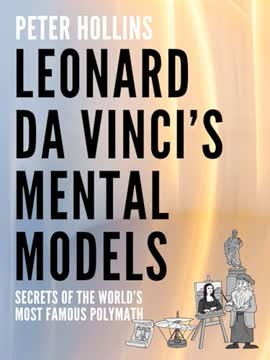
Leonardo da Vinci's Mental Models receives mixed reviews with an overall 4.26/5 rating. One critical reviewer disputes the book's premise, noting Leonardo wasn't actually a poor farmer but came from a wealthy family with good education, calling it one of the worst books they've encountered. Conversely, a enthusiastic five-star review praises the book as excellent, scientific, and artful, appreciating its innovative approach to applying genius-level thinking to everyday life and developing multifaceted intelligences.