

Key Takeaways
Treat advice as a seed, not a rulebook for someone else's life
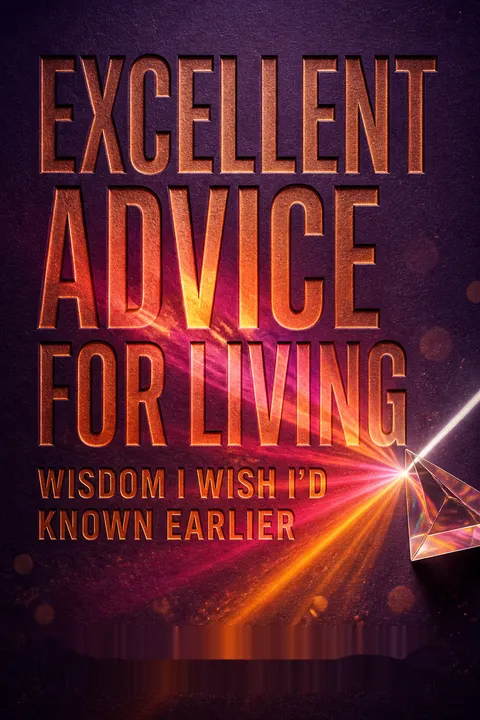
Advice begins as seeds. At 68, Kevin Kelly began writing advice for his adult children, expecting a short list. He kept adding to it over several birthdays until it grew to roughly 450 compact lessons. He describes each as a starting point, not a complete argument: readers should expand it to fit their own circumstances. That framing matters because the collection offers practical maxims that can conflict. Be generous, but be frugal; take risks, but plan exits; trust people, but verify suspicious requests.
Fit beats obedience. The advice ranges from serious guidance about forgiveness and responsibility to small fixes such as checking a car's fuel-door indicator. Its purpose is not to impose one system, but to help readers notice useful principles and test them in real life.
What's striking is that the book's form carries its central caution: short advice is memorable, but compression can disguise conditions and exceptions. A maxim works best as a prompt for judgment, not a substitute for it. This resembles a good scientific model: useful within a range, misleading when treated as universal. The collection's contradictions are therefore less a flaw than an invitation to ask which principle fits the stakes, people, and moment. Readers can make the advice more reliable by treating each item as a hypothesis to try, then revising it when experience gives contrary evidence.
Turn repeated actions into identity, not recurring negotiations
Habits save decision energy. Kelly argues that a habit is valuable because it removes a repeated action from the daily debate over whether to do it. He recommends describing behavior as something one does or does not do, rather than as a fluctuating ability or preference. Someone who wants to exercise, for instance, can focus less on getting fit and more on becoming the sort of person who reliably shows up.
Small repetitions accumulate. Kelly favors modest, regular progress over sporadic bursts. His recipe for getting better is to improve slightly from one year to the next, while treating consistency in exercise, work, and companionship as more important than occasional intensity. He also advises judging a routine by what happens on difficult days, not only when motivation is abundant.
This account joins identity to behavioral design: repeated action can make a chosen self-description credible, while the self-description can make the next action easier to choose. That is more durable than relying on inspiration, which varies with mood and circumstance. The emphasis on consistency also fits the mathematics of compounding, where modest gains can become substantial when they persist. A useful qualification is that identity language can become rigid. A missed workout need not mean someone has failed to be a certain kind of person. The strongest habit systems make returning easy, rather than turning each lapse into a verdict on character.
Let disagreement expose what your certainty is hiding
Listen for what is missing. Kelly urges readers to learn from people they disagree with, including people whose behavior or opinions repel them. The point is not to endorse their views, but to search for whatever truth or experience their perspective may contain. In conversation, he recommends asking a person to explain further several times; the deeper answer may reveal more than the first polished response.
Stay corrigible. He also advises demanding strong evidence for extraordinary claims, questioning beliefs regularly, and asking what one might be wrong about. A person who can argue the opposing side of a contentious issue, he suggests, has made their own position more robust. Curiosity, in this picture, is not indecision. It is a way to keep confidence answerable to evidence.
The useful distinction is between openness and credulity. Listening seriously helps reveal another person's assumptions, incentives, and lived experience, while evidence standards help prevent empathy from becoming agreement by default. This is close to intellectual humility, the recognition that a person's knowledge is incomplete and that confidence can exceed accuracy. The practice of explaining the strongest opposing case can expose weak premises on either side. Still, not every disagreement deserves extended engagement. Kelly's advice to avoid every invited argument complements this one: attention is limited, so curiosity should be directed where learning or relationship is genuinely possible.
Make relationships stronger through curiosity, generosity, and repair
Attention is a form of care. Kelly's relationship advice centers on acts that make other people feel heard and valued: ask follow-up questions, remember names, offer sincere compliments, share meals, and show appreciation. He recommends seeking advice rather than simply requesting criticism, because the first invites another person to help solve a problem. In conflict, he favors kindness over winning, private criticism over public humiliation, and a quick, specific apology without excuses.
Repair beats perfection. His description of apology includes regret for the harm, responsibility for one's part, and a willingness to remedy it. He also suggests forgiving even when an apology never arrives, because continuing resentment can injure the person carrying it. These are not techniques for controlling others. They are ways to behave well even when the other person's response is uncertain.
This advice treats relationships as ongoing exchanges of attention, trust, and repair, rather than as transactions to optimize. Research on social connection broadly supports the importance of feeling understood and supported, though no single conversational trick guarantees intimacy. The distinction between forgiving and excusing is especially important: a person can release a grudge without restoring access or ignoring a pattern of harm. Likewise, kindness is not passivity. The strongest version of this counsel pairs empathy with boundaries, so generosity does not become an obligation to tolerate disrespect.
Finish better work by separating invention from judgment
Creation needs room. Kelly warns that trying to invent and evaluate at the same time can make self-criticism stop a promising idea before it develops. He recommends separating the first act of making from the later work of editing, polishing, or analyzing. A deadline can help by limiting endless refinement and forcing a choice that makes the result distinct rather than merely safe.
Revision is the craft. Kelly's advice is to make many attempts, accept early mistakes, and seek useful criticism while there is still time to act on it. He notes that a large project can feel nearly finished well before its final details are complete. Producing regularly also makes discarded work less frightening: a weak draft is not the only chance to have a good idea.
Separating divergent thinking, which generates possibilities, from convergent thinking, which selects and improves them, is a practical way to protect creative range. The method is useful in writing, design, and problem-solving because evaluation and invention draw on different mental habits. Deadlines can also prevent polishing from expanding without limit. Yet speed is not automatically originality, and some tasks require careful checking before release. The key is sequencing: loosen judgment while possibilities are being generated, then apply standards deliberately during revision. That preserves both imagination and responsibility.
Guard attention, and schedule rest before work consumes you
Time needs boundaries. Kelly argues that worthwhile work can expand indefinitely, so the worker must set limits on hours rather than expect the task itself to reach a natural endpoint. He advises protecting the time of day when concentration is strongest, reducing a to-do list by asking what truly goes wrong if an item remains unfinished, and refusing to let other people's urgency dictate every priority.
Rest supports performance. He makes a case for regular days off, vacations, naps, and aimless walks, treating recovery as part of a serious work ethic rather than its opposite. He also notes that the inbox can quietly become a task list controlled by other people. His practical test is to ask whether productivity is helping someone do meaningful work or merely helping them clear more demands.
The insight is that attention, not clock time, is often the scarce resource. Boundaries protect deep work from being fragmented by incoming requests, while rest supports recovery and flexible thinking. This also challenges the cultural habit of treating visible busyness as evidence of value. Still, the advice assumes some control over one's schedule, which many workers do not have. For people with limited autonomy, small protected intervals, shared expectations, or team-level changes may matter more than individual discipline. Rest is a principle, but access to it is also shaped by working conditions.
Buy time and connection, not status or accumulating stuff
Look beyond the price tag. Kelly points out that possessions demand time and effort to set up, maintain, repair, and eventually discard. He suggests buying only the tools that prove useful: start cheaply, then invest in the ones used often. He also argues that experiences and relationships can offer deeper satisfaction than simply acquiring more objects.
Use money deliberately. The book favors paying debts promptly, avoiding consumer debt, investing steadily over long periods, and spending freely on a small number of genuine passions. Kelly also urges generosity, suggesting that giving can improve the giver's happiness and that money is most powerful when it serves other people. His image of a friend with access to a boat being better than owning one captures the value of shared resources over private status.
This perspective distinguishes wealth as visible ownership from wealth as freedom, time, and dependable relationships. The idea of counting maintenance and disposal costs resembles total-cost accounting: purchase price is only the opening expense. Shared access can also reduce waste while increasing social connection. But generosity should not be treated as a guaranteed percentage return in happiness, and debt can be reasonable when it funds a durable asset or necessary opportunity. The more useful principle is to evaluate money by what it enables, including security and agency, rather than by the number of things it lets someone display.
Treat uncertainty as a reason to experiment, not freeze
Test a life in motion. Kelly advises trying things instead of waiting for a perfect grand plan. When uncertain between paths, he favors the one that creates change, and he encourages detours because useful opportunities often appear outside an intended route. He recommends imagining the worst plausible outcome and preparing a response, which can make a risk feel less like a vague threat and more like a problem that can be handled.
Keep exploring. Kelly proposes spending roughly one third of one's time exploring new possibilities and the rest developing what already shows promise. He also urges people to accept that many important achievements take years, even when progress is difficult to see day by day. A failed experiment is informative when it fails for the reason anticipated; it can confirm a boundary rather than waste the effort.
Experimentation turns uncertainty from a prediction problem into a learning process. Instead of requiring a person to know the perfect future in advance, it creates feedback that can improve the next choice. The exploration-and-development balance is a useful heuristic, especially when familiar routines make discovery feel unproductive. It is not a universal ratio: caregiving, financial pressure, or a volatile environment can make exploration costly. A sensible experiment has bounded downside and a clear learning aim. That lets curiosity operate without romanticizing risk or confusing motion with progress.
Use your calendar to reveal whether your stated values are real
Behavior makes priorities visible. Kelly argues that a person's actual commitments show up in the way they spend time, not only in what they say they believe. A calendar can reveal whether work, family, health, or learning receives attention in practice. He also recommends asking who one is becoming before deciding what to do next, and choosing work that contributes beyond personal advancement.
Purpose is practiced. The book offers concrete ways to build a life around what matters: make time for family meals, create recurring rituals, tell people what they mean while they can hear it, and do something useful for future generations. Kelly's advice is not to wait for a finished life mission to appear. Direction becomes clearer through repeated choices, responsibilities, and relationships.
This is a practical account of values as enacted commitments. In moral philosophy, character is often understood not as a private collection of beliefs but as a pattern of choices; a calendar makes that pattern unusually visible. The test is powerful because it bypasses self-image. It also needs care: schedules are shaped by obligations, health, and economic constraint, so a calendar cannot by itself measure the depth of someone's values. The better question is whether available time is being allocated intentionally, and whether the unavoidable commitments leave room for relationships and work that feel consequential.
Analysis
Excellent Advice for Living is less a sequential argument than a compact field guide assembled from hundreds of observations. Its narrative frame is intimate: Kelly began writing advice for his adult children on his sixty-eighth birthday, then continued as family and friends asked for more. That origin explains the book's tone. The advice is designed to travel from an older person to a younger one, but its strongest passages resist pretending that age makes anyone omniscient.
The collection's broad thesis is that a good life is built through repeated acts of attention: notice what people need, notice what your habits are making of you, notice where time goes, and stay willing to revise your beliefs. Its most useful ideas reinforce one another. Experimentation reduces the pressure to choose perfectly. Habits make worthwhile actions repeatable. Rest and focus protect the capacity to act. Relationships supply perspective and meaning that solitary achievement cannot.
The aphoristic form is both advantage and risk. Compression makes a lesson portable, and practical details make advice memorable, from separating invention and editing to treating possessions as obligations. But compact counsel can sound more certain than its evidence warrants. Claims about generosity, productivity, or the right balance between exploration and commitment are best understood as heuristics, not universal laws. Kelly's own framing helps: these are seeds to grow in context, not instructions to follow mechanically.
The collection is most persuasive when a maxim changes a reader's next action. Ask a better question, apologize without self-defense, protect a period of concentration, or try the path that offers new information. Taken together, these small choices form a philosophy of practical humility: act, learn, care for people, and keep enough openness to discover where the advice does not fit.
Review Summary
Excellent Advice for Living receives high praise for its concise, practical wisdom. Readers appreciate its pithy quotes and timeless advice on various life aspects. Many find it a book to revisit regularly, savoring one piece of advice at a time. While some criticize its lack of originality, most value its distilled wisdom and applicability to daily life. The book is often recommended as a gift and a source of reflection. Some readers note its high "insight per sentence" ratio and its potential to provoke deep thought on personal growth and decision-making.
People Also Read









Glossary
pronoia
Assuming circumstances may helpPronoia is the opposite of paranoia: a deliberate choice to imagine that the universe may be working in one's favor. In Kelly's use, it is an optimistic orientation toward setbacks and opportunities, not proof that events are controlled by benevolent forces. It encourages people to see difficulties as temporary and to remain open to unexpected help.
Finite games
Games played to winFinite games have defined rules, participants, and endpoints, with success measured by winning or losing. Kelly contrasts them with ongoing pursuits that have no final victory condition. The distinction offers a way to evaluate goals: some contests are worth playing, but a life organized only around defeating others can neglect relationships, learning, and activities whose value depends on continuing.
Infinite games
Games played to continueInfinite games are ongoing activities whose purpose is to keep participation possible rather than to produce a final winner. Kelly uses the idea to encourage pursuits that generate continuing value, rather than treating every relationship, career, or creative practice as a contest with a fixed endpoint. The term is a strategic lens for distinguishing durable engagement from short-term victory.
Rule of 3 in conversation
Ask for deeper answersThe Rule of 3 in conversation is Kelly's technique of asking someone to go deeper than their first answer, then asking again, and then once more. The repeated invitations are meant to move past a quick or rehearsed response toward the person's underlying reason. It is a conversational prompt, not a guarantee that the third answer is always more accurate.
Rule of 7 in research
Follow referral chainsThe Rule of 7 in research is Kelly's advice to keep asking knowledgeable people who else might know when an initial source cannot answer a question. Each referral extends the search through a chain of expertise. Kelly's point is that persistence and well-directed referrals can uncover information that a first search or first contact misses.
creeping up
Trim toward exactnessCreeping up is a maker's method for reaching a precise measurement by first cutting a piece slightly larger than required, then removing small amounts until it fits. It avoids the irreversible error of cutting too much at once. Kelly uses the term as a practical lesson in incremental adjustment: approach precision through successive checks rather than a single overconfident move.
FAQ
What's "Excellent Advice for Living" about?
- Collection of Wisdom: "Excellent Advice for Living" by Kevin Kelly is a compilation of 450 pieces of advice that the author wishes he had known earlier in life.
- Personal Experience: The advice stems from Kelly's personal experiences and reflections, shared initially with his children and friends.
- Timeless Wisdom: The book channels timeless wisdom, modern aphorisms, and insights from various sources, aiming to provide guidance for a fulfilling life.
- Compact and Tweetable: Each piece of advice is presented in a concise, tweetable format, designed to be easily digestible and applicable.
Why should I read "Excellent Advice for Living"?
- Practical Guidance: The book offers practical advice that can be applied to everyday life, helping readers navigate personal and professional challenges.
- Broad Appeal: The wisdom shared is universal, making it relevant to readers of all ages and backgrounds.
- Inspiration and Reflection: It encourages readers to reflect on their own lives and consider how they can implement these insights for personal growth.
- Kevin Kelly's Perspective: As a well-respected author and thinker, Kelly's unique perspective on life and technology adds depth to the advice.
What are the key takeaways of "Excellent Advice for Living"?
- Learning and Growth: Emphasizes the importance of continuous learning and being open to new experiences.
- Relationships and Kindness: Highlights the value of building strong relationships and practicing kindness in all interactions.
- Self-Reflection: Encourages self-reflection and understanding one's own strengths and weaknesses.
- Practical Life Skills: Offers practical tips for managing time, resources, and personal well-being.
What are the best quotes from "Excellent Advice for Living" and what do they mean?
- "Being enthusiastic is worth 25 IQ points." This suggests that enthusiasm can significantly enhance one's effectiveness and perception by others.
- "Listening well is a superpower." Emphasizes the transformative power of active listening in building relationships and understanding others.
- "Don’t measure your life with someone else’s ruler." Encourages individuals to define success on their own terms rather than comparing themselves to others.
- "Pain is inevitable. Suffering is optional." Highlights the idea that while challenges are unavoidable, one's response to them is a choice.
How does Kevin Kelly suggest we approach learning in "Excellent Advice for Living"?
- Learn from Disagreement: Kelly advises learning from those you disagree with to find truth in differing perspectives.
- Prototype Your Life: Encourages trying new things and learning through experimentation rather than sticking to rigid plans.
- Teach to Learn: Suggests that teaching others is one of the best ways to deepen your own understanding of a subject.
- Continuous Improvement: Advocates for small, consistent improvements over time to achieve mastery.
What advice does Kevin Kelly give about relationships in "Excellent Advice for Living"?
- Be Kind Over Being Right: Kelly advises choosing kindness over being right in interactions, as kindness fosters stronger relationships.
- Treat Meals as Opportunities: Suggests that sharing meals is a powerful way to strengthen bonds with both old and new friends.
- Listen Actively: Encourages asking loved ones if there is more to what they are saying, promoting deeper understanding and connection.
- Value of Forgiveness: Emphasizes that forgiving others is a gift to oneself, aiding personal healing and growth.
How does "Excellent Advice for Living" address personal growth and self-improvement?
- Embrace Mistakes: Kelly highlights that making mistakes is part of the learning process and encourages graceful recovery.
- Set Ambitious Goals: Advises setting high goals to push beyond ordinary success, even if the effort falls short.
- Focus on Habits: Stresses the importance of building habits over relying on inspiration for consistent progress.
- Reflect on Irritations: Suggests that understanding what irritates you about others can provide insights into your own character.
What financial advice does Kevin Kelly offer in "Excellent Advice for Living"?
- Avoid Debt: Advises against using credit cards for credit and emphasizes acquiring assets that appreciate in value.
- Give Generously: Suggests that giving away a portion of income can lead to increased happiness and fulfillment.
- Invest in Experiences: Recommends prioritizing experiences over material possessions for deeper satisfaction.
- Manage Money Wisely: Encourages better management of existing resources rather than solely focusing on earning more.
How does "Excellent Advice for Living" suggest handling challenges and setbacks?
- View Setbacks as Temporary: Encourages seeing setbacks as temporary and part of the journey to success.
- Use Detours as Opportunities: Advises embracing detours as they often lead to unexpected opportunities and growth.
- Respond to Anger with Compassion: Suggests responding to anger with compassion, recognizing it as a sign of underlying pain.
- Persist Through Challenges: Emphasizes the importance of persistence and showing up consistently to achieve success.
What does Kevin Kelly say about creativity and innovation in "Excellent Advice for Living"?
- Prototype and Iterate: Encourages creating prototypes and iterating on ideas to refine and improve them.
- Embrace Imperfection: Suggests that things do not need to be perfect to be wonderful, especially in creative endeavors.
- Copy to Learn: Advises copying others as a starting point for learning, but warns against copying oneself to avoid stagnation.
- Focus on Process: Recommends focusing on the creative process rather than the end result to foster continuous innovation.
How does "Excellent Advice for Living" address the concept of time management?
- Prioritize Important Over Urgent: Advises focusing on important tasks rather than being driven by urgency.
- Limit Work Hours: Suggests setting boundaries on work hours to manage time effectively and prevent burnout.
- Value of Consistency: Emphasizes the importance of consistency in daily endeavors over sporadic efforts.
- Invest in Relationships: Highlights the significance of spending time with loved ones and building meaningful connections.
What unique perspectives does Kevin Kelly offer in "Excellent Advice for Living"?
- Optimism for the Future: Kelly's technological optimism is reflected in his belief in the potential for progress and improvement.
- Value of Curiosity: Encourages maintaining curiosity and openness to new ideas as a path to personal and professional growth.
- Importance of Empathy: Stresses the power of empathy in understanding others and fostering collaboration.
- Focus on Legacy: Advises considering the impact of one's actions on future generations and striving to be a good ancestor.
About the Author


Download PDF
Download EPUB
.epub digital book format is ideal for reading ebooks on phones, tablets, and e-readers.








