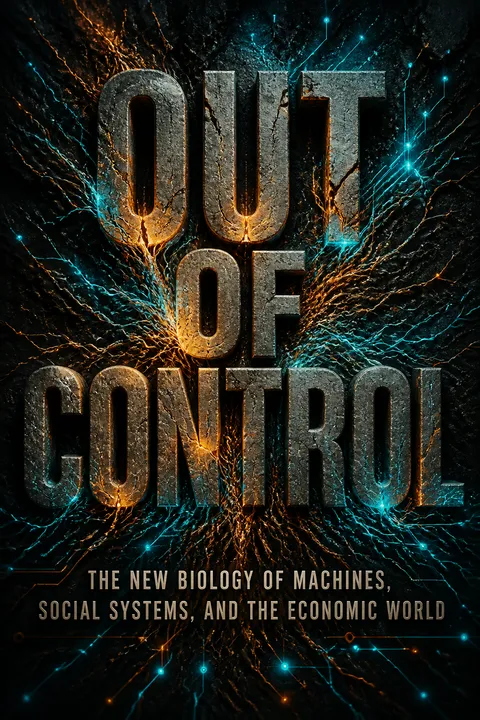


Key Takeaways
Let machines borrow life's logic, not merely its shape
A glass capsule makes the case. In the opening scene, a person stays alive inside an airtight cottage because plants, soil microbes, ducts, and machinery recycle air, water, and waste together. Neither greenery nor hardware could do the job alone. Kelly's central claim is that human-made systems are becoming so complex that they need principles borrowed from life: adaptation, self-maintenance, and learning. He calls natural and constructed systems with life-like organization vivisystems.
The boundary runs both ways. Machines are being given capacities such as self-repair and learning, while organisms are increasingly shaped through selective breeding and genetic engineering. Even familiar crops and livestock are partly human-designed. The future, in Kelly's view, is not a victory of machines over nature, but a hybrid civilization in which the made and the born increasingly share the same operating logic.
What's striking is the shift from asking whether a machine resembles an organism to asking whether it can perform life-like work. That distinction makes the argument practical rather than merely metaphorical. It also keeps the claim appropriately open: recycling air or adapting to failure does not automatically make a device alive in every meaningful sense. The most useful question is which biological capacities solve problems that rigid machinery cannot, and what costs accompany transferring those capacities.
Put intelligence in the connections, not a central commander
A hive can decide without a boss. When a honeybee colony scouts for a new home, individual scouts inspect sites and signal their preferences through dances. Other bees investigate promising locations, and support gathers around a favored option. The queen follows the swarm; she does not command it. Kelly uses emergence for a system-level pattern produced by many local interactions, even though no member contains or directs the whole result.
Crowds can coordinate, too. At a computer graphics conference, about 5,000 people controlled the paddles in a shared game of Pong by voting with colored wands. Fast feedback helped the crowd play reasonably well. A flight simulator was harder: delayed feedback led to overcorrection and instability. Simple flocking rules used in animation, such as keeping near neighbors and avoiding collisions, likewise create coordinated motion without a leader.
The bee election and the crowd-controlled game show that collective intelligence depends less on everyone knowing everything than on useful signals circulating among participants. The contrast between Pong and the delayed flight controls adds an important design lesson: coordination is sensitive to feedback speed. Distributed systems can be remarkably competent, but their competence is conditional. Poorly timed information can turn cooperation into a crowd amplifying its own mistakes.
Build minds from bodies, reflexes, and reliable layers
Start with competent reflexes. Rodney Brooks's small robot Genghis walked using simple sensors and local controllers rather than a master brain. Each leg handled basic actions, while the robot's gait emerged from their coordination. Brooks called this subsumption architecture: a layered design in which higher behaviors can suppress or redirect lower ones without erasing the simpler behaviors that already work.
Let the world do some thinking. A much larger planetary rover, Ambler, struggled to build an accurate internal map before moving. Brooks's approach instead tied sensing closely to action, as an insect does. A simple robot can avoid obstacles, wander, and then gain additional behaviors in stages. The book's point is that intelligence is not a disembodied plan: movement, sensory feedback, and a real environment help make intelligent behavior possible.
This account makes intelligence a practical achievement of coordination, not a mysterious substance installed in a central processor. Layering also explains how complexity can grow without rewriting every proven skill. The caution is that simple local rules do not remove the need for design. Someone still chooses the sensors, behaviors, and conditions under which one layer overrides another. Bottom-up control changes where intelligence resides, not whether responsibility exists.
Assemble ecosystems in sequence, with temporary scaffolds
A prairie needed more than seeds. Steve Packard tried to restore a Midwestern grassland, but his plots kept reverting to brush. Studying unusual plants at the edges revealed that he was rebuilding a savanna, a grassland with trees, not a pure prairie. Fire was essential: it suppressed invading trees and helped native plants flourish. The right species and processes mattered, not just a list of desired plants.
Order and support matter. Ecologist Stuart Pimm found that randomly assembled miniature ecosystems often settled into stable states, but different arrival sequences could produce different outcomes. On Bermuda, David Wingate planted temporary windbreak trees so native cedars could grow, and built artificial nesting sites while forests recovered. Such scaffolds help a system reach conditions it cannot establish all at once. Rebuilding a complex whole requires both components and an assembly path.
The prairie and island stories challenge the tempting idea that restoration means simply putting the right pieces back. History changes what a community can become: an early species or disturbance can open one path and close another. Temporary supports are not evidence of failure; they can be part of the route to independence. Still, restoration cannot guarantee a replica of the past when lost species, altered conditions, or unknown interactions have changed the available possibilities.
Treat partners and environments as one evolving system
Interactions reshape both sides. Coevolution means reciprocal evolutionary change among interacting organisms. A monarch caterpillar feeds on milkweed, while the plant develops defenses and the insect develops ways around them. The two are not changing in isolation; each helps shape the other's conditions for survival. Kelly extends this idea beyond biology to markets, technologies, and human societies that continuously respond to one another.
The planet is part of the relationship. James Lovelock observed that Earth's atmosphere contains reactive gases, including oxygen and methane, that should not persist together in a simple chemical equilibrium. He argued that living processes help maintain this unusual balance. Kelly presents Gaia as a planetary system whose life and environment shape each other, holding the whole in a persistent, changing state rather than a final rest.
The strength of this view is its refusal to treat an organism and its environment as separate actors. A species changes its surroundings, then inherits the consequences of those changes. That same loop helps explain why interventions can have indirect effects far from their apparent target. The Gaia example is most persuasive as a model of coupled regulation, not as a claim that Earth has intentions. System-level balance does not require a conscious planetary mind.
Choose swarm logic when adaptation matters more than control
Two kinds of machinery solve different problems. Clockwork systems follow a planned sequence and are well suited to tasks demanding precise control. Swarm systems consist of autonomous units that respond to local conditions and influence one another. They can adapt, recover from small failures, and generate novelty, but they tend to waste effort, resist direct control, and behave unpredictably.
Match the design to the stakes. A distributed telephone network can route around a damaged connection, even though local outages still occur. By contrast, an unexpected behavior in air traffic control could be dangerous. Kelly's practical distinction is not that one system is superior: use tightly controlled machinery where errors are unacceptable, and more adaptive systems where conditions change too much for a fixed plan. Most real applications need a mixture of both.
The tradeoff is more useful than a simple celebration of decentralization. Redundancy can prevent a small failure from becoming a total failure, but unpredictability can also make hazards harder to diagnose. A system's acceptable level of autonomy should therefore depend on the consequences of error, not just on its technical elegance. The key question is where adaptation creates value and where a human-defined limit must remain firm.
Connect factories and firms into resource-sharing networks
A product can coordinate its own supply chain. Kelly describes clothing companies using sales data from stores to trigger new orders and adjust production quickly. In one example, Benetton could wait to dye garments until customer demand revealed which colors were selling. Such networks blur the boundary between manufacturer, supplier, and retailer, turning information flow into part of production.
Industry can copy nature's no-waste logic. Industrial ecology treats factories as members of a material network, where one process's by-products can become another's inputs. A Danish cluster exchanged waste heat, sulfur, ash, and nutrient-rich sludge among businesses. A metal-finishing plant described in the book built a closed-loop water system that reduced pollution and paid for itself in two years. The larger aim is to make manufacturing more adaptive while sending fewer unwanted materials into the biosphere.
These examples connect economic flexibility with ecological responsibility: better information can reduce inventories, and better coordination can turn waste into a resource. The network metaphor also reveals a managerial challenge. When suppliers, customers, and producers jointly shape output, accountability can become as distributed as the work. Efficiency gains are valuable, but they do not by themselves establish that materials are safe, impacts are fairly shared, or a system is resilient to disruptions.
Protect privacy as networks make connection the default
More connection creates a need to disconnect. Kelly presents encryption as a tool for protecting privacy and enabling transactions among people who may never meet. David Chaum's proposed digital cash used cryptographic signatures so a merchant could verify payment without learning who paid. The book also describes cypherpunks working on anonymous messages and digital signatures, while acknowledging that the same tools could assist crime, tax evasion, or other harmful activity.
Let information travel, meter its use. Superdistribution is a proposed way to let software or other digital information circulate freely while charging for actual use rather than every copy. This approach recognizes that digital material is easy to duplicate and that rigid copy controls can obstruct legitimate sharing. Kelly's larger point is that a connected society needs privacy, authentication, reputation, and trust mechanisms, not simply faster networks.
The chapter treats privacy as infrastructure for participation, not as a privilege reserved for people with something to hide. That reframing is powerful because networked systems can make observation effortless and persistent. At the same time, anonymity and accountability are not identical goods, and systems must decide how to handle abuse without turning ordinary activity into permanent surveillance. The technical question of what can be hidden is inseparable from the civic question of who gets to decide.
Use evolution to search spaces human design cannot map
Selection can discover solutions no engineer planned. In Tom Ray's Tierra experiment, short computer programs copied themselves, sometimes with errors, and competed for limited computing time. A program that began at 80 bytes gave rise to a 22-byte self-replicator. Other programs became parasites, using host code to reproduce. The system generated variation, competition, and new behaviors from rules Ray had written but could not predict in detail.
Evolution is a search method. Genetic algorithms are computational procedures that create varied candidate solutions, test their performance, and reproduce stronger candidates. They can navigate complex spaces where designers cannot list every useful answer in advance. But the method trades understanding for discovery: an evolved program may work while remaining obscure. Its outcome also depends on what counts as success, a criterion that must be supplied or emerge from the system.
The striking result is not that computers imitate biology, but that a population of simple programs can produce workable innovations no individual programmer anticipated. This makes evolutionary search valuable when the design space is too tangled for direct calculation. Its limits are equally important. A fitness measure can reward a narrow proxy rather than the intended goal, and a successful but unreadable solution can be difficult to audit, repair, or trust.
Simulate worlds to learn, but trust only bounded predictions
A model can rehearse possibilities. Before Iraq invaded Kuwait, U.S. military planners had built a desert-war simulation using maps, force estimates, and logistics data. After the invasion, they used the model to test alternative campaigns and examine the role of airpower. The exercise did not make the war predictable in every detail, but it helped planners compare scenarios before acting.
A simulation inherits its blind spots. Kelly contrasts this with the Limits to Growth model, which relied on broad global averages, fixed assumptions, and little capacity for decentralized learning. It repeatedly produced collapse because it could not represent the kinds of adaptation and structural change found in human systems. Models are useful as instruments for testing assumptions and short-range patterns. They become misleading when their boundaries are mistaken for the boundaries of reality.
Simulation is strongest when used as a disciplined question generator: if these assumptions hold, what follows, and which changes matter most? Its authority should stop there. A model that cannot represent learning, local variation, or new forms of organization may be internally consistent yet poor at forecasting a world that changes through those very mechanisms. The proper response is neither to dismiss models nor to obey them, but to inspect what they leave out.
Design for self-organization by managing conditions, not dictating outcomes
Kelly's closing framework distills the book's design lessons into nine laws of god. Rather than reproducing a complex system from a complete blueprint, the framework emphasizes the conditions under which order can arise:
1. Distribute work among many units and let control emerge locally.
2. Build in layers from simple parts that already work.
3. Reinforce useful patterns while preserving diversity and room for error.
4. Balance competing aims instead of optimizing one measure.
5. Keep systems adaptable enough to alter their own rules.
The laws point toward a role change. A creator can establish boundaries, supply resources, and encourage useful interactions, but cannot fully prescribe what a complex system will become. Building something resilient therefore means designing the conditions for adaptation, then accepting that some outcomes will be surprising.
The framework is memorable because it turns a broad theory of living systems into design constraints. Its deepest implication is not that creators should abandon judgment, but that they should distinguish between shaping conditions and scripting every result. The framework also contains tensions: redundancy costs efficiency, diversity can destabilize a system, and errors can be dangerous as well as generative. Applying the laws requires choosing which surprises a particular system can safely absorb.
Analysis
The book's lasting contribution is a change in the unit of explanation. Instead of treating a machine, organism, company, or ecosystem as a finished object, it asks how interacting parts generate behavior that no part controls alone. That move lets Kelly connect bees, robot legs, prairie restoration, digital money, and industrial production without claiming they are identical. Their shared feature is organization that persists through change.
The argument is most persuasive when it stays operational. A hive's site choice, a robot's layered reflexes, or a factory's reuse of waste shows what distributed control can accomplish. It becomes less secure when life, intelligence, emergence, and selfhood begin to blur into a single expansive category. A system can adapt without being conscious; a network can be robust without being wise; and a machine's life-like behavior does not itself establish moral standing. Those distinctions matter wherever autonomy is used to justify less human oversight.
The book's technological optimism also needs a counterweight. Its examples often emphasize resilience, novelty, and efficiency, while the costs of opaque systems, unequal power, and harmful adaptation receive less sustained attention. Evolution produces fitness relative to a selection environment, not goodness relative to human values. The decisive design problem is therefore not simply how to release control, but how to define acceptable boundaries, preserve accountability, and intervene when emergent behavior causes harm.
Read this way, the book is not a prediction that machines will become organisms. It is a challenge to build systems that can cope with complexity without pretending that complexity can be centrally mastered. Its strongest practical lesson is disciplined humility: model what can be modeled, distribute what cannot be directed, and remain responsible for the conditions and consequences of the whole.
Review Summary
People Also Read






Glossary
vivisystems
life-like organized systemsKelly's term for systems, natural or human-made, that display some qualities associated with life, such as self-maintenance, adaptation, learning, or evolution. Examples include organisms, ecosystems, economies, computer networks, and artificial worlds. The term emphasizes shared organizational behavior, not a claim that every such system is a living organism in the biological sense.
bio-logic
life's organizing principlesThe set of organizational principles Kelly sees operating in living systems and transferable to machines. These include distributed control, adaptation, self-repair, learning, and evolution. Bio-logic is not a particular biological substance or a single mechanism. It is a way of building complex systems by borrowing processes that let natural systems function without a central designer directing every action.
emergence
whole patterns from interactionsA system-level pattern or capacity produced by interactions among parts, even though no individual part contains or directs the whole. A bee swarm choosing a nest site and simple animated agents forming a flock are examples. In Kelly's account, emergence is a lawful organizational effect, not a mystical force, though its precise mechanisms can be difficult to predict.
subsumption architecture
layered decentralized robot controlA robot-control design associated with Rodney Brooks in which simple, independently functioning behaviors are arranged in layers. Basic behaviors, such as avoiding obstacles, remain available while higher-level behaviors can suppress or redirect them. Complexity grows by adding working layers rather than replacing the entire system with a single central plan.
coevolution
reciprocal evolutionary changeEvolutionary change in interacting organisms, where each party alters the conditions affecting the other's survival and reproduction. The monarch butterfly and milkweed illustrate the pattern: plant defenses and caterpillar adaptations shape each other. Kelly applies the idea more broadly to connected systems, while its strict biological meaning concerns interacting populations or species.
industrial ecology
industry modeled as ecosystemAn approach to manufacturing that treats businesses and processes as an interconnected material system. One process's waste can become another's input, while energy and resources are reused and pollution is reduced. The goal is to make industrial production more like ecological cycling, rather than treating each factory as an isolated operation that discards its by-products.
genetic algorithms
evolutionary computational searchComputational methods that search for solutions by maintaining a population of candidate programs or designs. Candidates are varied, tested against a performance measure, and reproduced in proportion to success. Recombination and mutation help explore possible solutions. Kelly presents them as useful when a problem has many interacting variables and its best answer is difficult to specify directly.
autocatalytic set
mutually self-producing networkA collection of components or reactions in which members help produce other members, forming a self-supporting network of production. No single component needs to create the whole set. In the book's account, autocatalytic organization offers a possible route by which a collection of chemical processes could become collectively persistent and life-like.
edge of chaos
threshold of adaptive behaviorA proposed region between rigid order and uncontrolled disorder where a system may be flexible enough to adapt without losing all stability. Kelly discusses the idea through models of connected networks and evolving systems. It is a useful hypothesis about conditions for change, not a universal rule that every adaptive system must occupy one precise measurable boundary.
Nine Laws of God
principles for growing complexityKelly's concluding framework for making complex systems from simple beginnings. It emphasizes distributed organization, local control, increasing returns, incremental growth, diversity, error, multiple objectives, persistent disequilibrium, and systems that can change their own rules. The laws are design principles drawn from varied natural and artificial systems, not a literal account of divine commands.
About the Author


Download PDF
Download EPUB
.epub digital book format is ideal for reading ebooks on phones, tablets, and e-readers.








