

Key Takeaways
Prepare for Black Swans, the rare shocks that rewrite ordinary expectations
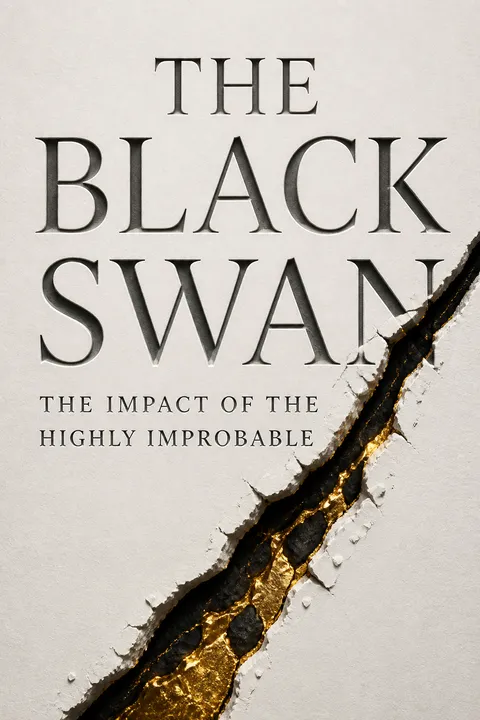
Three features define the shock. A Black Swan is an event that falls outside ordinary expectations, has major consequences, and is made to seem predictable by explanations invented afterward. Taleb points to Google’s unexpected success and the attacks of September 11 as very different examples. The label is relative to what an observer could reasonably anticipate, not a claim that the event was impossible for everyone.
The overlooked variable is ignorance. Taleb argues that a small number of such events can shape markets, politics, technology, and individual lives more than the routine developments that dominate attention. The more connected and complicated society becomes, the more one surprise can trigger others. Preparation therefore matters more than confidence in a forecast.
The concept is most useful when it shifts attention from the average case to the consequences of being wrong. Safety engineering, for example, does not only ask how often a system fails; it asks what happens when failure cascades. That is a practical way to apply Taleb’s emphasis on impact. The term also needs discipline: an event can be surprising to one person and foreseeable to another. Calling every bad outcome a Black Swan after the fact risks turning a challenge to prediction into an unfalsifiable label.
Remember that history jumps, even when hindsight draws a straight line
The past looks tidier afterward. Taleb grew up in Lebanon, where long-standing coexistence seemed to many residents like durable equilibrium. Then civil war transformed ordinary life. Many adults expected the conflict to end within days, while later accounts could make its causes and progression seem obvious. The gap between expectation and outcome became a personal lesson in how little people know while events are unfolding.
A diary preserves uncertainty. Reading journalist William Shirer’s account of events as they happened helped Taleb notice how different the present feels from its later retelling. Once outcomes are known, memory selects details that fit them and discards the rest. History may reveal what happened, but its finished narrative cannot reliably reproduce what people knew, feared, or thought possible at the time.
This is a useful corrective to hindsight bias, the well-documented tendency to remember an outcome as more predictable after it occurs. Contemporaneous records can preserve uncertainty that later histories smooth away, a practice valuable in medicine, policy, and organizational reviews. Yet diaries are not transparent windows: authors have limited information, and editors or memory can shape the record. Their value lies less in providing an unfiltered past than in showing how incomplete the view was before the ending.
A long calm record can make danger feel safest
The turkey learns the wrong lesson. Fed by people every day, a turkey sees each meal as confirmation that humans are benevolent. The evidence accumulates right up to the day it is killed. Its mistake is not simply failing to predict a surprise. The repeated pattern actively increases its confidence, even as the danger grows.
Past performance can hide a rare loss. Taleb applies the same logic to banking. U.S. banks had accumulated years of lending profits before losing nearly all their historical earnings in the Latin American debt crisis of 1982. Short stretches of success, and even long ones, cannot prove that a severe loss is impossible. When outcomes can be dominated by a rare event, confidence built from a quiet record may be least reliable just before the reversal.
The turkey story captures a general problem with induction: repeated observations support expectations, but they cannot guarantee that the generating process stays unchanged. In practice, the lesson is not to discard historical data. It is to ask what the data could not yet have revealed, especially when a single failure could overwhelm accumulated gains. This resembles stress testing in engineering and finance, although stress tests can also miss scenarios that designers never imagine. Evidence is informative, but its silence has limits.
Use different risk models for bodies and for scalable fortunes
Mediocristan has natural limits. Taleb calls domains such as human height and weight Mediocristan. In a large group, one unusually tall person barely changes the average. Extreme observations exist, but physical constraints keep their contribution bounded.
Extremistan has no such cushion. Wealth, book sales, and company size can be dominated by one case. A bestselling author can outsell thousands of writers combined; one very wealthy person can outweigh a stadium of ordinary fortunes. Taleb uses Extremistan for these scalable domains, where a single observation can reshape the total. The familiar bell curve works best when extremes are constrained and averages stabilize. Applying it indiscriminately to wealth or markets can make rare, consequential outcomes look negligible.
This distinction is a powerful first diagnostic: before calculating risk, ask whether the quantity is physically constrained or can scale through networks, technology, and accumulated attention. It helps explain why averages describe height better than artistic success. Still, the two territories are a practical map, not a complete taxonomy. Some processes combine limits and scale effects, and a label alone does not identify the right statistical model. Taleb’s strongest warning is methodological: establish how extremes affect the total before trusting a tidy summary.
Interrogate tidy explanations; test what would prove them wrong
Stories compress facts into causes. Taleb calls the urge to impose a neat plot on events the narrative fallacy. A market report once explained government bond movements with the same news event, Saddam Hussein’s capture, first as a reason prices rose, then as a reason they fell. The explanations sounded plausible, but their contradiction exposed how easily commentary can manufacture causation.
Look for disconfirmation. In psychologist P. C. Wason’s number-sequence experiment, participants saw 2, 4, 6 and tried to infer the rule. Many proposed sequences that confirmed their guesses instead of testing alternatives. The actual rule was simply that numbers increased. Taleb’s practical lesson is to seek observations that could break a favored explanation, rather than collecting only examples that make it feel right.
This approach connects to scientific falsification: a claim becomes more informative when its proponent specifies what evidence would count against it. It also counters motivated reasoning, in which people scrutinize unwelcome evidence more harshly than supportive evidence. But disconfirmation is not a magic filter. Tests can be noisy, and a failed prediction may reflect poor measurement rather than a false theory. The strongest practice pairs adversarial testing with careful replication, rather than treating one anomaly as an automatic verdict.
Judge forecasts by their error bars, not their polished confidence
Planning often outruns knowledge. Sydney’s Opera House was projected to open in 1963 for about AU$7 million. It opened more than a decade later, in a reduced form, at a cost of roughly AU$104 million. The gap illustrates how plans overlook forces outside their assumptions, then acquire an undeserved air of precision when written down.
Confidence is not accuracy. In one calibration exercise, people who expected their 98-percent confidence ranges to be wrong only 2 percent of the time missed far more often. Taleb also cites Philip Tetlock’s study of roughly 27,000 political and economic forecasts by nearly 300 specialists: credentials did not reliably confer superior accuracy. A useful forecast should include uncertainty, degrade with time, and be judged against a simple comparison, not just its persuasive story.
Forecasts can still help coordinate action, even when they are imperfect. Their value depends on the decision: a rough weather estimate may be useful, while a precise long-term economic projection can create false security. Decision science improves this distinction by scoring forecasts over time and comparing them with simple baselines. Taleb’s critique is strongest when forecasts hide their margins of error or escape evaluation. It is weaker if read as a reason to reject all modeling instead of demanding calibration and accountability.
Guard against ruin while keeping a small door open to upside
Protect the downside first. Taleb’s barbell strategy means avoiding the fragile middle ground: keep most resources in very safe holdings and place a smaller portion in high-risk opportunities whose losses are limited but whose gains could be large. He gives 85 to 90 percent in safe instruments and 10 to 15 percent in speculative bets as an illustration, not as a universal formula.
Match the strategy to the consequences. In a business where surprises can cause catastrophic losses, reduce exposure rather than trusting a precise probability estimate. In research, publishing, or venture investing, where one success can repay many small failures, seek opportunities with limited costs and open-ended potential. The common principle is asymmetry: be cautious where surprise can destroy you and experimental where it can reward you.
The barbell translates uncertainty into portfolio shape rather than pretending to know exact odds. Its underlying logic resembles a ruin constraint in decision theory: first keep catastrophic loss survivable, then preserve room for favorable surprises. The specific allocation depends on a person’s liabilities, time horizon, and access to safe assets, so the percentages should not be copied mechanically. More broadly, the strategy is a reminder that a moderate-looking average can conceal two very different exposures, one protected and one speculative.
Run many low-cost experiments where one lucky result can scale
Discovery rarely follows a schedule. Taleb uses Apelles, an ancient painter struggling to depict foam on a horse, as an image of accidental success: an exasperated brush-cleaning gesture produced the effect he wanted. He also describes Alexander Fleming noticing mold that had contaminated an experiment, an observation that helped lead to penicillin. In both cases, preparation made an accident usable.
Increase exposure to useful accidents. Taleb recommends tinkering, trying many approaches, and noticing unexpected results instead of relying only on top-down plans. This is especially valuable when an idea can reach many people without equal added effort, as a book or recorded performance can. Such scalable work offers large possible rewards, but also concentrates success among a few and leaves many attempts unrewarded.
This is an account of exploration as a portfolio: several modest experiments can reveal opportunities that no forecast identified in advance. The approach echoes evolutionary search, where variation generates options and selection preserves what works. It depends on having genuine room to experiment, however. People with little financial security may not be able to absorb repeated failures, and some fields require expensive trials. The practical extension is to make experiments cheap, reversible, and informative, rather than romanticizing failure for its own sake.
Count the failures and the unseen before admiring survivors
Survivors tell an incomplete story. Cicero’s story of shipwreck survivors who credited prayer leaves out those who prayed and drowned. Taleb calls this silent evidence: the missing failures distort what the visible successes seem to prove. Successful entrepreneurs and investors may share traits with people who failed; the missing cases make luck and risk difficult to assess.
Include consequences nobody advertises. After the September 11 attacks, some people avoided flying and drove instead. Taleb cites research estimating that about 1,000 additional road deaths occurred during the remaining months of 2001, a consequence less visible than the direct victims. Prevention has a similar problem: if a disaster never happens, the person who helped prevent it may receive no credit. Ask who is absent, what costs are hidden, and what never became a headline.
Survivorship bias matters wherever inclusion depends on success, survival, or visibility. Clinical trials, investment records, and startup stories can all look more favorable when failed cases disappear from view. A disciplined comparison asks what would have happened to the full original group, not only to those still observable. The challenge is that missing data are often genuinely unrecoverable. Recognizing that limit does not erase the bias, but it should lower confidence in claims built solely from visible winners.
Analysis
The book’s central contribution is not a recipe for predicting rare events. It is a change in what counts as responsible knowledge. Taleb argues that forecasts are especially brittle where outcomes are scalable, connected, and capable of being dominated by a few extreme cases. The reader is asked to treat surprise not as an occasional interruption to an otherwise stable world, but as a force that can shape the world’s central outcomes.
The narrative moves from Taleb’s experience of Lebanon’s civil war and the 1987 market crash, through psychological errors in inference, to statistical differences between bounded and scalable phenomena. Its anecdotes are memorable because they give abstract epistemic problems a face: the turkey grows confident before slaughter, survivors omit the drowned, and a tidy historical account hides how uncertain the present once was. Those stories illuminate the argument, but they are illustrations rather than proof of every broad claim.
The practical conclusion is notably more constructive than simple pessimism. Since probabilities may be unknowable, decisions can be organized around consequences: limit catastrophic exposure, preserve options, and seek settings where small experiments can produce outsized gains. This is a robust principle even when exact odds are unavailable.
There are important limits. Black Swan status depends on an observer’s knowledge, so the label can blur the difference between genuine unpredictability and neglected evidence. Likewise, rejecting Gaussian assumptions does not by itself identify a better model, and scalable distributions are not all alike. Taleb’s polemic against experts can also understate domains where accumulated expertise is reliable. The strongest reading is therefore neither anti-statistical nor anti-forecasting. It is a demand that models declare their boundaries, that prediction records be audited, and that decisions remain survivable when the model is wrong.
Review Summary
Reviews for The Black Swan are mixed. Many praise Taleb's insights on uncertainty and improbable events, finding the book thought-provoking and relevant. However, critics argue the writing is repetitive, arrogant, and unnecessarily complex. Some appreciate Taleb's irreverent style, while others find it off-putting. The book's core ideas about unpredictability and our inability to foresee major events are generally well-received, but the presentation and execution are contentious. Overall, readers seem to value the concepts but are divided on Taleb's delivery and personality.
People Also Read






Glossary
Black Swan
Consequential surpriseAn event that lies outside an observer’s ordinary expectations, has major consequences, and is explained as more predictable after it occurs. The term is relative to knowledge: an event may surprise one person while being anticipated by another. Taleb uses it to emphasize the impact of rare events and the limits of inference from past observations.
Mediocristan
Bounded variationTaleb’s name for domains in which physical or practical limits prevent one observation from dominating a large aggregate. Human height is an example: an unusually tall person barely changes the average height of a large group. In such settings, averages stabilize more readily, and bell-curve methods may be useful.
Extremistan
Scalable extremesTaleb’s name for domains in which a single observation can disproportionately affect the total. Wealth, book sales, and company size are examples because there are few fixed physical limits to their growth. Extremistan is vulnerable to large deviations and winner-take-most outcomes, making extrapolation from ordinary cases hazardous.
Platonicity
Mistaking model for realityTaleb’s term for privileging neat categories, clear models, and simplified representations over the messier world they are meant to describe. Such abstractions can be useful, but their errors may remain invisible until they meet reality. At that boundary, a model’s assumptions can create serious consequences.
narrative fallacy
Imposing a causal storyThe tendency to turn a sequence of facts into a compact, coherent story, often adding causes that the evidence does not establish. Narratives make information easier to remember, but can also make events seem more predictable and meaningful than they were. Taleb warns that this distortion is especially dangerous when rare events shape the outcome.
silent evidence
Missing cases distort conclusionsThe distortion that occurs when visible survivors or successes are examined while failures and absent cases are ignored. Shipwreck survivors who credit prayer do not represent those who drowned; celebrated entrepreneurs do not reveal how many similar attempts failed. The missing evidence can make luck, danger, and success appear more orderly than they are.
ludic fallacy
Treating life like a gameThe mistake of assuming that uncertainty in real life resembles uncertainty in games, where rules and probabilities are specified. In the world outside the casino, the sources of risk and even the relevant possibilities may be unknown. Taleb argues that calculations built for controlled games can mislead when applied to complex social or economic events.
barbell strategy
Protect downside, preserve upsideA decision strategy that combines a highly conservative position with a smaller, highly speculative one, rather than relying on a supposedly moderate middle. The conservative side is meant to limit ruinous losses; the speculative side seeks large gains while keeping individual losses bounded. Taleb applies the logic to investments and other choices under uncertainty.
Mandelbrotian Gray Swan
Modelable extreme eventA rare, consequential event whose broad possibility can be represented by scalable or fractal patterns, even when its exact probability remains difficult to calculate. Taleb contrasts Gray Swans, such as market crashes or earthquakes, with Black Swans that remain outside the observer’s model. Recognizing a Gray Swan can reduce surprise without making the event precisely predictable.
FAQ
1. What is The Black Swan: The Impact of the Highly Improbable by Nassim Nicholas Taleb about?
- Central concept: The book explores the concept of "Black Swan" events—rare, unpredictable occurrences with massive impact that are rationalized after the fact.
- Challenge to prediction: Taleb argues that most significant events in history, finance, and personal life are shaped by these Black Swans, which traditional models fail to anticipate.
- Human limitations: The book highlights our cognitive biases and the limits of our knowledge, showing how we are often blind to the possibility and impact of such events.
- Critique of conventional wisdom: Taleb critiques the overreliance on statistical models, especially those based on the Gaussian bell curve, for underestimating the role of extreme events.
2. Why should I read The Black Swan by Nassim Nicholas Taleb?
- Understanding uncertainty: The book provides deep insights into the nature of randomness, uncertainty, and the limits of prediction, which are crucial in a world dominated by rare, high-impact events.
- Skepticism of experts: Taleb exposes the failures of experts and models, especially in finance and economics, encouraging readers to question overconfident predictions.
- Practical strategies: Readers gain actionable advice, such as the "barbell strategy," to protect themselves from negative Black Swans while seeking positive ones.
- Intellectual humility: The book encourages embracing epistemic humility, recognizing the limits of our knowledge, and preparing for the unexpected.
3. What are the key takeaways from The Black Swan by Nassim Nicholas Taleb?
- Black Swan events dominate: Rare, unpredictable events have a disproportionate impact on history, markets, and personal lives.
- Limits of prediction: Traditional forecasting methods, especially those using bell curves, are inadequate for dealing with real-world randomness.
- Cognitive biases: Humans are prone to narrative fallacies, confirmation bias, and overconfidence, which blind us to the role of randomness.
- Practical risk management: Taleb advocates for strategies that are robust to uncertainty, such as the barbell strategy, and for maximizing exposure to positive Black Swans.
4. What is the definition of a "Black Swan" event according to Nassim Nicholas Taleb?
- Three characteristics: A Black Swan is an event that is highly improbable, has a massive impact, and is rationalized in hindsight as if it were predictable.
- Examples: The rise of Google, the 9/11 attacks, and major financial crashes are cited as Black Swans.
- Unpredictability: These events lie outside regular expectations and cannot be forecasted using standard models.
- After-the-fact explanations: Humans tend to create stories to make these events seem less random and more predictable than they actually were.
5. How does Nassim Nicholas Taleb explain why humans fail to predict or acknowledge Black Swan events?
- Focus on known information: Humans are biologically inclined to focus on specifics and what they know, neglecting unknown possibilities.
- Narrative fallacy: We create coherent stories after the fact, making unpredictable events seem inevitable in hindsight.
- Simplification and platonicity: People mistake simplified models for reality, which blinds them to the complexity and randomness of the world.
- Confirmation bias: We seek evidence that supports our beliefs and ignore evidence to the contrary, reinforcing false confidence.
6. What is the difference between "Mediocristan" and "Extremistan" in The Black Swan by Nassim Nicholas Taleb?
- Mediocristan: This domain involves mild randomness, where individual events have limited impact and outcomes are predictable (e.g., human height).
- Extremistan: Here, wild randomness prevails, with rare events dominating outcomes (e.g., wealth, book sales, financial markets).
- Statistical implications: Mediocristan follows bell curve distributions, while Extremistan has "fat tails" and power laws, making averages unstable.
- Relevance: Most impactful real-world phenomena belong to Extremistan, where Black Swans are most likely to occur.
7. What is the "ludic fallacy" and why does Nassim Nicholas Taleb warn against it in The Black Swan?
- Definition: The ludic fallacy is the error of applying simplified, game-like models of randomness (like dice or roulette) to the complex uncertainty of real life.
- Known vs. unknown probabilities: Games have fixed rules and known odds, while real life involves unknown variables and unpredictable Black Swans.
- Consequences: This fallacy leads to overconfidence in models and underestimation of rare, impactful events, especially in finance and policy.
- Taleb’s critique: He urges skepticism toward neat probabilistic models, emphasizing the messiness and opacity of real-world randomness.
8. How does Nassim Nicholas Taleb describe the "problem of induction" in relation to Black Swans?
- The turkey problem: A turkey fed daily expects this to continue, but is slaughtered unexpectedly, illustrating the danger of assuming the future will resemble the past.
- False sense of security: Confidence grows with each confirming observation, even as risk increases, leading to vulnerability to surprise events.
- Historical examples: Long periods of stability, such as before wars or financial crashes, often precede Black Swans, showing the limits of inductive reasoning.
- Learning backward: Relying on past data can be misleading when rare, high-impact events are possible.
9. What are the "narrative fallacy" and "confirmation bias" in The Black Swan by Nassim Nicholas Taleb?
- Narrative fallacy: Humans have a psychological need to create coherent stories, linking facts causally and simplifying complex events.
- Post hoc rationalization: People often invent reasons for outcomes after the fact, making rare events seem more predictable than they are.
- Confirmation bias: We naturally seek evidence that supports our beliefs and ignore disconfirming information, leading to overconfidence.
- Impact on risk assessment: These biases distort our understanding of randomness and make us underestimate the likelihood of Black Swans.
10. What is the "problem of silent evidence" and how does it affect our understanding of history and success in The Black Swan?
- Invisible failures: We only see survivors and successes, while failures remain unseen, skewing our perception of causality and probability.
- Diagoras problem: Remembering only those who survived or succeeded leads to false beliefs about the effectiveness of actions or traits.
- Misleading success stories: Overrepresentation of winners (like Casanova or millionaires) makes us underestimate the role of luck and randomness.
- Implications: This bias leads to flawed conclusions about talent, skill, and the true drivers of success.
11. What practical advice and strategies does Nassim Nicholas Taleb offer in The Black Swan for dealing with uncertainty and benefiting from Black Swans?
- Barbell strategy: Combine extreme conservatism (safe assets) with aggressive risk-taking (high-reward bets) to protect against negative Black Swans and benefit from positive ones.
- Maximize exposure to positive Black Swans: Engage in scalable professions or activities where rare, high-impact successes are possible.
- Emphasize anti-knowledge: Focus on what you do not know and remain open to surprises, rather than relying solely on known information.
- Avoid naive prediction: Accept the unpredictability of extreme events and build robustness or antifragility into your strategies.
12. What are the best quotes from The Black Swan by Nassim Nicholas Taleb and what do they mean?
- "I had to invent my predecessors, so people take me seriously." — Mandelbrot’s strategy for gaining credibility, highlighting how recognition often depends on connecting ideas to established thought.
- "It makes them gray. Why gray? Because only the Gaussian give you certainties." — Fractal randomness can make some Black Swans conceivable (gray), but not fully predictable, unlike Gaussian models that falsely promise certainty.
- "In a world in which these two get the Nobel, anything can happen. Anyone can become president." — Taleb’s critique of the Nobel Committee for awarding flawed financial theories, illustrating the disconnect between academic recognition and practical reality.
- "The turkey problem": A metaphor for the dangers of induction, showing how past stability can lead to catastrophic surprises.
- "History jumps, it does not crawl": Emphasizes that major changes often come suddenly and unpredictably, not gradually as models suggest.
Incerto Series
About the Author
Other books by Nassim Nicholas Taleb


Download PDF
Download EPUB
.epub digital book format is ideal for reading ebooks on phones, tablets, and e-readers.








