

Key Takeaways
Begin before you feel ready, then learn your way into the work
Start with a real attempt. At fifteen, Branson wanted to publish a magazine for students, despite having little experience and finding schoolwork difficult. He and a friend began making calls, soliciting articles, and seeking advertisers instead of waiting to feel qualified. Their early work taught them how to pitch, plan, and sell.
Let evidence reshape the idea. Their first plan targeted only school pupils and did not make financial sense. Branson widened the magazine's audience to college and university students, giving advertisers a larger market. The first issue ultimately had 30,000 copies and £2,500 in advertising. The project became a practical education in business, even before it was a reliable one.
What's striking is that confidence here is not presented as a private feeling that must arrive before action. It grows through contact with the task: calls reveal what customers want, and failed calculations force a better plan. This resembles learning by doing, where feedback replaces speculation. The story also has a useful limit: Branson had family support, time, and unusual access to decision-makers. Starting early is a principle, not proof that every venture will overcome unequal resources.
Make the work enjoyable, but make the economics add up
Enjoyment is fuel, not a business plan. Branson argues that money was not the original reason he started ventures. He wanted challenge, creativity, and a lively working life. But he also stresses that a business must earn more than it spends. His childhood Christmas-tree project made the point: he calculated a tempting profit from 400 seedlings, then rabbits ate the crop. Selling the rabbits rescued a small amount, but the forecast had omitted a basic risk.
Pair pleasure with persistence. Virgin took a chance on Mike Oldfield's unusual album, Tubular Bells, after other labels declined it. The team found unconventional ways to promote it, including a television film and placement in The Exorcist. Branson's lesson is not that fun guarantees wealth, but that meaningful work can sustain the effort required to make an idea viable.
This connects enjoyment to intrinsic motivation: people tend to persist when work offers interest, agency, and a sense of progress. Branson's stories also keep pleasure from becoming a euphemism for avoiding discipline. The rabbit venture is funny because the arithmetic was correct while the business model was incomplete. Still, the claim that enjoyable work brings money is anecdotal, not a general law. Enjoyment can guide career choices, but costs, demand, and timing still decide whether a venture survives.
Take risks with a survivable downside, not bets on blind luck
Distinguish a gamble from a plan. On The Rebel Billionaire, Branson offered a contestant a million dollars or a coin toss that could erase the prize. The contestant kept the money, showing judgment rather than bravado. Branson applies a similar test to Virgin Atlantic. The airline began with one plane, and he separated it from Virgin Music so a failure would not automatically sink the record company. He says the potential loss was less than a third of one year's Virgin Music profit.
Build an exit where possible. Boeing agreed to take back the second-hand aircraft if the airline failed, limiting one major risk. Branson still accepted substantial uncertainty, but he sought information, set a financial ceiling, and protected the existing business. His principle is to be bold without staking everything on a result no one can control.
The useful distinction is between uncertainty that can be bounded and a wager with an arbitrary outcome. In decision science, a downside limit changes the shape of a choice: the upside can remain large while the failure cost stays containable. Yet a spreadsheet cannot capture every cascade, especially in a capital-intensive business. Branson's account is also told by a winner, so it can understate how often careful founders still lose. Risk analysis improves judgment; it does not make risk disappear.
After failure, change the method before deciding the goal is impossible
Persistence needs adaptation. Branson's first attempt to reclaim the Blue Riband, the speed record for an Atlantic crossing, ended when the Virgin Atlantic Challenger broke apart in a storm near the finish. The crew escaped by liferaft. A year later he tried again in a longer, single-hull boat, better suited to rough seas. The second attempt suffered engine trouble and a storm, but the crew repaired the fuel problem and continued.
The revised attempt succeeded. Challenger II crossed the Atlantic in 3 days, 8 hours, and 31 minutes, beating the previous record by 2 hours and 9 minutes. The story is less about repeating an identical effort than about learning from a failed design and keeping the objective alive while changing the approach.
This is a strong example of iterative problem-solving: failure supplies information, and a changed design converts that information into a better attempt. In engineering, testing is valuable precisely because it exposes weaknesses before the next build. But persistence is not automatically virtuous. The first crossing nearly killed the crew, and a repeat attempt makes sense only when risks are re-evaluated, not simply denied. The memorable lesson is adaptive commitment, with a clear-eyed account of what the first failure revealed.
Treat constraints as design problems, not permission to give up
Find another route. Branson says dyslexia made classroom reading and writing difficult, so he found other ways to succeed, including sport and memory. In business, the same instinct meant challenging default procedures. A national postal strike stopped Virgin's mail-order record sales, so the company opened a record shop instead. A blocked route became a reason to redesign the work, not abandon it.
Keep innovation understandable. Virgin Galactic grew from a long-standing interest in cheaper access to space. After the Ansari X-Prize challenged private teams to build reusable crewed spacecraft, Branson backed Burt Rutan's design, which used an aircraft launch at high altitude and lightweight composite construction. The project took years to develop. Its lesson is not that every rule is pointless, but that a simpler system can open options a conventional process overlooks.
The section joins personal adaptation with organizational innovation. Both involve separating the goal from the first method tried. That is a powerful form of flexibility: a constraint can reveal which parts of a plan are essential and which are inherited habits. Still, not every barrier is an invitation to improvise around it. Aviation and space travel depend on safety rules for good reason. Innovation works best when it questions needless friction while respecting safeguards that protect people.
Build independence through capable people, not lone-wolf performance
Self-reliance is not isolation. Branson's parents taught him to take initiative, but his story is full of people who made that initiative possible. His mother helped fund Student, and his aunt lent him money to buy the country house that became Virgin's recording studio. His friend Nik Powell improved the magazine's finances and distribution, making the enterprise more stable.
Notice and use talent. Ken Berry began as a clerk in a Virgin record shop, but his ability to handle people and contracts led to larger responsibilities. He eventually became chief executive of Virgin Music. Branson's approach was to let people contribute beyond the job they were hired to do, delegate to those he trusted, and recognize strengths that a rigid job description might miss.
The book's version of independence is relational: people gain room to act because others contribute money, judgment, skills, and trust. Organizational research often describes this as autonomy supported by clear responsibility, rather than freedom without coordination. Branson's examples make that support visible, especially the shift from a biscuit tin to proper financial management. The approach requires care, though. Informal trust can privilege insiders, so fair hiring and transparent decision-making matter alongside personal loyalty.
Keep your name clean, even when an unlawful shortcut looks profitable
A small shortcut can become a serious breach. In the early 1970s, Branson exploited a tax loophole he thought he had stumbled upon while transporting records. Instead of stopping after one shipment, he repeated the scheme and sold the records in Britain. Customs raided Virgin's warehouse and shops, and he was arrested. He ultimately paid a £45,000 fine, three times the illegal profit.
Reputation is a business asset. The episode changed his view of rule-breaking: he had mistaken a game for a harmless workaround, then discovered the legal and personal costs. His parents had taught him that a trustworthy name matters, and he made legality a firm boundary afterward. The lesson is not simply to avoid getting caught. It is to refuse a shortcut that damages the trust on which future work depends.
This story gives ethical advice a concrete price tag. Trust functions like infrastructure: customers, lenders, employees, and partners rely on it, even when they cannot inspect every decision. A short-term gain can therefore impose costs far beyond a fine. The episode also shows how self-justification works: an initial accident made repeated deception feel less serious. Ethical rules are most useful when applied before temptation, not reconstructed after exposure.
A brand earns trust through service, not stunts alone
Attention starts the relationship. Virgin used unusual publicity to make an unfamiliar company visible, from playful advertisements to Branson's own stunts. But the brand's promise depended on what customers experienced afterward. When Virgin Atlantic passengers said a new first-class sleeper seat did not recline fully, the company replaced it rather than asking customers to accept the mistake. The discarded seats had cost £35 million, and replacements added another £70 million.
Listen close to the customer. Branson traveled on Virgin services, spoke with staff and passengers, and treated complaints as market research. The aim was to discover the gap between the company's story and the actual service. Publicity may make people notice a product; reliable service gives them a reason to trust the next Virgin offering.
The distinction between attention and trust is central to brand strategy. A stunt can buy awareness quickly, but it cannot substitute for performance once customers have direct experience. The costly seat replacement illustrates a credible form of customer orientation because the company accepted a sunk cost rather than defend a flawed product. That choice is easier for a well-funded firm than for a small one. The transferable lesson is to treat feedback as operational evidence, then respond at a scale the business can sustain.
Give the present your attention before the next ambition takes it
Attention is a finite resource. Branson describes how work once intruded into family life because he answered calls even when he meant to be present. At Ulusaba, the South African reserve where he spent time with his parents, he limited business to about fifteen minutes a day, then returned to the family. The arrangement made time together more deliberate rather than pretending work did not exist.
Release what cannot be changed. Branson also argues that regret can keep people mentally trapped in the past. After a dangerous fishing trip in Mexico, he believed the boat's crew had died, then later learned they had survived. The discovery showed him how much needless guilt can grow from incomplete information. Reflection matters, but it should help people act wisely now, not endlessly replay what cannot be altered.
This is an argument about attention as a choice, not merely a mood. Setting a boundary around work can make family time feel more real because the boundary is observable. The story about the fishing crew also shows why guilt deserves examination: emotion can become certainty even when the facts are incomplete. Still, accepting the past should not erase responsibility. A useful distinction is between remorse that repairs harm and repetitive self-punishment that changes nothing.
Make environmental responsibility part of the business model, not charity
Gaia Capitalism is Branson's phrase for pursuing profitable enterprise while reducing environmental harm and investing in solutions. He links it to James Lovelock's Gaia Theory, which views Earth as an interconnected system whose parts affect one another. After hearing Al Gore's presentation on climate change, Branson argued that large companies, especially transport businesses, had to act because their decisions shape emissions at scale.
Turn concern into industrial choices. Branson publicly pledged billions of dollars toward biofuel development and promoted local production to reduce unnecessary fuel transport. He also acknowledged a problem with existing biofuels: using crops for fuel can compete with food production. His proposed direction included making fuels from plant material normally discarded. These were ambitions and investments under development, not proof that every proposed fuel would work.
The distinctive move is to treat environmental impact as a core business question rather than a charitable add-on. That shifts attention toward technology, investment, and operations, where large organizations can have leverage. The tension is equally important: a green label does not establish a net climate benefit. Credible evaluation needs lifecycle accounting, including land use, production energy, transport, and effects on food supplies. Branson's own recognition of the food-versus-fuel problem points toward that harder standard.
Use business reach to solve human problems, not just sell more
Resources can move quickly. During the 1990 Gulf crisis, Branson used Virgin's airline network to send a plane to Jordan carrying 40,000 blankets, rice, and medical supplies for refugees. The action followed a direct request from Queen Noor and showed how commercial logistics could serve an urgent humanitarian need. Earlier, Student had created an advice service where young people could seek help on subjects including housing, pregnancy, and mental health.
Build capacity beyond emergencies. Branson later created Virgin Unite to connect Virgin staff with social and environmental projects. He also supported business education in South Africa through CIDA and a school of entrepreneurship, where students were encouraged to teach and support others in their communities. The aim is to use business networks, skills, and capital to address problems that ordinary commercial activity may leave untouched.
These examples make social contribution practical: an airline can transport supplies, while a business network can mobilize staff and funding. The strongest version of this approach treats companies as partners with distinct capabilities, not replacements for public institutions or local organizations. Emergency aid also needs coordination, and education programs need to follow local priorities rather than assume that outside leaders know best. Scale creates leverage, but accountability determines whether that leverage serves the people it is meant to help.
Analysis
This book is best read as an entrepreneur's operating philosophy narrated through a life story, not as a universal formula for building a company. Its central pattern is clear: notice an opening, act before certainty hardens into delay, learn from the response, and recruit people whose skills compensate for personal blind spots. The recurring accounts of Student, Virgin Atlantic, record shops, and ballooning give that pattern emotional force. The book's richest practical insight is that initiative is not the opposite of planning. Branson repeatedly describes researching a market, setting a limit on losses, consulting experts, and revising a design. His preferred alternative to bureaucracy is not ignorance, but a shorter path from judgment to action.
The narrative also complicates its own celebration of boldness. Branson presents calculated business risks alongside extraordinary physical adventures, where luck and rescue play major roles. Those stories can inspire courage, but they cannot establish that danger is a sound decision rule. The reader should separate persistence from escalation: a second attempt is defensible when the method changes and the risks are reassessed. Likewise, his commercial success supplies vivid examples but creates survivorship bias. Failed entrepreneurs with similar confidence and effort are largely absent, so success stories illustrate possibilities rather than predict outcomes.
The book's account of leadership is unusually relational. Family support, trusted partners, employees promoted beyond narrow roles, and customer complaints all contribute to the apparent lone founder's achievements. That insight is stronger than the myth of the self-made individual. It also points to a useful organizational question: can a company preserve speed while distributing authority and making people safe to speak honestly?
Finally, Gaia Capitalism is the book's most consequential challenge to conventional business purpose. It proposes that environmental responsibility should influence investment and operations, not sit outside the profit model. The idea is compelling, but its credibility depends on measurement. A proposed alternative fuel or efficient transport system must be judged by total effects, not intention or publicity. The book's enduring contribution is its insistence that action, enjoyment, commercial discipline, and responsibility belong in the same conversation, even when they pull against one another.
Review Summary
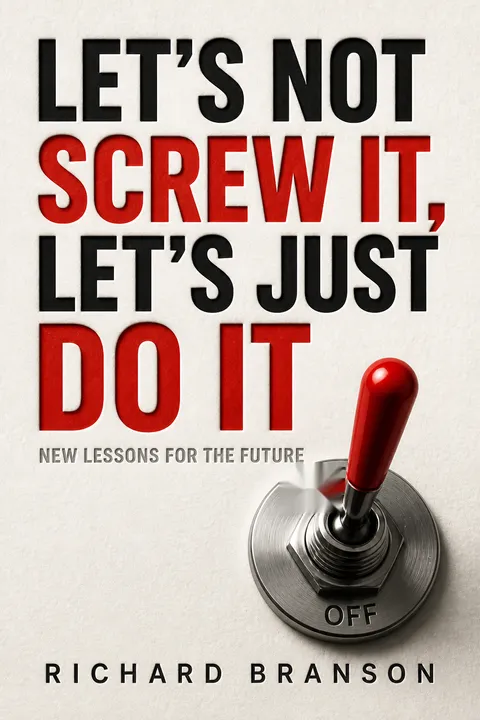
"Let's not screw it, let's just do it" receives mixed reviews. Many find it inspiring and motivational, praising Branson's positive attitude and adventurous spirit. Some appreciate the business insights and life lessons shared. However, critics note the book's rambling structure, repetitive content, and lack of coherent narrative. Some feel it's overly simplistic or self-aggrandizing. Despite these critiques, readers generally enjoy Branson's engaging personality and find value in his experiences and advice on taking risks and pursuing passions.
People Also Read


Glossary
Gaia Capitalism
Business with lower environmental harmRichard Branson's term for a business approach that seeks commercial success while reducing damage to the environment. It emphasizes using the reach and investment power of large companies to develop cleaner technologies and change operations, rather than treating environmental work solely as charity. The book presents it as an organizing principle for Virgin's future plans.
Gaia Theory
Earth as an interconnected systemJames Lovelock's hypothesis that Earth behaves as a connected system in which living organisms and physical conditions affect one another. In the book, Branson uses the idea to stress that industrial actions such as emissions, deforestation, and pollution can have consequences across the planet. It provides the conceptual inspiration for his Gaia Capitalism approach.
Action gap
Awareness without meaningful actionThe distance between recognizing a serious problem and taking steps to address it. Branson applies the phrase to climate change: people, businesses, and governments may discuss the danger while delaying practical responses. The book argues that visible leadership and coordinated action can help close this gap.
Ansari X-Prize
Prize for private spaceflightA competition that offered ten million dollars to the first team to send a person into space using a fully reusable private launch system, then repeat the flight within two weeks. Branson describes the prize as a catalyst for private innovation and as the route through which Virgin became interested in Burt Rutan's spacecraft technology.
Virgin Unite
Virgin's charitable foundationA charitable foundation established by Branson to connect Virgin employees and networks with social and environmental initiatives. The book describes it as a way to bring business capabilities to difficult problems, including health, education, and humanitarian emergencies, while supporting organizations working at both local and global levels.
FAQ
What's "Let's Not Screw It, Let's Just Do It" about?
- Overview: The book is a collection of Richard Branson's personal and professional experiences, offering insights into his approach to business and life.
- Environmental Responsibility: Branson emphasizes the importance of environmental responsibility and how businesses can lead the way in sustainable practices.
- Lessons and Inspiration: It includes lessons Branson has learned throughout his career, aiming to inspire readers to pursue their goals with determination and creativity.
- Future Vision: The book also discusses Branson's future plans for Virgin and his vision for new ventures, such as Virgin Fuels.
Why should I read "Let's Not Screw It, Let's Just Do It"?
- Inspiration: The book is filled with motivational stories and advice from one of the world's most successful entrepreneurs.
- Practical Advice: Branson shares practical tips on achieving success, making it valuable for aspiring entrepreneurs and business leaders.
- Environmental Focus: It provides insights into how businesses can operate sustainably, which is increasingly relevant in today's world.
- Personal Growth: Readers can learn from Branson's personal experiences and apply his lessons to their own lives and careers.
What are the key takeaways of "Let's Not Screw It, Let's Just Do It"?
- Just Do It: Branson emphasizes taking action and not overthinking decisions, encouraging readers to pursue their goals boldly.
- Environmental Responsibility: He advocates for businesses to lead in sustainability and reduce their environmental impact.
- Innovation and Creativity: The book highlights the importance of thinking creatively and finding new ways to solve problems.
- Value of Relationships: Branson stresses the importance of valuing family, friends, and colleagues, and building strong, supportive networks.
What are the best quotes from "Let's Not Screw It, Let's Just Do It" and what do they mean?
- "Screw it, let's do it!": This quote encapsulates Branson's philosophy of taking action and seizing opportunities without hesitation.
- "Do no harm.": Reflects his commitment to environmental responsibility and ethical business practices.
- "Have fun, work hard and money will come.": Emphasizes the importance of enjoying work and maintaining a positive outlook to achieve success.
- "Challenge is the core and mainspring of all human action.": Highlights the importance of setting goals and pushing oneself to grow and achieve.
How does Richard Branson approach environmental responsibility in "Let's Not Screw It, Let's Just Do It"?
- Gaia Capitalism: Branson introduces the concept of Gaia Capitalism, which combines business success with environmental responsibility.
- Corporate Leadership: He believes that large companies like Virgin should lead by example in adopting sustainable practices.
- Long-term View: Branson stresses the importance of considering the long-term environmental impact of business decisions.
- Innovative Solutions: He encourages finding innovative ways to reduce carbon emissions and promote sustainability.
What is Richard Branson's "Just Do It" philosophy?
- Action-Oriented: Branson advocates for taking immediate action rather than overanalyzing or procrastinating.
- Embrace Challenges: He encourages embracing challenges and learning from failures as part of the journey to success.
- Trust Instincts: Branson believes in trusting one's instincts and abilities to navigate new ventures and opportunities.
- Overcome Fear: The philosophy is about overcoming fear and hesitation to pursue one's goals with confidence.
How does Richard Branson view innovation and creativity in business?
- Break the Rules: Branson believes in challenging the status quo and breaking traditional rules to foster innovation.
- Think Creatively: He emphasizes the importance of thinking outside the box to find unique solutions to problems.
- Adaptability: Branson values adaptability and the ability to pivot when faced with obstacles or changing circumstances.
- Encourage Ideas: He encourages fostering an environment where new ideas are welcomed and explored.
What role does family and teamwork play in "Let's Not Screw It, Let's Just Do It"?
- Family Support: Branson highlights the importance of family support in achieving personal and professional success.
- Teamwork: He believes in the power of teamwork and collaboration to drive business success and innovation.
- Loyalty and Trust: Branson values loyalty and trust within his team, which he sees as essential for a thriving business.
- Empowerment: He advocates for empowering team members to take initiative and contribute their ideas.
How does Richard Branson address risk-taking in "Let's Not Screw It, Let's Just Do It"?
- Calculated Risks: Branson emphasizes the importance of taking calculated risks rather than reckless gambles.
- Learn from Mistakes: He encourages learning from mistakes and using them as stepping stones to future success.
- Bold Decisions: Branson believes in making bold decisions to seize opportunities and drive growth.
- Balance: He stresses the need to balance risk with careful planning and research to minimize potential downsides.
What is the significance of "Gaia Capitalism" in Richard Branson's book?
- Sustainable Business: Gaia Capitalism is Branson's approach to integrating sustainability into business practices.
- Holistic View: It involves taking a holistic view of business operations and their impact on the environment.
- Leadership Role: Branson believes businesses should take a leadership role in addressing environmental challenges.
- Long-term Success: He argues that sustainable practices are essential for long-term business success and viability.
How does Richard Branson incorporate fun into his business philosophy?
- Enjoy Work: Branson believes that enjoying work is crucial for maintaining motivation and achieving success.
- Positive Outlook: He advocates for maintaining a positive outlook and finding joy in everyday tasks.
- Balance: Branson emphasizes the importance of balancing hard work with fun to prevent burnout.
- Creative Environment: He encourages creating a work environment that fosters creativity and enjoyment.
What lessons does Richard Branson share about personal growth in "Let's Not Screw It, Let's Just Do It"?
- Continuous Learning: Branson stresses the importance of continuous learning and self-improvement.
- Challenge Yourself: He encourages setting personal challenges to push boundaries and achieve growth.
- Reflect and Adapt: Branson advocates for reflecting on experiences and adapting to new circumstances.
- Embrace Change: He believes in embracing change as an opportunity for personal and professional development.
About the Author



Download PDF
Download EPUB
.epub digital book format is ideal for reading ebooks on phones, tablets, and e-readers.








