

Key Takeaways
Treat sexual liberation as a possible instrument of control, not proof of freedom

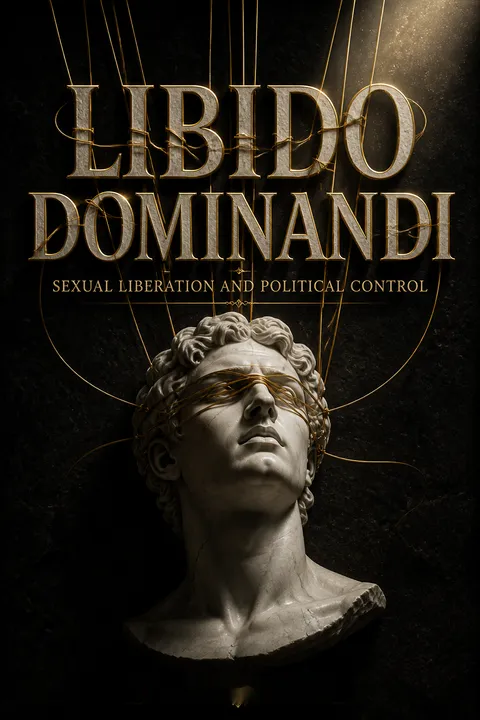
The central claim. Jones builds his argument around libido dominandi, a Latin phrase meaning the lust to dominate. Drawing on Augustine, he argues that people ruled by their vices are not fully free, even when they feel free to pursue them. The political danger, in his account, is that institutions can encourage those desires, then present themselves as guardians of the freedom they have helped make dependent.
A reversal of liberty. The book’s recurring paradox is that the person who believes every desire is self-authored may be easier to steer through images, money, or permission to indulge. The claim connects intimate behavior to political power: who shapes desire may shape conduct without issuing visible commands. Jones uses this as the lens for a long history, from Enlightenment secret societies to twentieth-century media.
What's striking is the distinction between freedom as choice and freedom as self-government. The book asks readers to notice who profits when desire is constantly stimulated, a useful question in an economy built around attention and consumption. But its argument needs a careful boundary: expanding legal or personal choice does not automatically create manipulation, and religious authority can also constrain people. The practical test is not whether a rule is traditional or modern, but whether people have meaningful agency, honest information, and protection from coercion.
Watch revolutions turn liberated desire into a demand for tighter order

A short-lived model. Jones begins with Adam Weishaupt’s Bavarian Illuminati, founded in 1776. The group borrowed organizational practices from Freemasonry and spiritual self-examination from the Jesuits, then used members’ private disclosures to build loyalty and control. It expanded rapidly, reaching roughly 2,000 members, but collapsed amid internal conflict and government suppression in the 1780s.
Ideas travel farther. Jones argues that its lasting influence came less from its brief institutional life than from the papers published after its collapse. Writers and revolutionaries encountered an image of a disciplined, secret network capable of guiding society. The French Revolution then supplied a dramatic example of liberation followed by disorder and coercion. In Jones’s telling, promises of freedom can generate demands for new controls when the old moral order is dismantled.
The chapter offers a useful model of political feedback: a movement weakens existing restraints, disorder follows, and leaders then justify new forms of discipline. That sequence is more persuasive than the suggestion that one secret organization directly caused later revolutions. Ideas can travel through books, institutions, and imitation without a single continuous command structure. The distinction matters because it preserves the insight about unintended consequences while avoiding a conspiratorial shortcut that treats resemblance as proof of coordination.
Notice when scientific language gives appetite a moral alibi

Sade’s thought experiment. Imprisoned in the late eighteenth century, the Marquis de Sade wrote fiction in which characters used materialist theories to excuse cruelty and sexual exploitation. In works such as Justine, they describe morality as a human convention rather than a binding order. Jones argues that this was not simply a philosophical debate: scientific-sounding explanations made it easier to treat other people as instruments of pleasure.
A pattern of rationalization. Sade’s writing joined sexual fantasy to political rebellion, while his own life supplied an example of how desire could outrun judgment. Jones also follows Mary Wollstonecraft, whose revolutionary hopes collided with the abandonment and suffering that followed her relationship with Gilbert Imlay. The contrast suggests that intellectual permission to pursue desire does not erase its consequences for partners, children, or the person pursuing it.
The important distinction is between science describing behavior and ideology using scientific language to excuse it. Facts about bodies do not, by themselves, settle questions of consent, responsibility, or justice. Jones is strongest when he shows how a theory can become a license to disregard another person. His account is less convincing when it implies that materialism inevitably produces cruelty. The more precise question is whether a framework recognizes other people as agents with claims, rather than treating them as means.
Ask who gains when intimate disclosure becomes a tool of surveillance
A method repurposed. Weishaupt’s Quibus Licet notebooks were monthly written disclosures in which members reported details about themselves to superiors. Jones says the practice adapted religious self-examination into intelligence gathering. Seelenspionage, or soul surveillance, meant inferring a person’s character and vulnerabilities from private disclosures and small behaviors, then using that knowledge to guide or control them.
A later parallel. Jones sees similarities in Freud’s psychoanalytic interviews and in Alfred Kinsey’s detailed sexual histories. He argues that such interviews could create dependence and leverage, especially when clients or influential sponsors revealed secrets. His account presents these practices as political control disguised as liberation or therapy. The historical analogy is suggestive, though the book does not establish that psychoanalysis and Illuminism formed one continuous organization.
Confession and disclosure can help people understand themselves, but they also create asymmetries: one person reveals, another interprets, and the interpreter may hold sensitive information. That is a genuine ethical problem in therapy, research, and workplaces. The safeguard is not to abandon disclosure, but to make consent, confidentiality, limits on data use, and independent oversight explicit. Jones’s comparison is most useful as a warning about power; it should not be mistaken for proof that every therapeutic relationship is covert surveillance.
Track how media turn sexual desire into both sales and leverage
Behavior as a technology. John B. Watson argued that psychology should predict and control behavior, while advertising executive Edward Bernays applied psychological insights to public opinion. Jones links their work to a broader ambition: shaping consumers by attaching products to powerful desires. In 1929, Bernays staged a public cigarette-smoking event during New York’s Easter Parade, presenting women’s smoking as emancipation while serving a tobacco company’s commercial goal.
Freedom as a sales pitch. The episode shows how a cause can be used to sell a product and weaken older social norms at the same time. Later advertising made similar links between consumption and independence. Jones argues that media can turn private appetite into financial and political leverage by making a commercial message look like spontaneous public demand.
The Easter Parade story captures a durable feature of public relations: a commercial campaign can borrow the language of social change and make consumption look like self-expression. Modern media literacy asks not only whether a message is persuasive, but who paid for it and what behavior it normalizes. The book sometimes treats audiences as more passive than they are. People reinterpret advertising, resist it, or use it for their own purposes, even when the campaign’s sponsors have considerable power.
Do not let racial justice become a cover for someone else’s agenda
The Negro as symbol. Jones follows Claude McKay, a Jamaican-born writer who became a leading figure in the Harlem Renaissance. McKay’s writing contrasted the intellectual, morally burdened character with the sexually carefree figure, while white patrons and publishers promoted images of Black life that suited their own rebellion against conventional morality. Jones sees a risk in turning real people into symbols of someone else’s desired freedom.
A later reassessment. McKay eventually criticized both Communist politics and the liberal culture that had helped promote him. In his later writing he argued that racial injustice and sexual exploitation could not be solved by treating African identity as a license for any behavior. Jones uses this story to show how race could be recruited into cultural conflict, while also acknowledging that the injustices McKay confronted were real.
The distinction between solidarity and projection is valuable. A movement can support genuine justice while outsiders use its symbols to validate their own choices. But Jones’s account risks treating Black sexual expression mainly as a white intellectual fantasy, which can understate Black agency and the reality of racial oppression. The sounder question is whether a proposed alliance serves the people it claims to represent, and whether it addresses material injustice rather than merely borrowing the moral authority of a cause.
Separate personal birth-control choices from population policy’s political aims
Two arguments collide. Margaret Sanger presented birth control as a way to relieve hardship, while Catholic thinker John A. Ryan argued that contraception could distract from low wages and unequal distribution of wealth. Jones traces an alliance between sexual reformers and wealthy funders, including the Rockefellers, who supported programs aimed at lowering fertility among poorer groups. He notes that the 1934 congressional debate joined birth control to claims about poverty and population.
The wider stakes. In Jones’s account, contraception offered individuals control over reproduction while also serving eugenic and political projects. The same method could be chosen freely by a couple or promoted coercively toward a targeted population. The distinction became especially important when foundations and, later, government programs focused on poor communities and racial minorities.
This section is strongest when it separates a person’s reproductive choice from a state’s demographic agenda. The same technology can support autonomy in one setting and coercion in another, depending on who sets the goals and who bears the pressure. The nuance is crucial: access to contraception can be a meaningful freedom, while using it as a substitute for wages, healthcare, or economic reform can serve powerful interests. Both realities can coexist.
Question claims about everyone when research samples the sexually unusual
Kinsey’s reach and limits. Alfred Kinsey’s Sexual Behavior in the Human Male appeared in 1948, followed by a volume on women in 1953. The Rockefeller Foundation supported his research, which relied on detailed interviews about sexual behavior. Jones argues that Kinsey’s interviewees were not a representative cross-section: they included people recruited from prisons, gay bars, and other unusual settings, as well as volunteers willing to discuss intimate conduct.
A problem of inference. Critics raised concerns about self-selection and sampling, but Kinsey’s findings were widely presented as a portrait of ordinary Americans. Jones argues that this apparent scientific authority helped challenge sexual norms and influence law. The central lesson is methodological: vivid testimony can reveal experiences, but it cannot establish how common those experiences are without a defensible sampling design.
The distinction between documenting a behavior and estimating its prevalence is basic to sound research. A biased sample can still reveal important patterns, especially among groups often excluded from study, but it cannot automatically stand in for a whole population. The book is persuasive in flagging that gap. Its own account also benefits from the same caution: allegations about Kinsey’s motives, funding, and research practices should be separated from what the available evidence can demonstrate.
Judge reforms by who gains agency, and who bears their costs
The backlash problem. Jones compares the Soviet experiment with sexual liberation to the American changes of the 1960s. In his account, permissive laws and weakened family norms initially promised freedom, but rapid social disruption prompted authorities to restore stricter controls. He points to Soviet reforms on divorce and abortion, followed by tighter policy under Stalin, as an example of liberation giving way to reaction.
A test for reform. The book ends by asking readers to look beyond slogans. A reform that expands choice for some may also shift burdens onto women, children, or poorer communities. Jones argues that institutions can promote liberation while preserving control over the people most affected. The practical measure is therefore not permissiveness alone, but whether people gain real agency and whether the costs are fairly shared.
This is a useful closing test because it makes outcomes, not labels, the measure of a policy. A law can expand autonomy while social conditions leave some people more vulnerable, and a protective rule can itself become coercive. The Soviet example illustrates political reversal, but it does not prove that sexual liberalization must produce authoritarian backlash. The more careful lesson is to examine who can exercise a new freedom, who cannot, and which institutions gain power over the transition.
Analysis
The book’s most compelling idea is that a society can weaken self-restraint while presenting the result as liberation, then use the instability that follows to justify new forms of management. Its examples connect intimate life to advertising, research, philanthropy, and law. That is a useful corrective to histories that treat sexuality as purely private or assume that consumer choice is automatically freedom. The recurring question, who controls the conditions under which people choose, remains relevant beyond the book’s period.
Its historical method is less secure than its central question. Jones often moves from resemblance to lineage: because Weishaupt’s methods, psychoanalytic confession, advertising, and modern research all involve gathering intimate information, he treats them as parts of a transgenerational project. The parallels are provocative, but they do not by themselves establish continuous coordination or common intent. Likewise, the book’s strong moral framework can make secular reform appear uniformly manipulative, while underplaying cases where legal contraception or access to information genuinely enlarges individual agency.
The account of Kinsey illustrates both the book’s value and its limits. It rightly distinguishes a vivid set of interviews from a representative survey and asks how funding and publicity shape scientific authority. But methodological weakness does not make every reported experience false, nor does it establish that research was designed chiefly as political control. A careful reader should separate three questions: whether the data are sound, whether the interpretation is warranted, and who uses the conclusions.
The most productive way to read the book is therefore neither as a neutral history nor as a conspiracy map. It is a forceful argument about the political uses of desire, supported by episodes that deserve independent scrutiny. Its enduring contribution is the insistence that freedom must be evaluated alongside agency, power, and consequences.
Review Summary
Libido Dominandi receives mixed reviews, with many praising its ambitious scope and thought-provoking thesis on sexual liberation as a form of political control. Supporters find it insightful and well-researched, while critics argue it lacks proper editing, coherence, and historical accuracy. Some readers appreciate Jones' extensive examples and chronological approach, while others find the writing repetitive and disorganized. Despite its flaws, many consider it an important work for understanding the relationship between sexuality and political power in Western society.
Glossary
libido dominandi
lust for dominationA Latin phrase Jones takes from Augustine to describe the desire to rule others. In the book, it also names a paradox: people who stir up others’ passions to control them may themselves be governed by their own appetite for power. Jones uses the phrase to connect personal vice with political domination.
sexual revolution
political mobilization of sexual viceJones uses this term for more than changes in private sexual behavior. He defines it as the public justification and political use of sexual conduct outside inherited moral rules. In his account, it can challenge religious authority, reshape social norms, and create opportunities for institutions or commercial interests to influence behavior.
Seelenspionage
surveillance of the soulA term associated in the book with Weishaupt’s practice of inferring an adept’s character and vulnerabilities from private disclosures, small gestures, and patterns of behavior. Jones contrasts this use of intimate knowledge for organizational control with religious self-examination intended to guide conscience.
Quibus Licet
monthly private reportsThe name Jones gives to written reports used within the Illuminati, in which members disclosed personal details to superiors. The practice was modeled on forms of religious examination, but in the Illuminati it served to gather information about members and help leaders direct or influence them.
sex-pol
sexual politicsWilhelm Reich’s term for linking sexual reform to political revolution. Reich argued that sexual repression supported authoritarian social structures, while sexual liberation could mobilize people against them. The book presents sex-pol as a strategy for organizing political action around sexual grievances.
sex-economy
Reich’s sexual-energy theoryReich’s theory that sexual energy and the capacity for satisfying sexual release are central to psychological health and social life. He argued that sexual repression produced neurosis and supported authoritarianism. Jones presents this theory as both a therapeutic claim and a political program.
Kinsey Report
sexual behavior interview studiesThe name commonly given to Alfred Kinsey’s reports on sexual behavior, beginning with the 1948 volume on men and the 1953 volume on women. Kinsey’s team collected detailed interviews. Jones emphasizes that the samples were not representative of the general population and argues that the findings were used to challenge existing sexual norms.
FAQ
1. What is Libido Dominandi: Sexual Liberation and Political Control by E. Michael Jones about?
- Central Thesis: The book argues that sexual liberation is not just a social or moral phenomenon but a deliberate tool of political and social control, engineered to manipulate populations by managing their passions.
- Historical Scope: Jones traces this dynamic from the Enlightenment through the French Revolution, the rise of psychoanalysis, and into the 20th-century sexual revolution, connecting key figures and movements.
- Philosophical Foundation: Drawing on St. Augustine’s concept of “libido dominandi” (the lust to dominate), Jones claims that the pursuit of sexual freedom paradoxically leads to new forms of bondage and domination.
- Mechanisms of Control: The book explores how technologies like psychotherapy, behaviorism, advertising, and pornography have been used to undermine traditional morals and impose subtle, pervasive control.
2. Why should I read Libido Dominandi by E. Michael Jones?
- Critical Perspective: The book challenges mainstream narratives that celebrate sexual liberation as progress, offering a provocative critique of modernity’s moral and social transformations.
- Historical and Intellectual Depth: Readers gain a comprehensive understanding of how sexual politics, revolutionary movements, and psychological theories have shaped contemporary society.
- Relevance to Current Issues: The analysis helps readers critically assess ongoing debates about sexuality, family, law, and culture, revealing the hidden mechanisms behind social change.
- Insight into Power Dynamics: The book provides a unique lens on how elites use sexual liberation to consolidate political and cultural power.
3. What are the key takeaways of Libido Dominandi by E. Michael Jones?
- Sexual Liberation as Control: Sexual freedom is portrayed as a calculated strategy to undermine moral order and impose new forms of control through the management of passions.
- Moral Order and True Freedom: Jones argues that true freedom depends on moral self-control; without it, individuals become slaves to their vices, inverting the promise of liberation.
- Cultural and Political Consequences: The sexual revolution is linked to family breakdown, social chaos, and political manipulation, including population control policies and the weakening of religious institutions.
- Historical Continuity: The book connects Enlightenment ideas, secret societies, and modern psychological techniques as part of a continuous project to reshape society through sexual politics.
4. What is the concept of “libido dominandi” in E. Michael Jones’s Libido Dominandi?
- Definition and Origin: “Libido dominandi” means “the passion for dominion,” a term from St. Augustine describing the paradoxical desire to dominate others while being dominated by one’s own passions.
- Philosophical Argument: Jones uses this concept to explain how revolutionary movements invert Christian values, promoting liberation that leads to new forms of bondage and control.
- Application to Sexual Politics: The book shows how sexual liberation, once separated from traditional morals, becomes a tool for social and political domination.
- Psychological and Political Implications: Understanding libido dominandi is key to grasping why revolutions often result in tyranny and why sexual freedom can lead to increased social control.
5. How does E. Michael Jones in Libido Dominandi connect sexual liberation with political and social control?
- Sexual Liberation as Political Tool: Jones argues that regimes promote sexual addiction and license to exploit passions for financial and political gain, using sexual liberation to control populations.
- Double Truth System: The book describes a system where the public is told sexual liberation is freedom, but in reality, it serves as a mechanism of control.
- Financial and Psychological Exploitation: Pornography and sexual license are likened to addictive substances, used to weaken traditional restraints and make individuals more susceptible to manipulation.
- Invisible Governance: People identify with their passions and thus defend the regime that enables their gratification, often unaware of the manipulation at play.
6. What role do secret societies and psychoanalysis play in the control mechanisms described in Libido Dominandi?
- Illuminati as Prototype: The Illuminati, founded by Adam Weishaupt, is presented as the first modern secret society using psychological manipulation and confession-like techniques to control members.
- Psychoanalysis as Modern Equivalent: Freud’s psychoanalysis is depicted as a secular secret society, using rituals and confessions to maintain control over followers and manage guilt and passion.
- Influence on Modern Control: These secret society models influenced later systems of psychological and political control, including behaviorism and advertising.
- Literary and Cultural Impact: The motif of secret societies also shaped literature and conspiracy theories, revealing hidden networks of power in modern history.
7. How does Libido Dominandi explain the influence of the Enlightenment and revolutionary movements on sexual politics?
- Philosophical Foundation: The Enlightenment is portrayed as the origin of efforts to liberate humanity from religious morals, replacing them with reason and science.
- Dialectic of Freedom and Control: Enlightenment ideals of liberty led to social chaos, necessitating new mechanisms of control, a pattern repeated in subsequent revolutions.
- Legacy in Modern Systems: Enlightenment ideas inspired secret societies, psychoanalysis, and behaviorism, all aimed at controlling populations by manipulating passions.
- Inversion of Values: The Enlightenment’s rejection of Christian morals created a worldview where reason serves the will to power rather than moral truth.
8. What is the significance of figures like Adam Weishaupt, the Marquis de Sade, and Wilhelm Reich in Libido Dominandi?
- Adam Weishaupt: Founder of the Illuminati, Weishaupt developed psychological control systems that prefigured modern surveillance and manipulation techniques.
- Marquis de Sade: Sade articulated sexual liberation as a political project, linking sexual vice to domination and showing how “freedom” can become bondage to passion.
- Wilhelm Reich: Reich’s theories connected sexual repression to mystical religion and social order, arguing that sexual liberation could be used to mobilize masses for revolution.
- Historical Continuity: These figures exemplify the book’s thesis that sexual liberation and political control are historically intertwined.
9. How does E. Michael Jones in Libido Dominandi analyze the role of foundations, population control, and the Catholic Church?
- Foundations as Drivers: Organizations like the Rockefeller Foundation funded birth control, sexual research, and population control as tools for ethnic and political warfare.
- Population Control as Imperialism: Population control policies are depicted as a form of demographic warfare, aimed at weakening both domestic opposition groups and developing nations.
- Catholic Church’s Internal Struggles: The book details how Catholic institutions and leaders were pressured or co-opted into supporting sexual liberation and population control, leading to internal dissent and weakened moral authority.
- Land o’ Lakes Statement: This declaration by Catholic universities marked a shift toward secularization and alignment with foundation interests, undermining Church teaching on sexuality.
10. What does Libido Dominandi say about the role of pornography in political and social control?
- Pornography as a Tool: Pornography is portrayed as a key instrument in fostering addiction, isolation, and distorted views of sexuality, weakening family structures and moral restraints.
- Behavioral Impact: The book presents evidence that exposure to pornography increases sexual violence and deviant behavior, challenging the idea that it provides harmless catharsis.
- Industry and Political Power: The pornography industry is shown to be deeply connected to political and legal power structures, using PR campaigns and legal challenges to protect its interests.
- Regulatory Challenges: The Lockhart Commission’s findings, influenced by political interests, led to a flood of pornography and normalization of sexual violence.
11. How does Libido Dominandi address the intersection of race, sexual liberation, and political control?
- Race as Symbol of Liberation: The book argues that white liberals idealized African American ghetto mores as paradigms of sexual freedom, using them to justify rebellion against Christian norms.
- Sexual Liberation as Eugenics: Promotion of contraception and family breakdown among blacks served both sexual liberation and covert eugenic policies aimed at demographic control.
- Political Exploitation: Both the Left and establishment elites used race and sexual liberation to reshape society, weakening traditional family structures for political ends.
- Cultural Consequences: The rejection of moral critiques like the Moynihan Report perpetuated family pathology and undermined efforts to address social decay.
12. What are the best quotes from Libido Dominandi by E. Michael Jones and what do they mean?
- St. Augustine on Freedom: “A good man, though a slave, is free; but a wicked man, though a king, is a slave. For he serves, not one man alone, but, what is worse, as many masters as he has vices.” This encapsulates the book’s thesis that true freedom is moral self-mastery.
- “Either prayer or masturbation”: This phrase, from Reich’s insight, frames the political struggle over sexual mores as a binary choice between spiritual discipline and sexual gratification.
- “He who controls sex controls the state”: This highlights the central argument that sexual norms are foundational to political power and social order.
- “Those who wished to liberate man from the moral order needed to impose social controls as soon as they succeeded because liberated libido led inevitably to anarchy.” This quote explains why sexual liberation is always followed by new forms of control.
Download PDF
Download EPUB
.epub digital book format is ideal for reading ebooks on phones, tablets, and e-readers.








