

Key Takeaways
Treat the post-presidency as a consequential chapter, not an epilogue.
Power must be surrendered. George Washington established a democratic precedent by giving up military command after the Revolution, then leaving the presidency after two terms. King George III had doubted that a victorious general would return to private life, but came to regard Washington's restraint as extraordinary. The book begins with this democratic stake: peaceful transfers of power depend on leaders accepting that office is temporary. Even in the United States, the transfer cannot be assumed to be safe or orderly.
The work continues. Former presidents lose formal authority, but keep public standing and face ordinary questions about money, family, relevance, and identity. Jared Cohen follows seven presidents who made very different choices with that influence. Their stories show that leaving office can become a new arena for achievement, conflict, or restraint.
What's striking is that stepping down is not merely a personal adjustment. It is part of how a political system demonstrates that its rules matter more than any one leader. The sociology of role exit describes the strain of losing a role that organizes identity, status, and daily life; a president experiences that strain at an unusually public scale. Yet the comparison with ordinary retirement has limits. Former presidents retain staff, security, money, and exceptional access. Their freedom after office is real, but it is not equally available to most people.
Turn an old ambition into an institution that outlives your title.
A postponed purpose returned. Thomas Jefferson had wanted to found a university long before he became president. After leaving office in 1809, he finally devoted himself to the project, combining his interest in education with his belief that a republic required an educated public. He planned the curriculum, recruited faculty, persuaded Virginia lawmakers to provide funding, and designed the University of Virginia around an academic village. The school opened in 1825, after seventeen years of post-presidential work.
Founding was imperfect. At eighty-two, Jefferson wept when students rioted on the new campus, fearing that his life's work would fail. The institution survived. But its buildings relied on enslaved labor, and Jefferson enslaved Sally Hemings and their children. A lasting institution can carry both a founder's ideals and the exclusions those ideals failed to overcome.
Jefferson's university illustrates how institutions extend a person's influence beyond a lifetime, while also preserving the biases of their founding conditions. Institutional theory helps explain the double edge: rules, buildings, curricula, and traditions can make an idea durable, but durability is not proof of moral success. The university's continued life does not settle judgment of its founder. Its history instead gives later generations a place to examine the gap between stated principles and lived practice, including who was permitted to learn and who was forced to build.
Let defeat redirect ambition toward the cause you can actually serve.
A lost election opened a door. After losing the presidency to Andrew Jackson in 1828, John Quincy Adams returned to Congress, a role no former president had held. He initially lacked a clear second-act plan. Then abolitionists sent him petitions, and he insisted that Congress hear them. In 1836, he fought a rule that suppressed debate on slavery, arguing that it violated the right to petition. The rule was finally repealed in 1844.
The work found him. Adams also represented Africans seized aboard the Amistad before the Supreme Court. The Court ruled they were free and could return to Africa. Adams served nine terms in the House and died in the Capitol in 1848. His presidency became a brief interruption in a longer career devoted to public service and, increasingly, abolition.
Adams's return shows how a new role can reveal a purpose that was not clear at the outset. His second act also demonstrates the political force of procedural rights: protecting the ability to petition and debate made it harder for lawmakers to keep slavery outside public scrutiny. Still, he was neither a perfect abolitionist from the beginning nor a disinterested observer. His views evolved, and personal resentment toward political opponents sometimes sharpened his attacks. Principle, temperament, and opportunity worked together rather than appearing as a tidy conversion story.
Winning your old role back may cost the life you built.
The comeback had a price. Grover Cleveland lost the 1888 election in the Electoral College despite winning the popular vote. Four years later, he returned to the White House, the only former president to win a nonconsecutive term. He believed his party was heading toward policies he opposed, especially on tariffs and currency, and thought his principles justified another run.
The job had changed. Cleveland's second term brought the Panic of 1893, a bitter fight over silver, unrest during the Pullman Strike, and a dispute over annexing Hawaii. He also secretly underwent cancer surgery aboard a yacht, fearing that news of his illness would worsen public panic. He left office unpopular and melancholy. His quiet years at Princeton and with his family brought greater comfort than the comeback had.
Cleveland complicates the familiar idea that returning to a lost position restores what was lost. The title came back, but the surrounding conditions had shifted, and each crisis competed with the policy goals that had motivated his return. Decision research often distinguishes controllable choices from outcomes shaped by circumstance; Cleveland could choose to run, but not the economic shocks or political coalitions he would inherit. His story does not prove that a comeback is wrong. It asks whether the work still matters enough to justify its costs.
Persist toward the work you wanted, not the title others wanted.
Taft wanted the bench. William Howard Taft spent years hoping to join the Supreme Court. Theodore Roosevelt offered him a seat three times, but Taft declined twice while he believed his work governing the Philippines needed him. His wife, brothers, and Roosevelt encouraged him toward the presidency instead. Taft accepted, though he preferred judicial work, and lost reelection in 1912 after finishing third.
The delayed goal arrived. Taft stayed connected to public service and the Republican Party. In 1921, President Warren Harding appointed him chief justice. Taft then reorganized the federal judiciary, helped secure a separate Supreme Court building, and supported reforms that gave the Court greater control over its caseload. He called those final years the most fulfilling of his life. His route required patience, but also unusual access and fortunate timing.
Taft's story distinguishes persistence from simple ambition. He did not merely climb toward the most prestigious job available; he remained oriented toward work that fit his interests and abilities. Career research often finds that satisfaction depends on a match between a person's strengths and a role, not simply rank. Still, Taft's outcome cannot be reduced to perseverance. Family influence, elite networks, presidential patronage, and the death of a chief justice all mattered. The useful lesson is to preserve a goal while recognizing that opportunity is partly structural and partly luck.
Use competence to serve again, even when reputation refuses full repair.
Defeat did not erase ability. Herbert Hoover left office in 1933 with the Great Depression attached to his name. For twelve years, he criticized Franklin Roosevelt's New Deal, while the public and his own party largely kept him at a distance. Roosevelt's death created an opening. President Harry Truman invited Hoover to assess postwar food needs, then asked him to lead an international relief effort.
Work rebuilt trust. In 1946, Hoover traveled 35,000 miles across twenty-two countries in fifty-seven days, urging governments with food surpluses to help famine-struck populations. He later helped Truman and Eisenhower reorganize the executive branch. His standing improved, though the Depression continued to define much of his legacy. His recovery came less from winning an argument about the past than from being useful in the present.
Hoover's rehabilitation depended on a practical form of trust: Truman needed expertise, and Hoover had it. Their collaboration shows how cross-party service can restore working relationships without requiring ideological agreement or historical amnesia. It also cautions against treating later good works as an acquittal for earlier decisions. Hoover's presidency remains open to debate, including the effects of his policies during the Depression. Public service after failure can add evidence to a life story, but it cannot erase the consequences people experienced.
Build an independent platform when office ends before your work does.
Carter extended his presidency. After losing in 1980, Jimmy Carter returned to Plains, Georgia, with debts, no clear next job, and a 34 percent approval rating. He and Rosalynn built a new base at Emory University: the Carter Center, founded to continue work on peace, public health, and democracy. He also volunteered with Habitat for Humanity and monitored elections around the world.
Results became measurable. The Center helped lead the campaign against Guinea worm disease, which affected about 3.5 million people annually in 1986. By 2018, reported cases had fallen to twenty-eight. Carter's independence also had risks. His dealings with North Korea exceeded the White House's intended role, and his forceful criticism of Israel drew serious objections, including resignations from Carter Center advisers. His activism expanded the former presidency, but not without controversy.
Carter demonstrates how a former leader can turn reputation and relationships into an institution with practical capacity. The Guinea worm campaign is especially instructive because it links sustained attention to a preventable disease with surveillance, public education, and local health partnerships. Yet independent diplomacy creates a governance problem: an ex-president can open doors, but lacks the democratic mandate and coordination of the sitting administration. Carter's model is powerful when access serves neglected needs; it becomes more questionable when personal certainty displaces the policy process.
Leave politics behind, then let a new craft carry your voice.
Bush chose a clean break. George W. Bush left office with a 34 percent approval rating and no plan to return to politics. He wrote a memoir, built the Bush Center, and focused on family, faith, and painting. His center continued initiatives begun during his presidency, including PEPFAR, the American program to fight HIV and AIDS, and projects supporting veterans.
A different public voice emerged. Bush painted portraits of veterans and immigrants, using personal stories to draw attention to people often missing from political debate. His approval rose above 60 percent, though that shift also reflects time and changing political context. Unlike Carter, he rarely criticized successors by name. His restraint did not mean silence: it allowed him to speak through chosen subjects and causes without trying to reclaim the presidency.
Bush's approach suggests that public influence does not require constant commentary. Painting created a slower, more personal channel: a portrait can direct attention toward a veteran's injuries or an immigrant's history without turning the subject into a policy argument. This resembles narrative persuasion, in which particular lives can make broad issues easier to see. But restraint is not automatically virtuous. Silence can protect successors from unfair interference, or leave consequential questions unanswered. Bush's selective interventions matter because they are paired with visible withdrawal, not because withdrawal alone guarantees approval.
Choose continuity, reinvention, or restraint for the life after power.
There is no standard second act. Jefferson and Carter carried earlier commitments into new institutions. Adams found a cause through a lower office. Taft waited for a long-deferred vocation. Hoover rebuilt through service after disgrace. Cleveland returned to power and learned that restoration could bring new burdens. Bush left politics and found another medium for public expression.
Make the transition concrete. These cases suggest three useful questions for anyone leaving an all-consuming role: Which part of the work still feels worth doing? Which parts of the old identity should be released? What practical supports, including money, relationships, and health, will the next chapter require? The presidents had unusual resources and public platforms, but their underlying challenge was recognizable: a title ends before a person's need for purpose does.
The book's strongest contribution is not a recipe but a range of outcomes. It resists the assumption that reinvention always means starting over, or that continued public activity is always better than stepping back. In identity research, transitions are easier to navigate when people can preserve valued elements of the old self while testing new roles. Yet the presidents' wealth, networks, and institutional access make their options exceptional. For most people, the transferable lesson is not to imitate a presidential project, but to plan for the material and relational conditions that make any next chapter possible.
Analysis
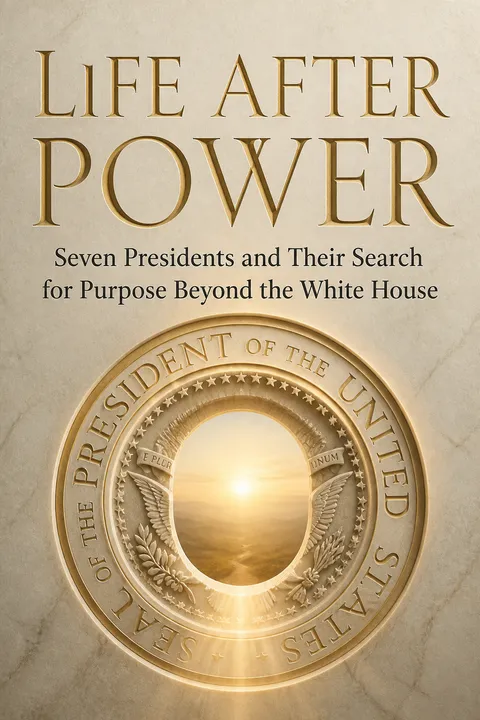
Life After Power turns presidential biography around: instead of treating departure from office as a fade-out, it treats the years afterward as a revealing test of identity, ambition, and democratic restraint. Its seven lives form a useful spectrum. Jefferson and Carter extend existing missions through institutions. Adams discovers an unexpected cause. Taft waits for a vocation that fits. Hoover rebuilds usefulness after repudiation. Cleveland's return warns that restoring a position cannot restore its earlier conditions. Bush tests the possibility of influence without political combat.
The book's historical argument is also institutional. Washington's willingness to leave made later post-presidencies possible, and every former president since has had to interpret a role the Constitution does not formally define. They lack the office's legal authority but retain symbolic authority, access, and a public following. That combination makes former presidents potentially valuable mediators and servants, but also potential rivals to successors. The post-presidency is therefore not inherently benign. Its democratic value depends on how former leaders use influence and whether citizens continue to distinguish service from a claim to power.
The comparison with ordinary career transitions is illuminating but incomplete. Presidents can draw on pensions, security, staff, foundations, and global recognition. Their ability to turn a private interest into a university, center, or humanitarian campaign is not a typical retirement option. The more general lesson is about the questions beneath those exceptional resources: what work remains meaningful, what identity can be released, and how should influence be exercised after formal authority ends?
The cases also resist simple reputational moralizing. Carter's public-health achievements coexist with contested diplomacy. Hoover's later service does not settle debate about his presidency. Bush's improved standing may reflect both conduct and changing political context. That tension strengthens the book's argument: a life after office can alter a public legacy, but it does not erase earlier choices. The best final chapter may be continued service, a different craft, or a dignified exit. The decisive distinction is whether the former leader accepts that the office belongs to the institution, not to its past occupant.
Glossary
Overview Effect
Perspective shift from spaceA term for the cognitive shift some astronauts experience after seeing Earth from space. The view can make national borders and ordinary concerns seem smaller, while drawing attention to global problems. The book uses this idea as a contrast: former presidents move from global-scale responsibility back to ordinary civilian life, often with a reduced public platform.
Gag Rule
Rule suppressing antislavery petitionsA congressional rule adopted in 1836 that prevented the House from debating or acting on petitions concerning slavery. John Quincy Adams challenged it as an infringement on the right to petition and used procedural arguments to keep the issue in public view. The House repealed the rule in 1844.
cognitive reappraisal
Reframing a changed situationA psychological process of assessing what is at stake in a situation and reconsidering how to cope with it. In the book, Jimmy Carter uses this kind of reframing to treat his former-president status not simply as a loss of authority, but as a new way to continue work on diplomacy, health, and democracy.
Pariah Diplomacy
Diplomacy from the political marginsJimmy Carter's label for his willingness to engage governments and political actors that the United States might isolate or punish. He believed dialogue and mediation could achieve results where exclusion could not. The approach let him act independently as a former president, but also risked conflicting with the sitting administration's policy and diplomatic authority.
President's Emergency Plan for AIDS Relief
U.S. HIV and AIDS relief programUsually called PEPFAR, this U.S. initiative began during George W. Bush's presidency to address HIV and AIDS, especially in Africa. The Bush Center continued related health work after he left office, including efforts against cervical cancer among women living with HIV. The book presents the initiative as an example of a former president supporting a policy commitment begun in office.
Download PDF
Download EPUB
.epub digital book format is ideal for reading ebooks on phones, tablets, and e-readers.








