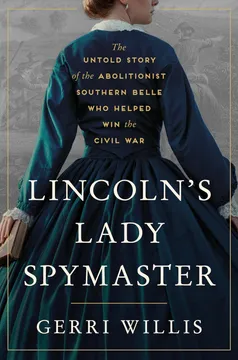


Key Takeaways
A Richmond socialite became Grant's vital source by organizing the overlooked.
A hidden command center. Elizabeth Van Lew began the Civil War as a wealthy, well-connected Richmond woman who opposed secession and slavery. She stayed in the Confederate capital, where she used her home, money, social skills, and network of Black and white allies to gather information and help Union prisoners. Her operation grew from charitable visits into a spy network that reported on troop movements, defenses, shortages, and morale to Union commanders, including Ulysses S. Grant.
Evidence surfaced late. Van Lew rejected the label of spy, but records rediscovered in the National Archives decades after the war documented the scale of her work. The book’s central claim is that her largely invisible network became one of the Union’s most effective intelligence operations inside the Confederacy.
What's striking is that the story treats intelligence as a social achievement, not merely an individual talent. Van Lew could collect useful facts because she connected people who otherwise had little reason to trust one another. That makes her operation resemble a distributed organization: its strength came from many ordinary observations coordinated by a capable center. The record also counsels against equating secrecy with insignificance. Historical fame often follows the surviving document trail, not the actual weight of a person's contribution.
Make private moral convictions costly through action, not just identity.
Conviction inside contradiction. Van Lew grew up in Richmond's elite world, where slavery shaped household labor, commerce, and social status. Her family enslaved people, and her father resisted her wish to free them. Yet she was deeply troubled by slavery's violence and by secessionists' efforts to silence Unionists. Her views were shaped by her mother's family history of abolitionism and by education in Philadelphia, away from schools designed to reinforce Southern loyalties.
Not a simple heroine. Van Lew and her mother freed Mary Jane Richards, educated her, and sent her to Liberia, a decision that reflected the colonization movement's belief that Black Americans should relocate to Africa. Mary later returned to Richmond and worked with Van Lew. The story shows a determined opponent of slavery whose choices still bore the limits and assumptions of her era.
Van Lew's life resists the tidy moral categories often imposed on historical actors. Opposition to slavery did not automatically free someone from the social assumptions that made racial hierarchy seem normal. Her treatment of Mary combines extraordinary investment in one person's future with a paternalistic plan made largely on her behalf. That tension does not erase Van Lew's courage. It makes the historical question sharper: how can people challenge an unjust system while still carrying parts of its logic?
Use the role others assign you as cover, then exceed it.
A genteel disguise. Van Lew's status as a Southern lady could open doors and lower suspicion. When Confederate officials initially refused her access to Union prisoners, she adjusted her approach, invoking Christian charity and the expectations of respectable womanhood. She complimented prison chief John Winder's appearance, won permission to visit inmates, and brought food, clothing, books, and family messages. The same visits also helped her learn how Richmond's prisons worked and build relationships with people who could provide information.
More than a mask. Her social position offered protection, but it also set limits on what others thought she could do. Van Lew turned those assumptions to her advantage without relying on charm alone. She studied people, took calculated risks, and kept widening her work even after newspapers accused her and her mother of helping the enemy.
The strategy works because it turns a constraint into an access point. In many organizations, people who are underestimated can hear or see what the powerful overlook, but invisibility is not automatically an advantage. It becomes useful only when paired with judgment, preparation, and a way to act on what is learned. Van Lew's case also makes the tactic's cost visible: the social conventions that protected her could expose others, especially Black operatives with far less status or safety.
Treat care as infrastructure: trust and escape routes grow together.
Help created access. Van Lew's first wartime work was not dramatic intelligence gathering. She and her mother cared for wounded Union prisoners, smuggled letters, and sometimes took sick men into their home. Prisoners and their families came to trust them. Their efforts also brought Van Lew into contact with Unionists beyond her elite circle, including German merchants, workers, and people connected to the prison system.
A network behind the door. Her Church Hill home had a concealed space where escaped prisoners could hide before attempting to reach Union lines. In February 1864, 109 men escaped through a tunnel from Libby Prison; 59 ultimately reached safety. Van Lew did not plan the tunnel, but her network had helped create the safe houses, contacts, and confidence that made escape more possible. Care was not separate from the operation. It was one of its foundations.
This episode clarifies how trust becomes operational: people take risks when they believe help exists beyond the first dangerous step. Food, shelter, messages, and safe passage formed a practical system, not just a series of generous gestures. The same principle appears in crisis response, where a plan is only credible if people know who will receive them and what happens next. Still, support networks distribute risk unevenly. The book's examples remind readers that the helpers with the least public recognition often faced the gravest consequences.
Turn scattered observations into verified reports with secure channels.
From rumor to dispatch. Van Lew gathered information from prisoners, servants, free Black residents, merchants, and contacts inside Confederate offices. Her couriers carried notes in hidden compartments and clothing; reports could be encoded or written in invisible ink. A cipher let her convert letters into numbers. She also used ordinary traffic, including food deliveries and railway work, to move information without drawing attention.
Mary's story has limits. The familiar claim that Mary Jane Richards served as a spy inside the Confederate White House rests on later accounts that conflict with Mary's own descriptions and are difficult to verify. The book presents the possibility while acknowledging the gaps. What is clearer is that Mary gathered information in Richmond and supported Van Lew's network. Strong intelligence depended not only on daring, but on careful handling and honest attention to what the evidence can establish.
The distinction between collecting information and establishing what is true matters especially in espionage, where rumor can be weaponized and sources have incentives to mislead. Van Lew's use of multiple channels reduced dependence on any single informant, while the uncertain White House story shows why a compelling tale should not outrun its documentation. That discipline is useful well beyond military history: a claim can be important, plausible, and still unproven. Preserving that uncertainty strengthens, rather than weakens, the account.
Demand analysis, not raw reports, before commanders commit lives.
Bad estimates have a price. Early Union intelligence was uneven. Allan Pinkerton's operation supplied information to General George McClellan, who already feared the Confederate army was larger than it was. Inflated estimates reinforced his hesitation during the Peninsula Campaign. General Grant also learned at Shiloh that reports from deserters could mislead: he discounted the Confederate army's strength and readiness, and thousands of Union soldiers were lost in the surprise attack.
A more complete picture. The Army of the Potomac's Bureau of Military Information, or BMI, combined reports from scouts, prisoners, deserters, captured papers, and newspapers. Its chief, George Sharpe, organized and assessed those sources, producing maps and estimates of enemy strength. Van Lew's reports became an important part of that larger effort. Intelligence could inform decisions, but it could not guarantee victory or replace a commander's judgment.
The contrast between Pinkerton's estimates and the BMI's method captures a fundamental organizational problem: data do not become knowledge merely by accumulating. Someone must compare sources, identify uncertainty, and translate findings into decisions. This is particularly important when a leader's prior belief can distort incoming evidence, as McClellan's inflated picture suggests. Yet analysis has limits. Even accurate intelligence cannot remove chance, weather, or an opponent's choices. Its real value is narrower and more defensible: it helps leaders make fewer decisions in the dark.
Separate wartime audacity from evidence, especially when retaliation becomes tempting.
The raid's dangerous aftermath. In 1864, Union forces attempted a bold cavalry raid toward Richmond to free prisoners. The operation failed amid bad weather, poor coordination, and resistance. Ulric Dahlgren was killed, and papers found on his body described plans to destroy parts of the city and kill Confederate leaders. Van Lew believed the orders were fabricated. The book's account concludes that the documents were genuine, while the identity of whoever authorized their most extreme language remains disputed; it presents Secretary of War Edwin Stanton as a possible author, not a proven one.
A widening war. The affair inflamed anger on both sides. Confederate covert operations also expanded into Northern territory. John Wilkes Booth, first intent on abducting Lincoln for a prisoner exchange, abandoned that plan and assassinated him in April 1865. These events show how escalating violence made restraint harder, while leaving questions about responsibility unresolved.
This section is strongest when it distinguishes levels of certainty. The papers can be treated as genuine without pretending that their precise chain of command is settled. That distinction matters because wartime propaganda converts ambiguity into certainty, often to justify revenge. The wider lesson is not that escalation makes every actor equally culpable. It is that the move from a bounded military objective to attacks on leaders, civilians, or political symbols changes the conflict's moral and strategic terrain, sometimes in ways no planner can control.
Expect victory to rewrite memory, not settle who deserves recognition.
The war ended; exclusion did not. Richmond fell in April 1865 after Union forces broke the Confederate defenses. Van Lew sheltered Unionists during the city's evacuation and welcomed federal troops. President Grant later helped secure her appointment as Richmond postmaster. In that role, she hired Black workers, challenged their mistreatment, and oversaw a major expansion in mail delivery. She received some government reimbursement, but not enough to offset what her work had cost her.
Memory turned against her. As Lost Cause mythology celebrated Confederate leaders and softened slavery's place in the war, Richmond continued to regard Van Lew as a traitor. She grew isolated and poor, and her Church Hill home was later demolished. The contrast is severe: a woman whose intelligence work helped the Union was remembered locally as a curiosity, while monuments and public stories rehabilitated the cause she had opposed.
The postwar arc exposes a gap between contribution and reward. Institutions may praise service when it is useful, then fail to protect the people who made that service possible. Public memory also has its own incentives: reconciliation can be built by celebrating shared bravery while leaving the original injustice unnamed. Van Lew's later treatment shows how that selective story affects both status and material security. Recognition matters, but so do the records, monuments, jobs, and protections through which a society decides whose service counts.
Analysis
This biography is not simply a tale of a clever woman in disguise. Its deeper subject is how intelligence depends on social structure. Van Lew's wealth, education, local standing, and command of genteel behavior gave her access; her willingness to risk those advantages turned access into a network. The network itself relied on people with sharply unequal power. Black servants and couriers supplied essential information and faced dangers that a white elite woman could sometimes evade. Their roles complicate any account that makes the spymaster the sole author of success.
The narrative also links the war's changing character to changing forms of knowledge. Early Union commanders could mistake confidence for evidence, or evidence for certainty. The BMI's value lay in synthesis and evaluation, not merely in collecting secrets. Even a sophisticated intelligence system, however, could not dictate outcomes. Van Lew's reports helped commanders understand Richmond, but the fall of the city also depended on armies, logistics, political choices, and attrition. The distinction between contributing to victory and causing it is important.
The book's most revealing historical tension lies in its treatment of uncertainty. Mary Jane Richards's precise role in the Confederate White House cannot be firmly reconstructed, and the Dahlgren documents do not settle who authorized their most extreme orders. Such gaps are not flaws to be patched with dramatic certainty. They expose the conditions under which history is made: records are partial, participants conceal themselves, and later storytellers have motives of their own. The result is a narrative that asks readers to admire courage without mistaking admiration for proof.
Finally, Van Lew's postwar isolation gives the story a structural ending rather than a simple victory lap. Military success preserved the Union and ended slavery, but it did not secure equality, protect Black political participation, or guarantee lasting gratitude to those who served. The book therefore treats memory as part of political power. What a nation honors, and what it quietly removes, shapes its understanding of the conflict as surely as battlefield reports once shaped military decisions.
Glossary
Bureau of Military Information
Union intelligence officeThe Union Army of the Potomac's organized intelligence unit during the Civil War. Led by George Sharpe, it gathered material from scouts, prisoners, deserters, captured documents, and newspapers, then assessed and combined the information into reports, maps, and estimates of Confederate strength. Its work offered commanders a more systematic alternative to relying on isolated observations.
all-source
Multiple intelligence streamsA method of assessing information by bringing together different kinds of sources rather than relying on one report or one type of evidence. In the book, the Bureau of Military Information's work is described as all-source because it compared scouting, captured papers, newspapers, and human reports to build a fuller picture of Confederate forces and plans.
Knights of the Golden Circle
Proslavery secret societyA secret society whose members supported a political vision centered on a slaveholding empire extending beyond the American South. The book describes its presence among secessionist networks and its alleged role in plots surrounding Lincoln's 1861 journey to Washington. The organization also appears as part of the broader culture of clandestine politics before and during the war.
Copperheads
Antiwar Northern DemocratsA name for Northern Democrats who opposed continuing the Civil War and favored a negotiated peace. Confederate planners hoped some antiwar groups could help weaken Union support or foment unrest in Northern states. The book emphasizes that such plans did not translate neatly into organized rebellion, as many peace advocates resisted violent action.
Lost Cause mythology
Nostalgic Confederate narrativeA postwar interpretation that portrayed the Confederacy and its leaders as honorable, emphasized states' rights and military valor, and minimized slavery's central role in the conflict. In the book, this story gains influence during national reconciliation and helps explain why Richmond's public memory celebrated Robert E. Lee while treating Van Lew as a traitor.
Download PDF
Download EPUB
.epub digital book format is ideal for reading ebooks on phones, tablets, and e-readers.








