

Key Takeaways
Your words reveal identity, but language leaves no perfect fingerprint
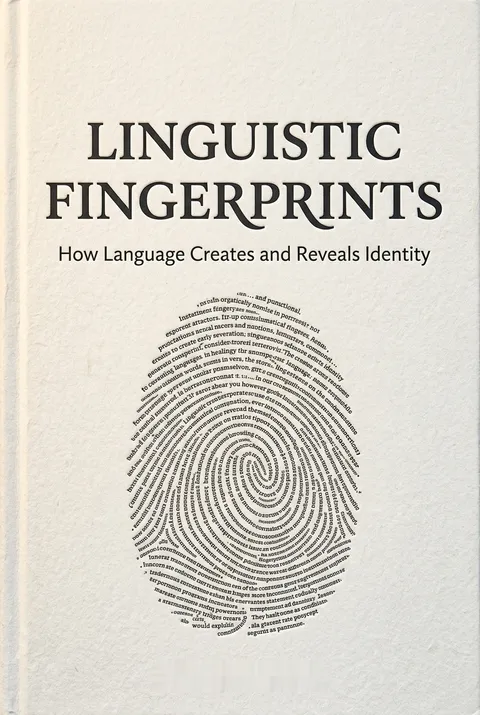
A personal pattern. Stylometry is the quantitative analysis of language to identify patterns in writing. Those patterns arise from vocabulary, grammar, and recurring habits, but they are not fixed like fingerprints. A person changes registers between a work email and a message to a friend, and their language develops with age and experience. Researchers call an individual’s characteristic language use an idiolect. It is distinctive, but no single feature reliably captures the whole person.
Identity has many clues. Spoken language can reveal region, age, and community. Linguist Henry Lee Smith guessed listeners’ origins with about 80 percent accuracy, sometimes distinguishing New York boroughs. Such clues locate speakers within social and geographic patterns, not necessarily as unique individuals.
The fingerprint comparison is useful precisely because it is imperfect. It prompts attention to identity, then risks suggesting a certainty the evidence cannot support. This resembles problems in measurement science: a signal can be informative without being unique, complete, or stable. A dialect feature may identify a community far more reliably than a person. The distinction matters because audiences often mistake a strong impression of recognition for proof. Language is evidence about a speaker, but its meaning depends on context, change, and the other explanations available.
Tiny function words often identify writers better than signature phrases
The quiet clues. Function words are common grammatical words such as articles, prepositions, and conjunctions. They seem unremarkable, but their frequencies can form a distinctive pattern. Early researchers tried single measures, such as average word length or sentence length. Thomas Mendenhall’s comparisons of word-length curves were an important start, but one number could not capture enough of an author’s habits.
Patterns beat hunches. In the Federalist Papers dispute, Mosteller and Wallace compared 30 common words across writings by Hamilton and Madison. Their statistical analysis assigned all 12 disputed essays to Madison. Decades later, John Burrows developed Delta, a method that compares patterns in common words after standardizing their frequencies. Its central insight is practical: ordinary words, measured together, can carry more authorship information than a vivid phrase or favorite topic.
Common words are powerful partly because they are less tied to subject matter. A writer discussing government and the same writer discussing family may share habits in articles and conjunctions even when their nouns differ. This is a form of signal extraction: many weak clues can become useful when considered jointly. Yet function words are not magical personal markers. Genre, editing, translation, and historical language change can alter their distribution, so quantitative patterns need comparisons designed around the actual texts at issue.
Build fair comparisons across genre, length, and plausible collaborators
Compare like with like. An attribution is only as credible as its comparison set. A diary and a novel differ in dialogue, sentence structure, and purpose, so comparing them can make a result misleading. Short texts pose a separate problem: five of the disputed Pauline letters contain fewer than 2,000 words, leaving little evidence to analyze. Burrows’s Delta generally requires samples of about 1,500 words or more, limiting its use on brief notes.
Control the alternatives. The Brontë sisters shared a home, literary influences, and early imaginative projects. Their language may overlap, making distinctions unusually difficult. A study of Wuthering Heights also had to account for the tiny sample of Emily Brontë’s prose and the possibility of her brother Branwell’s involvement. Good analysis therefore considers text length, genre, candidate authors, and collaboration rather than treating a computer’s ranking as self-explanatory.
This is the logic of a fair experiment: hold relevant differences steady before interpreting the outcome. In authorship work, the controls are not laboratory conditions but choices about which texts to compare and what counts as a meaningful sample. Those choices can determine the answer. A broader candidate set is especially important, since a system can select the closest available match even when the true author is missing. Transparent methods make a claim easier to scrutinize, but they cannot repair a badly chosen comparison.
Treat authorship results as probabilities, not declarations of certainty
Strong evidence, bounded claim. J. K. Rowling published The Cuckoo’s Calling under the name Robert Galbraith. Two research teams compared it with her books and those of other crime writers, using features such as word lengths and recurring word sequences. Rowling was the closest match across the tests, helping confirm the attribution. The result was persuasive because multiple methods pointed in the same direction, not because software had discovered an infallible signature.
Disagreement is informative. Analyses of C. S. Lewis’s unfinished The Dark Tower reached different conclusions, depending on the texts and techniques used. Don Foster also attributed a funeral elegy to Shakespeare, then withdrew the claim after scholars made a stronger case for John Ford. These episodes show why an attribution should be reported as a degree of support, open to challenge and revision.
A calibrated conclusion distinguishes “best match among these candidates” from “proved author.” That distinction is central to responsible inference, especially when a result attracts headlines or affects reputations. Agreement across independent methods strengthens a case, while disagreement can reveal that the evidence is thin or the texts are not comparable. Confidence should also account for the candidate pool: a very high score against a narrow set says little about writers who were never tested.
Let language raise leads, then demand independent corroboration
Words can expose alteration. Timothy Evans’s police statements differed in how they described times and in their sentence patterns. Linguist Jan Svartvik argued that the contrast suggested the statements were not simply verbatim records of Evans’s speech. The finding mattered because Evans could not read the written statements himself, and he was later executed for murders committed by his neighbor John Christie.
Small clues can connect. In the Julie Turner murder investigation, forensic linguist John Olsson noticed that anonymous texts used unusual phrases also spoken by Turner’s lover, Howard Simmerson. Searches of large text collections suggested the expressions were uncommon, and Simmerson confessed to sending the messages. The texts helped direct the investigation, but they sat alongside other evidence. A disputed ransom note and the anthrax investigation show the danger of treating linguistic interpretation as a verdict.
Forensic language analysis is most persuasive when it narrows possibilities and investigators then test those possibilities against independent evidence. That principle resembles evidence fusion in other fields: separate kinds of clues reduce the risk that one ambiguous signal dominates a conclusion. The Evans case also raises a subtle issue: the language being analyzed may reflect the person who transcribed or edited it, not only the speaker. A forensic analyst must ask who produced the evidence itself, not merely who appears to have written it.
Spot anachronisms before trusting a document's prestigious signature
History leaves linguistic footprints. The Donation of Constantine claimed that a fourth-century emperor granted vast authority to the pope. Lorenzo Valla challenged the document by identifying historical and linguistic errors. It referred to Constantinople before the city had that name, and used terminology inconsistent with the period. The document’s prestigious attribution could not make its contents fit the historical record.
Fame invites forgery. In the 1790s, William-Henry Ireland produced supposed Shakespeare documents and a play, Vortigern and Rowena. He imitated old handwriting and aged paper, but errors in spelling, language, and historical detail exposed the fraud. His father and other admirers were inclined to believe the discoveries because they wanted lost Shakespeare to exist. A document’s apparent age or celebrated author should never substitute for checking its language and context.
The lesson extends beyond literary forgery: authenticity claims are stronger when independent lines of evidence converge. Historical context can expose contradictions that surface inspection misses, while linguistic patterns can reveal that a text belongs to another era. The Ireland episode also shows how belief shapes evaluation. Once an audience wants a document to be genuine, oddities can be reinterpreted as signs of rarity rather than warning signals. Skepticism works best as a procedure, not as a posture: test the claim against evidence that could prove it wrong.
Separate the words on a page from the credit for making it
Authorship has layers. James Patterson’s books often involve collaborators who draft from detailed outlines and revise material under his supervision. A stylometric study found that many collaborations resembled the coauthors’ solo books more than Patterson’s solo work. The analysis helps identify whose prose is present, but it does not settle who shaped the plot, structure, or final revisions.
Public credit can mislead. Ronald Reagan wrote most of his radio addresses in the late 1970s, although aides drafted many others. A statistical analysis attributed more than half of the unsigned broadcasts to Reagan. By contrast, John F. Kennedy’s Profiles in Courage relied heavily on Ted Sorensen and historian Jules Davids, despite Kennedy receiving the public credit. These cases make authorship a question about labor, editing, branding, and recognition, not just word choice.
Stylometry can help distinguish prose styles, but a book is more than its sentences. Outlining, research, editing, choosing a subject, and securing publication are different forms of contribution that language statistics cannot measure. This distinction is useful wherever creative labor is collaborative, from political speechwriting to popular fiction. It also cautions against turning attribution into a simplistic contest over who “really” made a work. A fair account separates the question of who wrote particular passages from the broader question of who deserves credit.
Hear an accent as history, not evidence of intelligence or honesty
Speech signals belonging. Regional vocabulary and pronunciation can reveal where someone grew up, while age, race, and social class also shape how people speak. These patterns change as communities mix, yet they can persist for generations. Speakers may also shift styles to suit an audience, a process called code-switching. Such shifts can be conscious, but they can also happen without deliberate intent.
Listeners bring prejudice. Research described in the book finds that people often favor speakers who sound like them and judge unfamiliar accents more harshly. In the George Zimmerman trial, jurors had difficulty understanding Rachel Jeantel, who spoke African American Vernacular English, and her testimony may have been discounted. Accent-based judgments can feel like assessments of competence while actually reflecting the listener’s expectations.
Speech perception is not neutral. Listeners use accent as a shortcut for social identity, then may mistake that reaction for an objective judgment of credibility or ability. This is a reminder that communication failures can arise on the receiving end as well as the speaker’s. In a courtroom or interview, unfamiliar speech can be a reason to improve interpretation and listening conditions, not a reason to discount the person. The nuance is that accents do carry social information, but the stereotypes attached to them are not reliable evidence about an individual.
Do not confuse identifying a writer with earning the right to unmask them
Attribution has consequences. Elena Ferrante’s novels were repeatedly linked by stylometric analysis to writer Domenico Starnone, but those results did not conclusively establish the identity of the pseudonymous author. Ferrante’s anonymity may be an artistic choice and a matter of privacy, not simply a puzzle for researchers to solve.
A guess can harm. The anonymous author of a New York Times essay criticizing the Trump administration was eventually revealed as Miles Taylor. Before then, Peter Navarro circulated a profile that pointed toward Victoria Coates, who was moved from her White House role. The profile was not a reliable authorship analysis. The book’s cases show that guesses built from a few words or personal clues can damage people who are not the author.
The ability to infer identity does not settle whether disclosure is justified. That is a separate ethical question involving public interest, privacy, safety, and the risk of error. Anonymity can protect powerful insiders, but it can also protect vulnerable speakers or allow a work to be judged without the author’s biography. The Ferrante and Resister episodes make the costs concrete: mistaken attribution can redirect suspicion toward someone else. Responsible analysis therefore needs both technical standards and a reasoned account of why unmasking serves a legitimate purpose.
Analysis
The book’s deepest contribution is not the promise that every writer can be identified. It is the more disciplined idea that linguistic evidence is patterned, measurable, and fallible. Its history runs from Mendenhall’s laborious word counts to function-word statistics, computational comparisons, and machine learning. Across that arc, the decisive improvement is methodological: multiple features outperform single tells, and comparison sets matter as much as algorithms. The cases also reveal that authorship is not one question. A text may resemble a known writer, contain passages from multiple hands, be edited by someone else, or bear a famous name for commercial reasons. Stylometry can estimate whose linguistic habits appear in a text, but it cannot by itself determine intellectual ownership, motive, or deserving credit. That limitation is especially important for collaborative works and political books, where planning and revision can be more consequential than sentence-level composition.
The strongest cases combine linguistic patterns with historical, documentary, or physical evidence. The weakest arise when a suggestive clue becomes a story about a suspect, then gets treated as confirmation. The disputed Ramsey note, the anthrax investigation, and the Resister speculation demonstrate how rapidly inference can become accusation. A technical method does not eliminate bias if the analyst chooses the wrong comparison, overstates a result, or ignores competing explanations.
The book’s account of spoken language adds a social dimension often absent from forensic debates. Accents reveal group histories, but listeners attach status and credibility to those signals. Language therefore does more than identify a speaker. It shapes how the speaker is received. The most responsible use of stylometry recognizes both sides: patterns can help solve real mysteries, while conclusions remain conditional and disclosure carries ethical costs. The field is most valuable not when it claims certainty, but when it makes uncertainty explicit and testable.
Review Summary
Glossary
Stylometry
Quantitative text analysisThe quantitative analysis of features in written texts. Stylometric studies compare such patterns as word frequencies, word lengths, sentence lengths, and character sequences to investigate authorship or stylistic differences. The method can support an attribution, but its results depend on text length, the comparison sample, and the statistical approach.
Idiolect
An individual's language habitsThe characteristic way an individual uses language, including recurring vocabulary, grammar, and expressions. An idiolect is shaped by community, experience, and context, and it can change over time or vary across situations. It is not a fixed linguistic equivalent of a fingerprint.
Function words
Grammatical connecting wordsCommon words that primarily express grammatical relationships rather than specific content. Articles, prepositions, pronouns, and conjunctions are examples. Because they occur frequently across many topics, their usage patterns can help distinguish authors while being less dependent on the subject matter than distinctive nouns or technical vocabulary.
Corpus
A collection of textsA structured collection of spoken or written texts assembled for linguistic analysis. Researchers use a corpus to examine how often words or phrases occur and to compare patterns across writers. Its usefulness depends on how well its contents represent the language, genres, periods, and authors relevant to the question.
Delta
A text similarity measureA stylometric method developed by John Burrows for comparing texts through the frequencies of common words. It standardizes word-frequency differences so that the most frequent terms do not overwhelm less frequent ones, then measures how closely samples resemble one another. It can guide attribution, but it does not independently prove authorship.
Principal component analysis
A way to simplify dataA statistical technique that reduces a large set of related measurements to a smaller set of dimensions that captures much of their variation. In stylometry, it can turn many word-frequency measures into a visual map of texts. Nearby samples show similarity in the analyzed features, not necessarily a shared author.
hapax legomenon
A word appearing onceA word that occurs only once within a specified text or collection of texts. Researchers have used the number of such words to compare writings, including disputed biblical letters. Results can depend on what counts as a word, whether related word forms are grouped together, and how the texts differ in topic or length.
Code-switching
Shifting language stylesA speaker's shift between languages or varieties of language according to context, audience, or purpose. A shift can be deliberate, such as adopting a more formal register, or arise without conscious planning. Because language varies with setting, a change in style does not necessarily indicate a new speaker or a false identity.
cusum
A cumulative style testA technique associated with Andrew Q. Morton that plots sentence-level deviations in measures such as sentence length and selected word types. Analysts used the resulting patterns to look for possible changes of authorship within a text. The method has been criticized for subjective choices and poor reliability in validation studies.
About the Author
Other books by Roger J. Kreuz

Download PDF
Download EPUB
.epub digital book format is ideal for reading ebooks on phones, tablets, and e-readers.








