

Key Takeaways
Notice the inner narrator before treating its story as fact
Separate thought from truth. Singer calls the stream of inner commentary the “little voice.” It is shaped by remembered experiences and advice, and can sound so sensible that a person mistakes it for objective fact. Mastery does not mean silencing every thought. It means noticing the voice, stepping back, and choosing whether its message fits the present situation. A woman in one workshop could not get through a sentence promising commitment. After repeating it and pushing through the discomfort, she delivered it with such force that the audience stood to applaud. The change began when she stopped treating the block as proof of inability.
Create a pause. Ask what the voice is saying, where the reaction may come from, and what action is actually useful now. Singer’s premise is that this brief separation restores choice.
This resembles psychological distancing: describing a reaction as something the mind is producing can loosen its grip without pretending the feeling is unreal. That distinction matters. Fear may contain useful information, but it is not automatically an accurate forecast. The book’s practical contribution is to insert a decision point between thought and action. Its limitation is that awareness alone cannot remove every cause of distress. Chronic anxiety, unsafe conditions, or material hardship may require support beyond self-talk.
Check whether today's alarm belongs to an older experience
Past can masquerade as present. Singer describes how an old hurt can be activated by a new event. A person who once lost money may hear a trusted colleague ask for a loan and suddenly assume betrayal, even when the current relationship has given no such signal. The feeling is real, but its target may be wrong. Singer recalls losing money in a Colorado land deal, then passing on a Hawaii property because the earlier loss made every similar investment feel dangerous. He later regretted missing what became valuable land. The lesson is not that he should have bought it. It is that fear from one deal should not replace research into another.
Investigate the signal. Ask what memory or advice is feeding the alarm, then assess the actual evidence and risks in front of you.
This is a useful correction to emotional reasoning, the tendency to treat a strong feeling as proof that its interpretation is true. Memory helps people learn, but it can also generalize too broadly from a single painful case. The investment story rightly leaves room for due diligence: an old fear should not decide for someone, but neither should the desire to prove courage. A sound decision separates the remembered loss from the current facts, then considers both.
Give your dream enough value to outrank convenient distractions
Resistance often disguises self-doubt. Singer uses “resistance” for the inner objections and diversions that keep someone from pursuing a meaningful goal. A person who doubts the worth of a book, business, or health plan may suddenly find urgent reasons to tidy, answer messages, or postpone. Singer admits that errands and office clutter delayed his own writing. A workshop participant had carried a book idea for years; after connecting her delay to how little value she assigned her own contribution, she finished the book within four months.
Notice the trade. Each choice gives immediate attention to one thing over another. Write down the future you want and the excuses that arise beside it. The point is not to shame yourself for procrastination, but to see what the delay is protecting you from and what it is costing.
This account connects motivation to present bias: immediate tasks feel concrete, while a distant payoff remains easy to discount. Naming the trade can make avoidance visible and help restore priority. Still, procrastination is not always evidence of low self-worth. Fatigue, unclear goals, competing responsibilities, and executive-function difficulties can also block action. The most useful reading is diagnostic rather than accusatory: ask whether the dream has been undervalued, then also check whether the plan is realistic, specific, and supported.
Practice feared actions until experience gives confidence somewhere to stand
Confidence follows contact. Singer argues that confidence grows through repetition, rehearsal, and immersion, not simply through waiting to feel ready. As a young salesperson, he spent hours circling before making calls. After his manager gave him forty-eight hours to sell or lose his job, he made sixty-eight calls in one day and sold nothing. The next day he made two sales. Eighteen months later, he was the company's top salesperson. The first day's value was not revenue. It was practice that made the next day's action possible.
Train the exact skill. Rehearse objections with a partner, role-play a difficult conversation, or take on a manageable version of the task. Singer also recommends modeling a confident speaker. Repetition builds familiarity, though preparation should not be confused with a guarantee of success.
This is close to self-efficacy theory: people often trust their ability more after they have performed a relevant action, even imperfectly. Rehearsal can also reduce the mental load of a high-pressure moment. The sales story makes a strong case for action over endless preparation, but its ultimatum is not a universal training method. Exposure works best when difficulty is calibrated. Throwing an unprepared person into overwhelming pressure may reinforce avoidance rather than competence.
Build a life around real strengths, not borrowed expectations
Fit beats imitation. Singer describes authenticity as acting from one’s own values and natural strengths rather than trying to satisfy every outside opinion. He tells of a bank that wanted its investment analysts, who preferred data work, to become polished client-facing representatives. He argued that the better solution was to match work to their strengths instead of expecting etiquette training to change their basic fit. The book also urges readers to notice recurring successes, moments of deep engagement, and the abilities others repeatedly praise. Accepting a compliment without brushing it aside can reveal strengths that self-doubt hides.
Stop splitting attention. Comparing yourself with admired peers can divert energy from your own contribution. Singer’s point is not that skills never need improvement. It is that a role or ambition should not require abandoning the qualities that make a person effective.
The argument anticipates person-environment fit: performance and well-being often improve when a role makes use of someone’s capabilities. It also offers a useful challenge to organizations that treat every weakness as a training problem. Yet “play to strengths” can become an excuse to avoid learnable skills or necessary discomfort. Good fit is not fixed destiny. The practical question is whether a weakness is incidental, trainable, or central to the work, and whether redesigning the role would help both the person and the group.
Track behavior and results, then make commitments enforceable
Make reality visible. Singer argues that accountability needs both measures and behavioral rules. A business owner he describes checked the results of twenty stores each day, ranked them, and shared the figures with managers. Regular measurement made patterns and shortfalls harder to ignore. For an individual, useful measures might include spending, exercise, calls made, or time spent on a priority. The goal is not to stare at numbers for their own sake, but to use them to spot habits and correct course.
Add trusted witnesses. Singer calls a written set of personal standards a Code of Honor. It might include keeping promises, being honest about results, or asking others to call out broken commitments. He describes a high school football team whose players created shared rules and said their trust in one another helped them win an overtime game against the defending champions.
Measurement turns vague intentions into feedback, while social accountability adds a cost to quietly abandoning them. Together, they can make progress observable and help people learn from patterns rather than mood. But metrics can distort behavior if they reward the wrong thing, and public rankings can create shame instead of useful effort. A good code should be chosen by the people expected to follow it, with standards that are demanding yet humane. Accountability works best when correction matters more than punishment.
Engineer an early win before fear, fatigue, or frustration wins
Recognize four common exits. Singer groups failure into fear, fatigue, a self-image too small to sustain success, and quitting before improvement becomes visible. To counter the last pattern, he recommends compressing the learning curve with frequent practice, focused effort, a short and defined work period, a controlled setting, and close feedback. His example is a structured business exercise in which participants reportedly generated more than $55,000 in sales in under ten minutes and over $500,000 in four days. The experience gave them concrete evidence that they could sell.
Make progress believable. An early win can challenge a limiting self-image, but it needs to connect to a real skill and a repeatable process. The book also treats physical energy as essential: poor sleep, health, or conditioning can make a large goal harder to sustain. Motivation cannot indefinitely substitute for recovery.
A quick, genuine success can function as a mastery experience, giving someone evidence that a feared task is possible. Structured practice and rapid feedback also resemble effective skill-learning environments. The caution is that a high-pressure workshop result may not transfer automatically to an ordinary business setting. Success should be followed by reflection, repeat practice, and attention to context. The book’s broad claim that fatigue explains failure also needs care: exhaustion can reflect health, workload, caregiving, or financial strain, not merely a mindset problem.
Interrupt spirals with a name, a reset, and a debrief
Use a small reset. The book offers many brief exercises for changing an unhelpful state. Three especially practical ones are to identify the emotion precisely, use a physical gesture to mark a win, and review an event afterward. Instead of calling every feeling “upset,” distinguish anger, fear, confusion, or frustration. After a success, acknowledge it rather than dismissing it as luck. After a setback, ask what happened, what worked, what failed, and what to change next time. Singer also suggests that an unmet goal may conceal an outcome that did occur, such as earning recognition or proving a capability.
Turn review into action. These exercises are not meant to deny disappointment or make every result positive. Their purpose is to stop a vague emotional judgment from becoming a permanent verdict about ability.
Naming emotion can make an amorphous reaction easier to examine, and structured debriefs are common in fields where people must learn quickly from performance. Celebrating small wins may reinforce continued effort, especially when the person can identify what produced the result. There is a limit: forced optimism can invalidate real loss, and a missed goal should not be redefined as success before its consequences are faced. The strongest version of this method pairs honest evaluation with a next step.
Ask what a painful failure taught you to become
Reframe without erasing pain. Singer closes with a story about being publicly attacked after leading a business workshop in 1984. He felt exposed and humiliated. Years later, a mentor repeatedly asked what ability that moment had forced him to develop. Singer came to see that he had learned to take responsibility for the work rather than rely on charm or borrowed authority. He describes this as a shift from salesperson to business owner. After a later bankruptcy, he considered ending his life at a pier, then chose to make teaching and supporting other entrepreneurs central to his work.
Look for usable learning. The book’s final claim is that painful experiences can reveal capacities and commitments that were not visible before. Its invitation is to examine what a difficult event changed, without pretending the event was harmless or deserved.
Meaning-making can help people integrate adversity into a coherent account of their lives, and the mentor’s question redirects attention from humiliation toward agency. The story is powerful because the lesson is specific: public failure sharpened Singer’s sense of responsibility, while bankruptcy clarified the work he wanted to do. But no one should be pressured to find a gift inside every wound. Some losses remain losses. Recovery can begin with safety, support, and truthful acknowledgment, whether or not a redemptive story emerges.
Analysis
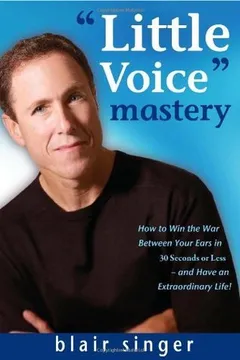
Little Voice Mastery is a motivational business and personal-development book built around a simple metaphor: inner commentary can either protect a person or keep that person from acting. Its strongest insight is not that thoughts are always wrong, but that they deserve inspection. Singer’s examples repeatedly turn an abstract problem into a moment of choice: the salesperson can make another call, the employee can distinguish a boss from a parent, and the writer can notice that tidying has displaced the work that matters.
The book is most useful when it translates that insight into behavior. Rehearsal, emotional labeling, feedback, written standards, and brief post-event reviews give readers actions to try rather than another slogan to repeat. Its stories also make failure legible as experience. Singer’s own progression from salesperson to business owner to teacher supplies a narrative spine: setbacks changed his understanding of what he could take responsibility for and what he wanted to contribute.
The framework becomes less reliable when it treats self-value as the master explanation for procrastination, fatigue, or poor results. People face constraints that cannot be solved by changing their inner dialogue: illness, care work, discrimination, inadequate resources, or a genuinely risky opportunity. Some of the book’s energy language, especially the idea of recovering “Life-Force Particles,” is presented as a mentor’s model rather than demonstrated science. Likewise, deliberately exaggerating confidence may help some people act, but it should not replace accurate feedback.
Read at its best, the book offers a practical discipline of self-observation: notice the thought, test its origin, choose a response, and review the result. The central promise is not instant transformation. It is increased room to maneuver between an old emotional script and a new decision. Agency matters, but it works best alongside evidence, support, and respect for real-world limits.
Glossary
Little Voice
Automatic inner commentarySinger’s term for the stream of self-talk shaped by memories, past experiences, and other people’s advice. It can offer helpful warnings, but may also mistake an old emotional reaction for an accurate reading of the present. The aim is not to eliminate this inner commentary, but to notice it, question its source, and choose how to respond.
Little Voice Mastery
Managing self-talk deliberatelyThe book’s approach to recognizing and redirecting inner commentary so it does not automatically govern emotion and behavior. It involves observing a reaction, considering where it came from, and applying a practical technique such as rehearsal, emotional identification, or a post-event review. Singer presents mastery as management, not the permanent removal of doubt or fear.
Code of Honor
Written personal standardsA set of explicit behavioral rules that a person or team agrees to follow and enforce. In the book, a personal code may cover keeping promises, taking responsibility, or asking others to point out a breach. The code is intended to guide behavior when emotions make it easy to rationalize abandoning commitments.
Self-Concept
How someone sees themselvesThe book’s term for a person’s picture and evaluation of themselves, which Singer links to the results they believe they can produce. He describes it through the qualities a person admires, their current self-image, and their sense of self-worth. In his model, a self-concept that feels small can limit action even when a person has a larger goal.
PERT chart
Visual project timelineA planning chart Singer recommends for breaking a measurable goal into dated activities or milestones. The goal is placed at the end of a timeline, with the required steps arranged in sequence and linked visually. The plan can be revised as conditions change, while progress through the milestones provides a visible basis for accountability.
Life-Force Particles
Alan Walter’s energy modelA concept Singer attributes to mentor Alan Walter, who describes personal energy as life-force particles that can be lost or trapped through difficult experiences and restored through certain processes. The book uses the model to explain fatigue and diminished drive. It is presented as Walter’s conceptual framework, not as an established scientific measure.
Learned Optimism
Explanatory style and resilienceMartin Seligman’s named work, which Singer cites when discussing how people interpret success and adversity. The book draws on the idea that explanations for outcomes can affect persistence: treating a setback as limited and specific may preserve motivation better than viewing it as a permanent verdict on the self. Singer applies this to sales, performance, and self-talk.
Download PDF
Download EPUB
.epub digital book format is ideal for reading ebooks on phones, tablets, and e-readers.








