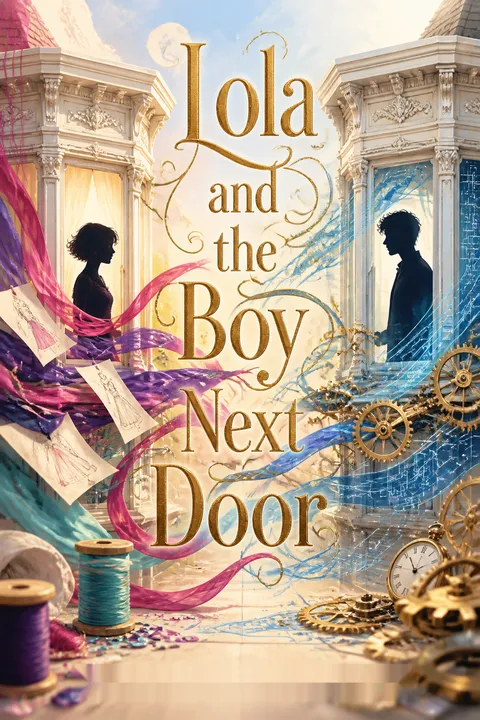


Plot Summary
The Bells Return
Seventeen-year-old Lola Nolan begins the day hoping her strict fathers will finally stop interrogating her twenty-two-year-old boyfriend, Max, over Sunday brunch. Her other worry lives in the lavender Victorian next door: the Bell family might return. Lola and her dog, Betsy, come home from a walk to find figure-skating star Calliope Bell on the porch.
The sight makes Lola drop the dishes she is carrying. Calliope's twin brother, Cricket, is not outside, but his absence only sharpens the shock. Lola has spent two years dreading this reunion, while building a life around costume-making, her best friend Lindsey, and a romance her fathers distrust. Now the childhood neighbors who once defined her world are back beside her.
The opening makes Lola's anxiety concrete through two competing forms of supervision. Her fathers monitor her romance with Max, while the neighboring house holds an older wound she has tried to manage by avoiding its windows. Her theatrical clothing is a chosen authorship of self, but her fear of the Bells shows how little control she feels over her own past. Calliope's return does not merely revive a crush; it unsettles Lola's carefully arranged present, where a boyfriend, a new identity, and a protected household have kept old feelings at a distance.
A Window Opens
After checking the Bell house and finding Cricket's room empty, Lola changes into her favorite pajamas and dances to Max's band. Cricket suddenly appears in the opposite window, grown taller but still unmistakably the inventive, restless boy she knew.
Lola remembers their childhood closeness, including the tiny elevator he built for her dolls and their first kiss, then the years when Calliope's hostility pushed them apart. When the twins returned as teenagers, Lola fell for Cricket, but neither could speak plainly.
His family moved away again after Calliope's career disrupted their life, and a humiliating birthday party left Lola believing Cricket had rejected her. Now he is back, and her practiced indifference cannot keep pace with the memories he awakens.
The window makes intimacy possible while preserving distance: Lola can see Cricket clearly, yet neither has to cross the physical boundary between their homes. Her recollections reveal that the romance began not with glamour but with practical generosity, a child building an elevator because Lola wanted one. The later heartbreak rests on silence and inference rather than a deliberate act she can easily condemn. Lola has made her old humiliation into certainty, and Cricket's return threatens that certainty before either of them has offered an explanation.
Amoeba's Interrupted Confession
Lola's attraction to Max began at a club, where she concealed that she was seventeen and let him believe she was eighteen. Once she admitted her real age, Max withdrew for a week, then returned because he had fallen in love; Lola introduced him to her fathers and their relationship grew under strict curfews.
At the record store Amoeba, Cricket finds Lola and urgently tells her he cannot stop thinking about her, then asks to see her. Max arrives before she can answer. Lola introduces the two men, and Max's arm around her shoulders turns a private history into a visible rivalry. In the van afterward, he demands to know why she hid Cricket. Lola insists she loves Max, but the certainty in her own answer has begun to fray.
Lola's first romance is structured around concealment from its beginning. She lies about her age not because she lacks judgment, but because she fears that truth will end a relationship before it can become real. At Amoeba, the secrecy reverses: she has kept Cricket from Max, and Max experiences the omission as evidence that Lola's version of events cannot be trusted. The scene makes jealousy less a simple contest between two men than a conflict over who gets access to Lola's unedited history.
The Birthday Party Lie
Cricket later apologizes for asking Lola out without knowing she had a boyfriend and says he wants to be part of her life again. Their tentative friendship deepens when he volunteers to help Andy bake pies, quickly mastering the work and making a tense delivery easier.
On a family outing to Muir Woods, Cricket finally explains why Lola believed he had excluded her from his sixteenth birthday party. Calliope had told him Lola declined; Lola had never been invited.
Cricket believed his sister and failed to ask Lola himself, while she went home with a gift for him and no explanation. He admits he had liked her then and still does. His confession clears the old misunderstanding, but it also makes their friendship dangerous while Lola remains with Max.
The revelation changes the moral shape of Lola's memory without erasing its consequences. Calliope's lie came from fear of losing her twin, but Cricket's passivity allowed that fear to govern his friendship with Lola. The story therefore resists treating intention as sufficient repair: his affection was real, yet Lola still spent years interpreting silence as rejection. Their renewed honesty offers relief, but it also exposes the limits of a friendship that both characters want and neither can experience neutrally.
Norah on the Porch
When the N olans return from Muir Woods, they find Norah, Lola's estranged birth mother, asleep on their porch after being evicted. Norah says she needs somewhere to stay, and Nathan lets her move into his office despite their history of rescuing her from crises.
Lola retreats upstairs, ashamed of Norah's disheveled appearance and afraid neighbors will connect them. When Max calls about his band's show, Lola's distress hardens into anger. She dresses for the night, defies her fathers, and climbs into Max's van as it pulls up, injuring her arm on equipment.
Her fathers are left watching her flee, while Cricket and Calliope witness the scene from next door. The episode earns Lola a month of grounding and makes her family conflict impossible to ignore.
Norah's arrival turns Lola's private fear of inherited failure into a visible family emergency. Lola's shame is directed partly at Norah's condition, but also at the possibility that other people will mistake ancestry for destiny. Her flight to Max offers an immediate escape from the house, yet the injury and punishment show how quickly escape can become another form of danger. The scene also places Cricket in the role of witness, linking Lola's most vulnerable family history to the relationship she has not admitted she wants.
The Broken Glasses Walk
Max later visits the Nolan home to apologize for taking Lola away, but dinner goes badly: Nathan questions his career, Norah provokes him, and Lola's defense of everyone only deepens the strain.
At the theater, Cricket reveals that he studies mechanical engineering and that his celebrated ancestor Alexander Graham Bell did not invent the telephone as the family story claims. Soon after, Franko breaks Lola's glasses, leaving her unable to see. Cricket takes her home by bus and train, helping her across buckled sidewalks and respecting her insistence that they remain friends.
He also offers to design the structural panniers for her Marie Antoinette dress. Calliope warns Lola to stop confusing her brother, but Lola cannot dismiss the tenderness she felt while holding Cricket's arm.
The broken glasses make dependence literal: Lola must accept help from the person whose attention most threatens her current relationship. Cricket's care is practical and careful, not a romantic conquest, which makes Lola's response harder to reduce to flirtation. His discovery about the Bell family also mirrors her anxiety about Norah: each young person fears that a compromised inheritance might define what they are allowed to become. Lola begins answering that fear through costume-making, while Cricket has not yet found an equivalent confidence in invention.
The Berkeley Visit
Norah reads Lola's tea leaves and predicts confusion, arguments, and a path toward first love, though Lola suspects the forecast is aimed at Cricket. After Calliope accuses Lola of taking advantage of her inexperienced brother, Lola travels to Berkeley under the pretense of retrieving her dress plans. She finds Cricket sharing a room and working on the panniers, with Jessica beside him.
Jealousy exposes what Lola has tried to call friendship. Cricket sends Jessica away so he and Lola can work, but Lola's hidden visit and evasions anger him. Their dinner ends in a fight: he asks why she came if she has a boyfriend, and she admits she does not understand her own feelings. Lola leaves by train, fearing she has lost Cricket again.
The Berkeley trip is a test of the distinction Lola keeps drawing between desire and action. She calls the visit practical, but her concealed motive is to regain access to Cricket and the intimate project they share. Jessica's presence transforms that denial into jealousy, while Cricket's anger exposes the cost of making him wait inside a relationship he cannot see clearly. Lola's confusion is genuine, but it does not absolve her from the choices she makes to preserve both possibilities.
The Bridge Between Bedrooms
At a Halloween music festival, Max insults Lindsey's costume and treats Cricket with contempt, then accuses Lola of hiding their encounters and the Muir Woods trip. Lola denies the truth, frightened by Max's anger, and accepts his possessive embrace without feeling reassured.
Later, she wakes Cricket and walks with him through the city. He admits that Max's coolness makes him feel inferior, and Lola reminds him that his creations have given beauty and wonder to the people around him.
Back home, Lindsey tells Lola she has gone bowling with Cricket, Calliope, and Charlie, confirming that her friend is building connections beyond Lola. That night Cricket crosses a wire shelf between their windows. Lola paints his nails, nearly kisses him, and watches him retreat rather than betray her existing relationship.
The improvised bridge is both an ingenious machine and an ethical shortcut. It lets Cricket cross the distance Lola has maintained, but the near-kiss ends with him choosing restraint. Meanwhile, Max's demand for honesty is compromised by his contempt and suspicion, leaving Lola caught between a relationship that requires disclosure and one she is actively concealing. Lindsey's new friendship with the Bells further complicates Lola's self-image: she is not the only person entitled to these relationships, and her fear of being displaced can resemble the possessiveness she resents in Max.
The Breakup and the Bedside
After recognizing that Max reacts to her natural appearance and her costumes as if one must cancel out the other, Lola goes to his apartment seeking clarity. Their argument turns cruel. Max calls her false and immature; Lola admits she has been spending time with Cricket and ends the relationship.
Max tells her to leave, and she reaches home devastated, convinced that she has lost both men. During the following week, Lola withdraws into bed and gives up on her Marie Antoinette dress. Cricket eventually climbs into her room to apologize for not answering her messages.
He admits he had been angry and confused, then asks whether she still loves Max. Lola says she does not, but refuses to kiss Cricket while she feels emotionally empty. She tells him her first feelings for him never disappeared.
The breakup is not presented as a triumph of one suitor over another. Lola leaves Max because the relationship has made self-definition feel like a performance staged for his approval, yet his rejection still wounds her deeply. Her refusal to kiss Cricket matters because she finally treats desire and readiness as separate questions. Rather than using him to anesthetize heartbreak, she asks for time and offers him a truth she had withheld: her attachment began long before the present crisis.
The Window Bridge Discovered
The next morning, Nathan discovers Cricket in Lola's bed and the wire shelf connecting their windows. He throws Cricket out and grounds Lola through winter break; Andy makes clear that the secrecy has damaged her fathers' trust.
Later, Cricket explains why he was distracted: his older brother, Aleck, has taken his baby daughter Abigail to the Bell home after separating from his unfaithful wife. Lola apologizes for overlooking Cricket's family crisis and begins helping with Abigail.
In the weeks that follow, she withdraws into plain black clothes and abandons the dress, believing she must become someone more deserving. On New Year's Day, Cricket tells her that goodness should bring out her real self, not erase it. His words help Lola understand that self-punishment is not the same as change.
The bridge's discovery converts romantic secrecy into a family boundary violation, and Lola must face a consequence beyond embarrassment: her fathers no longer trust her judgment. Aleck's crisis offers a parallel portrait of a relationship built too quickly and badly, while Cricket's steady care for Abigail reveals how responsibility can coexist with vulnerability. Lola's turn toward black clothing is a bid to become morally acceptable by becoming less visible. Cricket's challenge rejects that bargain: growth should deepen identity rather than punish it.
The Wrench Comes Home
Norah eventually admits that fortune-tellers read people, not leaves, and that she saw Lola's feelings for Cricket beneath the symbols in the teacup. When Lola learns Max has returned, she visits him to apologize for lying and for the way their relationship ended.
Max reveals he spent the separation with another woman and shuts the door on further reconciliation. His response helps Lola see that she no longer wants his approval. After Cricket returns to Berkeley, he texts that he misses her, and Lola finally tells her fathers she wants to visit him.
At his dorm, she gives him the tiny wrench she bought for his birthday years earlier but never delivered. The gift restores a piece of their interrupted past, and their renewed closeness no longer depends on pretending it is casual.
The wrench is a compact alternative to the grand gestures Lola once expected from romance. She bought it when she believed Cricket had excluded her, then kept it through years of resentment; giving it to him now acknowledges both her hurt and her continuing care. Norah's explanation also reframes the tea reading as psychological perception rather than supernatural knowledge. Lola's apology to Max closes a moral account, but it does not ask him to absolve her or resume the relationship.
Calliope's Last-Minute Costume
Before Nationals, Calliope arrives carrying the shredded remains of her skating costume, destroyed by Abigail. Lola cannot repair the fragments, so she proposes remaking the outfit from Calliope's old costumes.
As they work, Calliope admits that her family has overlooked Cricket's sacrifices and apologizes for lying about the birthday invitation years earlier. Lola designs a new black costume suited to Calliope's Romeo and Juliet program. At Nationals, Calliope falls twice in the short program and drops to sixth place, but performs a flawless long program in Lola's creation.
She rises to second overall and celebrates instead of treating second place as failure. The crisis repairs more than fabric: Calliope recognizes Lola's skill, and Lola sees the pressure beneath the twin's polished confidence.
Lola's craft becomes a form of ethical action. She helps Calliope not because the two have settled every grievance, but because she can respond to a real emergency with competence rather than retaliation. Calliope's apology recognizes that her ambition depended on Cricket's unseen labor, while the costume makes Lola's creative identity useful without making it subordinate. Calliope's joy at second place marks a shift from perfection as proof of worth toward performance as something she can own.
A Dress, A Moon, A Yes
On the night of the winter formal, Lola's towering wig collapses and ruins her carefully planned look. Cricket has left Nationals early to accompany her. He removes the smeared makeup, patiently arranges Lola's real hair, and tells her a story about wishing on stars whenever he was away from her. Lola kisses him first; he answers with a declaration of love, and she tells him her feelings have lasted since childhood.
After her fathers approve their departure, Cricket helps her lace her combat boots beneath the enormous gown. Outside, he gives her a handmade automaton: a miniature moon whose changing phase matches the real one, surrounded by stars. Lola walks toward the dance holding Cricket's hand, no longer hidden by the costume she made.
The climax resolves the book's central tension through integration rather than disguise. Lola does not have to choose between the extravagant gown and the recognizable self beneath it; Cricket's care helps her make the costume expressive instead of engulfing. His automaton translates years of observation into a gift that is intimate because it records the moon they both watched, not because it promises possession. The winter formal becomes meaningful less as a social triumph than as Lola's chosen public entrance, made beside someone who sees both her artifice and her personhood.
Analysis
Lola's central problem is not choosing between a safe boy and a dangerous boy. It is learning to distinguish the freedom to invent herself from the impulse to hide inconvenient truths. Her costumes make that distinction visible: they are chosen performances, not evidence that she lacks a stable self. Max mistakes her changes of style for deception, but Lola also uses secrecy to keep both relationships available, so the novel does not let self-expression excuse the harm of concealment.
The two neighboring houses create a precise architecture for this conflict. Lola and Cricket can see each other across a narrow gap, yet years of missed communication let Calliope's fear, Cricket's passivity, and Lola's assumptions turn closeness into estrangement. Their literal crossings, first through a constructed bridge and later through mutual honesty, do not erase the past. They make each person answer for how they handled it.
The book also sets inherited shame against chosen practice. Lola worries that Norah's instability has contaminated her future; Cricket fears his family's celebrated invention rests on theft. Both are tempted to treat ancestry as a verdict. Their growing respect for each other's creativity counters that logic: Lola's design and Cricket's mechanisms have value because of what they do for people, not because they confer status or erase history.
Family care is similarly double-edged. Nathan and Andy protect Lola, but their strictness can make disclosure feel dangerous. The Bells support Calliope, but Cricket's willingness to adapt lets his needs disappear. Norah's return forces Lola to see that love may require boundaries as well as rescue. The resolution does not reward perfect behavior. It rewards a more honest one: Lola apologizes, accepts consequences, resumes her vivid self-presentation, and chooses a relationship in which attention and restraint can coexist.
Review Summary
Lola and the Boy Next Door received mixed reviews. Many readers found it charming and enjoyable, praising the quirky characters and sweet romance. They appreciated the San Francisco setting and appearances by Anna and Etienne from the first book. However, some critics found Lola's character annoying and the plot predictable. The love triangle and Lola's treatment of her boyfriend were points of contention. Overall, fans of light contemporary YA romance generally enjoyed the book, while others found it lacking depth or originality.
People Also Read




Characters
Lola Nolan
Costume-making dreamerLola is a seventeen-year-old San Francisco high school student raised by her two fathers. She treats clothing as a creative language, making elaborate costumes that let her test out versions of herself, while she dreams of designing for film and theater. Her flamboyance is not simple vanity; it is a bid to make her inner life visible in a world that often labels her strange. She is devoted to her family and best friend, but can confuse intensity with certainty, especially in romance. Her history with her birth mother makes her sensitive to questions of inheritance, shame, and trust. Lola's central struggle is learning that being honest about desire includes responsibility for how her choices affect other people.
Cricket Bell
Inventor next doorCricket is Calliope's twin brother, a tall, energetic mechanical thinker who fills his hands and notebooks with reminders, calculations, and small inventions. He has spent much of his life adapting to his sister's demanding skating career and the family's frequent moves, yet he rarely expresses resentment directly. His curiosity makes him attentive to other people's preferences, from Lola's vegetarianism to the structure of her formal dress. He is kind without being socially effortless, and his difficulty speaking plainly has sometimes allowed others to decide his feelings for him. Cricket's relationship with Lola is shaped by childhood closeness, an old misunderstanding, and the challenge of respecting her choices while remaining honest about his own.
Max
Older musician boyfriendMax is a twenty-two-year-old musician and city meter reader who performs with the band Amphetamine. His tattooed, guarded appearance attracts Lola, while his careful habits and serious reading complicate her image of him as a reckless rocker. Max wants closeness and loyalty, but his jealousy and discomfort with Lola's age and independence can turn into pressure. He is also shaped by an unstable family history, including an alcoholic father and an absent mother. His relationship with Lola offers her an adult romance beyond high school, but its secrecy and power imbalance make trust difficult for both.
Calliope Bell
Olympic hopeful twinCalliope is Cricket's twin sister and a nationally celebrated figure skater whose training organizes much of the Bell family's life. Beautiful, disciplined, and accustomed to public scrutiny, she has learned to protect herself with confidence and control. That polished exterior can make her seem selfish, particularly when she feels Cricket's attention shifting elsewhere. Her fear of failure is intensified by a career in which talent is judged through brief, public performances. Calliope and Lola share a childhood history marked by admiration, rivalry, and hurt, making their interactions more complicated than a simple popular-girl conflict.
Lindsey Lim
Lola's loyal detective friendLindsey is Lola's closest friend, a practical, observant student who loves mysteries and approaches social problems like cases to solve. She is direct where Lola is impulsive, and her steady presence has helped Lola feel accepted since childhood. Lindsey has her own ambitions and has chosen to postpone dating while she focuses on school, though her feelings for classmate Charlie complicate that plan. Her loyalty does not mean she exists only to advise Lola: she needs time, privacy, and room to form friendships beyond their longstanding bond.
Nathan Nolan
Protective lawyer fatherNathan is one of Lola's fathers, an ACLU lawyer whose protective instincts express themselves through rules, check-ins, and pointed questions. He is the stricter parent and worries that Lola's relationship with an older musician may expose her to risks she cannot yet judge. His discipline comes from love, but his fear of repeating family damage can make him treat Lola as if she were responsible for choices she has not made. Beneath his sternness, he is deeply attached to his daughter and to the home he shares with Andy.
Andy Nolan
Warmhearted pie-baking fatherAndy is Lola's other father and the baker behind City Pie Guy, a homegrown pie business. He is affectionate, funny, and more likely than Nathan to soften during conflict, though he can be quietly firm when Lola's safety is at stake. Andy shares Lola's appreciation for beauty and costume, and he often notices the emotional meaning beneath her choices. His compassion for Norah coexists with frustration over the strain she brings into the household.
Norah
Lola's troubled birth motherNorah is Lola's birth mother and Nathan's older sister. Once caught in addiction and homelessness, she is sober but still struggles to maintain stable housing and adult responsibilities. She earns money as a tea-leaf reader, a practice that allows her to observe people while appearing to predict their futures. Her relationship with Lola is strained by years of absence, shame, and disappointed expectations. Norah can be defensive and ungrateful, yet she also recognizes Lola's independent spirit and has moments of unusual candor.
Anna
Lola's film-school supervisorAnna works with Lola at the movie theater while studying film. Warm, perceptive, and good-humored, she is part of a close couple with Étienne St. Clair and offers Lola both friendship and practical support. Her experience of making a serious relationship work across distance gives her a perspective Lola notices, even when she is not ready to apply it.
Étienne St. Clair
Charming theater coworkerÉtienne, usually called St. Clair, is Anna's confident, English-born boyfriend and Lola's coworker at the theater. He is witty and socially skilled, but his charm does not prevent him from taking responsibility, working, or thinking seriously about a shared future. His relationship with Anna gives Lola a contrasting example of a couple who communicate directly, while his friendship with Cricket brings the two young men into overlapping circles.
Alexander Bell
Cricket's struggling older brotherAlexander, known in his family as Aleck, is Cricket and Calliope's older brother, a composer and teacher. He is a father to Abigail and has long stood somewhat outside the twins' highly concentrated family dynamic. His personal life introduces a quieter adult crisis into the story and gives Cricket a reason to return home beyond his friendship with Lola.
Abigail Bell
Aleck's spirited toddlerAbigail, called Abby, is Aleck's young daughter and Cricket's niece. Curious, affectionate, and strong enough to turn a costume into scraps, she draws Cricket into a caretaking role and brings the Bell family together during a difficult period.
Mr. and Mrs. Bell
The twins' ambitious parentsThe Bell parents raise twins whose gifts pull the family in different directions. Their support of Calliope's skating requires years of travel and sacrifice, while Cricket's needs are easier to overlook because he is adaptable and rarely complains. They care about both children, but the family's habits do not always distribute attention fairly.
Charlie Harrison-Ming
Lindsey's quiet crushCharlie is a bright classmate who shares Lindsey's Quiz Bowl world and her red sneakers. His easy presence gives Lindsey a low-pressure chance to explore romantic interest without abandoning her academic priorities.
Johnny Ocampo
Amphetamine's drummerJohnny is Max's bandmate and roommate, a drummer whose presence connects Lola to the band's working life. He helps Max's music career move beyond rehearsal and occasionally appears in the practical logistics of performances.
Dustin
Cricket's blunt roommateDustin is Cricket's Berkeley roommate, a broad, casual student whose assumptions about Cricket's sexuality and Lola's age make their shared room socially awkward. His bluntness exposes how little he knows about either of them.
Heavens to Betsy
Lola's beloved rescue dogBetsy is the Nolan family's black rescue dog, loved by Lola and especially attached to Nathan. Her walks repeatedly bring Lola into the neighborhood and its returning residents, while her easy affection recalls the domestic warmth Lola fears losing.
Plot Devices
Lola's costumes
Identity made visibleLola's self-designed outfits are not decorative background; they make her shifting feelings visible to other characters and to herself. Her ambitious Marie Antoinette gown requires stays, panniers, research, and Cricket's mechanical insight, turning romance into collaboration before either of them can name it. Later, her plain black clothes mark a retreat from the self she has proudly displayed. The final formal look succeeds when Lola keeps the extravagance but lets her own face and hair remain present.
The facing windows
A fragile connectionThe aligned bedrooms let Lola and Cricket watch, avoid, and communicate with each other across only a few feet. Their windows make the old pattern of silence physically visible: they can see one another without knowing what the other means. Cricket's improvised wire shelf eventually turns that passive connection into a crossing, forcing the pair to confront the boundaries their secrecy has blurred.
Tea-leaf reading
Prediction as perceptionNorah's tea-leaf reading appears to offer Lola a forecast during a period of romantic confusion. The symbols give Lola a language for fears she has not admitted, especially her attraction to Cricket and the likely end of her relationship with Max. Norah later explains that her real skill is reading the person across from her, not the leaves. The device therefore turns fortune-telling into a study of projection, desire, and the stories people want to believe.
Cricket's small inventions
Affection built by handCricket's inventions reveal how he thinks: he solves emotional and practical problems by making something precise, playful, and useful to another person. His childhood doll elevator, the planned connection between the windows, the pannier framework, and his gift for Lola all make care tangible. His machines also challenge his fear that only inventions with obvious public utility deserve to exist. In the story, making is both a form of attention and a way for Cricket to express what he struggles to say directly.
FAQ
Synopsis & Basic Details
What is Lola and the Boy Next Door about?
- Teenage costume designer: The story centers on Lola Nolan, a seventeen-year-old aspiring costume designer living in San Francisco with her two dads. She navigates the complexities of teenage life, including romance, family, and personal identity.
- Reappearance of the past: Lola's life is disrupted when the Bell twins, Calliope and Cricket, move back next door, stirring up old feelings and unresolved conflicts from her childhood.
- Balancing love and identity: Lola grapples with her feelings for her older punk-rock boyfriend, Max, while also confronting her past crush on Cricket, all while trying to maintain her unique identity and creative passions.
Why should I read Lola and the Boy Next Door?
- Unique protagonist: Lola is a compelling character with a distinctive style and a passion for costume design, making her relatable and inspiring for readers who value individuality.
- Complex relationships: The novel explores the intricacies of teenage relationships, including first love, family dynamics, and the challenges of navigating past and present feelings.
- Heartfelt and humorous: Stephanie Perkins' writing style is engaging, blending humor with emotional depth, making the story both entertaining and thought-provoking.
What is the background of Lola and the Boy Next Door?
- Contemporary setting: The story is set in modern-day San Francisco, capturing the vibrant and diverse culture of the city, particularly the Castro district.
- Focus on personal identity: The novel explores themes of self-discovery and acceptance, reflecting the challenges faced by teenagers as they navigate their identities and relationships.
- Emphasis on creative expression: Lola's passion for costume design is a central element, highlighting the importance of creative outlets for self-expression and personal growth.
What are the most memorable quotes in Lola and the Boy Next Door?
- "I don't believe in fashion. I believe in costume.": This quote encapsulates Lola's unique perspective on self-expression and her belief in the transformative power of clothing.
- "You're delightfully screwy, and I wouldn't have you any other way.": Max's words to Lola highlight his acceptance of her individuality and his genuine affection for her.
- "Sometimes beauty and real-life magic are enough.": This quote, spoken by Lola, reflects her appreciation for the power of creativity and the importance of finding joy in the present moment.
What writing style, narrative choices, and literary techniques does Stephanie Perkins use?
- First-person perspective: The story is told from Lola's point of view, allowing readers to intimately experience her thoughts, feelings, and perceptions.
- Vivid descriptions: Perkins uses rich and detailed descriptions to bring Lola's world to life, particularly her unique style and the vibrant setting of San Francisco.
- Humorous and heartfelt tone: The narrative blends humor with emotional depth, creating a relatable and engaging reading experience that captures the complexities of teenage life.
Hidden Details & Subtle Connections
What are some minor details that add significant meaning?
- The significance of names: Lola's full name, Dolores, and its connection to the park and creek, highlights her family history and the weight of her past, contrasting with her chosen name, Lola, which represents her desire for individuality.
- Recurring objects: The presence of the Rube Goldberg machines in Cricket's past and the watch parts he gives Lola symbolize his inventive nature and their shared history, foreshadowing his role in helping her with her dress.
- The use of color: The recurring use of red, particularly in Lola's clothing and accessories, symbolizes her passion, creativity, and the intensity of her emotions, contrasting with the pale blue of her Marie Antoinette dress.
What are some subtle foreshadowing and callbacks?
- The mention of Norah's past: The early references to Norah's struggles with addiction and homelessness foreshadow her later appearance and the impact it has on Lola's life.
- Cricket's hand messages: The cryptic messages written on Cricket's hand, such as "FUSE NOW" and "REVERSE CIRCUIT," foreshadow his inventive nature and his internal struggles, as well as his eventual confession of his feelings.
- The recurring image of the moon: The moon, which Lola often talks to, foreshadows her connection with Cricket, who also looks to the sky, and symbolizes the cyclical nature of their relationship.
What are some unexpected character connections?
- St. Clair and Cricket: The unexpected friendship between St. Clair and Cricket, who meet at Berkeley, highlights the interconnectedness of Lola's world and the ways in which her past and present collide.
- Norah and Max: The shared experience of having difficult family relationships creates an unexpected connection between Norah and Max, despite their different backgrounds and personalities.
- Andy and Cricket: Andy's genuine interest in Cricket's inventions and his family's history reveals a deeper connection between them, highlighting Andy's ability to see beyond the surface.
Who are the most significant supporting characters?
- Lindsey Lim: As Lola's best friend, Lindsey provides a grounded and rational perspective, offering support and advice while also challenging Lola's decisions and behaviors.
- Anna and St. Clair: This couple serves as a foil to Lola and Max, showcasing a healthy and supportive relationship, and they also provide Lola with a sense of community and understanding.
- Norah: Lola's birth mother, Norah, plays a significant role in Lola's journey, forcing her to confront her past and her identity, and ultimately offering a unique perspective on love and acceptance.
Psychological, Emotional, & Relational Analysis
What are some unspoken motivations of the characters?
- Cricket's need for validation: Cricket's desire to be seen as more than just Calliope's brother drives his actions, including his attempts to reconnect with Lola and his passion for his inventions.
- Calliope's fear of abandonment: Calliope's actions are often motivated by her fear of losing Cricket, which stems from her reliance on him and her insecurities about her own identity.
- Max's insecurity: Max's possessiveness and jealousy stem from his own insecurities and his fear of losing Lola, which are rooted in his difficult past and his lack of a stable family.
What psychological complexities do the characters exhibit?
- Lola's internal conflict: Lola struggles with her identity, torn between her desire for individuality and her need for acceptance, which manifests in her ever-changing style and her conflicting feelings for Max and Cricket.
- Cricket's self-doubt: Despite his intelligence and talent, Cricket grapples with self-doubt and a sense of inadequacy, stemming from his family's history and his sister's success.
- Calliope's perfectionism: Calliope's relentless pursuit of perfection and her fear of failure reveal her deep-seated insecurities and her need for control, which often manifest in her relationships.
What are the major emotional turning points?
- Lola's realization of Cricket's feelings: The moment when Cricket confesses his feelings for Lola and reveals the truth about the past is a major turning point, forcing her to confront her own emotions and desires.
- Lola's breakup with Max: The breakup with Max is a significant emotional turning point, as it forces Lola to acknowledge the flaws in their relationship and to embrace her true self.
- Lola's acceptance of Cricket's love: The final scene where Lola and Cricket confess their love for each other marks a major emotional turning point, as she finally allows herself to embrace her feelings and move forward with him.
How do relationship dynamics evolve?
- Lola and Cricket's relationship: Their relationship evolves from childhood friendship to a complex mix of unresolved feelings, and finally to a genuine and loving connection, marked by honesty and vulnerability.
- Lola and Max's relationship: Their relationship begins with passion and excitement but ultimately crumbles under the weight of their insecurities and conflicting desires, highlighting the importance of authenticity in love.
- Lola and Calliope's relationship: Their relationship evolves from rivalry and resentment to a grudging respect and understanding, as they learn to appreciate each other's strengths and vulnerabilities.
Interpretation & Debate
Which parts of the story remain ambiguous or open-ended?
- Max's future: The novel leaves Max's future open-ended, leaving readers to wonder if he will ever find happiness or overcome his insecurities.
- Norah's long-term stability: While Norah makes progress, her long-term stability and her relationship with Lola remain somewhat ambiguous, leaving readers to question if she will ever fully overcome her past.
- The nature of Lola's feelings: The novel leaves some ambiguity about the nature of Lola's feelings for Cricket, allowing readers to interpret whether it's a true love or a result of her past and her desire for acceptance.
What are some debatable, controversial scenes or moments in Lola and the Boy Next Door?
- The age difference between Lola and Max: The five-year age difference between Lola and Max is a point of contention, raising questions about the appropriateness of their relationship and the power dynamics at play.
- Lola's treatment of Max: Lola's dishonesty and her conflicting feelings for Cricket raise questions about her treatment of Max and whether she was truly committed to their relationship.
- The portrayal of Norah: The portrayal of Norah, Lola's birth mother, can be seen as both sympathetic and problematic, raising questions about the complexities of addiction and the challenges of redemption.
Lola and the Boy Next Door Ending Explained: How It Ends & What It Means
- Lola's self-acceptance: The ending emphasizes Lola's journey toward self-acceptance, as she embraces her unique style and her feelings for Cricket, finally allowing herself to be true to herself.
- The power of love and friendship: The ending highlights the transformative power of love and friendship, as Lola finds support and understanding in her relationships with Cricket, Lindsey, and even Calliope.
- A hopeful future: The ending offers a hopeful vision of the future, as Lola and Cricket embark on a new chapter together, filled with love, honesty, and the promise of a bright and fulfilling life.
Anna and the French Kiss Series


About the Author
Other books by Stephanie Perkins

Download PDF
Download EPUB
.epub digital book format is ideal for reading ebooks on phones, tablets, and e-readers.








