

Key Takeaways
A boy seeking freedom learned to fight for everyone’s
Freedom widened with experience. Mandela’s childhood in Qunu offered real freedoms: roaming the fields, swimming, and living within the customs of his Thembu community. He did not begin with a political program. His horizons expanded through school, Johannesburg, and encounters with pass laws and racial exclusion. Over time, the struggle became less about winning a freer life for himself and more about securing dignity and political rights for all South Africans.
The change was gradual. Mandela describes no single moment of conversion. The injustice became impossible to ignore as he saw how law and daily life restricted black people. His personal ambition gave way to a collective purpose, and he came to see that one person’s liberty could not be separated from the freedom of others.
The memoir’s central movement is a widening of belonging: from child, to Thembu, to African, to citizen in a shared country. That progression makes political commitment feel learned rather than predestined. It also keeps the story human. Mandela’s starting point is not heroic certainty but ordinary attachment to home, family, and opportunity. The claim that freedom is shared is morally powerful, though it carries a demanding cost: collective duty can consume the private life it aims to protect.
Learn leadership by listening before claiming the right to lead
The regent modeled restraint. At Mqhekezweni, Mandela watched Chief Jongintaba convene public meetings where people of different ranks could speak without interruption. The chief explained the issue, listened while the gathering debated, and spoke near the end to summarize views and seek agreement. If people remained divided, the discussion could continue another time rather than forcing a majority decision.
Mandela carried the lesson forward. He learned to listen before offering his own position, sometimes stating what he understood as the meeting’s shared view. The model was not perfectly inclusive: women were excluded from political participation. Still, the practice taught him that authority can guide a group without dominating every exchange.
This is a concrete account of leadership as a listening practice, not a performance of certainty. The chief’s silence created room for disagreement and made the final summary more credible. That method can help groups surface information that a leader would otherwise miss. Its limits matter too: consensus takes time, and a procedure that hears every man while excluding women cannot claim to represent the whole community. Listening is a powerful discipline, but inclusion determines whose knowledge counts.
Treat daily indignities as evidence of a system, not isolated insults
Small humiliations added up. As a boy, Mandela saw white authority from a distance. In Johannesburg, he encountered its daily mechanics: passes, restricted movement, segregated facilities, and unequal treatment at work. At a liberal law firm, African employees received separate tea cups despite a secretary’s insistence that there was no color bar. The polite gesture did not erase the hierarchy; it made it visible.
Law sharpened the lesson. As a lawyer, Mandela saw people punished for living in the wrong place, lacking the right document, or being classified under an arbitrary racial category. He says his political awakening came through accumulating experiences, not a single revelation. Individual courtesy could soften an encounter, but it could not undo rules designed to preserve racial power.
The tea-cup episode shows how discrimination can survive in settings that describe themselves as fair. Its force lies in the mismatch between courteous language and unequal practice. The legal cases then reveal that prejudice was not merely a matter of personal feeling: it had administrative machinery, penalties, and courts behind it. The distinction is useful beyond this story. Better manners may improve a relationship, but structural injustice requires changing the rules that distribute rights and risks.
Make protest mass, disciplined, and achievable, not merely dramatic
A campaign built capacity. In 1952, the Defiance Campaign asked volunteers to break selected segregation laws without retaliating against police. Over five months, about 8,500 people took part, and ANC membership rose from roughly 20,000 to 100,000. The campaign made imprisonment less frightening and gave thousands direct experience in organized resistance.
Limits mattered as much as numbers. The targeted laws remained in force, and the campaign never reached its intended stage of mass defiance across the country. It depended on too few organizers and continued after its momentum weakened. Mandela later judged that leaders had ignored sound advice to end it sooner. A protest can recruit, teach, and expose injustice, but it cannot promise more than its organization and supporters can sustain.
The campaign’s value was not simply whether it won an immediate policy change. It turned passive sympathy into organized participation and helped transform the ANC into a mass movement. Yet the account also warns against treating courage as a substitute for planning. A vivid slogan or a full jail can create momentum, but overstaying a campaign or promising an outcome beyond its reach can weaken trust. Political action needs both moral clarity and an honest estimate of capacity.
Change tactics when repression closes peaceful routes, while protecting civilian life
The state narrowed the choices. After repeated peaceful campaigns met with bans, arrests, shootings, and new restrictions, Mandela argued that nonviolence was no longer working as a tactic. In 1961 he helped establish Umkhonto we Sizwe, or MK, as a separate but connected armed organization. Its first strategy was sabotage of government and military infrastructure, chosen over guerrilla warfare, terrorism, or open revolt because leaders hoped to limit harm to people.
The decision was grave, not romantic. MK instructed members to avoid loss of life, yet one member died accidentally in the first operations. Mandela understood that force could escalate conflict and insisted it was a response to state violence, not an end in itself. His account presents armed resistance as a constrained choice, with risks that no declaration of good intentions could eliminate.
The strategic case rests on a distinction between choosing violence and responding to a system that uses violence to close every other route. Mandela’s preference for sabotage reflects an attempt to preserve political space and limit casualties. But restraint in intention cannot guarantee restraint in outcome, as the accidental death shows. The section is strongest when it treats armed resistance as a costly decision requiring continuing judgment, rather than as either a pure moral failure or an automatic path to liberation.
Turn prison into a school of organization, not a pause in struggle
The prisoners made institutions. On Robben Island, political prisoners faced forced labor, censorship, segregated treatment, and severe limits on family contact. They responded collectively: they protested unequal clothing and food, negotiated for study privileges, organized political classes, and passed news through hidden notes and food containers. Mandela describes the island as a university because prisoners taught one another as well as studying formal subjects.
Routine could be resisted. Shared calendars, exercise, debates, and courses helped prisoners maintain a sense of time and purpose. Their protests over small conditions were part of the same struggle as their political work: degrading treatment was not separate from political repression. The authorities sought to isolate individuals, but cooperation helped prisoners protect dignity and build skills under confinement.
The prison narrative makes organization practical: a class, a shared newspaper summary, or a collective complaint can preserve agency when ordinary power has been removed. The prisoners do not simply endure; they create procedures and knowledge together. This is more than inspirational resilience because the methods are specific and social. Still, solidarity did not make incarceration harmless. Restricted visits, lost years with children, and bereavement remained injuries that collective discipline could not repair.
Name the family cost without pretending sacrifice makes it painless
The struggle entered the home. Mandela’s political life strained his marriage to Evelyn, who wanted a more settled family future. His later marriage to Winnie also unfolded around arrests, bans, long separations, and her repeated loss of work and freedom. Their children grew up with an absent father. Mandela describes one son asking where he lived, and later writes of being unable to attend his mother’s and eldest son’s funerals while imprisoned.
Duty did not erase grief. Mandela believed that serving the wider population was necessary, but he does not present that choice as costless or morally simple. He repeatedly wonders whether he neglected those closest to him. His account resists the easy image of the selfless leader whose family merely supports the cause; the family bears consequences it did not choose.
This honesty complicates the familiar story of public sacrifice. The cause may be just, but its burdens are distributed unevenly, often onto spouses and children who did not choose political life. Mandela’s reflections do not resolve the conflict between family duty and collective duty; they show why no slogan can resolve it. That unresolved tension gives the memoir moral depth, while reminding readers that admiration for a leader should not obscure the private costs paid by others.
Negotiate without surrendering core demands or mistaking access for victory
Dialogue began as strategy. Isolated at Pollsmoor, Mandela decided that talks with the government had to begin before violence pushed the country into civil war. He initiated contact without first securing full organizational approval, then explained his actions to colleagues and Oliver Tambo. Their reactions ranged from support to concern, but he argued that the result mattered more than which side opened the door.
Release was not the same as freedom. Mandela rejected P. W. Botha’s offer to free him if he renounced armed resistance, saying that the ANC remained banned and black South Africans still lacked political rights. He later met Botha and F. W. de Klerk while continuing to press for universal voting rights and a nonracial state. Negotiation was a new arena of struggle, not a reason to abandon its aims.
The account distinguishes negotiation from capitulation by asking what political conditions are changing, not simply whether a leader gains personal liberty or access to officials. It also reveals the danger of acting alone: secrecy can make an initiative possible, but it can unsettle colleagues whose legitimacy depends on collective decision-making. Mandela’s approach treats dialogue as a test of the opponent’s willingness to alter the system, while preserving the movement’s central demands.
Build democracy by giving former enemies a place in the future
The vote made power answerable. In April 1994, South Africans of all races voted in the country’s first national democratic election. The ANC won 62.6 percent of the vote and 252 of 400 assembly seats, enough to lead but not enough to write the constitution alone. Mandela welcomed the broader mandate because a new political order would be more legitimate if it included voices beyond his own movement.
Victory was not the finish line. Mandela entered office promising reconciliation and a shared country, while acknowledging that poverty, deprivation, and discrimination remained. His account frames political freedom as the right to continue building a just society, not proof that justice had already arrived. The outcome mattered because former opponents could contest power through institutions rather than rule by race or force.
The election’s most important detail is not simply that the ANC won, but that it did not win enough to govern alone without constitutional compromise. That constraint helped make the transition a shared political settlement rather than a clean reversal of domination. Reconciliation here is not amnesia: it follows decades of conflict and depends on enforceable democratic rules. The memoir also makes clear that equal voting rights cannot by themselves repair material deprivation or the family and social damage left by apartheid.
Analysis
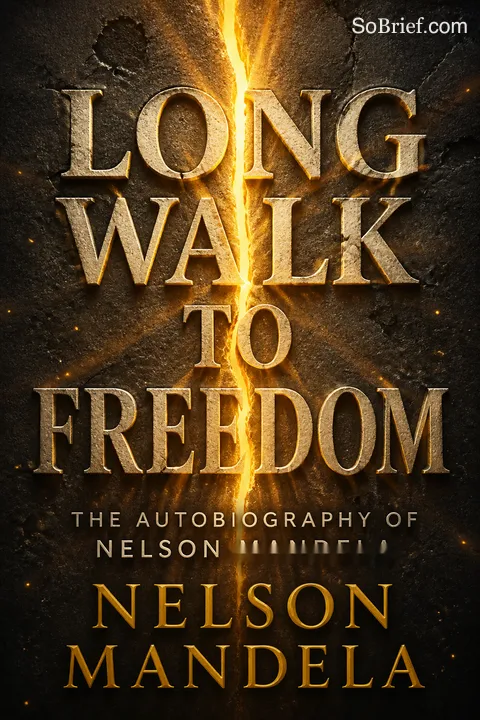
Long Walk to Freedom is both a personal memoir and a political history, structured as a widening journey. It begins with a child shaped by Thembu customs and kinship, then follows the pressures that enlarge his identity into a national political commitment. The story is not a simple march toward a predetermined destiny. Mandela describes uncertainty, misjudgment, youthful prejudice, fear, secrecy, and moments when he ignored wiser counsel. Those admissions help explain how political judgment develops through experience rather than arriving fully formed.
The book’s central political problem is how an oppressed movement can remain morally serious while changing tactics under a violent state. Mandela’s early faith in constitutional reform gives way to mass civil disobedience, then to sabotage, imprisonment, and negotiation. These stages are not presented as a tidy formula. Each creates dilemmas: protest can exceed organizational capacity; armed action risks civilian death; prison can isolate leaders from the public; and negotiations can weaken trust within a movement if conducted without enough consultation. The memoir’s strength is its attention to those costs and course corrections.
Its leadership ideal emerges from both the regent’s public meetings and the long discipline of the ANC: listen widely, build collective institutions, and place strategy above personal glory. Yet the story also exposes the tension between such collectivism and Mandela’s own decisions, particularly his initial private approach to the government. His political independence becomes useful, but it risks appearing to outrun the organization whose authority he represents.
The ending is deliberately incomplete. The 1994 election removes legal racial exclusion from political power, but Mandela states that freedom is only a beginning. That distinction guards against reading the victory as the repair of every injury. The autobiography closes with an elected government and a continuing obligation to confront deprivation, division, and the legacy of apartheid. Its deepest achievement is to portray freedom not as a personal escape or a change of rulers, but as a difficult process of shared political life.
Review Summary
Long Walk to Freedom is widely praised as an inspiring and enlightening autobiography. Readers commend Mandela's clear writing style, humble tone, and ability to convey South Africa's complex history. Many find his account of prison life and negotiations to end apartheid particularly compelling. The book is seen as essential reading for understanding South Africa's struggle and Mandela's pivotal role. While some note its length, most consider it deeply moving and appreciate Mandela's honesty in describing both triumphs and challenges throughout his long journey to freedom.
People Also Read






Glossary
Mandela-Plan (M-Plan)
Underground ANC structureA plan for keeping the African National Congress organized if the government banned it or prevented public meetings. It divided urban neighborhoods into small cells overseen by stewards, with information passed through a chain of local and provincial structures. Political lectures and regular contact were meant to preserve membership and leadership under clandestine conditions.
Umkhonto we Sizwe
ANC-linked armed organizationThe armed organization formed in 1961 after Mandela and other ANC leaders concluded that peaceful protest alone could not stop state repression. It was designed as a distinct organization linked to the liberation movement. Its initial strategy emphasized sabotage against government and military infrastructure, with instructions to avoid loss of life and hopes of forcing negotiations.
Defiance Campaign
Mass civil disobedience campaignA 1952 campaign led by the ANC and allied organizations in which trained volunteers deliberately broke selected segregation laws and accepted arrest without retaliating. About 8,500 people participated over five months, helping the ANC grow into a mass organization. The targeted laws remained, and the campaign did not expand into its planned nationwide stage of mass defiance.
Freedom Charter
Democratic equality programA political document adopted at the 1955 Congress of the People after suggestions were gathered from communities across South Africa. It called for democratic government, equal rights regardless of race, shared national wealth, and fair access to land. Mandela argued that it was not a blueprint for a socialist state, but a program for ending apartheid and establishing a nonracial democracy.
The Third Force
Suspected covert violence networkMandela’s term for suspected elements within the security forces who enabled or encouraged political violence in order to destabilize the country and obstruct negotiations. He used it after repeated attacks on ANC supporters went unprevented or uninvestigated. The term described a suspected covert role, not a formally named organization, and the memoir presents it as a conclusion drawn from reported incidents and later revelations.
Black Pimpernel
Nickname for fugitive MandelaA press nickname for Mandela during the period when he was living underground and evading arrest. He traveled in disguises, including as a chauffeur or worker, moved between safe houses, and sometimes used reporters to circulate information. The label alluded to a fictional character famous for evading capture, while the memoir stresses the strain and loneliness of life on the run.
Government of national unity
Transitional multiparty governmentA temporary post-election arrangement proposed during negotiations to include parties that won a significant share of the vote in the national cabinet. The agreement provided for proportional participation for parties above a threshold and set a five-year period before the arrangement ended. It offered a route from minority rule to democratic government while giving former opponents a role in the transition.
FAQ
What's Long Walk to Freedom about?
- Autobiographical Journey: Long Walk to Freedom is Nelson Mandela's autobiography, detailing his life from his childhood in the Transkei to his presidency in South Africa.
- Struggle Against Apartheid: It covers Mandela's experiences with racial discrimination, his political awakening, and his leadership in the anti-apartheid movement.
- Personal and Political Growth: The book intertwines Mandela's personal life with his political journey, highlighting his evolution from a rural boy to a global leader.
Why should I read Long Walk to Freedom?
- Inspiration and Resilience: Mandela's story is a powerful narrative of resilience, showcasing his unwavering commitment to justice despite immense challenges.
- Historical Context: It provides a detailed account of South Africa's history, particularly the apartheid era, essential for understanding the country's past and present.
- Human Rights Advocacy: The autobiography deepens understanding of human rights issues and the importance of activism, inspiring readers to engage in their communities.
What are the key takeaways of Long Walk to Freedom?
- Importance of Education: Mandela emphasizes education as a tool for empowerment, stating it can change the world.
- Unity in Diversity: The book illustrates the necessity of solidarity among different racial and ethnic groups in the struggle for freedom.
- Courage in Adversity: Mandela's life story is a testament to courage and determination, as he faced imprisonment and personal loss while remaining committed to his cause.
What are the best quotes from Long Walk to Freedom and what do they mean?
- “I have walked that long road to freedom.”: This quote symbolizes Mandela's journey and the struggles faced in pursuit of freedom.
- “For to be free is not merely to cast off one’s chains, but to live in a way that respects and enhances the freedom of others.”: Mandela highlights that true freedom involves personal liberation and the responsibility to uplift others.
- “It always seems impossible until it is done.”: This reflects Mandela's belief in perseverance, encouraging readers to confront challenges with the understanding that success often follows persistent effort.
How did Nelson Mandela's childhood influence his activism in Long Walk to Freedom?
- Cultural Roots: Mandela's upbringing in the Thembu royal family instilled a sense of duty and leadership, shaping his understanding of justice.
- Early Experiences of Injustice: Witnessing injustices from a young age fueled his desire to fight against apartheid and advocate for equality.
- Education and Exposure: His education at mission schools introduced him to new ideas and political thought, igniting his passion for activism.
What role did the ANC Youth League play in Mandela's political development in Long Walk to Freedom?
- Catalyst for Change: The ANC Youth League pushed the ANC towards a more radical approach, advocating for mass action and civil disobedience.
- Leadership Opportunities: Mandela's involvement provided leadership experience and a platform to express his views on African nationalism.
- Networking and Alliances: It connected Mandela with influential leaders, fostering camaraderie and shared purpose in the struggle.
How did Mandela's views on communism evolve throughout Long Walk to Freedom?
- Initial Skepticism: Mandela initially viewed communism with suspicion, seeing it as a foreign ideology.
- Recognition of Common Goals: Over time, he appreciated the shared objectives of the ANC and the Communist Party in fighting oppression.
- Pragmatic Collaboration: Mandela embraced a pragmatic approach, understanding that working with communists was essential for a united front against apartheid.
How did Mandela's imprisonment shape his perspective in Long Walk to Freedom?
- Reflection and Growth: Imprisonment provided time for reflection on beliefs and strategies, leading to personal and political growth.
- Strengthened Resolve: Harsh prison conditions strengthened his commitment to the cause, recognizing the importance of perseverance.
- Leadership Development: Mandela cultivated leadership skills, organizing fellow inmates and maintaining hope and purpose.
How does Long Walk to Freedom address the concept of nonviolence?
- Initial Commitment to Nonviolence: Mandela initially supports nonviolent resistance, viewing it as a moral principle.
- Shift to Armed Struggle: As oppression increased, he concluded that armed struggle was necessary, advocating for Umkhonto we Sizwe.
- Complexity of Resistance: The book illustrates that while nonviolence is noble, sometimes it is met with violence, necessitating a shift in tactics.
How does Long Walk to Freedom reflect Mandela's leadership style?
- Servant Leadership: Mandela's leadership is characterized by humility and a commitment to serving others, prioritizing the needs of the people.
- Visionary Thinking: He envisioned a united, democratic South Africa, guiding his actions and decisions.
- Emphasis on Reconciliation: His leadership focused on healing and reconciliation, building bridges between divided communities.
What personal sacrifices did Mandela make, as described in Long Walk to Freedom?
- Family Separation: Mandela's commitment to the struggle often meant long periods away from his family, missing important moments.
- Imprisonment: He endured 27 years in prison, facing harsh conditions and isolation for the cause of liberation.
- Personal Relationships: His political commitments strained his marriage, challenging the balance between personal and political responsibilities.
What impact did Long Walk to Freedom have on the world?
- Global Awareness: The book raised awareness about apartheid struggles, inspiring international solidarity movements.
- Cultural Significance: Mandela's autobiography became a symbol of resilience and justice, resonating globally.
- Legacy of Leadership: It solidified Mandela's legacy as a leader committed to peace and reconciliation, inspiring future generations.
Long Walk to Freedom Series
Download PDF
Download EPUB
.epub digital book format is ideal for reading ebooks on phones, tablets, and e-readers.








