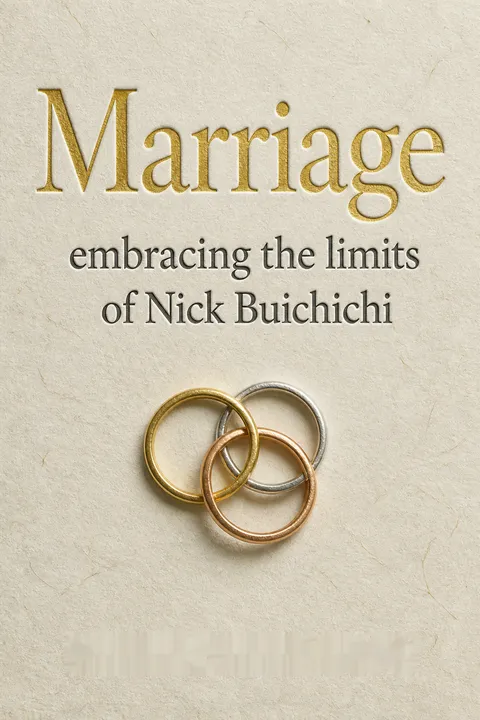


Key Takeaways
Keep faith in love, even when your body or past feels disqualifying
Fear is not a verdict. Nick was born without arms or legs and spent years believing no woman would choose him as a husband or father. His doubts persisted even as he built a public life and found purpose in his Christian faith. Kanae, raised in Mexico in a Japanese Mexican family, also carried grief and uncertainty from her parents’ separation and her father’s death. Their relationship began when both were unsure they would find lasting love, despite growing up thousands of miles apart.
Hope, not a guarantee. The couple presents their story as evidence that a person’s limitations or history do not make them unworthy of love. Their Christian faith gives that hope a particular shape: they trust that God can guide and sustain love. Their point is not that everyone must marry, but that fear alone need not decide the future.
The story’s force comes from the gap between Nick’s prediction and his lived experience. He treated a visible disability as proof of romantic impossibility, then encountered a partner who saw more than that condition. The distinction matters: worthiness is not earned by becoming unusually accomplished or inspirational. At the same time, one couple’s joyful outcome cannot promise that every person seeking marriage will find it. The broader, more durable claim is that shame is a poor judge of what another person can value.
Let heartbreak teach discernment without turning it into a wall
Loss can clarify. Nick’s first serious relationship began at a church camp when he was nineteen. He and the young woman shared faith and talked about marriage, but her father opposed the relationship. After years of separation, a brief attempt to reconnect, and another painful ending, Nick grieved for eighteen months. Friends and family helped him through a period he described as survival rather than progress.
Stay open, not attached. Nick argues that rejection hurts, but it does not establish that someone is unlovable. His earlier disappointments also helped him understand what he needed from a relationship and appreciate mutual commitment. He recommends widening one’s circle rather than judging potential partners only by looks, popularity, or a narrow picture of the ideal match. Love cannot be forced, and another person’s choice must be respected.
The most useful part of this account is not the suggestion that pain automatically makes people wiser. Pain can also harden into suspicion or fixation, as Nick’s years of waiting show. The difference lies in what happens around the grief: he had friends who listened, and he eventually let the relationship end rather than trying to override the family conflict. That makes the lesson less sentimental. Heartbreak becomes informative when it is mourned, supported, and allowed to change one’s judgment without becoming a permanent rule against intimacy.
Choose a partner by shared character, not fantasy or chemistry alone
Attraction starts the inquiry. Nick and Kanae felt an immediate spark when they met, but a tangle of mistaken messages, Kanae’s existing relationship, and Nick’s interest in the wrong sister delayed their courtship. Kanae eventually ended her prior relationship before dating Nick. She had already noticed that she was trying to fix her former boyfriend rather than choosing a future with him, and that their responses to faith and helping others differed.
Test the connection in life. The couple advises looking beyond appearance and asking whether there is shared faith or moral ground, whether family and friends can be welcomed, whether the person seems safe and supportive, and whether a shared future feels plausible. No checklist can prove someone is the one. The questions are meant to expose serious doubts and encourage people to know each other’s character before commitment.
This account usefully separates chemistry from compatibility without treating attraction as irrelevant. The initial spark drew the couple toward one another, but Kanae’s comparison of values and conduct helped her decide whether the attraction fit a life together. That is a stronger test than relying on destiny language alone. Their questions are also best understood as prompts for continued conversation, not a pass-or-fail scorecard. People can answer confidently in courtship and behave differently under stress, so consistency over time remains essential.
Discuss the hard logistics before making marriage promises
Love needs specifics. Before engagement, Nick and Kanae discussed family relationships, religious commitments, money and debt, past relationships, sex, children, and practical questions about Nick’s disability and caregiving. They also recommend raising sensitive differences, including politics, culture, and health, rather than hoping they will disappear after the wedding. Premarital counseling helped them discuss subjects that could otherwise feel awkward or unromantic.
Set clear boundaries. Their advice distinguishes ordinary concerns from serious danger. They identify abuse as a reason not to proceed without strong evidence that the behavior has changed, and they urge professional or trusted support for sexual trauma. Nick also wanted Kanae to know what assistance he needed and what he did not expect her to manage. These conversations are not a guarantee against conflict; they make expectations visible before the stakes rise.
The couple’s practical inventory is a useful corrective to wedding-centered thinking. A proposal celebrates commitment, but shared life also involves money, relatives, care work, sex, and children. Naming these subjects makes disagreement discussable before it becomes a recurring surprise. The nuance is that agreement is not always necessary: partners may differ and still build a workable arrangement if they can negotiate respectfully. But a commitment to sacrifice cannot substitute for safety. The book’s explicit rejection of violence is crucial, because devotion should never be used to excuse harm.
Look for love that gives in both directions
Mutual care, not scorekeeping. Nick’s uncle urged him to seek reciprocated love: both partners should want the other’s good, rather than one person carrying the relationship alone. His questions for a prospective spouse cover shared faith, mutual commitment, the prospect of parenting together, serious concerns, and basic respect. The underlying test is whether both people are choosing each other freely and responsibly.
Notice what matters to them. For Nick’s birthday, Kanae designed a package he could open by pulling a ribbon with his teeth or toes. He had never told her how disappointing it felt to need someone else to unwrap gifts, but she had noticed his wish to do things for himself. Her thoughtfulness made him feel understood. The gesture illustrates that care can be practical and personal, not merely dramatic.
The gift story gives mutuality a concrete scale: love can mean noticing a small frustration and removing it. Yet the couple’s emphasis on putting a spouse first should not be confused with equal effort in every task or perfect reciprocity on every day. Their own circumstances differ, and relationships inevitably include periods when one partner gives more. A healthier measure is whether care and respect flow both ways over time, with room to name exhaustion and renegotiate responsibilities rather than silently keeping score.
Practice marriage through attention, not grand gestures
The everyday reveals priorities. Soon after the wedding, Nick planned a business trip to Los Angeles without asking whether Kanae wanted to come. She felt left out; he had assumed she had other plans. The small mistake showed that he was still acting like a single person who made decisions alone. He began to think more deliberately about shared time and about including his wife in ordinary plans.
Protect time together. The book cites a study reporting that couples who talked or did something together at least weekly were 3.5 times more likely to describe their marriage as happy than couples who interacted less. Nick and Kanae also found that phone calls could not fully replace being together during his long trips. Their advice is to keep making time for one another, listen closely, and treat connection as part of married life rather than an optional reward after work is done.
The Los Angeles episode is memorable because no villain is needed: a reasonable assumption still makes a partner feel overlooked. It shows how attention is not simply affection held privately, but affection translated into choices the other person can feel. The study statistic supports the case for regular contact, though the book gives no details that would establish what kind of interaction matters most. The practical implication is modest and strong: protect recurring time, then use it to notice how each partner is actually doing.
Treat a new baby as a team test, not a private burden
Parenthood changes the marriage. Nick and Kanae had hoped to spend two years as newlyweds before having a child, but Kanae became pregnant three months after their wedding. Their son Kiyoshi arrived a year and a day after they married. The birth brought joy, but also recovery, sleepless nights, breastfeeding difficulties, and three months of colic, when the baby cried for long stretches.
Presence is part of care. Nick had a four-month speaking tour planned and was away for much of Kiyoshi’s first months. He returned expecting reunion and rest, while Kanae, who had carried the daily work of caring for a newborn, needed practical support. Their experience taught them that providing for a family does not replace being present in it. They urge new parents to ask for help, share the load, and make room for each other’s exhaustion.
The couple’s account refuses the tidy idea that a wanted child automatically makes family life easier. Love can deepen while sleep loss, unequal workloads, and missed milestones strain the partnership. Nick’s return makes the mismatch of expectations visible: the absent parent may arrive depleted, while the parent at home is also depleted and needs relief. The team metaphor is useful only when it leads to concrete redistribution of work. Appreciation matters, but so does changing the schedule or support system that created the imbalance.
Repair conflict by understanding the wound beneath the argument
The present carries history. Nick found that marriage revived insecurities about being unable to do household tasks or care for his son in familiar ways. His frustration sometimes came out as irritability toward Kanae. She, in turn, was sensitive to raised voices because her parents had divorced. Their arguments could therefore touch old fears that neither partner had caused.
Pause, explain, and repair. The couple recommends identifying what each person experienced, listening before trying to fix the problem, and apologizing when words cause harm. They try not to let resentments accumulate, and they seek help from a counselor or other impartial person when they cannot resolve an issue alone. They also make clear that disagreement is not an excuse for abuse. Understanding a reaction can explain it, but it does not remove the need to treat a partner with respect.
This is a particularly humane account of conflict because it treats irritation as information rather than a complete description of character. A partner’s reaction may be shaped by disability, past loss, or fear, and curiosity can prevent an argument from becoming a contest over who is irrational. Still, insight should not become a demand that the hurt partner endlessly interpret or absorb bad behavior. Repair requires both explanation and changed conduct. The emphasis on outside support is valuable because couples do not always have the perspective or safety needed to resolve every conflict alone.
Build a home with daily care, not just walls
A house can disappear. After Nick and Kanae bought a foreclosed home, Nick spoke with its former owner, who explained that job loss, injury, and unfinished contractor work had forced his family to leave. Despite the loss, the family had supported one another and leaned on their faith. Their story reminded Nick and Kanae that a beautiful property cannot guarantee security; the deeper refuge is the bond among the people who live together.
Make care repeatable. Nick and Kanae recommend simple practices that keep people connected: start the day together, pray or read together if that fits the couple, schedule dates, share enjoyable activities, express gratitude, and make room for humor. These routines are not decorations around a relationship. They create regular chances to pay attention, offer kindness, and return to one another amid work and parenting.
The former owner’s story gives the book’s idea of home a useful material contrast: property can be lost, while relationships and shared practices can endure. The religious framing is central to this couple’s sense of refuge, but the practical insight is broader: security is built through repeated acts of attention, not through a perfect setting. A sanctuary should not mean avoiding the outside world or concealing problems. It is most valuable when home becomes a place where difficulties can be spoken about and people can seek help.
Analysis
Love Without Limits is part memoir, part Christian relationship guide, and its most persuasive method is to let advice emerge from scenes rather than present it as expert doctrine. The story moves from Nick’s fear that his disability rules out marriage, through a courtship complicated by distance and miscommunication, to the less polished work of marriage and early parenthood. Kanae’s perspective matters: her childhood loss, doubts about a former relationship, and caregiving labor make the book a shared account rather than only Nick’s inspirational arc.
The strongest practical material concerns discernment and maintenance. The authors urge readers to evaluate character, discuss money and family expectations, clarify care needs, protect time together, and repair conflicts before resentment hardens. Their examples are specific enough to be useful: a forgotten invitation to a work trip, an accessible gift package, and an absent father returning to a tired new mother. These episodes show how ordinary assumptions can injure closeness, and how empathy becomes meaningful only when it changes behavior.
The book’s limits are also important. Its theology interprets the couple’s meeting and family life as providential, a compelling source of meaning for them but not evidence that everyone who wants marriage will find it. Its strong language of service and self-denial can inspire generosity, yet needs the book’s own boundary against abuse to remain safe. Mutual care is not submission to coercion, and forgiveness is not a reason to tolerate harm. The authors are writing from the early years of marriage, not offering a long-term clinical model. Their value lies less in predicting lasting love than in showing that love is sustained through honest choices, practical attention, faith, humor, and a willingness to keep learning each other.
Review Summary
Love Without Limits by Nick Vujicic receives overwhelmingly positive reviews, with readers praising its inspirational message and practical advice on relationships. Many appreciate the author's transparency in sharing his love story with his wife Kanae, as well as their insights on dating, marriage, and parenting. The book is particularly recommended for singles, engaged couples, and newlyweds. Some readers found the religious aspects helpful, while others felt the advice repetitive. Overall, reviewers found the book uplifting and a testament to overcoming obstacles in life and love.
People Also Read






Glossary
equally yoked
Shared spiritual commitmentA biblical expression the authors use for partners who share religious beliefs and a comparable depth of commitment to them. Nick and Kanae see shared faith as a source of guidance and strength in marriage. The book also acknowledges that couples with different beliefs may build a strong marriage when they respect one another and discuss how those differences shape family life.
reciprocal love
Mutual, unselfish careThe authors’ term for love in which both partners are committed to the other’s well-being, rather than one person pursuing affection that is not returned. It does not mean keeping an exact tally of favors. It means both people seek to make the relationship safe, respectful, and supportive, and each is willing to put the partnership ahead of selfish advantage.
threefold cord
Faith-centered marital bondA biblical image the couple applies to marriage: two spouses joined with God form a bond they believe is stronger than either partner alone. In their own marriage, faith provides a shared source of purpose, patience, and guidance. The phrase describes their Christian understanding of commitment, not a requirement that every couple share the same religious framework.
FAQ
What’s Love Without Limits by Nick Vujicic about?
- Personal journey and relationships: The book chronicles Nick Vujicic’s experiences of finding love, building a marriage, and starting a family despite being born without limbs.
- Faith-centered guidance: It emphasizes the role of Christian faith in relationships, focusing on putting God first, mutual respect, and selfless love.
- Comprehensive relationship advice: Topics include dating, courtship, marriage, parenthood, and overcoming challenges such as insecurities, cultural differences, and disabilities.
- Inspiration and motivation: Nick’s story inspires readers to embrace love without limits and to believe in their own worthiness of love.
Why should I read Love Without Limits by Nick Vujicic?
- Unique perspective on love: Nick’s journey as a man with a disability who found lasting love challenges conventional ideas about limitations and relationships.
- Practical, faith-based advice: The book offers actionable tips on dating, marriage, abstinence, and parenting, grounded in Christian values.
- Encouragement for all readers: Whether single, engaged, or married, readers can find hope and motivation to pursue meaningful relationships.
- Emphasis on emotional and spiritual growth: The book highlights the importance of empathy, forgiveness, and communication for a successful marriage.
What are the key takeaways from Love Without Limits by Nick Vujicic?
- Never give up on love: Everyone is worthy of love, regardless of imperfections or challenges, and should remain hopeful.
- Selfless, reciprocal love: Successful relationships require mutual commitment, putting the family’s welfare above self-interest, and growing together.
- Faith as a foundation: Building relationships on shared spiritual beliefs and trust in God is essential for enduring love.
- Preparation and honesty: Open discussions about finances, faith, and expectations before marriage help create a strong foundation.
How does Nick Vujicic’s personal story shape the message in Love Without Limits?
- Overcoming insecurities: Nick’s struggles with self-doubt and fears about being loved due to his disability illustrate that physical limitations do not define one’s worthiness of love.
- Learning from heartbreak: Early failed relationships taught Nick patience, trust in God’s timing, and the value of perseverance.
- Support systems: Faith, family, and friends played crucial roles in helping Nick overcome challenges and find lasting love.
- Real-life love story: The book details Nick’s courtship, proposal, and marriage to Kanae, offering practical and emotional insights.
What role does faith play in relationships according to Love Without Limits by Nick Vujicic?
- Central foundation: Faith in God is portrayed as the cornerstone of love, marriage, and family life.
- Equally yoked principle: Sharing the same spiritual beliefs and commitment to God is emphasized as vital for a strong marriage.
- Prayer and surrender: Trusting God’s plan and seeking guidance through prayer are recurring themes.
- Biblical love definition: The book uses 1 Corinthians 13 to define love as patient, kind, forgiving, and enduring.
How does Love Without Limits by Nick Vujicic address abstinence before marriage?
- Challenging but rewarding: Nick and Kanae share that abstaining from sex before marriage was difficult but ultimately strengthened their commitment and honored their faith.
- Sex as sacred: The book teaches that sex is a gift from God meant for marriage, fostering true intimacy and unity.
- Practical tips for abstinence: Advice includes double dating, avoiding tempting situations, and finding nonphysical ways to show affection.
- Community and support: Seeking prayer and guidance from mentors or faith communities is encouraged to help couples maintain boundaries.
What practical advice does Love Without Limits by Nick Vujicic offer for dating and courtship?
- Realistic expectations: The book acknowledges the risks and insecurities of dating but encourages openness and hope.
- Building friendship first: Nick and Kanae’s relationship began with friendship, mutual respect, and honest communication, which is recommended for lasting love.
- Navigating differences: The couple overcame cultural and language barriers with empathy and humor, showing love can transcend such challenges.
- Guarding the heart: The authors advise being cautious due to past hurts but emphasize the importance of emotional risks and trusting God’s timing.
How does Love Without Limits by Nick Vujicic describe the transition from single life to married life?
- Mindset shift: Marriage requires moving from self-centeredness (“me”) to prioritizing the needs and happiness of the spouse (“we”).
- Learning and adjustment: Early marriage involves adjusting expectations, open communication, and resolving conflicts with patience and love.
- Giving over receiving: True happiness in marriage comes from serving and loving your spouse selflessly.
- Continuous growth: Marriage is a lifelong learning process that requires ongoing effort, prayer, and mutual support.
What insights does Love Without Limits by Nick Vujicic provide about parenting and family life?
- Parenthood transforms life: Having children brings joy and new challenges, requiring patience, teamwork, and adaptability.
- Faith as a pillar: Daily prayer and reading the Bible together help the family navigate parenting ups and downs.
- Practical parenting tips: The book offers a “Ten Point Survival Guide” for new parents, emphasizing presence, gratitude, and teamwork.
- Embracing imperfection: Nick discusses his limitations as a father and the importance of humility and asking for help.
How does Love Without Limits by Nick Vujicic address the challenges of marriage and parenting when one partner has a disability?
- Open communication: Honest discussions about disabilities, caregiving needs, and boundaries are essential before and during marriage.
- Maintaining roles: Distinguishing between spouse and caregiver helps preserve intimacy and respect in the relationship.
- Empathy and adaptation: Kanae’s willingness to adapt and Nick’s creative approaches to parenting demonstrate the power of empathy.
- Family and community support: Acceptance and encouragement from family and faith communities are vital for overcoming doubts and fears.
What practical tools and questions does Love Without Limits by Nick Vujicic offer for evaluating and strengthening relationships?
- Self-assessment questions: The book provides questions based on 1 Corinthians 13 to help couples evaluate patience, kindness, trust, and commitment.
- Premarital discussion topics: Couples are encouraged to discuss family dynamics, faith, finances, intimacy, and other important issues before engagement.
- Faith compatibility: Assessing whether partners are “equally yoked” in faith is highlighted as crucial for long-term harmony.
- Ongoing evaluation: Revisiting these questions periodically helps couples adapt and maintain a strong bond.
What are the best quotes from Love Without Limits by Nick Vujicic and what do they mean?
- “Love suffers long and is kind…” (1 Corinthians 13): This encapsulates the selfless, patient, and humble nature of true love that Nick and Kanae strive to embody.
- “Sex without marriage is not authentic in our view…”: Reflects their belief that sexual intimacy is sacred and meant for the lifelong commitment of marriage.
- “You can’t be that self-centered and have a happy marriage…”: Highlights the importance of prioritizing the relationship over individual desires.
- “Your marriage, your family, and your home should always be a safe, loving, caring, and comforting place…”: Expresses their vision of marriage and home as sanctuaries of peace and unconditional love.
About the Author


Download PDF
Download EPUB
.epub digital book format is ideal for reading ebooks on phones, tablets, and e-readers.








