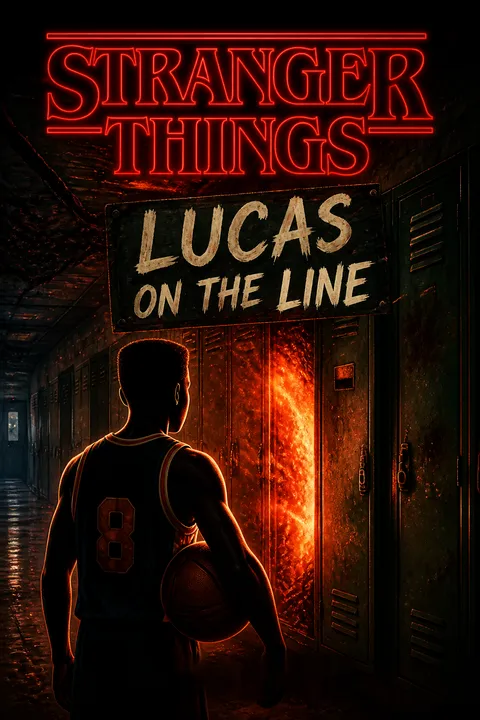


Plot Summary
A Blank First-Day Self
On the morning he starts Hawkins High, Lucas Sinclair trades his familiar clothes and trusty Wrist-Rocket for plain clothes, hoping to leave the frightening summer behind and begin again. At breakfast, his visiting Uncle Jack describes the Philadelphia police bombing of the Black MOVE community.
Lucas wants to understand the wider world, but his father, Charles, shuts down the discussion, preferring to keep his children safe inside Hawkins. At school, Lucas finds himself separated from Mike and Dustin, surrounded by classmates who ignore him. He notices he is the only Black student in his homeroom. When the school assigns peer mentors, one name catches his attention: Jermaine Demario, another Black student.
Lucas’s attempt at a fresh start begins with subtraction. He removes the objects that connect him to danger, but the school’s social order immediately makes a different part of his identity impossible to set aside. Uncle Jack’s account of MOVE gives Lucas a historical frame for the isolation he is beginning to feel; Charles’s silence shows how protection can become a form of withholding. The opening therefore makes growing up more than a change of clothes. Lucas wants to choose who he will be, while discovering that the world has already made some choices about how it sees him.
Jay Opens Another Door
Lucas meets Jermaine, who prefers to be called Jay, and discovers an ease he has not found among his new classmates. Jay is a Black transfer student from Cleveland, a basketball player who reads widely and refuses to treat those interests as opposites. Lucas tells him he plans to join Hellfire, the school’s Dungeons & Dragons club, and admits he knows little about basketball.
Jay offers to help him explore the sport anyway, pointing out that Lucas’s own plan calls for new friends and unfamiliar experiences. He also warns Lucas not to let relationships or activities consume everything else. Lucas leaves the mentoring session intrigued, but still assumes a nerd cannot also belong on a basketball court.
Jay’s importance lies in the example he embodies before he offers any advice. Lucas has learned to sort people into school categories, partly because those categories promise a map through high school. Jay complicates the map simply by being a reader, a basketball player, and a Black teenager without treating any one of those identities as the whole of him. His invitation gives Lucas permission to experiment, but it also makes visible the gap between wanting freedom and trusting himself to claim it. The mentor relationship begins as practical help and becomes a model of identity without forced simplicity.
A Seat at the Jock Table
At lunch, Lucas sees upperclassmen pull at Dustin’s carefully styled hair and send Mike’s Dungeons & Dragons die skittering across the cafeteria. He feels ashamed that he waited for them to leave before approaching his friends. When Jay later invites him to eat with the basketball players, Lucas chooses Jay’s table instead of Mike and Dustin’s.
He hopes basketball might let him belong in more than one world, but his friends see the choice as a rejection. Lucas insists he can make his own decisions and signs up for tryouts, despite not knowing the game. At the extracurricular fair, he also sees Max at the Video Game Club table. She studies his changed appearance as if she barely recognizes him.
This choice is neither a simple betrayal nor a triumphant escape. Lucas acts from a real hunger to find someone who shares his racial experience, while Mike and Dustin interpret the visible choice as evidence that their friendship matters less. The scene exposes how change redistributes attention even when no one intends harm. The bullying Lucas witnesses also complicates his desire to join the jocks: he knows they hurt his friends, yet hopes access to their group can protect him and perhaps them. Max’s searching look adds another cost, making his reinvention feel both exhilarating and estranging.
Max Refuses the Invitation
Lucas tries to draw Max back into the group with movie-night plans, but she avoids him. Her stepfather, Neil, tells Lucas that Max no longer lives at home and wants nothing to do with him. Max misses the gathering, leaving her tent empty, then also fails to appear when the friends meet at Family Video.
On Thanksgiving, Lucas takes food from his family’s table to Elmore skatepark, where he finds her alone. Instead of demanding an explanation, he listens as she reveals that Neil left her mother, forcing them into a trailer in Forest Hills and leaving them unable to afford a holiday meal. Max says she cannot pretend life is normal. She ends their relationship, telling Lucas she cannot be happy with him.
Lucas’s care initially takes the form of repair work: invitations, food, and plans meant to return Max to ordinary happiness. Max experiences those gestures through the reality he cannot see, so even generosity can feel like a reminder of the distance between their lives. Her disclosure reframes her earlier absences as material hardship and grief, not indifference. Lucas’s decision to sit beside her rather than argue marks a first, incomplete movement from solving toward listening. The breakup hurts precisely because affection remains; what fails is Lucas’s assumption that love gives him the power to make another person feel safe.
The Silence Between Friends
After Lucas’s choice of the basketball table, he and Mike and Dustin go weeks without speaking. The Byers family returns briefly to pack their house, and Will and Eleven’s departure from Hawkins deepens the group’s sense of loss.
Dustin’s request for advice reaches Robin Buckley, who helps the three boys talk through their resentment at Family Video. They resume a cautious friendship, though Lucas’s time with Jay still unsettles them.
When Max again misses a planned outing, Robin points out that Lucas’s new pursuits may make old friends feel displaced, and that his relationship with Max cannot be treated as a problem only she must solve. Lucas leaves with two challenges: be honest with his friends and learn to stay present without taking control.
This repair is deliberately partial. The boys reconnect, but reconciliation does not restore the old arrangement or erase the reasons it broke. Robin helps Lucas see that loyalty is not measured by keeping every friendship unchanged; it requires recognizing how one person’s growth can unsettle another’s sense of security. Her advice about Max is more demanding: empathy is not a technique for producing disclosure or gratitude. Lucas is still tempted to treat relationships as puzzles with correct solutions, but he begins to understand that presence may matter even when it cannot immediately change the outcome.
Books, Hair, and Inheritance
After Lucas brings Thanksgiving dinner to Max, he sneaks back into his bedroom and finds his family waiting with weapons, alarmed by his disappearance. Charles notices a history book Jay lent Lucas and condemns it as dangerous, fearing that racial knowledge will expose his son to harm. Lucas argues that not discussing Black history does not make him less vulnerable.
His mother, Susie, explains that she has used a name that reads as white to move through doors that might otherwise close. Jay later lends Lucas James Baldwin and Run-D.M.C., showing him that Black identity can hold many influences at once. Before school resumes, Charles cuts Lucas’s hair and admits his fear comes from wanting his son to live, not merely survive.
The family argument gives Lucas’s search for identity a history older than high school. Charles’s caution is not indifference; it is a survival strategy built from abandonment, racism, and a lifetime of feeling targeted. Susie makes clear that even a name can function as protection, while Jay offers cultural knowledge as an expansion rather than a restriction. The haircut becomes a quiet act of care because Charles meets Lucas within interests he does not personally share. Neither generation resolves the tension between safety and self-knowledge, but they begin to speak across it.
A Roster with a Price
Jay coaches Lucas through basketball basics, and Lucas discovers he genuinely enjoys practicing with him. At tryouts, Lucas performs poorly beside Lee Garroway, a gifted freshman, but assistant coach Mr. Theo still places both boys on the junior varsity roster. Lee suggests Lucas was selected because he is Black, and teammates later mock Lucas’s mistakes with a racial insult.
During a rough practice game, Lucas is knocked down repeatedly and blamed for the team’s loss. Mike, Dustin, and Erica see the abuse, though only Erica fully understands the insult’s sting. Feeling reduced to a stereotype from both directions, Lucas tells his friends he needs a break from basketball. They offer to help him join Hellfire instead.
Basketball gives Lucas pleasure before it gives him status, but the school repeatedly interprets his presence through racial expectation. The contradiction is cruel: he is presumed to possess natural ability, then ridiculed when he has to learn the game like anyone else. Lee’s taunt and the teammates’ treatment make Lucas question whether he chose basketball freely, yet his enjoyment with Jay remains real. The scene resists an easy answer about belonging. Lucas can reject the stereotype without rejecting the sport, though at this moment the pressure of being watched makes stepping back feel necessary.
The Locker Bomb Evidence
Two days after a glitter bomb explodes from Lucas’s locker, Jay warns him not to open it and prevents the trap from hitting him. Their lockers were targeted because the junior varsity players resent Jay’s place on the varsity bench and Lucas’s entry into their team. Jay says reporting the hazing could expose them to retaliation from players whose families support the school.
Lucas nevertheless decides to gather proof. After Mike refuses to lend him a camcorder, Lucas secretly takes his mother’s and hides it inside his locker. A full day of recordings appears useless until he reviews them with his family and Chief Powell. One tape shows Lee moving through the hallway with a metal pipe.
The camcorder turns Lucas’s old habit of preparing for danger into a tool for documenting ordinary institutional violence. His friends have learned that Hawkins can conceal threats, but Jay adds a more mundane lesson: power protects some perpetrators before anyone needs to deny what happened. Lucas acts without permission, taking a risk because the official channels seem unreliable. The tape does not yet guarantee justice, but it changes the situation from competing accounts into evidence. Its hidden viewpoint also echoes Lucas’s own experience: what the school overlooks can still be seen if someone pays attention.
Jay’s Last Lesson
Police investigate the explosion after a janitor is burned while opening Jay’s locker. Lucas shows Powell the camcorder footage, which places Lee at the school with the pipe; Lee confesses and faces several charges. The police photograph also reveals a racist slur painted inside Jay’s locker.
When school resumes, however, the hallway has been repaired and the incident is kept quiet. Lee returns under restrictions, while the students involved in the attack are removed. Lucas visits Jay, whose family has decided Hawkins is too dangerous and will leave.
Jay explains that they came seeking a fresh start after racism in Cleveland, but the town’s quiet hostility has repeated the same pattern. He and Lucas part as friends, with Jay urging him to keep trying new things without trusting too quickly.
The arrest offers accountability, but the polished hallway reveals how quickly an institution can make a public injury look as if it never happened. Jay’s departure exposes the limits of Lucas’s new belonging: being rooted in Hawkins may give him a different position from an outsider, but it does not make the town just. Their friendship has mattered because it gave Lucas room to test identities without explanation. Losing that space is painful, yet Jay’s final lesson asks Lucas to carry its freedom forward rather than mistake one mentor for a permanent shield.
A Place on Varsity
After Lee’s allies are removed and the team needs players, the basketball coach calls Lucas into the varsity squad as a backup. Mike and Dustin question why he wants to join a group that has treated him badly, but Lucas accepts the opportunity and proposes that they support each other’s interests. Max remains distant.
When Lucas forgets to leave her a note, he remembers the previous Halloween, when she planned to run away toward California. He walked with her to the bus station and listened as she reconsidered the danger and decided not to go. That memory clarifies how long she has been struggling. Lucas decides he must find his way back to her, even as he continues to pursue basketball and a new place at school.
The promotion arrives as a reward for persistence, but it does not settle Lucas’s doubts about the team or make his friendships fit neatly around his ambition. His recollection of Max’s attempted escape corrects an earlier misreading: her withdrawal is not a temporary mood he can fix with invitations. It has a history, and she has trusted him with fragments of it. Lucas’s attention is still divided between belonging and care, yet the memory gives his concern a more grounded basis. He wants to reconnect, but the story has taught him that wanting access is not the same as being invited in.
Two Worlds Collide
On the day of the championship, Lucas learns that Hellfire’s final campaign is scheduled for the same evening as the Tigers’ game. He asks Mike and Dustin to attend the game, but they hesitate to abandon their campaign, and he argues that popularity could protect all of them from bullying.
Max refuses the ticket he offers, saying that people change and she has changed. Later, when Jason and his teammates sneer at trailer-park residents, Lucas defends them because Max lives in one.
Jason belittles Lucas’s place on the roster and compares him unfavorably with Jay. Lucas recognizes the team’s approval is conditional, yet he still hopes to prove himself. Mike and Dustin ultimately head to Hellfire, leaving Lucas to prepare for the game without knowing who will stand with him.
Lucas’s desire for recognition has become entangled with a promise he cannot control: that success will make him safer and perhaps bring his friends along. Jason’s contempt shows that the team’s welcome is conditional on silence and usefulness, while Mike and Dustin’s choice reveals that Lucas’s interests do not automatically outrank their own. Max’s refusal is especially painful because it echoes his own lesson about change without offering reconciliation. The scene presses Lucas toward a more adult distinction: he can choose a path for himself, but he cannot make other people validate it or share it.
The Shot and the Split
The Tigers fall behind, and Lucas spends most of the championship on the bench, watching the bleachers for Mike, Dustin, and Max. When point guard Charlie is injured, the coach sends Lucas onto the court. With seconds left and Hawkins trailing by one, Jason misses a shot and Lucas catches the rebound. He evades a defender and scores the winning basket.
Teammates carry him into a celebration at the abandoned Benny’s Burgers, where he drinks too much and enjoys the attention. Then he sees Mike, Dustin, and Erica leaving in Hellfire shirts. He feels abandoned after asking them to share his biggest moment, but the next morning’s report of a student murder interrupts his anger: the victim is from Max’s trailer park.
The winning shot is both a genuine achievement and an imperfect answer to Lucas’s longing to be seen. He acts under pressure using skills he once believed he did not have, but the crowd’s acclaim cannot replace the particular recognition he wanted from his friends. His choice to join the Tigers’ celebration is not false; he enjoys it. The hurt comes from discovering that success and intimacy do not necessarily arrive together. The murder report then punctures his self-absorption with immediate danger, shifting the question from who supports Lucas to whom he must protect.
Jason Hunts Hellfire
Chief Powell arrives at Benny’s and asks Jason to identify Chrissy Cunningham, his girlfriend, who has been found dead at Eddie Munson’s trailer. Jason blames Eddie and recasts Hellfire as a satanic cult, then rallies his teammates to hunt him. Lucas knows the club is a role-playing group, not a murder ring, but his new teammates’ anger and their fixation on revenge make speaking up dangerous.
He also fears Jason’s search could reach Max, who lives in the same trailer park, and Dustin, who belongs to Hellfire. When Jason, Patrick, and Andy gather tools as weapons the following morning, Lucas goes with them, hoping to keep their hunt from hurting anyone.
Jason transforms grief into certainty. By giving Chrissy’s death a human culprit and a demonic explanation, he can act rather than endure helplessness. The boys’ team loyalty makes his story contagious, especially in a town already primed to fear satanic explanations. Lucas recognizes the danger because he has seen Hawkins confuse appearance with truth, but he is also invested in his new status and hesitant to break with the group. His decision to accompany the hunters is therefore morally unstable: he enters a violent plan not because he believes it, but because he hopes proximity will let him limit it.
The Wrong Kind of Monster
At a garage where Hellfire members rehearse, Jason assaults Gareth until Gareth reveals that Dustin has been searching for Eddie. Lucas slips into Dustin’s room and reaches him by radio, learning that Dustin and Max have found Eddie hiding and believe he did not kill Chrissy.
When Jason discovers Lucas, Lucas lies that he knows Eddie’s location and leads the armed group to Hopper’s empty cabin. He escapes on Eleven’s old bicycle and rides to Hawkins High, where he finds Max, Dustin, Steve Harrington, Robin, and Nancy.
They explain that Eddie witnessed Chrissy’s supernatural death and that another student, Fred, has died in the same way. Max found that both victims had reported disturbing symptoms to school counselor Ms. Kelley. She has them too.
Lucas’s shift from reluctant escort to active deception marks a decisive change in his idea of loyalty. He risks his standing with Jason’s group to protect Dustin and the Hellfire members, then uses a familiar Hawkins tool, the abandoned cabin, as a decoy. The revelations at school restore the supernatural frame that the town’s rumors had distorted: there is a real threat, but Eddie is not the monster the jocks imagined. Max’s symptoms make the danger intimate. Lucas’s fear for her is now grounded in evidence, not merely his wish to repair their relationship.
Kate Bush at the Grave
At the Wheelers’ basement, the group connects the victims’ symptoms to Victor Creel, a man confined at Pennhurst after his family died decades earlier. Max prepares letters in case she does not survive, while Nancy and Robin go to question Creel. When Max hears the chimes of a grandfather clock again, she insists on visiting her trailer and then Billy’s grave.
There, Vecna’s curse takes hold: Max becomes unresponsive as Steve and Lucas try to wake her. Dustin brings her Walkman and the Kate Bush cassette she loves. Lucas puts the headphones on her and starts the song. Max levitates, then falls. After a terrible pause, she gasps awake and clings to Lucas. She is alive, though the threat remains.
The rescue pays off the novel’s recurring lesson about listening, but it does not turn listening into magical mastery. Lucas cannot argue Max out of danger or promise a future; he can remember what matters to her and act with the help of his friends. The cassette makes memory tangible, a private attachment carried into a public crisis. Max’s return brings relief without erasing the peril that brought them to the grave. The ending preserves uncertainty: Lucas has found his way back to her, but the group has only interrupted Vecna’s attack, not ended the danger.
Analysis
Lucas’s story treats adolescence as a struggle over who gets to define a person. At Hawkins High, he wants to move beyond the familiar image of himself as a nerd, but his first route toward change is shaped by racial visibility. Jay’s mentorship matters because it does not ask Lucas to exchange one identity for another. Basketball, literature, Dungeons & Dragons, Black history, and friendship can coexist, even when Hawkins’s social categories insist otherwise. The school’s treatment of Lucas and Jay shows how ostensibly neutral institutions distribute risk unevenly: the students with status can harm others and still expect the hallway to be repainted before anyone asks what happened.
The novel also distinguishes care from control. Lucas’s first instinct with Max is to arrange the right outing, bring food, and repair her unhappiness. Her disclosure teaches him that affection cannot make hardship disappear, and that listening is not a prelude to taking charge. This lesson becomes more consequential as the supernatural plot surfaces. Max’s danger cannot be solved by Lucas alone, but his attention to her habits and attachments gives the group a way to reach her. The story links relational knowledge to practical survival without pretending either is sufficient by itself.
Charles’s caution complicates the idea of self-expression. He wants Lucas safe in a world that has repeatedly made Black identity a target, while Lucas understands that ignorance cannot make him less exposed. Their disagreement is not between wisdom and prejudice, but between two generations’ different calculations of danger. Jay, Susie, and eventually Charles help Lucas see that survival strategies can protect and constrain at once.
The ending offers a reprieve, not a clean victory. Lucas scores the shot that wins the championship, yet feels the absence of the friends whose recognition he wanted. Later, the song brings Max back from Vecna’s attack, but the threat remains. Success does not erase loneliness, and rescue does not end danger. Lucas’s growth lies in choosing a wider self and accepting that real belonging depends on attention, mutual effort, and the courage to act before certainty arrives.
Review Summary
Lucas on the Line receives mostly positive reviews, with readers praising its exploration of Lucas's character, his experiences with racism, and his relationship with Max. Many feel the book provides important context for Lucas's actions in Stranger Things season 4. Criticisms include some dialogue feeling off-character and the book's ending recap of show events. Fans appreciate the deeper dive into Lucas's perspective but wish more of this content had been included in the show itself.
Characters
Lucas Sinclair
The searching strategistLucas is a thoughtful, capable Hawkins teenager whose confidence is strained by a new school, old grief, and the feeling that his friends see only the version of him they already know. He likes science, games, and problem-solving, but increasingly recognizes that he has learned to make himself legible to other people before asking what he wants. His search for belonging takes him toward basketball and Jay, while his bond with Max keeps drawing him toward patience and care. Lucas’s central psychological tension is not whether he can change, but whether he can do so without treating approval as proof that he has become someone worthwhile.
Max Mayfield
The guarded survivorMax is sharp-witted, self-reliant, and wary of promises, shaped by repeated upheaval in her family and a painful history with her stepbrother Billy. She shares a deep, complicated bond with Lucas, but resists being treated as a problem he can solve. Her habit of withdrawing protects her from disappointment while also making it difficult for others to understand the scale of what she is carrying. Max’s independence is genuine, not simply a defensive pose, yet her self-sufficiency can become isolation. She values honesty and space, and she is most likely to trust people who respect both.
Jermaine Demario, called Jay
The expansive mentorJay is a sophomore transfer from Cleveland, a skilled basketball player who has yet to claim a starting place on Hawkins High’s team. He is confident without insisting that confidence means having all the answers. Basketball, literature, music, and friendship coexist easily for him, offering Lucas a living example of a self that does not fit one category. Jay understands racial isolation and the unequal risks Black students face at school, but he does not reduce Lucas to a lesson or a cause. His mentorship grows from recognition: he wants Lucas to have room to try things, even when the world may misunderstand what that freedom costs.
Mike Wheeler
The grieving childhood friendMike is Lucas’s longtime friend and a central member of their Dungeons & Dragons circle. He is grieving the separation from Eleven and Will, and his withdrawal makes him irritable when Lucas begins investing in a life beyond their familiar routines. Mike can be loyal and brave, but he often assumes that closeness means preserving old habits. His conflict with Lucas comes less from hostility than from fear that change will leave him behind. He is still learning how to support a friend whose interests and ambitions no longer match his own.
Dustin Henderson
The exuberant connectorDustin is Lucas’s inventive, talkative friend, devoted to Dungeons & Dragons, science, and his long-distance relationship with Suzie. He often uses humor and activity to keep difficult feelings at bay, which can make him miss what Lucas or Max needs in the moment. His loyalty is real, though he may express it through shared projects rather than emotional attention. Dustin is also a persistent investigator who connects clues others overlook. His friendship with Lucas is tested by their competing ideas of what high school should offer, not by a lack of affection.
Erica Sinclair
The incisive younger sisterErica is Lucas’s younger sister, quick to puncture pretension and rarely willing to soften a judgment for someone’s comfort. Her sharp tongue can make her seem indifferent, but she notices when Lucas is hurt and understands the racial insults he faces more readily than some of his friends do. Erica protects her independence by refusing to romanticize popularity or change. Her teasing masks a clear sense of family loyalty, and her bluntness often reveals what others have chosen not to notice.
Charles Sinclair
A cautious fatherCharles is Lucas and Erica’s father, a military veteran who values discipline, stability, and keeping his family safe. His reluctance to discuss race or Black history comes from exhaustion and fear, not a lack of love. Having endured childhood displacement and a difficult path through foster care, he is wary of anything that might make his son a target. That protective instinct can silence Lucas, even as Charles slowly recognizes that silence cannot shield him from the world.
Susie Sinclair
A careful family bridgeSusie is Lucas and Erica’s mother, affectionate and attentive to the emotional weather in her home. She often mediates between Charles’s caution and Lucas’s growing curiosity, translating the fears her husband struggles to voice. Her own experience with names and racial perception gives her a practical understanding of how identity shapes access. Susie wants her children protected, but she also knows that protection cannot mean pretending the world is fair.
Robin Buckley
The perceptive mediatorRobin works at Family Video with Steve and has a quick, observant mind. She helps Mike, Dustin, and Lucas talk through their rift, then encourages Lucas to understand how his new interests affect old friendships. Her advice is practical rather than sentimental: she asks him to listen without trying to fix Max and to be more honest with his friends. Robin notices contradictions in people without immediately condemning them, making her a steady guide for Lucas as he navigates relationships.
Steve Harrington
The reluctant big brotherSteve is Robin’s coworker at Family Video and an older friend to the younger Hawkins teens. He is confident, teasing, and sometimes careless, but he is willing to step into danger when the younger group needs help. His past as a popular student makes him a useful contrast to Lucas’s idea that status guarantees safety. Steve’s practical courage often appears before his emotional insight.
Nancy Wheeler
The determined investigatorNancy is Mike’s older sister, a student journalist who responds to uncertainty by gathering evidence. She is focused on her future and on the people around her, even when grief makes her impatient. Her work with Robin gives the group a way to investigate Hawkins’s history rather than accept the first explanation offered. Nancy is resourceful, ambitious, and unusually willing to follow a clue into uncomfortable territory.
Eleven
Lucas’s distant friendEleven is Mike’s girlfriend and a close friend of Max and the Hawkins group. After moving to California with the Byers family, she remains an important absence in Lucas’s daily life. Her departure intensifies Mike’s grief and changes the friendships that once formed the group’s center. Lucas remembers her as a courageous ally, though distance and limited contact leave him uncertain about how to reach her.
Will Byers
A missing piece of homeWill is one of Lucas’s oldest friends and a member of the original Hawkins group. His move to California with his family marks a major change in the group’s shared life. Will is quiet and artistic, and his absence affects Mike and the others in different ways. He remains part of Lucas’s sense of friendship even when distance keeps them apart.
Eddie Munson
Hellfire’s theatrical leaderEddie leads Hawkins High’s Hellfire Club, a Dungeons & Dragons group whose handmade banners and heavy-metal style attract suspicion from more conventional students. He is flamboyant, funny, and protective of the outsiders who gather around him. Lucas initially knows him mostly through the club and its reputation. Eddie’s appearance makes him an easy target for the town’s fears, while his enthusiasm for fantasy games reveals a more welcoming side.
Jason Carver
The righteous team captainJason is the confident captain of the Hawkins basketball team, admired by classmates and accustomed to leading. He believes in athletic discipline and school pride, but his certainty can harden into contempt for anyone he sees as an outsider. He expects loyalty from teammates and treats public respect as something earned through obedience. Jason’s charisma gives his assumptions unusual force, especially in a town eager for simple explanations.
Lee Garroway
The favored freshmanLee is a talented freshman basketball player with strong family connections to the school. His skill earns him immediate attention, and he expects others to accept his place in the team. He resents players whose presence challenges the hierarchy he takes for granted. Lee’s confidence is reinforced by the protection and status surrounding his family.
Neil Hargrove
Max’s threatening stepfatherNeil is Max’s stepfather, an intimidating and unreliable presence in her home life. His hostility toward Lucas helps explain why Max keeps her private life at a distance. He represents the adult instability Max cannot control.
Chief Calvin Powell
The measured police chiefPowell is Hawkins’s police chief, a deliberate investigator who prefers evidence to dramatic guesses. He questions Lucas about the locker attack and takes the camcorder footage seriously. His calm manner offers a contrast to the town’s appetite for rumor, though his authority operates within institutions that do not always protect everyone equally.
Mr. Theo
The hard-edged coachMr. Theo assists with the junior varsity basketball team and runs tryouts with little patience for hesitation. He pushes players to perform under pressure, sometimes mistaking anxiety for lack of commitment. His standards make Lucas’s early mistakes feel public and consequential.
Chrissy Cunningham
The celebrated cheerleaderChrissy is a popular cheerleader and Jason’s girlfriend. Her polished public image sits alongside private concerns that classmates do not fully understand. She connects the school’s social center to events the students cannot yet explain.
Victor Creel
The isolated asylum patientVictor is an elderly man confined at Pennhurst after a decades-old family tragedy in Hawkins. His account of what happened to his family has made him a figure of local fear and rumor. Nancy and Robin seek him out because the town’s past may contain clues to the present.
Uncle Jack
The outspoken family visitorJack is Charles’s brother, a community organizer from Philadelphia who visits the Sinclair household. He challenges Charles’s desire to keep the children insulated from conflict and gives Lucas access to histories rarely discussed at home. His bluntness can unsettle the family, but it also opens a window onto the world beyond Hawkins.
Plot Devices
Lucas’s freshman guide
A changing personal compassLucas writes a short set of rules for surviving high school, beginning with making friends, trying new things, and being himself. As the story progresses, he revises the list to account for relationship conflict and the need to live in the moment. The guide tracks his shifting idea of growth: at first he treats change as a checklist, then discovers that it affects his friends as well as himself. Its plain, practical format keeps his internal development tied to concrete choices, including whether to join basketball, how to respond to Max, and what loyalty requires.
The basketball season
A test of chosen belongingBasketball gives Lucas a route into a social world he has previously viewed from the outside. Jay teaches him the basics, and Lucas discovers enjoyment in the sport independent of popularity. At the same time, teammates and coaches impose racial assumptions and status rules on him. The season therefore tests whether Lucas can claim an interest without accepting every expectation attached to it. His progress from awkward tryout to championship substitute makes the sport a visible measure of skill, while the friendships and pressures around it reveal that belonging is never guaranteed by performance alone.
The hidden camcorder
Proof against quiet denialAfter a glitter trap targets Lucas and Jay, Lucas hides his mother’s camcorder inside his locker to record whoever returns. The first recordings seem empty, but one shows Lee carrying a metal pipe through the school hallway. Lucas shares the evidence with Chief Powell, helping connect the student harassment to the later explosive attack on Jay’s locker. The camera turns a private attempt at self-protection into a record that can challenge the school’s tendency to make incidents disappear. Its usefulness depends on Lucas’s patience and willingness to take a risk without knowing whether the evidence will be enough.
Kate Bush’s cassette
A remembered lifelineMax repeatedly listens to a cassette of Kate Bush’s Hounds of Love, especially one song that becomes associated with the night Lucas sits beside her at Elmore skatepark. The Walkman and tape give the pair a way to share a feeling they cannot easily explain to each other. Later, when Max is trapped in a supernatural trance, her friends use the song to reach her. The device links an intimate memory to urgent action: Lucas does not solve Max’s pain, but remembering what she loves helps him participate in bringing her back.
Vecna’s curse
A hidden threat made visibleA series of visions, headaches, nosebleeds, insomnia, and trances precedes attacks that leave Hawkins students dead. Lucas initially encounters the name Vecna as part of a Hellfire campaign, then learns that the fantasy figure resembles the force behind the real killings. Nancy, Robin, and the others use victims’ counselor records and Victor Creel’s history to connect the pattern. The curse turns private distress into a supernatural countdown, particularly for Max. It also forces the group to distinguish genuine danger from the satanic panic that Jason uses to justify hunting Hellfire members.
Download PDF
Download EPUB
.epub digital book format is ideal for reading ebooks on phones, tablets, and e-readers.








