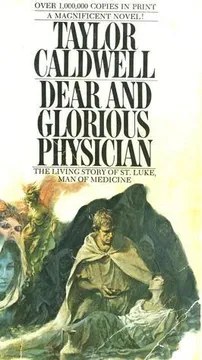


Plot Summary
The Unknown God
Ten-year-old Lucanus grows up in Antioch watching his father, Aeneas, pour wine to the Unknown God, a deity who seems unlike the flawed gods of Greece and Rome. When Rubria, the young daughter of the Roman tribune Diodorus, falls dangerously ill, Lucanus prays for her and brings Diodorus a strange stone and healing herbs he gathered himself.
The herbs ease Rubria’s suffering, and Diodorus discovers that the quiet boy longs to become a physician for the sick of every nation. Moved by Lucanus’s purpose, Diodorus promises to pay for his education and arranges for Keptah, his gifted physician, to teach him. The promise gives Lucanus a route toward medicine, while his prayer for Rubria begins his lifelong search for the God he calls Father.
Lucanus’s vocation begins not as a career choice but as a response to a particular body in pain. His childhood theology is unusually intimate: unlike Diodorus, who approaches divinity through inherited rites, Lucanus imagines a God who listens and loves. The stone and herbs leave open whether his gift is instinct, faith, or something beyond either. Diodorus’s patronage turns that private conviction into a material possibility, while his own tenderness toward the children complicates the Roman hierarchy that governs the household.
The Star and Cross
On the night a brilliant star appears, Lucanus finds Keptah watching it beside the river. The physician reveals that he is a Chaldean, descended from a secret order of scholars who have guarded ancient prophecies, and that the star announces the birth of a promised child. Keptah shows Lucanus a gold cross, an old sign whose meaning he cannot yet explain, then witnesses the Magi visit a hidden temple where Lucanus kneels before a great cross.
The Magi confirm that Lucanus is marked for work beyond their own order. Diodorus frees Keptah and appoints him Lucanus’s teacher, with Alexandria as the next step. Lucanus receives neither the prophecy’s full meaning nor its timetable, only a sign he will carry through years of doubt.
The star and cross establish a pattern of partial knowledge. Lucanus receives signs before he can interpret them, while Keptah’s secret history gives those signs a human chain of transmission. The Magi do not offer certainty or immediate initiation; instead, they affirm that Lucanus must follow a different route. That deferral matters psychologically. His future faith will not be inherited whole from a teacher but tested against loss, medicine, and his own insistence on evidence.
Lessons in Human Cruelty
Cusa, Diodorus’s sharp-tongued tutor, finds that Lucanus learns languages and philosophy with startling speed, while Keptah teaches him medicine among the household’s sick. Lucanus and Rubria grow close through lessons and play, and his wish to become a physician deepens.
Then Keptah brings him to a wineshop and lets the merchant Linus inspect him as a saleable boy. Lucanus feels his dignity stripped away before Keptah stops the transaction and summons soldiers.
The physician explains that Lucanus has encountered only a glimpse of what slavery does to a person, a truth hidden from him by his sheltered upbringing. Lucanus leaves the encounter newly resolved to treat slaves as human beings, not property. The lesson turns compassion from an abstract belief into a response to humiliation.
Keptah’s lesson is ethically uncomfortable because he uses Lucanus’s body to make a point about slavery. The scene exposes the gap between benevolent household management and the coercive system that makes people saleable. Lucanus’s protected status has allowed him to condemn cruelty without fully knowing its bodily meaning. His recognition does not erase that privilege, but it changes what he considers a physician’s responsibility: healing must include attention to the social conditions that produce injury.
Rubria's Last Summer
Rubria’s illness recedes for years, letting her and Lucanus imagine an ordinary future together. When the white sickness returns, Keptah tells Lucanus she will not survive the year. Lucanus rejects the diagnosis and rages inwardly against a God who could take someone so gentle. As Rubria weakens, she remains calm, gives Lucanus Keptah’s cross, and tries to restore his belief in a life beyond death.
She dies beside him in the garden, her hand falling from his hair. Lucanus’s grief becomes a direct accusation against God, and he vows to defeat death by saving those it claims. The loss ends the sheltered happiness of his youth and gives his medical ambition a new, furious purpose.
Rubria’s death changes Lucanus’s relationship to faith because it makes suffering personal rather than observed. He had prayed for her as a child, but the return of illness turns prayer into a demand for control. Rubria’s serenity does not persuade him; it intensifies his sense of injustice by showing that acceptance is possible for her but not yet for him. The cross passes from Keptah to Rubria to Lucanus as a tangible inheritance he cannot interpret and cannot discard.
A Son From Death
A violent storm floods the estate, and Aeneas stays behind to protect the account books that have given his life meaning; the river sweeps him away. Lucanus is left grieving a father he had too often dismissed as small-minded. Soon Aurelia suffers a fatal pregnancy crisis. Keptah operates to save her premature baby, but Aurelia dies, and the infant lies still.
Lucanus clears the child’s airway, breathes into his lungs, and keeps working until the boy begins to cry. The child, named Priscus, survives. Diodorus is left with his son, his grief, and the love he has long concealed for Iris. Learning that his mother adopted Iris, he marries her, and Lucanus is drawn into a new family even as sorrow hardens his sense of purpose.
This sequence places two different forms of care beside one another. Aeneas preserves the records that testify to his worth, while Lucanus preserves a living child through physical skill and refusal to stop. Neither action can undo loss, but each reveals what a person has chosen to protect. The birth also brings Iris and Diodorus together, showing that love can resume after bereavement without cancelling it. Lucanus’s calling grows out of both medical competence and the limits of what medicine can save.
The Tribune's Final Stand
After moving his family to Rome, Diodorus grows increasingly appalled by the Senate’s corruption and the Empire’s appetite for power. He speaks publicly against the senators, accusing them of trading the Republic’s laws for privilege and mob approval.
Carvilius Ulpian reports him to Tiberius, who orders a military summons that Diodorus understands as a command to die. Already gravely ill, Diodorus dies before the message can be delivered as intended.
Tiberius nevertheless gives him a state funeral and publicly honors his integrity, while Carvilius is later poisoned. Lucanus is studying in Alexandria during his father’s final struggle. Diodorus’s example remains a difficult inheritance: a man may resist a collapsing society without being able to save it.
Diodorus’s political arc makes integrity costly without pretending it is politically effective. He sees Rome’s decline clearly, yet his intervention cannot restore the institutions he defends. Tiberius’s private respect and public honor arrive too late to change that outcome. For Lucanus, the father’s example creates a parallel between civic duty and medical service: both require acting against harm without control over the result. The story preserves the dignity of resistance while refusing to confuse moral witness with victory.
The Missing Lion
At Alexandria’s vast medical school, Lucanus studies medicine while refusing to treat knowledge as separate from the patient’s whole life. The wealthy trader Elazar ben Solomon summons him near death, not to save himself but to ask for help finding his kidnapped son, Arieh, identifiable by a crooked little finger.
Elazar’s wife died in childbirth, and two nursemaids were murdered when the boy vanished from a guarded garden. Lucanus promises to search, though he doubts the child is alive.
Elazar dies soon after, leaving his daughter Sara and a request that binds Lucanus to a family he has just met. Sara’s beauty and grief stir his affection, but Lucanus keeps emotional distance, already afraid that love will only prepare him for another loss.
Elazar’s request gives Lucanus a duty medicine cannot fulfill through diagnosis or treatment. Finding Arieh requires attention to people, places, and memory over time. The crooked finger becomes a small physical fact charged with enormous emotional consequence. Sara introduces a second tension: Lucanus can offer compassion to strangers more readily than he can accept intimacy for himself. His promise to Elazar begins as professional kindness, but it gradually becomes a test of whether he can remain connected to another person without trying to control the outcome.
A Leper's New Skin
When a physician named Sira returns secretly to see his wife and children, the city pursues him because leprosy makes his presence a capital offense. Sira’s wife refuses to leave him, and Lucanus hides them from the mob.
In the courtyard he grips Sira’s shoulders, pleads for mercy, and watches the leper’s skin become whole. Lucanus gives the couple his mantle, sandals, purse, and dagger so they can escape. The encounter strengthens his belief that a doctor must go where suffering is ignored.
Though Diodorus has arranged a prestigious medical post in Rome, Lucanus rejects it and chooses work among the poor, prisoners, slaves, and sick travelers. His refusal costs him comfort and family proximity, but makes his vocation a deliberate way of life.
Sira’s healing places Lucanus’s medical identity under pressure: what happens exceeds ordinary treatment, yet the immediate ethical action remains concrete. He protects a hunted couple and gives away the objects that could protect him. The episode also complicates his grievance against God. Lucanus begs for mercy while insisting that he cannot believe in divine goodness, so his action precedes his reconciliation. His rejection of a Roman post translates that contradiction into practice: he can serve vulnerable people even while he remains unsure of the source of the power he has witnessed.
The Galley Hold
On the voyage from Alexandria, Lucanus learns that plague has broken out among chained galley slaves, whom Captain Gallo has sealed below deck. Gallo forbids Lucanus to enter, fearing for his valuable passenger.
With Cusa’s lock picks and help from the young centurion Scipio, Lucanus slips into the hold and finds the sick among the dead in foul, flooded darkness. He separates the living, gives medicine for pain, orders water and disinfectant, and has bodies removed before infection spreads.
The captain later reports that the stricken slaves recovered, though Lucanus had expected them to die. He cannot explain the recovery and initially assumes the diagnosis was wrong. The event deepens his bewilderment while showing what his medical oath demands when authority abandons the sick.
The locked galley is the novel’s starkest image of institutionalized disposability. Gallo’s distinction between a passenger and a slave is not merely prejudice; it determines who receives air, medicine, and a chance to live. Lucanus breaks a lawful order because he recognizes a higher obligation to the people imprisoned below. The unexpected recovery unsettles his rational self-conception, but the narrative does not make uncertainty an excuse for inaction. He acts before he understands, and the unexplained outcome follows the act rather than replacing it.
Julia's Dangerous Banquet
In Rome, Tiberius grants Lucanus a private audience, appoints him to inspect medical care, and orders him to remain six months in honor of Diodorus. At a banquet held by the Emperor’s wife, Julia, wine and spectacle blur Lucanus’s judgment; he responds to her advances before recovering enough to reject her and flee.
The refusal humiliates Julia, who has one of her favorites, Hyacinth, killed. Praetorian Plotius hides Lucanus, then disguises him as a laborer and carries letters, money, and medicine to his escape route. Caesar allows the fiction that Lucanus has been banished, protecting him from Julia’s revenge. Lucanus leaves Rome alive but newly aware that imperial favor cannot make a palace safe.
The banquet is a collision between Lucanus’s inexperience and a court where desire is also power. His intoxication weakens his control, but his final refusal exposes how little protection status guarantees when Julia feels publicly slighted. Plotius’s intervention shows loyalty operating beneath official appearances: the palace can announce banishment while quietly preserving a life. Lucanus’s departure also strips away the illusion that proximity to Caesar offers moral influence. His vocation will take shape outside institutions that can reward him and threaten him in the same breath.
The King in Chains
After years of wandering, Lucanus reaches an Athenian slave market and sees a regal African man displayed in chains. The merchant says the mute stranger, called Ramus, was imprisoned after rumors cast him as a sorcerer. Lucanus buys him, breaks the chain himself, and treats him as a companion rather than property.
Ramus writes that he is a king searching for a promised deliverer who can end the persecution of his people. Lucanus dismisses the prophecy but lets him stay. Together they care for the sick. In another household, Lucanus also confronts Phlegon, a vigorous old man who feigns illness to punish his loving sons; Lucanus exposes the deception and persuades him to reconcile with them.
Ramus’s arrival gathers several of the novel’s questions into one relationship: who is recognized as human, what freedom requires, and whether a search can persist without proof. Lucanus rejects ownership even while using the language of purchase to remove Ramus from danger. Phlegon’s case offers a smaller, practical counterpoint: some suffering is sustained by resentment and can ease when someone names the truth. Lucanus still explains miracles away, yet his daily practice repeatedly joins bodily care to moral attention.
The Blind Man's Dawn
A wealthy peasant who resents Lucanus’s modest medical fee turns the poor against him, claiming that Lucanus and Ramus are sorcerers who harm the community. While Lucanus is away, the mob wrecks his house, destroys his instruments, and beats Ramus nearly to death. A blade slashes Ramus’s eyes, leaving him blind.
Lucanus returns, treats his friend, and hears that fear and rumor turned former patients against the man who helped them. In despair, he asks God for mercy. When the bandages are finally removed, Ramus’s eyes are whole. Lucanus insists he must have misjudged the injuries, yet the recovery deepens his fear that he is being drawn toward a truth he refuses to name.
The attack is not a simple reversal in which the poor become virtuous because they are poor. A prosperous man exploits their insecurity, and the crowd repeats his accusation because it offers a target for grief and fear. Lucanus’s loss of instruments also shows how violence can disable care beyond its immediate victim. Ramus’s restored sight offers no tidy explanation to the physician; instead, it intensifies his conflict. The scene asks whether rational skepticism remains honest when it dismisses evidence only because its meaning is frightening.
The Soldier's Testimony
Centurion Antonius tells Lucanus that a Jewish teacher healed his dying freedman, Creticus, with a single touch, and that the encounter transformed him. Ramus recognizes the testimony as confirmation of the deliverer he seeks. When the ship reaches port, he leaves Lucanus without waking him and heads for Israel. Lucanus soon falls into a dangerous fever that lasts two weeks.
His dreams bring back the cross, the star, and a voice promising that he has not been forgotten. He wakes to learn Ramus is gone and reads his friend’s explanation. Lucanus calls the testimony superstition, but the dreams have made his old indifference impossible. His body recovers; his spiritual argument does not.
Antonius’s account functions as testimony rather than proof: it cannot compel Lucanus, but it gives Ramus the courage to act. The separation is painful precisely because Lucanus has come to depend on a companion he once treated as a temporary guest. Fever suspends his control and lets buried images return in a form he cannot reduce to medical observation. The scene does not settle whether his visions are divine; it establishes that denial no longer restores his former emotional distance.
The Letter From Sara
Lucanus returns to his family briefly, but his old restlessness drives him back to the road. Sara, who has loved him for years, dies in Jerusalem and leaves a letter describing a mysterious young man who comforted her during a pilgrimage.
She says she believes Lucanus will find her brother. Letters from Priscus report that Jesus healed a man blind from birth; Ramus later writes that Jesus restored a widow’s son and returned his voice.
Lucanus answers each account with medical explanations, yet Sara’s death leaves him unable to recover his earlier numbness. He has spent years offering comfort to others while refusing it himself. The testimonies accumulate, and his reason begins to look less like an open inquiry than a defense against grief.
The letters make absence an active force. Sara’s message reaches Lucanus after she is gone, while reports from Priscus and Ramus bring miracles into the same channel of delayed knowledge. He cannot question the witnesses face to face, so he can either accept their accounts provisionally or dismiss them outright. His repeated rationalizations protect his autonomy, but they also keep him from grieving openly. The section marks a shift from anger at God to exhaustion with the argument itself.
The Scarred Heir
In Athens, Lucanus encounters Samos, a branded slave physician whose master, the wealthy Cleon, mistreats him and values his knowledge only when useful. Lucanus buys Samos and offers to free him. To remove the brand, he cuts away the scar and carefully closes the wound. When he gives Samos a cup of wine, he sees that the young man’s little finger bends sharply inward.
Elazar’s identifying mark, absent from Lucanus’s search for twenty years, is suddenly before him. Samos is Arieh, the kidnapped son promised to Sara and his dying father. Lucanus’s recognition turns a medical procedure into a homecoming. For the first time, his long search produces not another loss but a living bond he can place in the hands of the family that waited.
The discovery depends on Lucanus’s accumulated habits of attention: he studies the body, remembers Elazar’s description, and recognizes the finger while treating an injury. Medicine and narrative converge, since the mark is simultaneously anatomy and family history. The act of removing the brand also reverses the violence of slavery without pretending that freedom can erase what was done. Arieh is not recovered by wealth or surveillance but by the patient continuity of a promise kept across decades.
The Cross on Golgotha
After reuniting Arieh with Elazar’s world, Lucanus travels with him and Hilell, a wealthy Jewish friend who has fallen into despair. Hilell explains that Jesus asked him to give up his fortune and follow, but he turned away. On their voyage, Lucanus finds his brother Priscus dying of stomach cancer.
Priscus recounts his duty at Golgotha, where he saw Jesus forgive His executioners, comfort the condemned thief, and die as darkness covered the land. He believes his own illness is punishment. Lucanus tells him that the story points to love, not condemnation, and prays for him. By morning, Priscus’s cancer has vanished. Lucanus can no longer reduce every healing to error; he recognizes that his own plea has become part of the answer.
The crucifixion reaches Lucanus through the eyes of a Roman officer who participated in it, reversing the usual authority of official testimony. Priscus’s guilt makes the event intimate: he has mistaken spiritual proximity for a sentence of punishment. Lucanus offers not a medical theory but a reinterpretation that permits his brother to approach death without terror. The healing follows prayer, yet the deeper change is relational. Lucanus no longer treats suffering as evidence that God has abandoned humanity; he sees the possibility of mercy within the wound.
Rebecca Rises at Burial
On the road toward Jerusalem, Lucanus meets a funeral procession carrying Rebecca, a young woman who died after childbirth. Her husband David refuses consolation, and her father can only repeat prayers. Lucanus asks them to open the coffin, takes Rebecca’s hand, and commands her to wake. She breathes, opens her eyes, and sits up, while David embraces her and the mourners praise God.
Lucanus insists that he did not cause the event, even as the Roman officers watch in astonishment. The incident makes his healing work impossible to separate from the faith he has spent decades resisting. He continues toward Jerusalem, now less interested in disproving the reports of Jesus than in gathering the people who witnessed Him.
Rebecca’s return echoes the earlier story of Rubria, but reverses its emotional result: this time the family receives the life Lucanus could not preserve in childhood. The contrast does not imply that faith guarantees survival; rather, it shows how the same healer must live with both rescue and loss. Lucanus’s insistence that he is not the source of the miracle is a decisive change in self-understanding. His skill remains real, but he no longer mistakes it for ultimate power.
Witnesses at Jerusalem
In Jerusalem, Lucanus stays with Hilell and meets the apostles James and John, whose fierce memories of Jesus differ from the compassion they describe. He also learns that Saul of Tarsus, once a persecutor, has become a Christian after a vision and now intends to preach to Gentiles.
At a dinner with Pontius Pilate and Herod Antipas, Lucanus hears Pilate confess his unease about condemning Jesus and Antipas admit that he hoped the teacher would prove to be a political liberator. Their fear and self-interest helped turn a harmless prisoner into an execution. Lucanus sees why testimony matters: the same event lives differently in a soldier, a ruler, an apostle, and a grieving witness.
Jerusalem presents belief as a conflict among institutions and memories. Pilate sees the execution through the machinery of public order; Antipas through disappointed political expectation; the apostles through personal loss and religious hope. None is a neutral observer, yet each preserves evidence the others would omit. Lucanus’s emerging Gospel depends on holding these partial accounts together without disguising their differences. The scene also widens the story’s audience: Saul’s mission signals that the message will cross the boundary Lucanus has always believed God intended to cross.
Mary's Witness, Luke's Gospel
Lucanus travels to Nazareth and finds Mary living simply in the home where Jesus grew up. She tells him how the angel announced her child, how she visited Elizabeth and sang her praise of God, and how Jesus’s quiet childhood carried an awareness beyond His years. Mary also recalls a vision in which a dark angel challenged her Son and He answered by making barren earth bloom.
Lucanus listens as a physician, son, and former skeptic, gathering the intimate memories unavailable to the other witnesses. He writes them into the opening of his Gospel, alongside the accounts of Jesus’s ministry, death, and resurrection. His journey ends not with a claim to have seen Jesus in life, but with a vocation to preserve what those who loved Him witnessed.
Mary supplies the human scale that doctrine and public testimony cannot provide. Her account locates the sacred in pregnancy, household labor, a mother’s fear, and a child’s tenderness. Lucanus’s own attachments to Iris, Rubria, and Sara prepare him to recognize her testimony without reducing it to sentiment. The Gospel becomes the form through which he reconciles his medical discipline with faith: he does not claim eyewitness authority, but practices careful listening, comparison, and preservation. His vocation is now both clinical and literary.
Analysis
The novel organizes Lucanus’s spiritual life around a conflict between direct observation and meanings that exceed observation. He is not an enemy of reason; he is a physician whose habits of examination make him attentive to detail, consequence, and error. His difficulty is that he treats explanation as a defense against vulnerability. When a patient recovers unexpectedly, he searches for a misdiagnosis; when someone dies, he interprets the loss as evidence that God is cruel. Both responses protect him from the risk of trust, but neither relieves his obligation to care for the next sufferer.
That obligation is the story’s ethical center. Lucanus repeatedly crosses boundaries that his society treats as natural: he enters the galley hold, aids a leper, frees enslaved people, and insists that a black man or a criminal remains a person. The novel’s critique of Rome is therefore not only political. It asks what happens to perception when a culture teaches people to see status before suffering. Diodorus’s opposition to imperial corruption and Lucanus’s medical service become different forms of resistance, one directed at institutions and the other at the individual body.
The story also treats grief as an education that can either close or enlarge a person. Rubria’s death makes Lucanus accuse God; Aeneas’s death exposes his own impatience; Sara’s death leaves him emptied. Yet he continues to work, and his care keeps his heart responsive before belief returns. The witnesses to Jesus do not erase these losses. They give Lucanus a way to understand them without declaring them good or deserved. Mary’s memories then place the divine within ordinary acts of birth, labor, food, and maternal attention.
Lucanus’s Gospel becomes the form that joins these strands. He does not claim the authority of an eyewitness. He listens to people whose accounts are partial, embodied, and emotionally distinct, then records them with the discipline of a physician. Faith, in this novel, is not a substitute for attention. It is the conviction that every particular life deserves it.
Review Summary
Dear and Glorious Physician receives mostly positive reviews, with readers praising Caldwell's vivid descriptions and historical detail. Many find the fictionalized account of St. Luke's life compelling and inspiring, though some criticize historical inaccuracies and anachronisms. The book's portrayal of Luke's spiritual journey and his eventual conversion to Christianity resonates with many readers. Some find the prose overly descriptive and the pacing slow at times, but overall, the novel is praised for its emotional depth and exploration of faith.
People Also Read

Characters
Lucanus
The physician apostleA Greek physician raised in Antioch, Lucanus is observant, disciplined, and more comfortable relieving another person’s pain than accepting love or consolation for himself. His curiosity ranges from medicine and philosophy to the beliefs of Jews, Egyptians, and Greeks. He begins with an intimate conviction that God hears him, then experiences grief as evidence against divine goodness. His attention to individual patients keeps that argument grounded in bodies rather than abstractions. He is also an exacting witness, reluctant to claim knowledge he has not earned. What drives him is a need to make suffering less lonely, even before he understands why that need has become the center of his life.
Diodorus
The principled tribuneA Roman soldier and governor, Diodorus distrusts luxury, corruption, and the political class that feeds on public weakness. His sternness hides a generous attachment to Lucanus, Rubria, and the people in his household, including former slaves. He values discipline because he has seen how power deforms those who possess it, but he is not immune to pride or grief. His complicated love for Iris and his fierce loyalty to Rome place private desire beside public duty. Diodorus gives Lucanus education and a model of moral courage, while his own political convictions expose the limits of individual resistance against a decaying state.
Iris
The steadfast motherLucanus’s mother, Iris was once enslaved and later freed by Diodorus’s family. Gentle but not passive, she sees through her husband Aeneas’s pretensions without humiliating him and understands Diodorus’s guarded nature with unusual patience. Her strength appears in practical care: she raises Lucanus, supports her household, and meets grief without turning it into cruelty. She also respects the independence of those she loves, even when their choices frighten her. Iris’s quiet faith contrasts with Lucanus’s intellectual combativeness, offering him an example of belief that is neither argument nor surrender.
Aeneas
The scarred bookkeeperLucanus’s father is a freed Greek who manages Diodorus’s accounts with meticulous pride. His learning is limited, but he clings to Greek culture and philosophy as proof that slavery did not define his worth. Aeneas can be pompous and insecure, especially around Diodorus, yet his careful work reflects a real desire to be useful and respected. Lucanus’s impatience with him grows as his own education surpasses his father’s. Their strained bond reveals how easily a child mistakes imperfect expression for an insignificant life.
Keptah
The Chaldean physicianDiodorus’s physician is a freed Chaldean whose medical knowledge, hypnotic skill, and guarded manner make him difficult to classify. Keptah distrusts simple explanations, but his skepticism is paired with spiritual conviction and practical compassion. He teaches Lucanus to observe suffering closely and to see the patient as more than a diseased organ. His lessons can be severe, as when he forces Lucanus to confront the reality of slavery, yet he recognizes the young man’s capacity for tenderness. Keptah is both mentor and witness, guiding Lucanus without pretending to control the road he must take.
Rubria
The beloved first lossDiodorus and Aurelia’s daughter is Lucanus’s childhood companion, a lively, affectionate girl whose illness shapes his earliest understanding of prayer. She treats servants with warmth and meets her fragile health with surprising composure. Her bond with Lucanus grows through lessons, games, and a shared delight in the natural world. She is not simply an emblem of innocence: she has humor, curiosity, and a will of her own. Her presence gives Lucanus his first experience of love as both joy and vulnerability.
Aurelia
The generous Roman wifeDiodorus’s first wife is a practical, affectionate Roman matron who finds meaning in tending her family and household. She is not highly educated, but her steadiness under pressure reveals a form of intelligence that Diodorus sometimes overlooks. Her friendship with Iris is generous rather than possessive, and she can recognize emotional truths that her husband avoids. Aurelia’s warmth helps make Diodorus’s home a refuge from the harsher Roman world, while her loyalty shows how courage can take the quiet form of caring for others.
Priscus
The soldier sonDiodorus’s son grows from a premature infant into a cheerful Roman officer who values family, comradeship, and the pleasures of an ordinary life. He is brave and affectionate, but less interested than Lucanus in political argument or philosophical systems. His easy humor can look like avoidance, though he is capable of confronting questions that unsettle him. Priscus’s relationship with Lucanus is unusually close, shaped by the older brother’s care from infancy and by shared loyalty to Diodorus. He embodies a more sociable, practical response to the same world Lucanus experiences as a moral crisis.
Cusa
The irreverent tutorA clever, impudent teacher, Cusa uses sarcasm to conceal a genuine devotion to learning and to the pupil he initially envies. His wit cuts through pomp, though he is also capable of fear and self-interest. Over time, Lucanus’s gifts earn his respect, and the tutor becomes a loyal companion. Cusa’s comic instincts keep the household from becoming solemn, while his doubts about Lucanus’s choices highlight how radical the physician’s vocation appears to people who judge success by comfort and status.
Sara
The faithful belovedElazar’s daughter is poised, compassionate, and deeply devoted to her family. She loves Lucanus without trying to force him to abandon his calling, though his refusal to build a life with her causes her pain. Her religious faith gives her a language for hope that Lucanus cannot yet share. Sara is neither merely a lost love nor a passive believer: she keeps searching, serves others, and follows her convictions. Her letters become a vital connection between Lucanus’s wandering life and the Jewish world he continues to avoid.
Arieh
Elazar's missing sonThe son Elazar entrusts to Lucanus is remembered through a distinctive crooked little finger and the family’s determined hope that he lives. His disappearance is a lasting wound for Sara and a promise Lucanus carries from port to port. Arieh’s story gives the physician a goal that extends beyond treating whoever happens to arrive at his door. He represents the possibility that patient attention can reconnect a family severed by violence.
Ramus
The searching African kingRamus is an African ruler traveling far from home in search of a deliverer for his people. Mute but highly educated, he communicates through writing and expressive gestures. His dignity survives enslavement, public suspicion, and physical violence. Ramus’s compassion for the afflicted mirrors Lucanus’s, though his faith is steadier and more hopeful. Their companionship offers Lucanus a form of intimacy built through service rather than speech, and Ramus’s quest repeatedly challenges the physician’s assumption that reason can explain every event.
Jesus
The Galilean teacherLucanus never meets Jesus during His earthly life. He learns of Him through Mary, apostles, soldiers, patients, and families changed by His teaching. These accounts describe a Galilean teacher whose attention falls on the poor, the sick, children, and people excluded by respectable society. He is remembered as both gentle and authoritative, unsettling rulers and religious gatekeepers without pursuing political power. The distance between Jesus and Lucanus is essential: the physician must decide what to do with testimony rather than rely on personal sight.
Mary
The mother and witnessMary is a Galilean woman whose humble circumstances contrast with the immense claims surrounding her son. She is remembered by those who meet her as gentle, self-possessed, and deeply faithful. Her life includes ordinary work, family care, and the private knowledge of a destiny she cannot control. For Lucanus, she is not only a sacred figure but a mother able to describe Jesus’s birth and childhood from intimate experience. Her memories offer the human detail his Gospel needs.
Joseph ben Gamliel
The patient Jewish teacherA Jewish scholar who teaches Lucanus in Alexandria, Joseph combines intellectual rigor with deep compassion. He does not evade Lucanus’s questions about suffering, though his answers fail to satisfy the grieving young physician. Joseph’s own history gives his counsel emotional weight, even when Lucanus does not know it at first. He believes that reason can point toward faith but cannot contain it. His teaching keeps open a path Lucanus repeatedly tries to close.
Tiberius
The embittered emperorRome’s emperor is a disciplined soldier and administrator whose private judgment is more complicated than his public reputation. He respects Diodorus’s honesty and recognizes Lucanus’s refusal to pursue wealth or rank, though he cannot fully understand it. Tiberius is acutely aware that power has made him dependent on the same corrupt society he resents. His encounters with Lucanus reveal a ruler capable of honoring integrity while still governing through coercive authority.
Plotius
The loyal PraetorianA Roman officer who loved Diodorus as a commander and father figure, Plotius extends that loyalty to Lucanus. He understands both the danger of court politics and the practical means of surviving them. His humor makes him an easy companion, but his judgment is sharp: he knows when to conceal, escort, or mislead in order to protect someone. Plotius’s friendship shows that affection and conscience can persist even inside an institution built on force.
Hilell
The wealthy Jewish witnessA prosperous Jewish intellectual, Hilell has been raised among privilege but remains capable of self-questioning. His encounter with Jesus exposes the conflict between wealth and the life of discipleship, a choice he cannot resolve without pain. He later becomes a host and mediator for Lucanus, joining people who might otherwise distrust one another. Hilell’s generosity does not make him immune to fear or regret; it gives him a way to turn both into service.
Pontius Pilate
The troubled governorPilate is a Roman administrator who prizes order, education, and personal control. He believes he can manage political and religious conflict through procedure, yet the execution of Jesus unsettles him more than he admits. He is not portrayed as a simple villain or innocent bystander: his fear of disorder helps make him complicit in a decision he privately questions. His conversations with Lucanus reveal how a person can recognize injustice and still protect the system that produces it.
Saul of Tarsus
The zealous Roman JewA Roman citizen and Pharisee, Saul is a formidable lawyer with a proud temperament and intense commitment to Jewish law. Before his change of belief, he considers the Christian movement dangerous and heretical. Hilell’s account presents him as a man whose forceful certainty can be redirected rather than extinguished. His coming work among Gentiles parallels Lucanus’s own widening sense of whom the message concerns.
James and John
The thunderous apostlesThe brothers James and John are Galilean followers of Jesus, marked by zeal and intense loyalty. They remember His life and death with conviction, but their early hostility toward Lucanus reveals how difficult it is for them to extend trust beyond their own community. John’s apocalyptic fervor differs sharply from Lucanus’s careful witness-taking. Together, they show that those closest to Jesus still struggle to understand the breadth and demands of His message.
Sira
The leper physicianSira is a physician who continues helping lepers despite the danger of infection and the law that drives them into exile. His love for his wife and children does not outweigh his concern for other sufferers. His situation forces Lucanus to confront how public fear can punish people for the very mercy that makes them useful to others.
Antonius
The believing centurionA Roman soldier and family man, Antonius is disciplined but capable of affection that crosses status. He loves his freedman Creticus as a brother and is willing to spend his resources seeking help. His story of Jesus reaches Lucanus through a Roman voice rather than a Jewish one, making faith harder for the physician to dismiss as a matter of cultural allegiance.
Phlegon
The suspicious fatherAn old, vigorous peasant, Phlegon resents his successful sons even as he depends on their love and generosity. He feigns illness to punish them for imagined ingratitude, turning affection into a weapon. Lucanus recognizes that his distress is genuine but not physical, and confronts him with the consequences of his behavior. Phlegon illustrates how resentment can injure a family without leaving a visible wound.
Isaac
The Nazareth innkeeperAn elderly innkeeper and distant relative of Mary, Isaac is poor, hospitable, and more thoughtful than his circumstances suggest. He remembers Jesus as a boy and recounts the local response to His difference from other children. Isaac’s testimony supplies Lucanus with details of Jesus’s youth while demonstrating how quickly a community can turn unfamiliarity into suspicion.
Plot Devices
The Gold Cross
A carried sign of faithKeptah gives Lucanus a small gold cross whose meaning predates the Roman execution device most people associate with it. Rubria later gives the cross back to Lucanus as she dies, and he carries it through years of skepticism, travel, and medical work. Its physical presence links the Star, the Chaldean tradition, the suffering Lucanus witnesses, and the Christian faith he comes to accept. The cross works less as a magical object than as a recurring question: can an instrument of public humiliation become a sign of mercy and life?
The Star
A prophecy without a timetableThe brilliant star seen over Antioch connects Lucanus’s childhood to the birth of Jesus and to the ancient expectations guarded by Keptah’s Chaldean order. The Magi follow its movement, while Lucanus sees it without understanding what it announces. It later returns in memory and dreams, giving the story a visual measure of his spiritual distance. Because the star does not explain itself, it functions as a promise that meaning may arrive long after the event that first awakened it.
Medical Practice
Care tested by sufferingLucanus’s work supplies the novel with recurring encounters that test his beliefs in practical terms: Rubria’s illness, the galley plague, Sira’s leprosy, Ramus’s wounds, and Priscus’s cancer. He studies the body carefully and respects medical knowledge, but some recoveries exceed what he can explain. The device prevents theology from remaining abstract. Each patient makes him choose whether to help despite danger, social status, or uncertainty. His medicine is both a craft and a moral discipline, even as its limits expose his need for an explanation larger than technique.
Witness Testimony
A Gospel assembled from livesLucanus never meets Jesus during His earthly ministry, so he builds his understanding from the memories of people who did: Mary, the apostles, Priscus, Antonius, Ramus, Hilell, and others. Their accounts differ in tone and emphasis, reflecting each witness’s history and temperament. Lucanus listens, questions, compares, and records rather than claiming a vision of his own. The process makes the Gospel both a narrative frame and an ethical practice: testimony is valuable because it preserves particular lives, not because every witness speaks from the same perspective.
Tiberius's Ring
Imperial power redirectedTiberius gives Lucanus a valuable ring that can carry the emperor’s authority. Lucanus does not use it to gain money, position, or protection for himself. He later hands it to Pilate to secure the lifting of the proscription against Christians. The ring makes visible the difference between power as private advantage and power used to protect others. Its presence also reveals Lucanus’s unusual standing in Rome, though he remains reluctant to rely on status unless a vulnerable person’s safety depends on it.
Download PDF
Download EPUB
.epub digital book format is ideal for reading ebooks on phones, tablets, and e-readers.








