

Key Takeaways
Treat management as a distinct career, not an automatic promotion.
The role shifts sharply. Many people are promoted for technical skill, then discover that managing consumes time once spent on the work they enjoy. In a survey of 150 leaders cited by Zack, 43 percent said they felt comfortable managing, and only 32 percent said they liked it. The mismatch is common, not a personal failure. A manager's work includes guiding other people, handling conflict, and taking responsibility for their results, often with little training.
Choose with open eyes. Fredrico, an attorney, returned to an individual-contributor role after finding that managing a team alongside his legal work made him less satisfied. He valued the autonomy and shorter hours of his former role. His choice illustrates that career advancement need not mean accepting every promotion. Before taking one, consider whether the work itself fits your aims.
What's striking is how easily organizations mistake excellence at one job for readiness to do a different job. The shift is not simply a larger workload; it changes what counts as contribution, from producing the work to enabling others to produce it. Treating management as a distinct profession supports better hiring and promotion decisions. At the same time, disliking some managerial tasks does not settle the question: role design, training, and team conditions matter. A fair assessment distinguishes a poor fit from a poorly supported manager.
Build your leadership style from your temperament, not a borrowed persona.
Authenticity is the starting point. Zack's central principle, which she calls the Royal Rule, is to manage from a clear understanding of one's natural strengths rather than imitate a supposedly ideal boss. A quiet manager need not become a constant networker, and a direct manager need not perform effusive warmth. The point is not to freeze personal habits in place, but to know which behaviors come naturally and which need deliberate practice.
Adapt without acting fake. A manager can learn a new communication skill while remaining true to personal values. For example, a manager who dislikes praise can still offer specific recognition when an employee has done strong work. Self-knowledge makes that adjustment intentional: the manager chooses a useful behavior for the situation, rather than copying a personality that does not fit.
The useful distinction is between authenticity and spontaneity. Authenticity can mean acting consistently with one's values, not indulging every reflex. That distinction connects the book's advice to emotional intelligence: recognizing a habitual response creates room to choose a more effective one. The risk is that authenticity can become a shield for bluntness, avoidance, or favoritism. A good test is whether the behavior serves the work and respects the people affected, not merely whether it feels natural to the manager.
Treat thinker and feeler as preferences, never measures of competence.
The distinction is about decisions. In the Myers-Briggs vocabulary used by Zack, the Thinker-Feeler continuum describes a preference in decision-making. Thinkers tend to prioritize principles, consistency, and analysis. Feelers tend to weigh values, relationships, and the human impact. Neither group lacks the other capacity: thinkers have feelings, and feelers reason. The distinction does not measure intelligence, creativity, decisiveness, or the quality of a decision.
Preferences vary by degree. Zack emphasizes a spectrum rather than two fixed types. She also describes gender stereotypes that can distort how a manager is judged: assertiveness may be praised in a man and criticized in a woman, while a male manager's empathy may be mistaken for weakness. The practical use of the model is to notice different priorities, not to reduce a person to a label.
As a conversational lens, the distinction can help managers notice that colleagues may value different evidence when reaching a decision. As a classification system, it needs restraint. Contemporary personality psychology generally treats traits as dimensions, and no brief type label captures a person's behavior across every context. The book's own emphasis on gradations helps, but the strongest application is a question, not a diagnosis: What does this person need to understand or trust this decision?
Assume your good intentions can land as mistrust.
Intent does not dictate impact. Tatiana, newly promoted, delivered mail to her team's desks to signal respect and camaraderie. Her staff interpreted the visits as surveillance and concluded that she did not trust them. The gap between what a manager means and what employees perceive is one reason good intentions alone cannot build rapport.
Check the interpretation. Zack describes a similar shift in her own thinking about James, a gym employee who kept asking to see her membership card. She initially read his routine as hostility, then considered that he might simply be doing his job carefully. She greeted him warmly, and their interactions improved even though he continued checking her card. Flexing means changing how one communicates to meet another person's preferences, while holding expectations steady.
These examples show the value of attributional humility: behavior rarely reveals motive on its own. That is especially important in workplaces, where hierarchy makes an ordinary action feel loaded. Still, the lesson should not become a demand that employees reinterpret every uncomfortable interaction generously. Managers have more power to set norms and should ask directly how their behavior is landing, then take credible criticism seriously. Flexibility works best as mutual clarification, not as a technique for explaining away harm.
Focus your management effort on what you can actually control.
Start with your own choices. Zack argues that a manager directly controls their own thoughts, words, and actions, not another person's inner life. Managers can set expectations, offer support, and shape conditions, but cannot force another person to feel motivated or interpret a message as intended. The practical shift is from trying to control a colleague's attitude to choosing a clear, respectful response.
Test the story in your head. A manager may read a brief nod from a supervisor as proof that a report was poor or a job is at risk. That is an interpretation, not established evidence. Zack encourages noticing such assumptions and checking them instead of treating them as facts. This reduces wasted energy and creates room for action, such as asking for feedback or clarifying what is needed.
The focus on personal agency is useful because it converts frustration into a choice about the next interaction. It also echoes cognitive approaches that separate an event from the meaning assigned to it. But managerial outcomes are not controlled by mindset alone. Staffing levels, authority, incentives, and organizational rules can constrain both managers and employees. Self-responsibility is most constructive when paired with honest attention to those structural conditions, rather than used to blame individuals for problems they cannot solve alone.
Set clear outcomes, then let employees choose their route.
Clarity makes autonomy possible. Zack's guidance is to explain what success looks like, then avoid hovering over every step. Managers should remain available as advisers, remove obstacles, and give employees credit for their work. They must also hold people responsible for the agreed result. Delegation without clarity breeds confusion; support without accountability can leave standards vague.
Silence creates invented rules. In Zack's balloon exercise, teams had to satisfy criteria their bosses never explained. The teams responded by guessing what the bosses wanted, sometimes inventing elaborate rules from random events. The exercise makes a workplace cost visible: unclear instructions encourage rumor, rework, and resignation. A manager saves time by defining the target at the start, checking for understanding, and judging the result rather than insisting on a single personal method.
This balance resembles the distinction between autonomy and abandonment. People need discretion to solve problems, but discretion is meaningful only when the objective and constraints are visible. The approach can also expose a management blind spot: leaders often believe they have communicated clearly because the task is obvious to them. Asking an employee to restate the deliverable is a simple check. Accountability should focus on agreed standards and outcomes, not on whether a subordinate imitates the manager's working style.
Make feedback candid, specific, and shaped for the recipient.
Useful feedback names behavior. Zack recommends giving feedback promptly, privately, and with concrete examples. In her example, a manager discusses a presentation with Stephanie soon after it ends, recognizes how she handled a difficult question, and identifies a practical need for training on the new presentation equipment. The message is both encouraging and clear about improvement.
Adjust delivery, not standards. Zack calls this the Platinum Rule: communicate in a way the particular employee can hear, rather than assuming everyone prefers the manager's style. A direct employee may appreciate a concise conversation; another may need more context and reassurance. Praise should be sincere and tied to real contributions, not automatic applause for mediocre work. The manager's purpose is to help the employee improve, not merely to avoid discomfort or produce a pleasant moment.
Feedback is information, but it is also a signal about whether the relationship is safe enough for candor. Specific examples reduce ambiguity and make it easier to act on a message. Adapting the delivery can improve comprehension without changing the performance standard. The main caution is to avoid turning personality labels into scripts. Asking employees how they prefer to receive difficult feedback is more reliable than assuming that every analytical person wants bluntness or every relational person wants cushioning.
Move emotional conversations from venting toward a chosen next step.
Listen without becoming the therapist. Zack advises managers to give a distressed employee a clear amount of focused time, acknowledge the employee's feelings, and avoid dismissive responses. Then ask what the person wants to happen and what step might help. The employee should generate possible solutions, with the manager summarizing the agreed next action. Serious or recurring situations may need referral to human resources.
Ask before solving. Zack recounts a consumer who was furious after receiving the wrong carpet. Rather than immediately demanding a replacement, she asked what the caller wanted. The answer was an apology; the customer was willing to keep the carpet. The question revealed the actual desired outcome and avoided unnecessary work. A direct question can sound impatient if delivered poorly, so tone matters as much as wording.
This method combines emotional validation with problem-solving. Validation does not require agreement with every claim; it signals that the concern has been heard, which can make practical discussion possible. Asking about the desired outcome also returns agency to the person closest to the problem. Boundaries matter, however. A manager should not treat every disclosure as a performance issue or attempt to handle a mental health crisis alone. Role clarity protects both the employee and the manager.
Protect different thinking rhythms instead of rewarding only your own.
People process out loud differently. Zack describes introverts as more likely to reflect before speaking and to need time alone to recharge. Extroverts are more likely to develop ideas by talking and gain energy from interaction. These are tendencies, not measures of sociability, reliability, or communication skill. The Thinker-Feeler dimension is separate, so a person can combine any of these preferences.
Offer more than one route in. Share a proposal in writing before asking for a decision, giving reflective employees time to consider it. After a lively discussion, confirm specific commitments so spoken possibilities are not mistaken for promises. Zack's Envelopes exercise applies the same principle to group work: people contribute ideas in brief written rounds before discussing a selected problem together. Structure can make participation easier for both quieter and more vocal colleagues.
The deeper point is procedural inclusion. Meetings often reward people who can formulate ideas quickly in public, even when that skill is unrelated to the quality of their judgment. Written preparation, quiet reflection, and explicit follow-up create several ways to contribute. The labels still require care: a quiet employee may prefer conversation, and a talkative one may need private thought. Managers should observe individual preferences and make participation formats flexible rather than treating type as destiny.
Build trust through small acts that make respect visible.
Ordinary actions communicate priorities. Zack tells of a Southwest Airlines vice president who stayed after a flight and helped the crew tidy the cabin. The task took about ten minutes, but crew members remembered it as evidence that senior leaders did not consider the work beneath them. The example captures the book's view of charisma: it need not come from status or performance, but can grow from visible enthusiasm, humility, and regard for other people.
Attention carries weight. The book cites Southwest's high employee retention and describes its emphasis on hiring for customer service and recognizing colleagues' contributions. A leader's small actions can make values tangible, especially when they match the systems employees experience every day. A gesture cannot compensate for unfair policies, but consistent behavior can make respect credible and give employees a reason to trust a manager's stated commitments.
Small acts work because they are observable evidence, not just claims about character. In social psychology, people infer norms from what leaders repeatedly do, especially when actions carry some cost or inconvenience. That helps explain why a brief act of shared work can travel farther than a polished speech. Yet anecdotes can overstate the power of individual gestures. Durable trust depends on alignment between symbolic acts and everyday decisions about workload, recognition, fairness, and opportunity.
Replace forced consensus with a fair way to rank choices.
Participation is not unanimity. Zack argues that groups often want their views considered, not a guarantee that every person gets their preferred outcome. Multivoting is her method for prioritizing options: participants can allocate several votes among the choices, signaling both their strongest preference and other acceptable alternatives. The result helps a group identify leading options without waiting for complete agreement.
Make the process visible. Zack describes using multivoting when a group must choose a direction or rank possibilities. An open process gives people a way to register their views and makes the outcome easier to accept, even for those whose first choice does not prevail. The method is especially useful when discussion is consuming time without narrowing the field. It does not replace judgment; it gives the group a transparent starting point for deciding what to examine or do next.
A fair process can increase acceptance even when outcomes disappoint, a central insight in procedural justice. Voting also prevents the loudest voice from automatically defining the group's preference. Still, a tally is not the same as a sound decision. Minority concerns, unequal expertise, and options that cannot be compared on a single scale may require discussion before a vote. The technique is strongest when used to organize input, with the decision-maker remaining accountable for the final choice.
Analysis
Zack's book is a practical argument against the idea that there is one correct managerial personality. Its organizing movement is from self-recognition to adaptation: notice how personal preferences shape communication, then learn to work effectively with people who process decisions, conflict, and interaction differently. The stories keep this principle grounded. Tatiana's mail deliveries show that benevolent intent can be read as distrust; the balloon exercise shows how unclear expectations invite employees to invent rules; the Southwest crew story shows how a small action can make a leader's values observable.
The book is strongest when it turns self-awareness into a behavior a manager can practice: specify the outcome, ask what the employee wants, give concrete feedback, or make space for written reflection. Its humane view of management also resists two common evasions: pretending that technical expertise automatically makes someone a manager, and treating employees as people to control rather than people to enable.
Its personality vocabulary is best used as a prompt for curiosity, not as a diagnostic system. Thinker-Feeler and introvert-extrovert categories can clarify contrasting preferences, but individuals vary by context, and labels can harden into stereotypes. The book itself warns about gendered judgments, an important reminder that perceived style is shaped by culture and power as well as temperament. A manager should test assumptions with actual colleagues instead of predicting their needs from a type.
The larger tension is between authenticity and adaptability. Authenticity without learning can excuse a damaging habit; adaptation without integrity can become performance. Zack's most persuasive answer is that flexibility changes the route of communication, not the standard of fairness. That makes her advice less about personality management than disciplined attention: understand one's own defaults, check their impact, and choose actions that help other people do capable work.
Review Summary
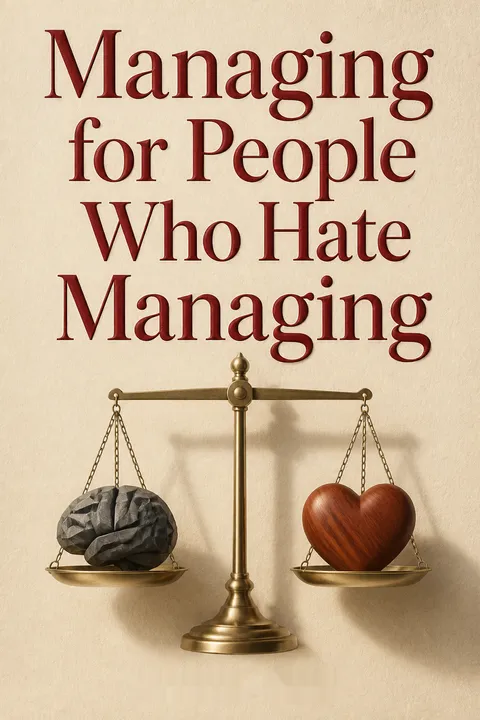
Managing for People Who Hate Managing receives mixed reviews, with an average rating of 3.47/5. Many readers find it humorous and insightful, particularly for new managers. The book focuses on understanding personality types, especially thinkers vs. feelers, to improve management skills. Some praise its practical advice and accessibility, while others find it overly simplistic. Critics note its heavy reliance on MBTI concepts and casual writing style. Overall, readers appreciate its quick read and useful tips, though experienced managers may find limited value.
Glossary
Royal Rule
Lead from your strengthsZack's name for the principle that effective management begins with knowing and using one's natural temperament rather than copying a supposedly ideal manager. It does not mean refusing to develop new skills. Self-knowledge helps a manager choose when a familiar approach works and when deliberate adaptation is needed.
Thinker-Feeler continuum
Decision-making preferencesA dimension Zack draws from the Myers-Briggs Type Indicator to describe how people tend to weigh decisions. Thinkers often emphasize principles and consistency, while Feelers often emphasize values and effects on people. The book presents these as preferences along a spectrum, not as measures of intelligence, emotional capacity, or decision quality.
Flexing
Adapt communication to othersZack's term for adjusting how one leads, communicates, or motivates to fit another person's preferences while retaining personal integrity and consistent performance standards. Flexing may involve changing the amount of context, directness, or opportunity for reflection in a conversation. It is a learned skill, not a change in one's underlying personality.
Platinum Rule
Use their preferred approachZack's management principle of treating people according to how they prefer to be treated, rather than assuming they want the manager's own preferred style. Applied to feedback and everyday communication, it calls for observing or asking what helps a particular employee understand and act on a message. It changes delivery, not expectations.
Multivoting
Prioritize group optionsA group decision technique Zack recommends when people need to rank choices without pursuing unanimity. Participants can distribute several votes among options, showing both a leading preference and other choices they support. The visible result helps a group narrow its focus, though the vote informs rather than replaces careful judgment.
Down To It
Ask for the desired outcomeZack's label for asking a person what they actually want from a difficult situation. The question can reveal that the desired response differs from the manager's assumption, as when a dissatisfied customer wanted an apology rather than replacement work. Its effectiveness depends on a sincere, attentive tone.
Envelopes
Structured team brainstormingA group exercise Zack describes for combining individual reflection with shared discussion. Teams receive workplace challenges and contribute brief written ideas as topics circulate, then develop recommendations together. The structure gives people time to think independently while still producing collective analysis and next steps.
About the Author

Download PDF
Download EPUB
.epub digital book format is ideal for reading ebooks on phones, tablets, and e-readers.








